Amazon US Market Analysis: Self-Cleaning Litter Boxes Category
📊 Executive Summary
📈 Market Trends
From Function Popularization to Experience Upgrade: The Amazon US self-cleaning litter box market is shifting from providing basic automation to deepening user experience and value. Consumers now view features like app control, safety, large capacity, and odor control as standard. Future competition will focus on providing more stable, precise, user-friendly solutions and enhancing product aesthetics and health management functions.
⚡ Major Pain Points
Hard Issues with Reliability & Cleaning Depth: Core market pain points are concentrated in: Inflated maintenance-free cycles (multi-cat households need frequent cleaning), incomplete odor control (especially when emptying waste), incomplete automatic cleaning (adhesion, dead spots requiring manual intervention), and unstable app functions with inaccurate data (especially multi-cat identification). More severe hard issues are poor product reliability and high failure rates, seriously damaging user trust.
💡 Selection Opportunities
Deepen User Experience, Build Trust: Selection opportunities lie in solving consumers' 'pain points within pain points.' Prioritize developing products that achieve 'zero-residue' deep cleaning with easy maintenance, paired with a long-lasting 'active' multi-layer odor sealing and purification system. The high-end market can explore multi-cat smart individual identification and precision health management. Most crucially, establish a full lifecycle 'reliability' and 'service guarantee' to build trust barriers and brand premium in a homogenized market through longer warranties and quality after-sales service.
I. Analysis Overview
1.1 Introduction & Report Scope
This report analyzes the 'Self-Cleaning Litter Boxes' category in the Amazon US market, focusing on target user personas, core needs, decision factors, market communication, and potential opportunities.
1.2 Category Snapshot
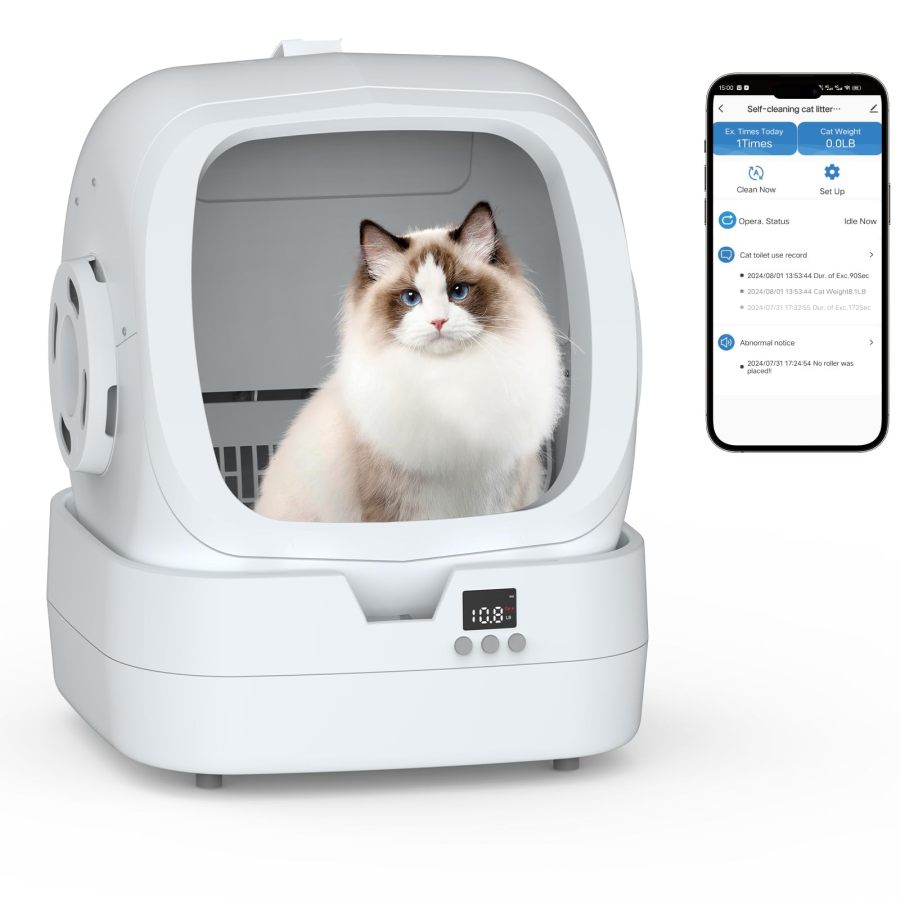
A self-cleaning litter box is a smart pet product that uses an automated mechanical or sensor-driven cleaning system to automatically separate and collect cat waste into a sealed compartment. Its purpose is to free pet owners from manual scooping, providing a continuously clean and odor-free toileting environment. These products typically feature smart app control, multiple safety protections, and various capacity options to meet the needs of different numbers of cats and households. The following table illustrates the key characteristics of consumer behavior in this category.
| Dimension | Segment | Description |
|---|---|---|
| Need Driver Type | Planned Purchase / Emergency-driven Purchase | Users often proactively seek solutions due to the long-term pain point of manual scooping or sudden cleaning needs (e.g., pregnancy, business trips), with clear expectations for automation as a replacement. |
| Purchase Frequency | Low Frequency | As a durable good, purchase frequency is extremely low. Consumers tend to make a one-time investment for long-term convenience and experience upgrade. |
| Decision Complexity | Complex | The high price and involvement of pet health and safety require users to deeply research factors like safety, cleaning efficiency, app functionality, and long-term reliability. |
| Price Sensitivity | Medium to High | Price is an important consideration. Users expect high value for money but are willing to pay a reasonable premium for significant experience improvement, reliability, and value-added features. |
| Emotional Dependency | Medium to High | Purchase decisions are highly tied to care for the pet, improvement of personal quality of life, and the hygiene and comfort of the home environment, highlighting strong emotional value. |
II. User Personas & Usage Scenarios
2.1 Busy Modern Pet Owner
🎯 Works long hours, values efficiency and quality of life, seeks to free up time through smart devices and provide a clean, comfortable environment for their beloved cat.
| Typical Usage Scenarios | Core Pain Points | Primary Purchase Drivers |
|---|---|---|
|
|
|
2.2 Multi-Cat Household Owner
🎯 Owns multiple cats, faces more frequent and voluminous litter cleaning than single-cat households, requiring higher capacity, efficient cleaning, and multiple safety protections.
| Typical Usage Scenarios | Core Pain Points | Primary Purchase Drivers |
|---|---|---|
|
|
|
2.3 Quality & Tech-Focused Pet Enthusiast
🎯 Not only demands functional utility but also pursues product design aesthetics, quiet performance, and premium smart experiences, willing to pay a premium for better user experience and innovative features.
| Typical Usage Scenarios | Core Pain Points | Primary Purchase Drivers |
|---|---|---|
|
|
|
III. User Needs Hierarchy (KANO Model)
3.1 Basic Needs (Must-Haves)
- Automatic Cleaning: Core function: automatically separates and collects cat waste without manual scooping. This is the primary driver for purchasing an automatic litter box.
- Odor Control: The product effectively reduces and contains odors from waste, improving indoor air quality and preventing odor spread.
- Safety Protections: Equipped with sensors to accurately detect cat entry/exit, preventing accidental injury during cleaning and ensuring cat safety.
- Litter Compatibility: Supports commonly used clumping litters (e.g., bentonite, tofu litter) to reduce user switching costs and adaptation difficulty.
3.2 Performance Needs (Linear Satisfiers)
- Large Capacity Design: Sufficient litter area and waste compartment to meet the needs of multi-cat households or owners away for short trips (several days) without cleaning.
- Quiet Operation: Cleaning noise is below an acceptable range (e.g., 35-45dB), not disturbing human/cat rest and daily life, especially at night.
- Easy Cleaning & Maintenance: Reasonable product structure design with detachable parts facilitates regular deep cleaning and daily maintenance, reducing hard-to-clean spots.
- App Smart Control: Provides a stable, user-friendly mobile app supporting remote operation and monitoring of cat toileting data (e.g., frequency, duration), enhancing convenience.
- Anti-Stick Design: Drum, rake teeth, or inner walls use anti-stick materials or special coatings to reduce waste adhesion, enabling more thorough cleaning.
3.3 Excitement Needs (Delighters)
- Health Monitoring Reports: The app provides detailed cat health trend analysis reports (e.g., weight changes, abnormal toileting patterns), helping owners detect health issues early for scientific pet care.
- Multiple Cleaning Modes: Supports highly customizable cleaning delays, scheduled cleaning, manual cleaning, and other modes to adapt to different cat habits and household scenarios.
- Integrated Advanced Deodorizer / Negative Ion Deodorization: Uses more advanced, active odor purification solutions (e.g., negative ion sterilization, smart deodorizing spray, activated carbon composite filtration) for ultimate freshness.
- Low Entry: Specifically designed for kittens, senior cats, short-legged cats, or cats with mobility issues, providing a more user-friendly entry/exit experience and lowering the usage barrier.
- High Aesthetic Appeal: Fashionable, modern product design that blends into various home environments, no longer a 'pet product' to be hidden away, enhancing home aesthetics.
3.4 Unmet Needs & Opportunities
-
Accurate Multi-Cat Identification & Weight Tracking: For multi-cat households, the app can accurately identify and record each cat's weight and toileting usage, not just total or vague data.
User Reviews (VOC) Weight is not totally accurate, but close enough that I can at least tell which cat is which, as they are about a 4 pound difference right now. // It was supposed to tell me the weights of the cats entering the box...but the weights would fluctuate constantly. Just based off the numbers you would think I have 5 different cats ranging from 5lbs to 14lbs but I only have 2.
-
Comprehensive Litter Tracking & Splatter Prevention: Effectively reduces litter tracked out or scattered when cats enter/exit or dig, keeping the area around the litter box clean and reducing extra cleaning burden for users.
User Reviews (VOC) My house doesn't smell like I have cats anymore. It's amazing. :D Mine do tend to jump out and fling litter everywhere (as opposed to stepping out) but I think that's a personal issue. Haha! // Oh, and there really aren't any high sides/front, so if your cat is a big digger/kicker, they will throw litter everywhere out of the front. I've put down a mat to catch the litter and just dump it back in.
-
App Connection Stability & Broad Compatibility: Improve app connection stability and compatibility, addressing the limitation of only supporting 2.4G WiFi, supporting 5G networks or more convenient pairing methods to ensure smooth use of smart features.
User Reviews (VOC) My router has 5Ghz / 2.4Ghz dual mode, notorious for dropping the devices requiring 2.4Ghz, like cameras. The device stays in the app queue for the litter box, may show offline, but escaping out of the error screen returns the device to normal connection operation, does not lose the records, another bonus. // I can't connect it to my WiFi since I have 5G. It only works with 2.5 G.
-
Long-Term Reliability of Core Functions: Address issues like motor/sensor false alarms/failure, mechanical jamming or damage, ensuring the product can operate stably long-term and reducing failure rates.
User Reviews (VOC) After several frustrating rounds of troubleshooting and customer service chats, I sent the thing back and purchased this Petkit litterpan instead. // I've had this litter box for a month and it literally won't work anymore. The infrared anti-pinch sensor will trigger when there's nothing in the litter box and it won't work anymore. Don't buy this product. It sucks..
-
Thorough, No-Dead-Spot Cleaning & Anti-Adhesion: Solve the issue of hard-to-clean residues (like stuck-on feces, urine clumps) in dead spots such as inner drum edges, rake teeth gaps, or sieve mesh, avoiding odor sources and bacterial growth.
User Reviews (VOC) The "bowl" area is smaller, which makes the cat more cramped. Not awful, but this tends to make the cats poo above the litter line, which means the poo basically cements itself to side areas and won't manage to clean and dump, I've had to use a litter scoop many times to scrape it enough to get in line for the drop off. // The grate that the clean litter goes into when it rolls back can get little clumps stuck on the other side of it so maybe making them closer together would help.
-
Waste Compartment Odor Sealing & Bag Change Experience: Improve waste compartment sealing to ensure no odor leakage when emptying trash or when the compartment is full, while optimizing the garbage bag attachment and replacement design for more convenience and hygiene.
User Reviews (VOC) The liners don't close all the way at the top when you close it like regular trash bags do so it does leave space for clumps to fall out when you're throwing it away. // The bin fits a good week of waste and while i dont close it with the pull and go since it doesn't close all the way, i definitely smell it when opening the drawer, but that's 5 mins of smell vs consistent constant odor.
IV. User Decision Drivers
4.1 Key Decision Factors
- Cleaning Efficiency & Thoroughness: Users care most about whether the product truly frees their hands, if waste is cleaned efficiently and thoroughly without sticking or residue, directly impacting purchase satisfaction.
- Odor Control Effectiveness: Whether it can effectively suppress and eliminate odors from the litter box, maintaining a fresh home environment, is a key veto factor affecting user quality of life.
- Cat Acceptance & Safety: Whether the cat is willing to use the product, and if the product has sufficient safety mechanisms to prevent injury or fright, are prerequisites for long-term product use.
- Product Durability & Stability: For a high-priced smart product, users expect it to operate stably long-term with low failure rates, avoiding hassle and costs from frequent repairs or replacements.
4.2 Secondary Decision Factors
- Ease of Operation: Whether app functions are practical, connections are stable, and daily operations (e.g., adding litter, changing bags, deep cleaning) are simple and quick, affecting user onboarding and long-term experience.
- Noise Level: The amount of noise generated during cleaning, whether it disturbs household members (including cats) during rest and daily life, especially when used in bedrooms or quiet areas.
- Capacity Size: The actual capacity of the litter area and waste compartment determines cleaning frequency and whether it meets the household's number of cats and owner's travel needs.
- Ease of Cleaning & Maintenance: Beyond daily automatic cleaning, whether performing thorough deep cleaning and consumable replacement is convenient and quick, directly impacting user willingness for long-term maintenance.
- Price & Value for Money: Whether product features and performance match the price, and if it provides exceptional value, is an important consideration when comparing similar products.
- Design & Appearance: Whether the product appearance is aesthetically pleasing, can blend into modern home environments, and has user-friendly design details, enhancing user perception.
V. Selling Points & Competitive Landscape
5.1 Selling Point Analysis
5.1.1 Standard Features (Points of Parity)
- Automatic Cleaning: No manual scooping required, providing continuous cleanliness for the home environment. This is the core function and selling point of self-cleaning litter boxes.
- App Control: Remote management, monitoring, and operation of the litter box via a mobile app, providing convenient smart experience.
- Safety Protection: Built-in multiple sensors (e.g., infrared, weight) ensure cat safety during use, preventing accidental injury.
- Large Capacity: Claims to have a large litter area and waste compartment, reducing cleaning frequency and meeting the needs of multi-cat households or short trips.
- Odor Control: Effectively contains or eliminates litter box odors through a sealed waste compartment, built-in deodorizer, or specific materials.
- Quiet Operation: Emphasizes low noise during cleaning, not disturbing human/cat life, enhancing home comfort.
5.1.2 Key Differentiators
- Open Design: Provides a wider entrance/exit, reducing cat claustrophobia, making entry/exit easier, especially suitable for cats sensitive to enclosed spaces.
- Multi-Cat / Large Cat / Kitten Friendly: Emphasizes that product size and functions meet the needs of different sized or multiple cats, expanding the target user base.
- Easy to Clean / Washable: Emphasizes detachable part design, facilitating user deep cleaning and daily maintenance, raising the product hygiene standard.
- Health Monitoring: The app provides health data monitoring like cat weight and toileting frequency, helping owners monitor pet health.
- Anti-Scatter / With Mat: Reduces the amount of litter tracked out by cats through product design or included anti-scatter mats, keeping the surrounding area clean.
5.1.3 Unique Selling Propositions (USPs)
- Negative Ion / Smart Deodorizer: Uses more advanced active deodorizing technology, like negative ion sterilization or smart spray deodorization, providing ultimate air purification effects.
- Silicone Anti-Stick Liner: Inner walls use special materials or coatings to effectively prevent waste adhesion, significantly simplifying cleaning difficulty and improving hygiene levels.
- Customizable Ambient Lighting: Adjustable built-in lighting provides a warm, comfortable toileting environment for cats, combining aesthetics and practicality.
- Crystal Litter Specific System: Brands like PetSafe use a crystal litter system that dehydrates and solidifies waste, offering a different cleaning and odor control experience from traditional litter boxes.
5.2 Competitive Landscape
5.2.1 Market Maturity
The self-cleaning litter box market has entered the late growth to maturity stage. Common selling points are becoming homogenized; features like app control, safety protection, large capacity, and odor control are now standard. Brands compete for market share through differentiation points like open design, multi-cat compatibility, and more detailed health monitoring. Consumer expectations for core functions are largely met, and attention is shifting to experiential details and brand-added value.
5.2.2 Innovation Trends
Current innovation trends primarily revolve around refining user experience details, such as more precise cat behavior and health data analysis (multi-cat identification), more comprehensive odor solutions (e.g., negative ions, smart deodorizers), and more convenient cleaning and maintenance (e.g., detachable washable parts, anti-stick materials). Design-wise, beyond function, there is increasing emphasis on product integration with home environments, with more products combining aesthetics and practicality. Continuous optimization is also seen in noise control and litter tracking prevention. Additionally, some brands are starting to focus on product long-term reliability and after-sales service promises to build brand trust.
VI. Marketing Claims vs. Reality Check
The table below analyzes the gap between common marketing claims and actual user experiences in this category:
| Dimension | Marketing Claim | User Reality | Verdict |
|---|---|---|---|
| Maintenance-Free Cycle & Capacity | Claims like '10-15 days maintenance-free,' 'extra-large capacity, ideal for multi-cat households,' implying users can go long periods without emptying waste. | Multi-cat household users commonly report needing to empty the waste compartment every 2-4 days, far below claimed durations; otherwise, odor becomes unbearable or capacity overflows. Some products claiming large capacity still feel cramped for large cats. | Sellers exaggerate maintenance-free cycles using data from single-cat or extreme ideal conditions, failing to fully consider the actual needs and physical capacity limits of multi-cat households, creating a severe mismatch between user expectations and reality. |
| Odor Control Effectiveness | Commonly advertised as 'zero odor,' 'advanced deodorizing system,' '0 escapes,' promising to completely solve odor problems. | User feedback indicates strong odor upon emptying waste, or the need for additional measures (e.g., baking soda, air fresheners) for effective control. Some open designs still leak odor during daily use. Insufficient waste compartment sealing becomes more pronounced with prolonged use. | Typical marketing rhetoric, using idealized scenarios to mask the pain point of odor leakage in actual use. User expectations for 'odor-free' far exceed the limits of current product design, leading to trust erosion. |
| Automatic Cleaning Efficiency & Thoroughness | Claims like 'effortless cleaning,' 'perfectly clean with no residue,' implying no manual intervention is needed to keep the litter box clean. | Multiple reviews point out waste sticking to rake teeth, drum walls, or machine edges; small clumps not being fully sifted out; and even specific cat elimination habits (like 'high-position elimination') causing waste to stick outside the cleaning range, still requiring manual cleaning. | Overlooks the diversity of cat elimination habits and the physical properties of litter, over-promoting the ideal state of 'zero manual intervention.' This leads to poor user experience on the core function and adds extra cleaning burden. |
| App Functionality & Connection Stability | Emphasizes 'smart app control,' 'real-time health monitoring,' 'precise data tracking,' painting a picture of an intelligent pet care experience. | User feedback cites inaccurate app data (large weight fluctuations, inability to distinguish multiple cats), unstable connections, inconvenience due to only supporting 2.4G WiFi, and overly basic functions. Some users even question the app's excessive privacy permissions, considering it 'gimmicky.' | Smart feature design remains superficial, failing to provide stable, deep user value. Instead, connection limitations, data accuracy issues, and privacy concerns increase user friction, diminishing the added value of a smart product. |
Key Takeaway: The self-cleaning litter box market exhibits widespread parameter inflation and experience exaggeration, especially regarding 'maintenance-free cycles,' 'odor control,' and 'smart feature accuracy.' There is a significant gap between marketing promises and actual user experience.
VII. Supply-Demand Misalignment Analysis
The table below highlights mismatches between seller focus and buyer priorities:
| Dimension | Seller Behavior | User Focus | Verdict |
|---|---|---|---|
| Product Long-Term Reliability & After-Sales Service | Generally emphasizes 'safety protection' and 'easy cleaning & maintenance,' but lacks specific promises or validation regarding the long-term operational reliability, failure rates, and after-sales support for core components like motors and sensors. Often only offers a 1-year short warranty. | Numerous users complain about products failing within months, sensor malfunctions, motor jamming, or complete stoppage, with slow or missing after-sales support, leading to terrible post-purchase experience for a high-priced item. | The market generally equates 'functional' with 'reliable,' overlooking the consumer's core implicit need for 'long-term stable operation' in high-priced smart products. This directly impacts user return on investment and brand trust, and is a key pain point driving negative word-of-mouth. |
| Cleaning Thoroughness Under Specific Elimination Habits | Most products advertise 'efficient self-cleaning,' but rarely mention solutions or special designs for specific scenarios like 'high-position elimination cats,' 'sticky feces,' or 'litter jamming.' Generic claims are overly idealized. | Many users report waste sticking to high spots, edges, or rake teeth, not being cleaned by the machine automatically, still requiring manual intervention, severely impacting the fully automatic experience. | Sellers failed to fully consider the diversity of cat behavior and the physical properties of litter during design, leading to products failing to deliver on the promise of 'thorough cleaning' in some user scenarios, creating a shortcoming in the core function. |
| App Data Accuracy & Multi-Cat Identification | Widely advertise that the app has 'health monitoring' and 'weight tracking' features, but lack specific technical explanations or case studies on how to accurately distinguish and record data for each cat in multi-cat households, or the accuracy of such data. | Multi-cat household users complain that the app cannot accurately identify each cat's weight and usage, making health data of low reference value and turning smart features into 'gimmicks.' | Smart feature design remains superficial, failing to deeply explore the precision management needs of multi-cat households. This causes the value of 'health monitoring' to be greatly diminished, failing to truly build a differentiated advantage. |
Key Takeaway: Sellers focus on piling up generic 'smart' and 'large capacity' selling points, while collectively lacking supply and strategically avoiding the core experiences users care most about: long-term product 'reliability,' 'cleaning thoroughness,' and 'app data accuracy.'
VIII. Strategic Opportunities & Recommendations
8.1 'Zero-Residue' Deep Cleaning & Fully Washable Structure
8.1.1 Target Audience & Pain Points
⚡️ Pain Points Addressed: Thorough, No-Dead-Spot Cleaning & Anti-Adhesion; Waste Compartment Odor Sealing & Bag Change Experience.
8.1.2 Action Plan
Redesign the drum, rake teeth, and internal flow guide structure to narrow sieve mesh gaps, ensuring no waste residue or jamming. Apply nano-level anti-stick coating to inner walls for 'rinse-clean' ease. Design modular, fully detachable (non-electronic parts) and completely washable internal components with no hidden dead spots. Optimize waste compartment sealing structure with vacuum or double-layer magnetic seals, and simplify bag attachment and replacement process for touchless changes.
| Tech Complexity | Medium |
| Cost Impact | Medium Impact |
| Trade-off Warning | Requires more precise mold tooling, may slightly increase structural complexity or manufacturing cost, but offers immense user experience improvement. |
| Price Band | Only viable above $249.99 |
8.1.3 Marketing Strategy
Emphasize 'Say goodbye to manual scraping, truly zero-residue cleaning'; showcase 'Patented anti-stick design, waste doesn't adhere, rinse-clean easy'; demonstrate cleaning thoroughness and ease of maintenance via slow-motion video. Highlight 'Entire unit (non-electronic parts) washable, truly clean with no dead spots.'
8.2 Long-Lasting 'Active' Multi-Layer Odor Sealing & Purification System
8.2.1 Target Audience & Pain Points
⚡️ Pain Points Addressed: Odor control effect not lasting; odor when emptying waste; odor challenges for multi-cat households.
8.2.2 Action Plan
Combine physical sealing (vacuum or double-layer airtight compartment), activated carbon filters, negative ion generators, and smart deodorizing spray (consumable) to form a multi-layer active deodorizing system. Integrate an odor sensor to automatically activate purification modes of different intensities based on ambient odor concentration. Offer replaceable, long-lasting, and optionally subscribable eco-friendly deodorizing consumables.
| Tech Complexity | Medium |
| Cost Impact | Medium Impact |
| Trade-off Warning | May slightly increase power consumption; requires periodic replacement of active consumables (filters, deodorizer), but this cost can be converted into recurring revenue. |
| Price Band | Only viable above $229.99 |
8.2.3 Marketing Strategy
Emphasize 'Multi-layer technology, odor eliminated: Say goodbye to litter box smell, 24/7 fresh air'; promote 'Smart purification, odor-free even when emptying waste'; showcase effectiveness via third-party lab odor removal rate data and real user comparison demonstrations. Highlight 'Long-lasting consumable subscription service, worry-free and cost-saving.'
8.3 Multi-Cat Smart Individual Identification & Precision Health Management
8.3.1 Target Audience & Pain Points
⚡️ Pain Points Addressed: Accurate Multi-Cat Identification & Weight Tracking; App data accuracy; Multi-cat health monitoring.
8.3.2 Action Plan
Integrate multi-dimensional biometric sensors (e.g., paw pressure, gait analysis) or AI vision recognition modules, combined with advanced algorithms to achieve cat individual identification and precise tracking of health data (weight, toileting time, excretion volume anomalies). The app provides personalized health reports and anomaly alerts (e.g., frequent urination, sudden weight loss), and supports independent management and export of multi-cat data.
| Tech Complexity | High |
| Cost Impact | High Impact |
| Trade-off Warning | Requires more complex sensor arrays and AI algorithms to identify multiple cats and handle data fluctuations. High R&D cost, but no significant physical side effects. |
| Price Band | Only viable above $499.99 |
8.3.3 Marketing Strategy
Emphasize 'AI-powered, precise to the cat: Health data for each beloved cat, all in your control'; highlight 'Veterinarian recommended, the new height of scientific pet care'; use data visualization reports to showcase the advantages of scientific pet care, building a premium brand image.
8.4 Full Lifecycle 'Reliability' & 'Service Guarantee'
8.4.1 Target Audience & Pain Points
⚡️ Pain Points Addressed: Long-term reliability of core functions; durability and failure rates; insufficient after-sales service.
8.4.2 Action Plan
Use more reliable industrial-grade motors and sensors, reinforce key connection component structures, and enhance overall product durability. Establish a localized, responsive customer service team, offer a warranty period of up to 2-3 years, and provide convenient replacement services for core wearable parts with an online accessory store.
| Tech Complexity | Medium |
| Cost Impact | High Impact |
| Trade-off Warning | No direct physical side effects, but requires higher costs for raw materials, quality control, R&D, operations, and necessitates building a strong after-sales service team. |
| Price Band | Only viable above $399.99 |
8.4.3 Marketing Strategy
Emphasize 'Five-year worry-free warranty, choose with more peace of mind'; promote 'Not just smart, but stable: We protect your investment with our commitment'; showcase a robust after-sales service system and user satisfaction data to build a trust barrier. For compliance, ensure all electrical products pass UL/FCC/CE certifications and clearly display them in the listing.