Amazon US Market Analysis: Handheld Sewing Machines Category
📊 Executive Summary
📈 Market Trends
Demand for portable sewing is strong, but market quality is mixed. Handheld sewing machines cater to users' lightweight needs for emergency repairs and DIY due to their compact size and ease of use. However, the market suffers from severe homogenization. Many products excessively exaggerate 'portability' and 'accessory completeness' in marketing but fail to address the most critical sewing quality and reliability issues, leading to generally poor user word-of-mouth.
⚡ Major Pain Points
Unsecure stitches, difficulty with thick fabrics, and product fragility are fatal flaws. Current products have stitches that easily unravel, are almost useless for slightly thicker fabrics like denim, and numerous users report machines arriving broken or failing within a short period, severely damaging consumer trust. Additionally, vague manuals and complicated threading make 'beginner-friendly' an empty promise.
💡 Selection Opportunities
Return to the essence of sewing, building a brand on quality. The real opportunities lie in: First, fundamentally solving stitch security and machine durability issues (e.g., upgrading to lockstitch). Second, expanding the product's actual sewing capability for medium-weight fabrics to meet a wider range of daily repair needs. Simultaneously, providing comprehensive beginner tutorial systems and smart troubleshooting to completely solve user onboarding challenges. A built-in rechargeable lithium battery can also enhance user experience and product eco-friendliness, thereby creating differentiated competitive advantages in the mid-to-high-end market.
I. Analysis Overview
1.1 Introduction & Report Scope
This report analyzes the 'Sewing Machines' category (specifically Handheld Sewing Machines) within the Amazon U.S. market, focusing on target user personas, core needs, decision drivers, market communication, and potential opportunities.
1.2 Category Snapshot
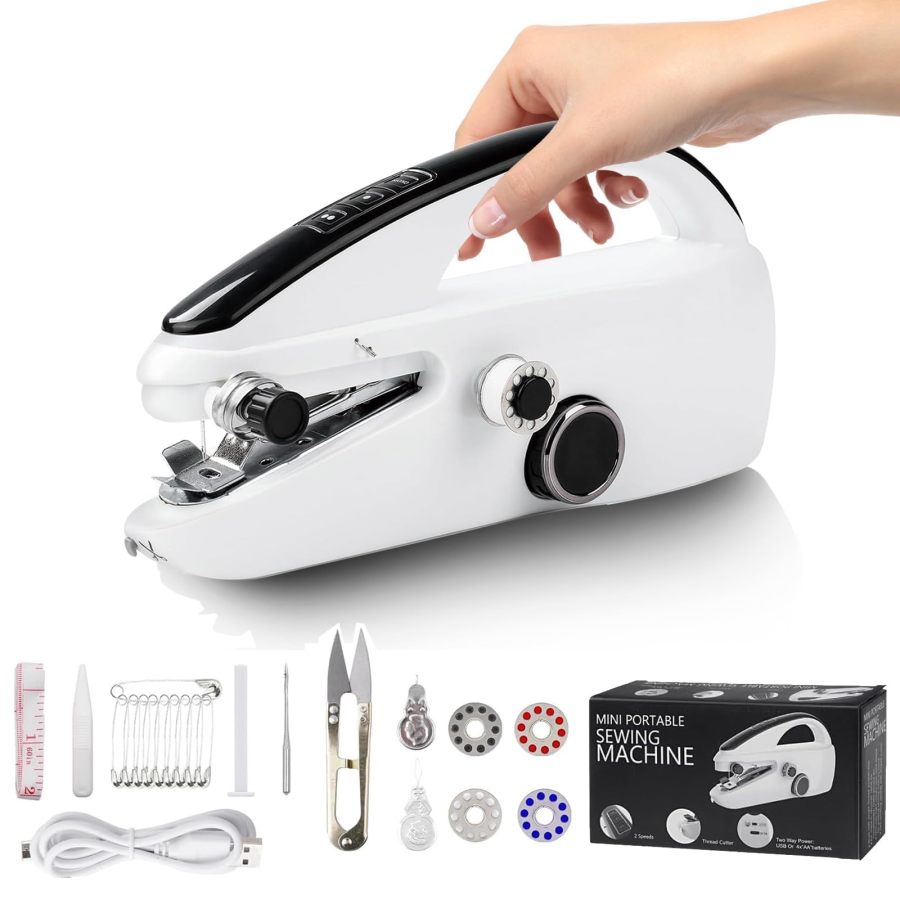
A handheld sewing machine is a compact, portable, and typically battery or USB-powered mini sewing device. It primarily targets non-professional users, aiming to provide a quick and convenient mending solution for emergency clothing/fabric repairs, simple DIY projects, and daily household use. Products in this category typically emphasize ease of use, portability, and multi-scenario applicability. The following table illustrates the key characteristics of consumer behavior in this category.
| Dimension | Segment | Description |
|---|---|---|
| Need Driver Type | Emergency-driven / Planned Purchase | Users purchase handheld sewing machines both to handle emergency situations like sudden clothing damage and for planned preparation as a tool for daily minor repairs or as an entry-level tool for cultivating a hobby. |
| Purchase Frequency | Low Frequency / Emergency-driven | Handheld sewing machines are not daily consumables, resulting in low purchase frequency. However, purchase decisions can be immediate when triggered by an urgent repair or a specific DIY need. |
| Decision Complexity | Medium | Consumers will compare based on price, portability, ease of use, and accessory sets, but will not invest excessive time in deep research or technical parameter comparisons. |
| Price Sensitivity | Medium | Price is an important consideration, especially in the entry-level market. However, users are willing to pay a reasonable premium if the product can effectively solve their pain points and provide reliability. |
| Emotional Dependency | Medium | The core value lies in solving functional problems (quick repair), but as a DIY tool or gift, it also carries emotional value such as convenience, a sense of accomplishment, and care. |
II. User Personas & Usage Scenarios
2.1 The Emergency Fixer
🎯 Busy office workers or homemakers who frequently encounter sudden clothing damage (e.g., missing buttons, split seams) and need a quick, effortless solution.
| Typical Usage Scenarios | Core Pain Points | Primary Purchase Drivers |
|---|---|---|
|
|
|
2.2 Sewing Novice / Hobby Beginner
🎯 Individuals with a basic interest in sewing who want to try DIY small items, learn simple sewing techniques, or provide a creative starter tool for children, but are unwilling to invest high costs or face complex equipment.
| Typical Usage Scenarios | Core Pain Points | Primary Purchase Drivers |
|---|---|---|
|
|
|
III. User Needs Hierarchy (KANO Model)
3.1 Basic Needs (Must-Haves)
- Effective Stitching: The product must be able to successfully and reliably stitch two pieces of fabric together or repair a tear. This is the minimum requirement for a sewing tool.
- Simple Operation: One-button start or minimal steps, smooth threading, allowing even zero-experience users to get started quickly, reducing learning pressure.
- Lightweight and Portable: Compact size, lightweight, easy to hold with one hand, can be easily carried in a bag to meet mobile repair needs.
- Compatibility with Common Fabrics: Able to handle common lightweight to medium-weight fabrics in daily life (e.g., cotton, silk), not limited to extremely thin fabrics.
3.2 Performance Needs (Linear Satisfiers)
- Secure Stitches: Stitches after sewing are strong, not prone to loosening or breaking, can withstand daily wear and use, ensuring lasting repair.
- Multi-Speed Settings: Offers speed options (fast/slow), allowing users to adjust based on sewing needs (e.g., delicate repair vs. quick sewing), enhancing control.
- Dual Power Modes: Supports both battery and USB power, increasing product flexibility for different scenarios (e.g., indoor plugged-in or outdoor wireless use).
- Complete Accessory Set: Includes basic sewing tools like spools, needles, scissors, threaders, allowing users to start using immediately after purchase without extra shopping.
- Low Noise: Runs quietly, providing a more comfortable and peaceful user experience, especially in public spaces or during nighttime use.
3.3 Excitement Needs (Delighters)
- Premium Storage Box: Provides a high-quality storage box (e.g., wooden box or EVA hard case), not only for organizing all accessories but also enhancing product perceived value and gifting appeal.
- Clear Video Tutorials: Provides high-quality, easy-to-understand video tutorials detailing steps like threading, knotting, and troubleshooting, genuinely helping novices overcome usage barriers.
- Ergonomic Design: Body design is more ergonomic, offering a more comfortable grip, reducing hand fatigue during prolonged use, and improving operational stability.
- Built-in Rechargeable Battery: Instead of relying solely on AA batteries or external USB power, it features a true wireless, rechargeable battery, making it more eco-friendly and convenient.
3.4 Unmet Needs & Opportunities
-
Poor Stitch Stability: Numerous users complain that stitches are easily loose, not secure enough, failing to form an effective lockstitch, requiring manual knotting, severely impacting the durability of repairs.
User Reviews (VOC) Stitches are so loose that I can easily pull them out. // The stitches don't thread, the needle just jabbed itself into the fabric repeatedly without making a stitch. // threads ALWAYS COMES OUT.
-
Insufficient Thick Fabric Compatibility: Current market products generally cannot effectively sew thicker fabrics like denim or wool, even if claimed. The actual experience is unsatisfactory, limiting usage scope.
User Reviews (VOC) Not powerful enough for polos // Not for heavy material like blue jeans // I tried patching a pair of jeans and it didn't quite have the strength for that.
-
Insufficient Product Durability: A significant number of low-rating reviews report products arriving broken or failing after a few uses, raising quality reliability concerns. User complaints include 'It worked for about 15 stitches and then stopped working.', 'Broken on arrival', 'Broke on first use, sent it back'.
User Reviews (VOC) It worked for about 15 stitches and then stopped working. // Broken on arrival // Broke on first use, sent it back.
-
Unclear Threading/Operation Instructions: Despite emphasizing 'ease of use,' many novices still find threading complex and manuals difficult to understand, leading to a difficult start, contradicting marketing claims.
User Reviews (VOC) instructions are vague // I was pretty lost. // threading was a little fiddly // I couldn't get it to work but the company was great and refunded my total plus gave me an addition $20.
IV. User Decision Drivers
4.1 Key Decision Factors
- Actual Functional Usability: Whether the product works properly and the stitching mechanism is reliable is the primary and most basic consideration for users buying a handheld sewing machine, directly impacting problem-solving ability.
- Stitch Security: Whether the stitches after sewing are sturdy and not prone to falling out, able to withstand daily use, directly determines the durability of the repair and user satisfaction.
- Ease of Operation: Especially for novices, whether all steps from threading, starting, to control are truly simple, intuitive, and require no guesswork is key to lowering the usage barrier.
- Portability: Whether the product is sufficiently small, lightweight, and convenient for one-handed holding, carrying around, and storage, meeting emergency and mobile usage scenarios.
4.2 Secondary Decision Factors
- Accessory Completeness: Whether it includes a complete sewing kit (spools, needles, scissors, etc.), allowing users to use it right out of the box, saving the hassle of additional purchases.
- Power Flexibility: Whether it supports dual battery/USB power or has a built-in rechargeable battery to adapt to the convenience of different usage environments.
- Price: Given that basic functionality and quality are met, the product's value for money is an important factor in the final decision, especially in the lower price segment.
- Fabric Adaptability: The ability to handle a wider range of daily fabrics, especially medium-weight fabrics, would expand product utility, but is not a deal-breaker.
V. Selling Points & Competitive Landscape
5.1 Selling Point Analysis
5.1.1 Standard Features (Points of Parity)
- Portable and Easy to Use: Almost all products emphasize handheld, mini, portable design and simple operation, suitable for beginners, aiming to address the pain points of traditional sewing machines.
- Quick Repair: Commonly highlights the product's ability for emergency or quick repair of clothing/fabric at home or while traveling, aligning with users' emergency needs.
- Dual Power Mode: Most products claim support for both battery and USB power to increase usage flexibility and convenience, though actual USB power quality varies.
- Complete Accessories: Commonly includes basic accessories like spools, needles, scissors, claiming to be ready-to-use out of the box, lowering the initial usage barrier.
5.1.2 Key Differentiators
- Dual-Speed Mode: Some products offer fast/slow speed selection, aiming to meet different sewing precision and efficiency needs, but not all products have this feature.
- Ergonomic Design: A few products emphasize their ergonomic design to provide a more comfortable grip and better operational experience.
- High Power / Low Noise: Some sellers claim technological upgrades for a quieter, more powerful sewing experience to differentiate from generally inferior products.
- Gift Set: Some products are paired with a premium storage box (e.g., wooden box), positioning them as attractive gifts to enhance product added value.
5.1.3 Unique Selling Propositions (USPs)
- One-Button Automatic Stitching: A very few products highlight their automated operation, further simplifying use, though actual results are often unsatisfactory.
- Specific Scenario Enhancement: For example, specifically mentioning 'Children's DIY' functionality or emphasizing unique convenience like 'sew without taking clothes off'.
- Explicit After-Sales Promise: A few sellers explicitly offer customer service or problem-solving guidance in their listings to increase consumer confidence, but implementation is generally poor.
5.2 Competitive Landscape
5.2.1 Market Maturity
The handheld sewing machine market is in a low maturity stage. Although product supply is abundant, core selling points are highly homogeneous (portability, ease of use, quick repair), and product quality is inconsistent. A large number of low ratings and negative reviews consistently reflect serious defects in basic functions (e.g., stitch security, durability), repeatedly lowering user expectations. This indicates the market has not yet established clear quality standards or leading brands, remaining in a phase of chaotic competition and poor user experience.
5.2.2 Innovation Trends
Current innovation trends mainly revolve around minor adjustments and marketing packaging of existing basic functions, such as attempting to offer dual-speed modes, promoting high-power low-noise motors, or enhancing gifting appeal through premium storage boxes. However, these innovations still fail to effectively address core user pain points like 'stitch security' and 'thick fabric compatibility,' lacking disruptive technological breakthroughs. Some products are beginning to focus on providing more detailed instructional videos or customer service support, hinting that the service layer may become a future competitive point.
VI. Marketing Claims vs. Reality Check
The table below analyzes the gap between common marketing claims and actual user experiences in this category:
| Dimension | Marketing Claim | User Reality | Verdict |
|---|---|---|---|
| Sewing Function Reliability | High power, low noise, fast stitching, strong stitching, even beginners can easily complete sewing. | Users commonly report products arriving broken, stitches being loose and easily pulled out, inability to form effective stitches, thread jams or skipped stitches-core functions completely failing. | Sellers excessively overstate core product performance, but actual quality control and design have fatal flaws, downgrading a functional tool to a 'toy,' severely deceiving consumers, leading to high return rates and negative reviews. |
| Fabric Thickness Compatibility | Widely applicable to various fabrics like denim, leather, wool, thick curtains, capable of sewing thickness up to 1.8mm or 5/64 inch. | User feedback indicates the product struggles or fails to sew slightly thicker fabrics (like jeans, thick T-shirts); it can only handle extremely thin fabrics. | Sellers exaggerate the product's physical limits, attempting to imply strong performance through vague thickness data. However, the power of the mini motor and needle strength determine its inability to handle heavy fabric sewing. Such claims have reached a physical ceiling and constitute misleading marketing. |
| Operation Simplicity and User Guidance | Designed specifically for beginners, one-button operation, easy to start, hassle-free. | Multiple users complain about vague instructions, difficult threading, complex operation, needing external tutorials to figure out usage, and some even give up due to inability to operate normally. | Sellers pursue minimalist operation in design but neglect the actual learning curve and needs of novices. Vague manuals and lack of effective onboarding guidance turn the promise of 'ease of use' into a logical paradox, causing significant user frustration. |
Key Takeaway: The market is rife with marketing chaos involving exaggerated product performance and glossing over core defects, leading to a severe disconnect between consumer expectations and actual experience, resulting in low trust.
VII. Supply-Demand Misalignment Analysis
The table below highlights mismatches between seller focus and buyer priorities:
| Dimension | Seller Behavior | User Focus | Verdict |
|---|---|---|---|
| Sewing Quality and Reliability | Sellers repeatedly emphasize the product's mini size, portability, and number of accessories in listings, vaguely claiming 'high power, easy stitching,' but rarely provide specific guarantees or test data on stitch security, motor stability, and long-term durability. | Users care most about whether stitches are secure and if the machine will frequently malfunction, but these core pain points are almost never effectively addressed in listings. Instead, numerous reviews reflect products breaking easily and stitches falling out. | Sellers generally fail to provide the core assurance of product quality and reliability, leading to extremely low user trust. This supply gap means that even with many other advantages, they cannot compensate for the negative experience caused by core functional defects. |
| Fabric Application Range | Sellers generally claim the product is 'widely applicable to various fabrics' (e.g., denim, leather) to highlight versatility, but usually only note 'thickness limit ≤1.8mm' in inconspicuous corners and do not provide video demonstrations of actually sewing different fabrics. | Users expect to use handheld machines to repair various daily clothes, including jeans, but find them incapable in practice, leading to unmet expectations and a perception that marketing does not match reality. | Sellers overpromise the product's capability in fabric compatibility but fail to deliver in product design or performance. This is typical marketing-reality disconnect. This oversupply leads to inflated user expectations, exacerbating post-purchase disappointment. |
| Beginner Tutorials and Problem-Solving | Sellers generally emphasize the product is 'beginner-friendly,' 'easy to use,' but most products only include rudimentary paper manuals or claim to offer instructional videos that lack clear, understandable guidance. | Novice users encounter difficulties with threading, knotting, and troubleshooting; manuals are not detailed enough, leaving them with nowhere to turn for help, attributing operational issues to the product 'not working'. | Sellers' promotion of 'ease of use' stops at verbal promises, failing to provide practical and effective onboarding tutorials and problem-solving support. This supply gap leads to a steep learning curve for users, strong frustration, and negatively impacts product reputation and novice user retention. |
Key Takeaway: There is a severe supply-demand mismatch in the handheld sewing machine market: sellers generally engage in excessive competition on low-value attributes like 'portability' and 'number of accessories,' while collectively ignoring or failing to address the users' most core pain points of 'stitch security' and 'product durability'.
VIII. Strategic Opportunities & Recommendations
8.1 Core Function Upgrade: Stable Lockstitch & Structural Durability
8.1.1 Target Audience & Pain Points
⚡️ Pain Points Addressed: Poor stitch stability, insufficient product durability.
8.1.2 Action Plan
Redesign the internal sewing mechanism, upgrading from single-thread chain stitch to a more secure double-thread lockstitch (even if sacrificing some portability). Use more robust metal transmission components and high-quality motors. Strengthen factory quality control and offer extended warranty promises.
| Tech Complexity | Medium |
| Cost Impact | High Impact |
| Trade-off Warning | Upgrading to a lockstitch mechanism will increase internal mechanical complexity, potentially slightly increasing product volume or cost, but can fundamentally solve the single-thread easy-to-unravel issue. |
| Price Band | Only viable above $29.99 (applicable to high-end sub-categories) |
8.1.3 Marketing Strategy
Emphasize 'Professional-Grade Lockstitch, Say Goodbye to Unraveling Stitches'; showcase stitch pull-test videos, highlight 'Long-lasting Durability, Good as New for Years'; contrast with the fragility of competitors' single-thread stitching.
8.2 Advanced Fabric Compatibility: Efficient Penetration of Medium-Weight Fabrics
8.2.1 Target Audience & Pain Points
⚡️ Pain Points Addressed: Insufficient thick fabric compatibility.
8.2.2 Action Plan
Adopt a small high-torque motor and specialized heavy-duty needles (e.g., #16), optimize feed dog and presser foot design to ensure smooth penetration and stitching of fabrics like denim, canvas up to 3-4mm thickness. Clearly label applicable fabric types and maximum thickness, and provide real demonstration videos.
| Tech Complexity | Medium |
| Cost Impact | Medium Impact |
| Trade-off Warning | Higher power motor and thicker needles may lead to slightly increased noise or body heat, requiring a balance between heat dissipation and quiet performance. |
| Price Band | Only viable above $24.99 (applicable to mid-to-high-end sub-categories) |
8.2.3 Marketing Strategy
Highlight 'Strong Power, Easily Conquers Thick Fabrics'; showcase comparison videos sewing jeans, leather; emphasize 'One Machine for Multiple Uses, Tackles All Household Repair Challenges'; strengthen persuasiveness through material certifications.
8.3 Novice-Friendly Tutorial System & Smart Troubleshooting
8.3.1 Target Audience & Pain Points
⚡️ Pain Points Addressed: Unclear threading/operation instructions, steep learning curve for novices.
8.3.2 Action Plan
Create professional, multi-language video tutorials (from unboxing, threading, knotting to common troubleshooting), embed QR codes on the product or packaging for instant access. Provide in-app smart diagnostic guides or 24/7 online customer support for quick user issue resolution.
| Tech Complexity | Low |
| Cost Impact | Low Impact |
| Trade-off Warning | No significant physical side effects, mainly involves content creation and software/service investment. |
| Price Band | Only viable above $14.99 |
8.3.3 Marketing Strategy
Emphasize 'Novice to Pro in Seconds, Scan to Learn'; highlight 'Exclusive Tutorial Videos, Goodbye to Usage Headaches'; promise '100% Solution for Beginner Problems'; display clear tutorial screenshots or video covers in listings.
8.4 Rechargeable Built-in Lithium Battery Design
8.4.1 Target Audience & Pain Points
⚡️ Pain Points Addressed: High dependency on disposable batteries, not eco-friendly, high usage cost.
8.4.2 Action Plan
Replace AA battery power with a built-in rechargeable lithium battery, equipped with a USB-C charging port to enhance eco-friendliness and convenience. Ensure battery capacity provides at least 1+ hours of high-brightness runtime and obtain certification from authoritative bodies (e.g., UL).
| Tech Complexity | Medium |
| Cost Impact | Medium Impact |
| Trade-off Warning | Built-in lithium battery may slightly increase product weight and requires higher safety standards (e.g., overcharge protection), necessitating relevant certifications. |
| Price Band | Only viable above $22.99 |
8.4.3 Marketing Strategy
Highlight 'Say Goodbye to Disposable Batteries, Eco-Friendly & Cost-Saving'; emphasize 'USB-C Fast Charging, Always Ready to Go'; use runtime comparison charts to highlight advantages; provide battery safety certifications to alleviate user concerns.