Amazon US Market Analysis: Makeup Skincare Mini Fridge Category
📊 Executive Summary
📈 Market Trends
Strong demand exists for makeup skincare mini fridges, with clear trends towards integration and personalization. Consumer demand for convenient cooling in personal spaces and refined preservation of skincare products continues to grow, driving products towards multifunctionality (e.g., with mirrors), colorful designs, and diverse usage scenarios (home/car). However, widespread performance misrepresentation and quality issues are eroding market trust.
⚡ Major Pain Points
Insufficient core performance and durability flaws constrain category development. Users commonly complain about cooling performance falling short, with short product lifespan and easy failure being the biggest pain points. Frequent complaints also include condensation accumulation, excessive noise, and inability to precisely control temperature. These issues lead to high return rates and negative reviews, severely impacting consumer purchase confidence.
💡 Selection Opportunities
Return to product fundamentals, breaking through with 'reliability' and 'true experience'. Future opportunities lie in fundamentally solving cooling insufficiency and durability issues, potentially by introducing more advanced cooling technology and optimizing design to eliminate condensation. Simultaneously, enhance the practical utility of makeup mirrors, achieve precise temperature control, and provide real data and long-term warranty promises in marketing to meet users' underlying needs for 'true quality' and 'high value'.
I. Analysis Overview
1.1 Introduction & Report Scope
This report analyzes the 'Compact Refrigerators' category (Makeup Skincare Mini Fridges) within the Amazon US market, focusing on target user personas, core needs, decision factors, market communication, and potential opportunities.
1.2 Category Snapshot
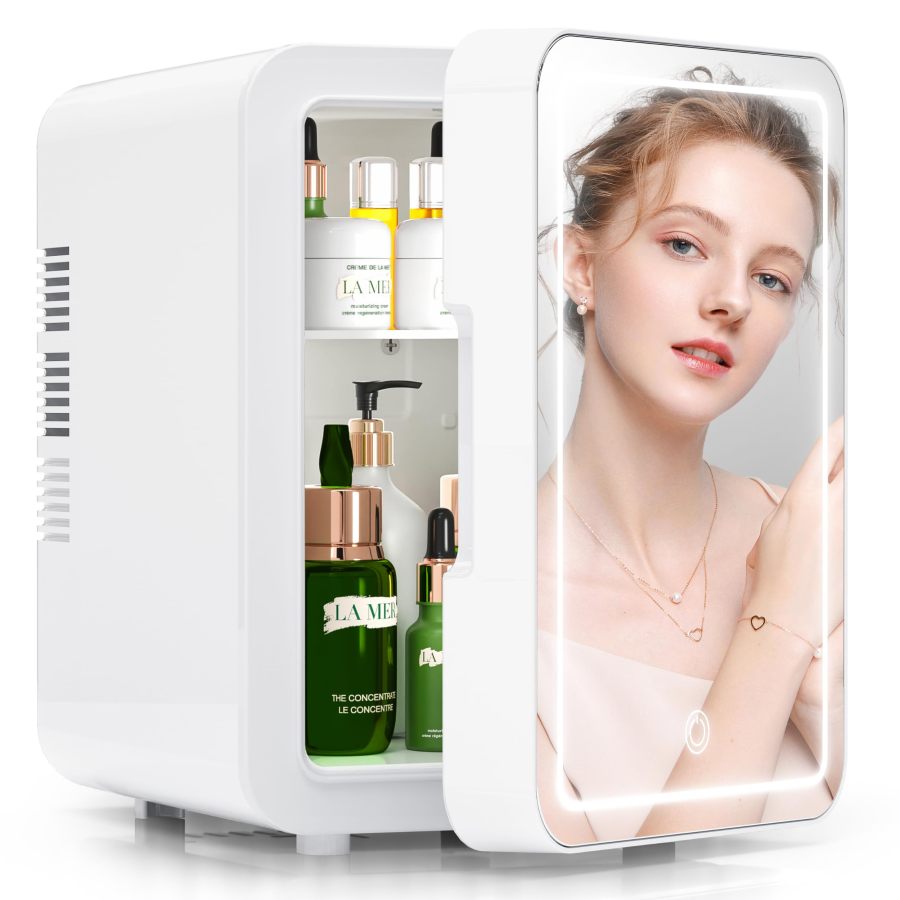
A makeup skincare mini fridge (also known as a personal mini fridge or cosmetic cooling cabinet) is a compact, portable personal refrigerator primarily using thermoelectric cooling technology, offering both cooling and warming functions. It is typically designed to be small, with capacities mostly ranging from 4 to 10 liters, specifically for storing small items like cosmetics, skincare products, medicine, breast milk, beverages, and snacks. It is commonly used in bedrooms, offices, dormitories, and vehicles. The following table illustrates the key characteristics of consumer behavior in this category.
| Dimension | Segment | Description |
|---|---|---|
| Need Driver Type | Planned Purchase/Emergency-driven Purchase | Users plan their purchase considering long-term use, but may also make emergency purchases for specific needs (e.g., medicine, breast milk storage). |
| Purchase Frequency | Low Frequency | Typically a one-time purchase with a long repurchase cycle; replacement is only considered if the product fails. |
| Decision Complexity | Medium | Consumers compare features (cooling, mirror), size, noise level, and reviews, but the decision-making process is not highly complex. |
| Price Sensitivity | Medium | Price is an important consideration, but users are willing to pay a reasonable premium for significant experience upgrades or solutions to core pain points. |
| Emotional Dependency | Medium | The product is closely related to personal care, quality of life, and convenience, with aesthetics and a 'treat yourself' mindset playing a motivating role. |
II. User Personas & Usage Scenarios
2.1 Sophisticated Lifestylers
🎯 Consumers who focus on the preservation efficacy of skincare products and pursue high-quality life details.
| Typical Usage Scenarios | Core Pain Points | Primary Purchase Drivers |
|---|---|---|
|
|
|
2.2 Convenience Seekers (Office/Student)
🎯 Users seeking personal, convenient access to cold drinks or snacks in offices, dormitories, or cars.
| Typical Usage Scenarios | Core Pain Points | Primary Purchase Drivers |
|---|---|---|
|
|
|
2.3 Parental/Health Caregivers
🎯 Users needing stable cooling/warming environments for breast milk, formula, or specific medications.
| Typical Usage Scenarios | Core Pain Points | Primary Purchase Drivers |
|---|---|---|
|
|
|
III. User Needs Hierarchy (KANO Model)
3.1 Basic Needs (Must-Haves)
- Effective Cooling: Ability to stably lower internal temperature by 20-30°F (approx. 10-18°C) below ambient temperature, keeping items cool.
- Compact Size: Small footprint for easy placement on desks, nightstands, dressing tables, or in cars without occupying too much space.
- Quiet Operation: Operating noise should not disturb rest or work when used in quiet environments like bedrooms or offices.
- Easy Operation: Plug-and-play, with simple switches for cooling/warming mode change.
3.2 Performance Needs (Linear Satisfiers)
- Stable Low Temperature: Cooling effect should achieve 'cold' rather than just 'cool', maintaining a consistently low temperature without freezing.
- Product Durability: The product should have a long service life, operating stably for at least a year without failure.
- Multi-Scenario Power Support: Equipped with both household AC and car DC power cords for greater flexibility.
- Internal Space Flexibility: Removable or adjustable shelves to accommodate items of different heights, like tall bottles or skincare products.
- Aesthetic Appeal: Offering various color options or stylish designs to meet personalized aesthetic needs and blend into home decor.
3.3 Excitement Needs (Delighters)
- Integrated LED Makeup Mirror Door: Door panel integrates a high-definition makeup mirror and adjustable brightness LED fill light for convenient skincare and makeup application.
- Smart Temperature Control & Display: Features more precise temperature adjustment or an LED temperature display for clear visibility.
- Ultra-Low Energy Consumption: Uses advanced energy-saving technology to significantly reduce power consumption, reflecting environmental value.
- Unique Colors & Shapes: Offering unique, novel colors or retro/fashionable designs, making it a room highlight.
3.4 Unmet Needs & Opportunities
-
Insufficient Cooling Capacity: Many users report products fail to achieve true 'coldness', sometimes close to room temperature, especially in warmer environments.
User Reviews (VOC) It does not get cold and there is a water puddle in the bottom. // The inside will not get cold anymore. It is blowing cold air from the fans, but the inside will not chill.
-
Short Lifespan/Easy Damage: Common issues include products stopping work within months, fan failures, or door latch breakage.
User Reviews (VOC) After about two years, it just... died. The unit stopped cooling altogether. // It broke within two days of use and did not last a year in home settings.
-
Condensation/Leakage Issues: Prone to internal frost, generating significant condensation that accumulates or leaks, causing cleaning inconvenience and potential risks.
User Reviews (VOC) There is some water that drips though due to condensation so I do recommend cleaning/drying out the inside every few days. // This mini fridge is so cute and a nice size for skincare products, but it doesn't cool at all. It's maybe 5 degrees warmer than my room temp which is ~70*F. Sad:(
-
Inconsistent Noise Levels: Although often advertised as quiet, some users report noticeable fan noise affecting the experience.
User Reviews (VOC) Mine is definitely not silent. // Customers have mixed opinions about the fridge's noise level, with some finding it quiet while others describe it as loud.
-
Inability to Adjust Temperature: Most products only have a cool/warm switch, lacking precise temperature adjustment, unsuitable for items with strict requirements (e.g., specific medications).
User Reviews (VOC) There's no way to adjust the temperature since it's fixed. // This unit has is a switch for Cool or Heat. So I'm not exactly sure how people would use this Mini Fridge due to its lack of actual thermostat control.
IV. User Decision Drivers
4.1 Key Decision Factors
- Actual Cooling Performance: Ability to truly keep items at the desired low temperature consistently.
- Product Durability: Ability to operate stably long-term without easy damage or failure.
- Noise Level: Ability to achieve genuine low noise in quiet environments without causing disturbance.
- Size and Capacity Fit: Whether the product size fits the intended location and internal capacity meets storage needs.
4.2 Secondary Decision Factors
- Anti-Condensation/Leakage: Whether the product effectively prevents internal frost, water accumulation, or leakage.
- Appearance Design and Color: Whether it matches personal aesthetics and the decor style of the usage space.
- Price and Value for Money: Whether the price is reasonable and offers good value, assuming core functions are met.
- Additional Features: Practicality of features like LED makeup mirrors, car adapters, heating functions, etc.
V. Selling Points & Competitive Landscape
5.1 Selling Point Analysis
5.1.1 Standard Features (Points of Parity)
- Compact and Portable: Emphasizes small size, light weight, easy to carry and place in various personal spaces.
- Dual Cooling/Warming: Highlights the product's two modes (cool/warm) for multiple uses.
- Multi-Purpose Storage: Widely advertised for storing cosmetics/skincare, beverages, food, medicine, breast milk, etc.
- Multi-Power Adaptability: Equipped with household AC and car DC power cords, emphasizing indoor/outdoor versatility.
- Quiet Operation: Claims use of low-noise technology to ensure user rest and work are undisturbed.
5.1.2 Key Differentiators
- LED Makeup Mirror Door: Some products integrate a high-definition mirror and adjustable LED light to enhance the skincare/makeup experience.
- Capacity Options: Offering different capacities (4L, 5L, 6L, up to 10L) to meet diverse needs.
- Unique Exterior Design: Retro styles, various colors (pink, blue, green, etc.) catering to personalized aesthetics.
- Eco-Friendly & Energy Saving: Emphasizes being Freon-free, using thermoelectric cooling technology, with energy consumption lower than a laptop.
5.1.3 Unique Selling Propositions (USPs)
- Built-in Bluetooth Speaker: Very few products integrate a Bluetooth speaker for additional entertainment.
- Enhanced Cooling Chip: Some products advertise using technologies like '4A cooling chip' to indicate stronger cooling performance.
- Refined Internal Structure: Adjustable shelves, door storage compartments, or small drawers optimizing internal space utilization.
5.2 Competitive Landscape
5.2.1 Market Maturity
Medium to High. The category market has reached a certain scale, with product functions and designs showing homogenization trends and intense price competition. Consumers have awareness of basic functions, but there's a gap between expectations for performance/quality and actual experience.
5.2.2 Innovation Trends
The market is moving towards providing added value and personalized experiences, such as integrated makeup mirrors and LED lights, and car compatibility. Pursuit of quieter operation and energy efficiency continues. However, innovation in core cooling technology and product durability has not yet widely addressed user pain points.
VI. Marketing Claims vs. Reality Check
The table below analyzes the gap between common marketing claims and actual user experiences in this category:
| Dimension | Marketing Claim | User Reality | Verdict |
|---|---|---|---|
| Cooling Performance | Efficient cooling, can reach freezing temperatures/32-40°F below ambient. | Users widely report actual cooling performance is poor, only achieving 'slightly cool', and failing to effectively cool when ambient temperature is slightly higher, creating a huge gap from advertised 'freezing' claims. | Thermoelectric cooling technology has physical limitations. Sellers create false expectations by blurring the concept of 'below ambient temperature' versus 'absolute low temperature', misleading consumers about cooling capability. |
| Product Durability | Long-lasting, reliable quality. | Numerous users report products failing within days or months, experiencing fan failures, broken door latches, loose power ports, etc., with overall lifespan far below expectations. | Pursuit of low cost leads to widespread use of cheap components and low-quality assembly, causing severe conflict between product lifespan and user expectations for basic appliance durability, eroding brand trust. |
| Condensation Management | Anti-frost design, easy to clean. | Prevalent issues include internal frost, condensation accumulation, and even leakage, requiring frequent manual wiping, increasing maintenance burden, and potentially damaging surfaces. | Product design fails to adequately account for the inherent condensation of thermoelectric cooling or lacks effective drainage/evaporation systems, shifting a physical reality problem onto users, making cleaning and leakage frequent complaints. |
Key Takeaway: The market exhibits widespread parameter inflation and exaggeration of scenario-based experiences, especially regarding cooling performance, durability, and noise control.
VII. Supply-Demand Misalignment Analysis
The table below highlights mismatches between seller focus and buyer priorities:
| Dimension | Seller Behavior | User Focus | Verdict |
|---|---|---|---|
| Actual Cooling Performance | Generally emphasize 'efficient cooling' or 'XX degrees below ambient', but rarely promise stable, perceptible absolute low temperature directly. | Users care most about 'whether it can truly reach and maintain a low temperature, not just slightly cool', especially for cosmetics/medicines with strict temperature needs. | Sellers fail to directly address user pain points regarding core cooling performance, avoiding technical shortcomings through vague expressions, resulting in a huge gap between user experience and expectations. |
| Product Durability & Lifespan | Listings mostly mention basic certifications or one-year warranties, lacking clear promises of long-term lifespan or展示 of technical guarantees. | Users express extreme dissatisfaction with products failing within months, considering them 'not worth buying', with short lifespan being the biggest post-purchase 'red flag'. | Sellers underestimate the user's rigid need for long-term stable operation of appliances, lacking investment and confidence in core product reliability, leading to negative reviews and trust crises. |
| Built-in Bluetooth Speaker | Some products prominently feature the Bluetooth speaker as a differentiation point to attract young consumers seeking multifunctional integration. | Users generally perceive the Bluetooth feature as 'gimmicky', considering its sound quality mediocre and non-essential, potentially adding unnecessary power consumption and failure points. | A typical case of 'innovation for innovation's sake', without deep validation of whether this add-on truly solves user pain points, instead increasing product complexity and cost, representing ineffective internal competition. |
Key Takeaway: Sellers exhibit collective silence or downplaying on key performance aspects (cooling, durability), while over-promoting secondary features and design, leading to a severe misalignment between supply focus and demand concerns.
VIII. Strategic Opportunities & Recommendations
8.1 High-End Constant-Temperature Makeup Skincare Mini Fridge
8.1.1 Target Audience & Pain Points
⚡️ Pain Points Addressed: Insufficient cooling capacity, inability to adjust temperature, short lifespan.
8.1.2 Action Plan
Adopt small compressors or optimized high-end thermoelectric systems, integrate digital temperature control modules for precise adjustment/display. Use metal interior lining, optimize sealing and condensation handling to prevent leaks. Strengthen quality control, offer 3+ year warranty.
| Tech Complexity | High |
| Cost Impact | High Impact |
| Trade-off Warning | Using miniature compressors or advanced thermoelectric modules increases product size/weight, requiring balance between portability and performance. |
| Price Band | Only viable above $89.99 |
8.1.3 Marketing Strategy
Emphasize 'Precise Constant Temperature, Luxurious Skincare Care'; highlight 'Medical-Grade Preservation Standards', using third-party certification data to build a professional, high-end image. Target the gift market, reinforce 'Ideal Gift, Choice for the Refined' concept.
8.2 "Truly Quiet" Multi-Function Personal Mini Fridge
8.2.1 Target Audience & Pain Points
⚡️ Pain Points Addressed: Inconsistent noise levels, condensation accumulation, poor product durability.
8.2.2 Action Plan
Upgrade to brushless DC fans, optimize airflow design and soundproofing materials to stabilize operating noise below 20dB (requires verified testing). Improve internal drainage or use moisture-absorbing materials to effectively solve condensation. Strengthen casing and door hinges for impact resistance and durability.
| Tech Complexity | Medium |
| Cost Impact | Medium Impact |
| Trade-off Warning | Optimizing fans and heat dissipation may slightly increase depth/cost, but significantly improves noise and lifespan. |
| Price Band | Only viable above $49.99 |
8.2.3 Marketing Strategy
Promote 'Library-Level Quiet Experience', provide actual decibel test videos. Emphasize 'Say Goodbye to Water Worries, Long-Lasting Durability'; offer various fashionable colors, highlight seamless integration as a bedroom, office, or car companion.
8.3 Integrated Practical Makeup Lighting & Storage Optimization
8.3.1 Target Audience & Pain Points
⚡️ Pain Points Addressed: Insufficient practicality of built-in mirrors, low internal space utilization.
8.3.2 Action Plan
Use high-definition, distortion-free glass mirrors, optimize LED arrangement and color temperature for even, natural lighting. Add adjustable shelves and door-side compartments specifically sized for common skincare bottles/jars and sheet masks to enhance space utilization.
| Tech Complexity | Low |
| Cost Impact | Low Impact |
| Trade-off Warning | Improving mirror quality and lighting layout has no significant physical downsides and minimal cost impact. |
| Price Band | Only viable above $34.99 |
8.3.3 Marketing Strategy
Advertise as 'Your Mobile Makeup Artist', emphasize 'HD Soft Light, Flawless Beauty'. Showcase storage effect images for various skincare/cosmetic products, reinforcing functionality and aesthetics as a dressing table essential.