Amazon US Market Analysis: Smart Reminder Pill Box Category
📊 Executive Summary
📈 Market Trends
The smart reminder pill box market is growing, but user experience is the bottleneck. The category is evolving from traditional manual pill boxes to electronic/smart devices to meet chronic disease management and elderly care needs. However, most products stop at feature-stacking, failing to deliver a truly seamless and reliable smart experience, damaging market trust.
⚡ Major Pain Points
Unusable smart apps, unreliable reminders, and pill jamming are the three major flaws. Users widely complain about companion apps being complex, poorly translated, and privacy-invasive; alarms being too quiet or malfunctioning, leading to missed doses; automatic dispensers having serious safety hazards like pill jams or dose errors, severely undermining the product's core value.
💡 Selection Opportunities
Deepen focus on basic reliability and redefine the smart experience. Future opportunities lie in: 1) Extremely Reliable Basic Reminders: Meet the needs of the hearing impaired and non-tech users through adjustable volume, multi-modal persistent reminders, and local programming. 2) Precise, Anti-Jam Dispensing: Redesign the dispensing mechanism to ensure smooth, accurate pill delivery, enhancing medication safety. 3) Long Battery Life & Dual Power: Solve battery anxiety, improving portability. 4) User-Friendly Remote Monitoring: Provide barrier-free remote care solutions with privacy compliance and minimalist apps. These improvements will help differentiate in a commoditized market and build genuine brand trust and premium.
I. Analysis Overview
1.1 Introduction & Report Scope
This report analyzes the 'Pill Organizers' category (specifically smart reminder pill boxes) within the Amazon US market. It focuses on target user personas, core needs, decision drivers, market communication, and potential opportunities.
1.2 Category Snapshot
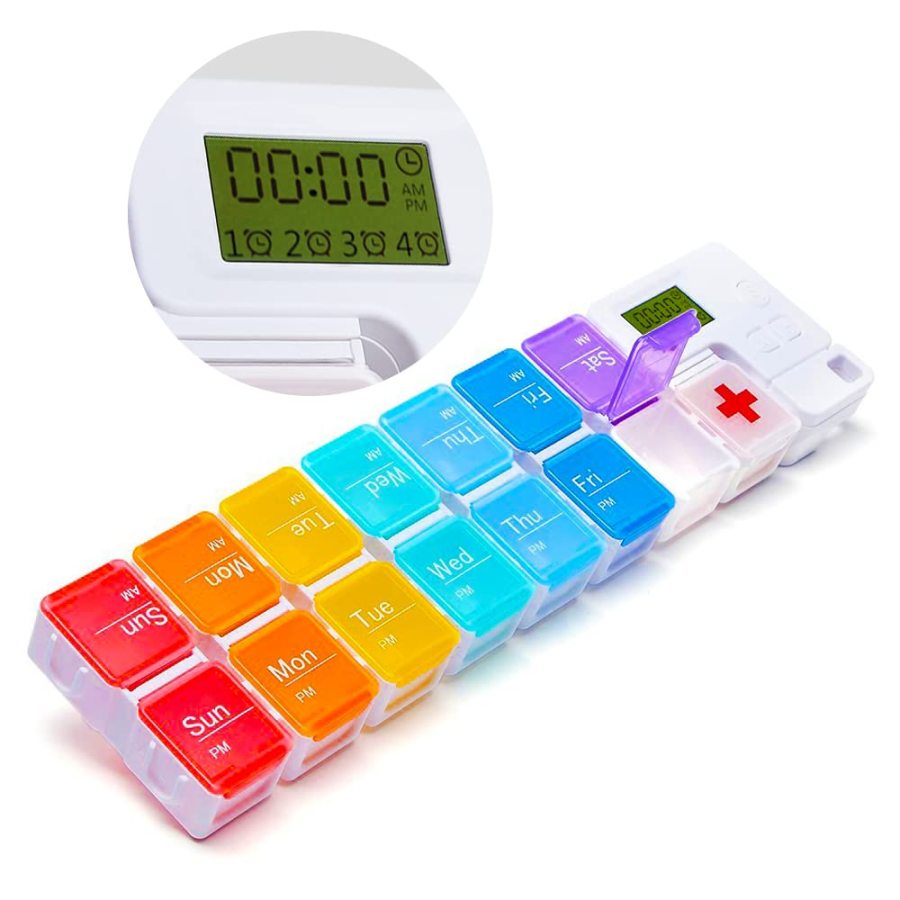
A smart reminder pill box is a device that combines medication storage with various reminder functions, designed to help users ensure they take their medications or supplements on time and in the correct dosage. The category ranges from basic electronic alarm pill boxes to smart pill boxes with Bluetooth/WiFi connectivity, remote app management, fingerprint locks, and automatic dispensing. The core objective is to solve user problems such as forgetting to take medication, confusing medications, and poor medication adherence. This is particularly crucial for the elderly, patients with chronic conditions, or individuals requiring long-term management of multiple medications. The following table illustrates the key characteristics of consumer behavior in this category.
| Dimension | Segment | Description |
|---|---|---|
| Need Driver Type | Planned Purchase / Emergency-driven Purchase | Primarily driven by health management needs. Users require long-term, regular medication intake (Planned Purchase), or must rely on external aids due to memory decline or chronic conditions (Emergency-driven Purchase). |
| Purchase Frequency | Low Frequency | Typically a one-time purchase, as the product itself has a long lifespan. Repurchase occurs only upon damage, upgrade, or the emergence of special needs. |
| Decision Complexity | Moderately Complex | Features are diverse, involving precision, ease of use, reliability, and smart connectivity. Users need to carefully evaluate whether the product can meet their specific medication management needs. |
| Price Sensitivity | Medium to High | Sensitivity is higher for basic models, but users and caregivers are willing to pay a premium for solutions that address core pain points like medication adherence and safety. |
| Emotional Dependency | High | Directly related to health status and life safety. Users and caregivers have a strong emotional dependency and a need for peace of mind regarding the accuracy and timeliness of medication intake. |
II. User Personas & Usage Scenarios
2.1 Precision-Seeking Chronic Patient
🎯 Requires long-term management of multiple medications, including large vitamins or fish oil. Highly focused on the pill box's capacity, precise reminders, and ease of operation.
| Typical Usage Scenarios | Core Pain Points | Primary Purchase Drivers |
|---|---|---|
|
|
|
2.2 Stressed Caregiver
🎯 Primarily responsible for caring for individuals with cognitive impairments (e.g., dementia, Alzheimer's) or family members requiring strict medication monitoring. Values remote management, overdose prevention safety, and operational simplicity.
| Typical Usage Scenarios | Core Pain Points | Primary Purchase Drivers |
|---|---|---|
|
|
|
2.3 Convenience-Seeking Daily Health Manager
🎯 Focused on personal health, taking regular vitamins, supplements, or occasional prescription medication. Seeks a stylish, portable pill box with basic reminder functions to integrate into a busy lifestyle.
| Typical Usage Scenarios | Core Pain Points | Primary Purchase Drivers |
|---|---|---|
|
|
|
III. User Needs Hierarchy (KANO Model)
3.1 Basic Needs (Must-Haves)
- Safe Storage: Ensures medication is protected from moisture, dust, and contamination, using food-grade, BPA-Free materials.
- Clear Compartmentalization: Has independent compartments for each day or time (e.g., AM/PM) for easy differentiation and organization of medications.
- Easy to Open/Close: Compartment lids should be easy for the elderly or those with arthritis to open and close effortlessly.
- Basic Reminder: Provides an audible alarm function to notify users of medication time.
3.2 Performance Needs (Linear Satisfiers)
- Multiple Reminder Modes: Combines multi-sensory reminders like sound, vibration, flashing LED lights to ensure the user doesn't miss the alert.
- Sufficient Capacity: Compartments should be large enough to accommodate common large-sized vitamins, supplements, or multi-dose medications.
- Portability: Compact design for easy daily carry, travel, or business trips.
- Adjustable Scheduling: Allows setting up to 4-7 reminders per day to accommodate complex medication schedules.
- Long-Lasting Durability: Product is made of sturdy materials and robust construction to withstand daily use and occasional drops.
3.3 Excitement Needs (Delighters)
- Remote Monitoring & Management: Enables setting medication schedules remotely via an app, receiving dose notifications, and viewing patient medication status. Crucial for caregivers.
- Safety Lock Mechanism: Features fingerprint locks, mechanical key locks, or timed locks to prevent accidental ingestion by children or overdose by cognitively impaired patients.
- Personalized Voice Reminders: Allows users or caregivers to record personalized voice reminders, adding a personal touch and increasing adherence.
- Medication Data Tracking & Analysis: App automatically records medication times and dosages, generating historical reports to facilitate health management and assessment by users or doctors.
3.4 Unmet Needs & Opportunities
-
Poor App Usability: Many smart pill box apps have complex interfaces, awkward translations, and excessive permission requests, resulting in a steep learning curve and poor user experience.
User Reviews (VOC) This app is terrifying. Pill holder is OK otherwise. // Decent hardware paired with a TERRIBLE app // The app is worthless. It's easier to manually program the device than it is to use the app.
-
Insufficient/Non-Adjustable Alarm Volume: Users commonly report alarm sounds are not loud enough, unfriendly to the hearing impaired, and often lack volume adjustment.
User Reviews (VOC) The alarm is so soft it can barely be heard even when it's close by. // Alarm tone was not within elderly user's hearing range. // The alarm is much too soft.
-
Battery Life/Charging Inconvenience: Some products have short battery life, requiring frequent charging or constant plug-in use, limiting portability and usage scenarios.
User Reviews (VOC) The battery life does not last long.. maybe 24-36 hours? // The unit needs to be plugged in all the time even though it has a battery. // Battery only lasts 3 days!
-
Pill Jamming/Difficult Retrieval: Automatic dispensing pill boxes suffer from pills getting stuck, or compartment design makes large pills hard to retrieve, impacting medication accuracy.
User Reviews (VOC) one or more pills getting stuck and not releasing into the tray // the dispenser doesn't always drop all of the pills. It has also jammed up a few times // some of the larger pills get stuck
-
No Offline Programming Function: Some smart pill boxes overly rely on Bluetooth/WiFi for setup. Once disconnected, basic settings cannot be modified, potentially affecting reminder functionality.
User Reviews (VOC) To change the reminder/dispense times, you must be connected by blue tooth. // if it loses battery charge and wifi-you will have to reset the whole system again.
IV. User Decision Drivers
4.1 Key Decision Factors
- Reminder Reliability: Whether the alarm reliably sounds on time, is loud and persistent enough to ensure no missed doses.
- Ease of Use: Whether operations like setting alarms, sorting medication, and daily retrieval are simple and intuitive, especially for elderly users.
- Capacity & Compatibility: Ability to hold the required amount and size of pills, with well-designed compartments for easy access.
- Medication Safety: Whether the product is moisture/dust resistant, made of non-toxic materials, and has lock mechanisms to prevent accidental ingestion or child access.
4.2 Secondary Decision Factors
- Battery Life & Charging: Whether the battery is long-lasting, the charging method is convenient, and supports extended use away from power.
- Portability: Whether the product's size and weight are suitable for daily carry or travel.
- App Functionality & Stability: Whether the app is easy to use, feature-rich, has stable connections, and ensures data privacy.
- Product Durability: Whether the materials and construction are sturdy for long-term, reliable operation.
- Aesthetic Design: Whether the product is aesthetically pleasing, resembling a daily item rather than a medical device, to increase user willingness to use it.
V. Selling Points & Competitive Landscape
5.1 Selling Point Analysis
5.1.1 Standard Features (Points of Parity)
- Multi-Day/Multi-Time Sorting: Offers 7-day/14-day/31-day sorting, supporting multiple daily doses (e.g., AM/PM).
- Alarm Reminder: Built-in audible alarm to remind users; some include lights or vibration.
- BPA-Free Material: Emphasizes food-grade safety materials to protect user health.
- Portability: Compact design for easy daily carry or travel.
- Large Capacity Compartments: Spacious enough to hold large vitamins, fish oil, and various supplements.
5.1.2 Key Differentiators
- Smart App Connectivity: Syncs with a smartphone app via Bluetooth or WiFi, offering more settings and remote functions.
- Multiple Reminder Methods: Combination of sound, light, vibration, and app notifications to enhance reminder effectiveness.
- Safety Lock Mechanism: Fingerprint recognition, mechanical key lock, or timed lock to prevent accidental ingestion by children or patient misuse.
- Easy Fill/Retrieval Design: Features easy-open lids, push-button mechanisms, or automatic dispensing tailored for the elderly or those with hand mobility issues.
- Personalized Voice Reminders: Allows recording family/friend voices, making reminders more emotionally resonant.
5.1.3 Unique Selling Propositions (USPs)
- Remote Forced Intervention: Caregiver can remotely control pill dispensing or lock the box (few products have this, and technological maturity varies).
- Medication Adherence Data Reporting: Provides detailed historical medication records and analysis to assist doctor diagnosis and health management.
5.2 Competitive Landscape
5.2.1 Market Maturity
The smart reminder pill box market is in a 'Growth-to-Maturity' stage. Basic products are highly commoditized with intense competition. Smart, connected products attempt to differentiate through technology, but user experience and functional reliability remain challenges. Market demand for innovation and solving user pain points persists.
5.2.2 Innovation Trends
Innovation trends are shifting from simple physical reminders to multimodal, personalized, and intelligent solutions. Key manifestations include: integrating app/Bluetooth/WiFi for remote management and monitoring; incorporating safety mechanisms like fingerprint recognition and mechanical locks; offering customizable voice reminders; and integrating medication data with personal health management ecosystems.
VI. Marketing Claims vs. Reality Check
The table below analyzes the gap between common marketing claims and actual user experiences in this category:
| Dimension | Marketing Claim | User Reality | Verdict |
|---|---|---|---|
| Smart App Experience | Bluetooth sync, app control, convenient medication plan management, remote monitoring. | Users widely report apps with poor translations, complex operations, buggy features, unstable connections, and even unnecessary privacy permission requests, severely undermining the smart experience. | A classic case of technology-driven thinking ignoring real user needs and usability, turning a core smart selling point into the biggest pain point and a crisis of trust. |
| Alarm Volume & Reliability | Loud alarm, multiple reminders (sound, light, vibration), never miss a dose. | Multiple users report alarm volume is too low for those with hearing difficulties; some products have alarms that fail randomly or ring for too short a duration, rendering them ineffective. | Subjective and unquantified definition of 'loud,' failing to deliver on the core reminder function's effectiveness in real-world noise environments or for specific user groups, posing a safety risk. |
| Automatic Dispensing Reliability | Automatic dispensing, precise delivery, anti-jam design. | High-end automatic dispensers frequently experience pill jams, missed doses, or dispensing multiple doses at once, leading to inaccurate or excessive medication intake. | Structural design fails to adequately account for the diversity of pill sizes, shapes, and friction during mechanical movement, resulting in a fatal flaw in the core dispensing function that threatens medication safety. |
Key Takeaway: The smart reminder pill box market is rife with over-promising and inflated specifications, particularly regarding the reliability of smart features and core reminder effectiveness.
VII. Supply-Demand Misalignment Analysis
The table below highlights mismatches between seller focus and buyer priorities:
| Dimension | Seller Behavior | User Focus | Verdict |
|---|---|---|---|
| Smart App vs. Basic Functions | Listings dedicate significant space to promoting advanced features like app remote control, data tracking, Bluetooth/WiFi connectivity. | Users complain the app is difficult to use, poorly translated, asks for too many privacy permissions, ultimately abandoning it in favor of phone alarms or viewing the product as 'just a pill box with a clock.' | Sellers are enamored with technology stacking but fail to translate it into smooth user value. The significant investment doesn't solve core pain points and even creates new usage barriers. |
| Alarm Volume & Persistence | Commonly claim 'loud alarm' but rarely provide specific, quantified details on volume or duration, nor mention adjustable volume features. | Numerous users complain the alarm is too quiet to hear, leading to missed doses; or the ring duration is too short and easily missed, severely impacting reminder effectiveness. | Sellers lack insight into real user scenarios for the most core 'reminder' function, failing to provide a sufficiently reliable solution, directly leading to decreased user medication adherence. |
| Pill Dispensing Mechanism & Retrieval Experience | Market 'large capacity,' 'easy to use,' but descriptions of actual pill retrieval mechanisms and anti-jam measures are vague or gloss over issues. | High-frequency user feedback on pills getting stuck, difficulty retrieving large pills, loose compartments, and even fatal flaws like automatic dispensers releasing multiple doses by mistake. | Sellers have design flaws and insufficient quality control at the most critical physical interaction point of the product, severely impacting medication safety and user experience, and are a root cause of high return rates. |
Key Takeaway: Sellers generally over-invest marketing in 'Smart App Connectivity' and 'Personalized Features,' while neglecting the strong user demand for the stability of core functions like 'Basic Reminder Reliability' and 'Pill Dispensing Accuracy,' leading to a severe supply-demand mismatch.
VIII. Strategic Opportunities & Recommendations
8.1 Develop an Accessible, High-Reliability Basic Reminder Pill Box
8.1.1 Target Audience & Pain Points
⚡️ Pain Points Addressed: Insufficient/non-adjustable alarm volume; No offline programming function; Poor app usability (focus on localization optimization).
8.1.2 Action Plan
Design a physical button (or dial) for multi-level adjustable alarm volume, ensuring maximum volume meets the needs of the hearing impaired. Integrate multi-modal reminders (sound, light, vibration) with a progressive, persistent reminder logic lasting 30-60 minutes. Support direct, local device programming with large-font displays to simplify setup. Offer only an extremely simple 'reminder' app, not a complex 'management' app, focusing on stable connection and basic notifications.
| Tech Complexity | Low |
| Cost Impact | Low Impact |
| Trade-off Warning | No significant physical side effects. |
| Price Band | Only viable above $18.99 |
8.1.3 Marketing Strategy
Emphasize 'Simple & Reliable, Easy to Learn'; Highlight 'Loud Volume, Never Miss a Dose'; Demonstrate actual volume levels in different scenarios. Target users who are not interested in smart features but seek ultimate reliability in basic reminders.
8.2 Optimize Pill Dispensing & Anti-Jam Automatic Pill Box
8.2.1 Target Audience & Pain Points
⚡️ Pain Points Addressed: Pill jamming/difficult retrieval; Medication safety (risk of multi-dose errors).
8.2.2 Action Plan
Redesign the dispensing mechanism and outlet, using wider, more gently sloped channels. Optimize the material and shape of pill agitators to reduce friction. Introduce dual-sensing mechanisms (e.g., photoelectric + pressure sensor) to monitor complete pill dispensing in real-time, triggering clear alerts and attempting a second dispensing cycle if jams occur. Provide adjustable compartment inserts to accommodate different pill sizes. Pursue FDA certification to highlight medical-grade safety and precision.
| Tech Complexity | Medium |
| Cost Impact | High Impact |
| Trade-off Warning | May slightly increase product size or require higher mold precision, raising costs and design complexity. |
| Price Band | Only viable above $79.99 |
8.2.3 Marketing Strategy
Highlight 'Medical-Grade Precision Dispensing, Eliminates Jams & Errors'; Showcase videos of smooth pill dispensing tests (including large and irregularly shaped pills); Emphasize 'Designed for Life & Health, Every Step is Safe & Controlled'; Offer extended warranties.
8.3 Long Battery Life + Dual-Power Mode Smart Pill Box
8.3.1 Target Audience & Pain Points
⚡️ Pain Points Addressed: Battery life/charging inconvenience.
8.3.2 Action Plan
Use higher energy-density lithium batteries, targeting 30-60 days of battery life. Add a USB-C charging port and provide a backup AA/AAA battery compartment for dual power assurance. Optimize power management chips to reduce standby consumption. Clearly label battery life under different modes in listings and back claims with third-party lab test data.
| Tech Complexity | Medium |
| Cost Impact | Medium Impact |
| Trade-off Warning | Higher capacity batteries may slightly increase product weight or thickness, requiring a trade-off between portability and battery life. |
| Price Band | Only viable above $29.99 |
8.3.3 Marketing Strategy
Emphasize 'Ultra-Long Battery Life, Fear No Power Outage'; Highlight 'USB-C Fast Charging + Emergency Battery, Dual Assurance'; Use scenario-based imagery to showcase product reliability during travel, power outages, etc.; Promise 'Worry-Free Power, Constant Peace of Mind.'
8.4 User-Friendly Remote Monitoring Solution with Data Privacy
8.4.1 Target Audience & Pain Points
⚡️ Pain Points Addressed: Poor app usability; Lack of real-time monitoring (remote).
8.4.2 Action Plan
Develop an app compliant with local data privacy regulations (e.g., HIPAA), featuring a clean user interface, multi-language support, and professional localized translations. The app should focus on core functions: medication logging, reminder settings, and dose status feedback, minimizing unnecessary permission requests. Implement true remote WiFi connectivity, allowing caregivers to view medication history and set reminders remotely. Provide clear privacy policy statements and support two-factor authentication to enhance data security. Consider initial integration with home smart health ecosystems (e.g., Amazon Echo Health).
| Tech Complexity | High |
| Cost Impact | High Impact |
| Trade-off Warning | WiFi module and cloud service costs are high. App development and maintenance require significant investment and may introduce privacy compliance risks. |
| Price Band | Only viable above $99.99 |
8.4.3 Marketing Strategy
Emphasize 'Remote Care, Close at Hand, Privacy Assured'; Showcase the app's intuitive medication log interface and remote setup features; Highlight 'Compliant & Secure, Safeguarding Your Family's Health'; Build trust through endorsements from experts or public figures.