Amazon US Market Analysis: Cordless Jump Ropes Category
📊 Executive Summary
📈 Market Trends
The cordless fitness trend is significant, with smart tracking becoming the new standard. The cordless jump rope market attracts many home fitness users due to its space-agnostic and tangle-free nature. Smart counting, weighted design, and dual-mode (rope/cordless) have become mainstream selling points. Growing consumer demand for quantified exercise data is driving product development towards smarter, more personalized directions.
⚡ Major Pain Points
Lack of 'Realism' and Frequent 'Quality Issues'. Users widely report that current cordless jump ropes are unsatisfactory in terms of 'weighted feel' and 'realistic simulation,' impacting exercise effectiveness. Simultaneously, common quality issues like easily detaching weighted balls and fragile connectors severely undermine user trust. Inaccurate smart counters and poor APP experiences also reduce product added value.
💡 Selection Opportunities
Deep Dive into 'Realistic Exercise Feel,' Rebuild User Trust. The market opportunity lies in developing innovative weighted systems that truly simulate the physical feedback of traditional ropes, offering adjustable, highly durable products that solve core user pain points. Secondly, there is a need to build a reliable smart APP ecosystem providing accurate data analysis and personalized training plans. Finally, optimizing handle design and multi-size fit for different demographics will enhance user experience. Building long-term brand trust through solid quality control and after-sales promises is crucial.
I. Analysis Overview
1.1 Introduction & Report Scope
This report analyzes the 'Jump Ropes' category (specifically cordless jump ropes) in the US Amazon market, focusing on target user personas, core needs, decision drivers, market communication, and potential opportunities.
1.2 Category Snapshot
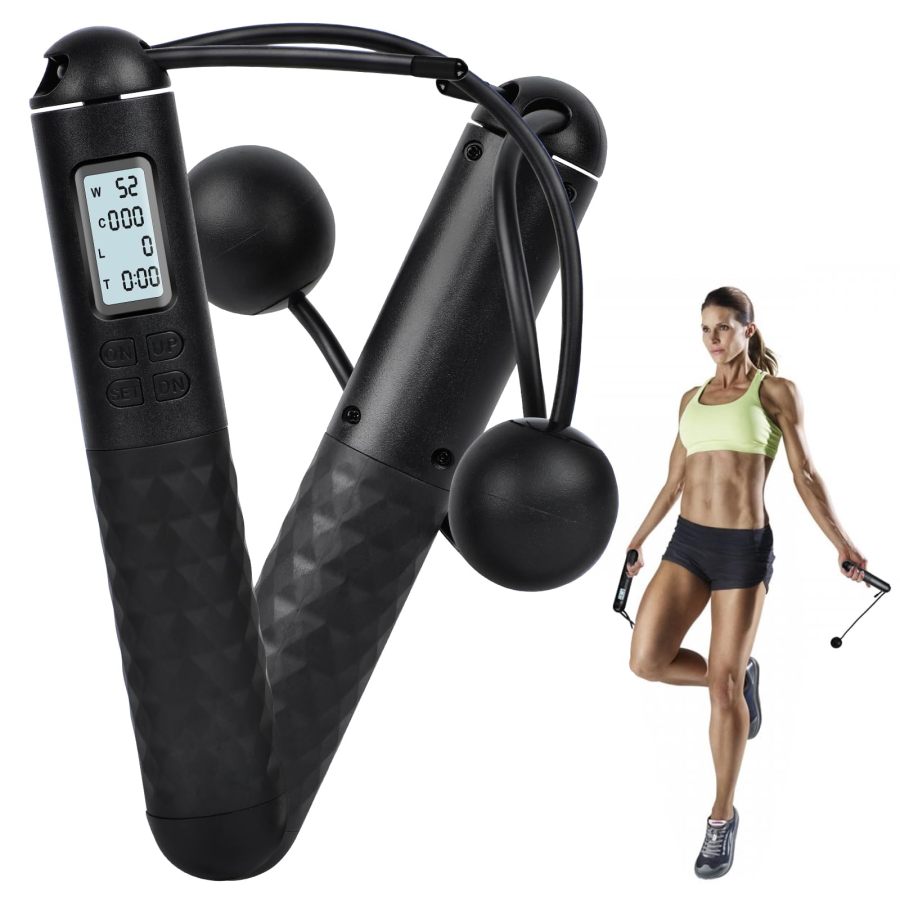
A cordless jump rope is an innovative fitness device that simulates the sensation of traditional rope jumping using short cords and weighted balls on handles, eliminating the need for a long rope. It is primarily used for efficient cardio workouts, fat burning, and coordination training. This category is especially suitable for users with limited space, those not proficient with traditional jump ropes, or those concerned about tripping. The market offers a variety of product types, including basic models, models with counters, adjustable-weight models, smart/connected models, and dual-mode (rope/cordless) models. The following table illustrates the key characteristics of consumer behavior in this category.
| Dimension | Segment | Description |
|---|---|---|
| Need Driver Type | Planned Purchase / Emergency-driven Purchase | User purchases typically stem from planned daily fitness needs or from seeking an alternative solution to practical problems posed by traditional jump ropes, such as space constraints and tripping. |
| Purchase Frequency | Low | As a durable fitness tool, a cordless jump rope is usually purchased once for long-term use, resulting in low repurchase frequency. |
| Decision Complexity | Medium | Consumers compare core features (e.g., counting, weight adjustment), simulation of realistic feel, and value for money, requiring a certain evaluation process. |
| Price Sensitivity | Medium | Price is an important consideration, but users are willing to pay a reasonable premium for a better experience (e.g., accurate counting, good weight feel) and additional features. |
| Emotional Dependency | Medium | The product primarily fulfills functional needs but also provides emotional value such as 'enjoying the fun of exercise' and 'worry-free experience,' enhancing user satisfaction. |
II. User Personas & Usage Scenarios
2.1 Home Fitness Beginners & Space-Constrained Users
🎯 These users want to conveniently perform cardio exercises at home but are limited by insufficient living space, lack of skill with traditional jump ropes, or concerns about noise and safety.
| Typical Usage Scenarios | Core Pain Points | Primary Purchase Drivers |
|---|---|---|
|
|
|
2.2 Data-Driven Fitness Enthusiasts
🎯 Users who value quantifying exercise results, tracking training data, and seeking technological assistance to improve fitness efficiency and experience.
| Typical Usage Scenarios | Core Pain Points | Primary Purchase Drivers |
|---|---|---|
|
|
|
III. User Needs Hierarchy (KANO Model)
3.1 Basic Needs (Must-Haves)
- Cordless Design: This is the core of a cordless jump rope. It must ensure the cordless mode smoothly simulates jumping rope motions, is tangle-free, and space-saving.
- Grip Comfort: Handles should have soft, non-slip, ergonomic materials that don't cause hand fatigue during prolonged use and effectively absorb sweat.
- Basic Durability: The product structure must be sturdy, not prone to breaking or falling apart during use-especially at the connection points between handles and weighted balls-ensuring safety and longevity.
3.2 Performance Needs (Linear Satisfiers)
- Weighted Feel: Weighted balls or handles should have appropriate weight to simulate the 'gravity feel' and inertia of a real rope, enhancing movement realism and intensity.
- Counting Function: Built-in, accurate digital counter to precisely record the number of jumps, helping users track workout volume.
- Smooth Rotation: High-quality bearings inside the handles ensure the weighted balls or cords rotate fluidly without jamming, maintaining exercise rhythm.
- Dual-Mode (Rope/Cordless): Providing a traditional rope accessory allows users to switch modes based on scenario needs (e.g., outdoors, seeking realism), increasing product flexibility.
- Portability: The product should be lightweight, easy to disassemble, and come with a storage bag, facilitating use and storage in different locations and enhancing convenience.
3.3 Excitement Needs (Delighters)
- Smart APP Connectivity: Bluetooth connection to a smartphone APP for data syncing, detailed exercise reports, historical data analysis, personalized training plans, and social sharing, enriching the user experience.
- Timer/Calorie Display: Beyond jump counts, displaying workout duration, estimated calorie burn, and other comprehensive exercise data helps users evaluate results more scientifically.
- Multiple Training Modes: Pre-set modes like free jump, countdown jump, and target jump count provide diverse training experiences, increasing exercise fun and challenge.
- Fast Charging/Long Battery Life: Using a Type-C charging port or offering extended battery life reduces the hassle of frequent charging or battery replacement, improving convenience.
3.4 Unmet Needs & Opportunities
-
Insufficient Weighted Realism: Many users complain that the weighted balls on cordless jump ropes are too light, failing to effectively simulate the 'sweeping feel' or 'heaviness' of a real rope, leading to a poor exercise experience.
User Reviews (VOC) I wish the balls on the end were heavier because I hardly feel anything. // For ropeless jumping it was set up out of the box. On my first try it seemed like twirling a foam ball wasn't going to help much.
-
Poor Product Quality & Durability: User feedback indicates weighted balls easily detach, handle connections are weak, or ropes (in dual-mode) wear out and break quickly, impacting product lifespan and safety.
User Reviews (VOC) The one just came flying out when I was using it. // The plastic balls on the end literally flew off in the middle of a workout and I ended up having to superglue them back on.
-
Counter Accuracy & Functional Defects: Some counters are inaccurate, or cannot input data for users above a specific weight, leading to miscalculated calorie estimates; other products lack a power-off button or have unintuitive operation logic.
User Reviews (VOC) The counter is faulty stopped working on the first day. // Product says the weight can be programmed up to 250 lbs but, my product won't adjust past 110 lbs.
-
Imperfect APP Experience: Smart APPs may have language issues (non-English), unstable data syncing, or limited features, failing to provide in-depth data analysis or social interaction.
User Reviews (VOC) Part of the terms that you have to accept are in Chinese (probably), but the rest of the app is in English.
-
Handle Size & Balance: Some users find handles too large or small for their hand size; or the two handles feel unbalanced in weight, affecting coordination and causing uneven movement.
User Reviews (VOC) Grip is fine,just wish they had a choice for smaller handles for people with smaller hands. // The side with out the screen is a bit light. As such can be difficult at times to get spinning.
IV. User Decision Drivers
4.1 Key Decision Factors
- Cordless Mode Usability: Whether the product truly functions cordlessly, is tangle-free, and can be used smoothly in confined spaces is the primary factor for users deciding to purchase a cordless jump rope, directly addressing the core pain point.
- Exercise Effectiveness: Whether the product can simulate the cardio and fat-burning effects of a real jump rope, especially regarding the feel of switching between rope and cordless modes, is key for users assessing its value, relating directly to achieving fitness goals.
- Ease of Use & Learning Curve: Operation should be simple and intuitive, especially for fitness beginners or users not skilled with traditional ropes, enabling quick adaptation and enjoyment of exercise, avoiding frustration.
- Grip Comfort & Safety: Handle material, non-slip properties, and size suitability for prolonged use, as well as the safety of weighted balls in cordless mode (not prone to detaching and causing injury), are prerequisites for a good experience.
4.2 Secondary Decision Factors
- Counting & Data Tracking: Having functions to display jump counts, time, calories, etc., helps users quantify fitness results, provides motivation, and supports long-term fitness plans.
- Product Durability: Whether the product material is robust, the structure is reliable, and it is not easily damaged, extending lifespan, reducing post-sale risks, and building user trust.
- Price & Value for Money: Given that core needs and functions are met, a more competitive price or higher perceived value can attract users and influence the final purchase decision.
- Portability & Storage: Whether the product is lightweight, easy to carry, and store, adaptable to various scenarios like home, office, or travel, enhancing convenience.
- Additional Features: Features like smart APP connectivity, multiple training modes, special colors, or materials add extra appeal but are not core decision factors.
V. Selling Points & Competitive Landscape
5.1 Selling Point Analysis
5.1.1 Standard Features (Points of Parity)
- Cordless/Tangle-Free Design: Almost all products emphasize their cordless design, avoiding rope tangles and tripping, which is the core advantage and foundational selling point of the category.
- Suitable for Small Spaces: Widely promoted as usable indoors, in apartments, offices, and other confined spaces, solving the user pain point of space limitations.
- Portable & Easy to Carry: Emphasizing the product's lightweight and portable nature, convenient for fitness anytime, anywhere, highlighting mobile usage scenarios.
- Cardio & Fat Burning: Highlighting the product's ability to provide efficient aerobic exercise, aiding fat loss and improving cardiovascular health, attracting health-conscious users.
- Comfortable Grip: Often employing ergonomic designs with non-slip, sweat-absorbing foam or silicone handles to enhance the user experience.
5.1.2 Key Differentiators
- Counter/LED Display: Most products feature a digital counter and LED screen, displaying real-time data like jump counts, time, and calories, providing quantitative feedback.
- Weighted Design: Simulating the feel of a real rope or increasing training intensity through weighted handles or heavier balls, attracting advanced users.
- 2-in-1 Mode: Some products offer a switchable dual-mode (rope/cordless), meeting diverse user needs across different scenarios.
- Suitable for Different Demographics: Emphasizing suitability for children, adults, beginners, or professionals, showcasing its universality and broad audience.
5.1.3 Unique Selling Propositions (USPs)
- Smart APP Connectivity: A few brands like RENPHO offer Bluetooth connectivity to a smartphone APP, enabling advanced data analysis, training plans, and community interaction, enhancing the tech feel and user stickiness.
- Type-C Charging/Long Battery Life: Some products are upgraded with a Type-C charging port or advertise extended battery life, improving convenience and eco-friendliness, reducing charging hassles.
- Exclusive Patent Design: For example, YOTTOY's 'Large Ropeless Ball Design' emphasizes stability and resistance to detachment, creating a differentiated advantage.
- Shoulder Rehabilitation Use: A few products or user reviews mention that cordless jump ropes can be used for shoulder rehabilitation training, expanding the product's usage scenarios and target audience.
5.2 Competitive Landscape
5.2.1 Market Maturity
The cordless jump rope market is transitioning from an emerging to a mature product stage. Basic cordless and counting functions have become commoditized, with intense price competition. Consumer acceptance for products solving traditional rope pain points is high, but they are also beginning to seek more refined exercise experiences and data feedback. Smart features, more realistic simulation, and product durability are key future competitive points.
5.2.2 Innovation Trends
Current innovation trends are mainly reflected in several areas: First, smart upgrades, providing more comprehensive data analysis and personalized training through APP connectivity. Second, experience optimization, enhancing the 'real rope feel' of cordless jump ropes through more precise weighted design and material selection. Third, multi-function integration, with 2-in-1 (rope/cordless) designs becoming mainstream to meet diverse needs. Fourth, durability improvements, especially regarding connections for weighted balls and handle materials, to address frequently reported quality issues.
VI. Marketing Claims vs. Reality Check
The table below analyzes the gap between common marketing claims and actual user experiences in this category:
| Dimension | Marketing Claim | User Reality | Verdict |
|---|---|---|---|
| Weighted Feel & Realism | Claims of 'weighted design,' 'simulates real rope feel,' providing high-intensity training. | Users widely report that weighted balls are too light (e.g., foam balls), or handle weight is insufficient, lacking the 'sweeping feel' or 'heaviness' of a traditional rope, resulting in a 'fake' exercise experience. | Sellers overemphasize the concept of 'weighted' but fail to provide sufficient physical feedback through actual weight, typically using marketing buzzwords to mislead user expectations about training intensity, creating a core functional perception gap. |
| Product Durability | Claims of 'high-quality materials,' 'sturdy and durable,' 'built-in premium bearings,' and 'lifetime warranty.' | Multiple users report weighted balls easily breaking or detaching during use, handle connections being weak, with some products even damaged before first use. | There are clear defects in material choice or structural design at key stress points, severely contradicting the 'durable' marketing promise, directly leading to user safety hazards and brand trust erosion. |
| Smart Counter Accuracy & Functional Integrity | Claims of 'smart counter, tracks jumps and calories in real-time,' precise and efficient. | Users report inaccurate counting, inability to correctly set weight (e.g., max 110 lbs), lack of a power-off button, and some manuals not matching the product. | Smart features are superficial, not optimized from actual user scenarios. The counter, as a core smart selling point, has fundamental flaws, diminishing the product's smart value proposition. |
Key Takeaway: The cordless jump rope market commonly suffers from exaggerated marketing claims misaligned with actual user experience, particularly regarding 'weighted feel' and 'durability,' leading to failed user expectation management.
VII. Supply-Demand Misalignment Analysis
The table below highlights mismatches between seller focus and buyer priorities:
| Dimension | Seller Behavior | User Focus | Verdict |
|---|---|---|---|
| Core Exercise Experience | Sellers generally emphasize 'cordless/tangle-free' and 'indoor suitability,' and vaguely mention 'weighted design' to simulate realism. | Users widely complain that products lack the gravity feedback and rhythm of a real rope, feeling like 'waving in the air,' with insufficient perceived exercise intensity. | While sellers solve the space limitation, they fail to deeply simulate the core physical sensation of traditional rope jumping, causing cordless ropes to incompletely replace traditional ones in the key dimension of 'exercise effectiveness,' missing the opportunity to enhance immersive user experience. |
| Product Long-Term Durability & Quality | Sellers mention 'high-quality materials' and 'long-lasting durability' in listings but generally lack specific guarantees or third-party certifications for connectors, ball material, bearing lifespan. | Numerous users report weighted balls easily detaching, loose handle connections, and ropes wearing out quickly, expressing concerns about product quality and long-term lifespan. | Sellers collectively remain silent or make vague promises on this basic need of product quality and durability, failing to build user trust, leading to high return rates and negative word-of-mouth. This is a major flaw and potential risk area for category development. |
| Smart Counter Functionality & User Experience | Most products claim to have smart display functions like digital counting, time, calories, and even APP connectivity. | Users have many complaints about counting accuracy, weight settings, power-off operation, and APP experience is often hindered by poor localization. Smart features are often seen as 'gimmicky.' | Sellers tend to 'pile on' rather than 'refine' smart features, investing cost without providing a seamless, reliable user experience, leading to reduced consumer trust in smart fitness products. |
Key Takeaway: Sellers overly focus on basic 'cordless/tangle-free' and 'portability,' but there is a significant supply gap regarding the 'realistic exercise feel' and 'product long-term reliability' that users highly prioritize.
VIII. Strategic Opportunities & Recommendations
8.1 Create a Flagship 'Realistic Feel' Cordless Jump Rope
8.1.1 Target Audience & Pain Points
⚡️ Pain Points Addressed: Insufficient weighted realism, lacking the physical feedback of a real rope.
8.1.2 Action Plan
Develop an innovative weighted system using high-density materials (e.g., metal alloy) to create adjustable magnetic damping or fluid-filled weighted balls that generate inertia and a 'sweeping feel' closer to a real rope during rotation. Offer multiple weighted ball options to cover different needs from lightweight (beginners/rehab) to heavyweight (high-intensity training), ensuring balanced internal handle weight. Use sturdy metal connectors and pass rigorous fatigue testing.
| Tech Complexity | Medium |
| Cost Impact | Medium Impact |
| Trade-off Warning | Heavier weights may slightly increase overall product weight, but if it improves the experience, users will likely accept it. |
| Price Band | Only viable above $24.99 |
8.1.3 Marketing Strategy
Emphasize 'Say goodbye to the fake feel, experience every beat of a real rope-revolutionary weight, making your sweat worth it!'; Showcase close-ups of the weighted ball's internal structure and demonstrations of multi-stage weight adjustment. Compare physiological data with traditional ropes. Provide extreme durability test videos to reinforce product professionalism and reliability.
8.2 Comprehensively Enhance Product Durability & Quality Perception
8.2.1 Target Audience & Pain Points
⚡️ Pain Points Addressed: Poor product quality and durability, connectors easily break, handles loosen.
8.2.2 Action Plan
Upgrade connectors between handles and weighted balls using more wear-resistant, anti-pull engineering plastics or metal materials. Optimize mold precision and assembly processes. For easily loosening handle caps, design snap-fit or threaded locking mechanisms. Reinforce the anti-wear coating on PVC ropes (if applicable) and the fatigue resistance of internal steel wire cores. Implement strict QC standards in production to ensure batch-to-batch consistency.
| Tech Complexity | Low |
| Cost Impact | Low Impact |
| Trade-off Warning | No significant physical side effects, mainly optimizing materials and processes. |
| Price Band | Only viable above $14.99 |
8.2.3 Marketing Strategy
Highlight 'Long-lasting, quality assured'; Provide close-ups of connectors showcasing high-strength materials. Promote rigorous quality control processes and extended warranty promises (e.g., 2-year free replacement) to boost purchase confidence. Showcase product stability after long-term use through customer reviews.
8.3 Build a User-Centric Smart APP Ecosystem
8.3.1 Target Audience & Pain Points
⚡️ Pain Points Addressed: Counter accuracy and functional defects, imperfect APP experience.
8.3.2 Action Plan
Invest resources to optimize APP functionality, ensuring data accuracy (jumps, calories, time) and providing clear chart-based historical data analysis with weekly/monthly reports. Add personalized training plan recommendations that auto-adjust based on user fitness level and goals. Develop engaging challenge modes like 'Jump Rope Marathon' or 'Daily Challenge,' integrating social features (friend leaderboards, achievement sharing) to enhance user stickiness. Ensure the APP supports English and other major languages and can seamlessly sync with health platforms like Apple Health/Google Fit. Optimize device firmware to ensure counter accuracy and intuitive operation logic, e.g., adding auto-shutdown and memory functions.
| Tech Complexity | Medium |
| Cost Impact | Medium Impact |
| Trade-off Warning | APP development and maintenance require ongoing investment, potentially slightly increasing product pricing or maintenance costs. |
| Price Band | Only viable above $29.99 |
8.3.3 Marketing Strategy
Emphasize 'Smart rope, more than just counting-it's your personal exercise coach. Data insights, extraordinary results!'; Showcase APP interface previews (data dashboard, challenge screens), user success stories (achieving fitness goals via the APP), endorsements from professional fitness coaches, and third-party certifications for data accuracy. Highlight the convenience of multi-platform data syncing.
8.4 Optimize Handle Ergonomics & Multi-Size Fit
8.4.1 Target Audience & Pain Points
⚡️ Pain Points Addressed: Poor handle size and balance, affecting grip comfort for users with different hand sizes.
8.4.2 Action Plan
Based on user hand-size data, offer S/M/L handle size options or design a modular solution for adjustable handle thickness. Optimize internal weight distribution within handles to ensure balanced feel between the two in cordless mode, reducing movement incoordination. Consider using dual-injection molding or skin-friendly coatings for handle materials to improve touch. Address existing issues of handles being too light or heavy.
| Tech Complexity | Low |
| Cost Impact | Low Impact |
| Trade-off Warning | Offering multiple handle sizes may increase SKU and inventory complexity, but significantly improves user experience. |
| Price Band | Only viable above $17.99 |
8.4.3 Marketing Strategy
Highlight 'Comfortable grip tailored for your hand'; Use comparison charts to showcase the fit of different handle sizes. Emphasize 'Balanced design for smoother movement.' For family users, promote 'Shared by the whole family, meets diverse needs.'