Amazon US Market Analysis: Automatic Dog Ball Launchers Category
📊 Executive Summary
📈 Market Trends
Reliability Crisis Coexists with Homogenized Competition. The automatic dog ball launcher market is maturing but plagued by widespread core experience issues: poor durability, high failure rates, and loud operation. Current innovation focuses on basic features like adjustable distance and dual power, lacking products that fundamentally solve user pain points or deliver delightful differentiation. High value-for-money and stable user experience remain market gaps.
⚡ Major Pain Points
Frequent Failures, Noise Disturbance, and Wet Ball Jams are the Three Major Flaws. Users are extremely dissatisfied with product quality and lifespan. Short-term failures, high-decibel noise scaring dogs, and wet balls causing jams are primary drivers of low ratings and high returns. Additionally, safety hazards from mismatched ball sizes are increasingly prominent, requiring manufacturer attention.
💡 Selection Opportunities
Focus on Core Experience, Build High-Value Niche Products. Market opportunities lie in launching the 'Ultra-Quiet & Wet-Ball Proof Premium Launcher' to address top user concerns about noise and wet ball jams, building trust with long-term warranties. Simultaneously, develop the 'Multi-Size Ball Compatible & Intelligent Safety Launch System' to solve ball safety hazards and breed compatibility. Longer-term, the 'Human-Pet Interaction Upgrade: APP-Enabled Smart Training & Data Tracking Launcher' will attract premium users pursuing tech-enabled pet parenting, achieving brand premium through differentiated innovation.
I. Analysis Overview
1.1 Introduction & Report Scope
This report analyzes the 'Automatic Ball Launchers' category (for dogs) in the US Amazon market, focusing on target user personas, core needs, decision factors, market communication, and potential opportunities.
1.2 Category Snapshot
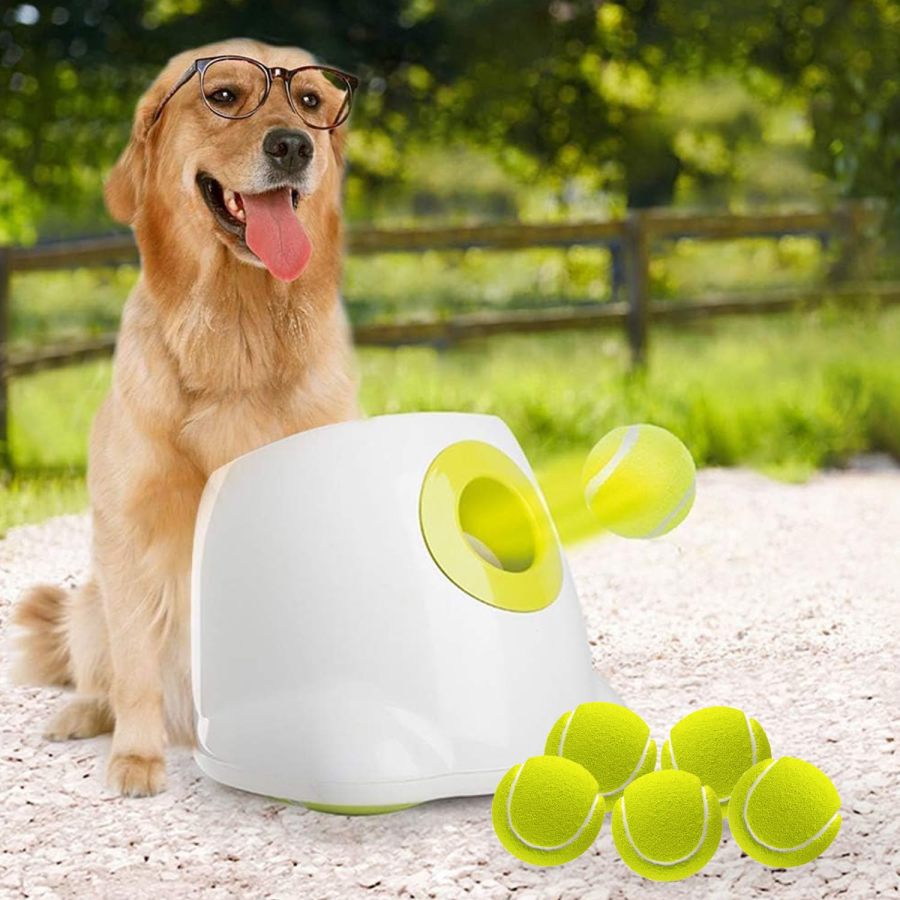
The automatic dog ball launcher is an innovative pet interactive toy designed to provide dogs with continuous exercise and entertainment by automatically throwing balls. Products typically feature adjustable throwing distances (e.g., 10-80 feet), dual indoor/outdoor use (AC/battery powered), and include appropriately sized balls. Market offerings primarily serve small to medium-sized dogs, with some compatible with standard tennis balls or designed for large breeds. Ball sizes typically range from 2 to 2.5 inches. The following table illustrates the key characteristics of consumer behavior in this category.
| Dimension | Segment | Description |
|---|---|---|
| Need Driver Type | Planned Purchase/Emergency-driven Purchase | Consumers primarily purchase to address high-energy dogs when owners lack time for play, or to provide entertainment in specific scenarios like rainy days or working from home. |
| Purchase Frequency | Low Frequency | As a durable electronic toy, purchase frequency is low. Consumers expect the product to function reliably over the long term. |
| Decision Complexity | Medium | Consumers compare functionality, safety, durability, noise levels, ball size, and reviews, requiring a decision process that weighs multiple factors. |
| Price Sensitivity | Medium to High | Price is an important consideration, but consumers prioritize product reliability, safety, and the actual value delivered over simply seeking the lowest price. |
| Emotional Dependency | Medium to High | The product embodies the owner's care and responsibility for their pet, aiming to enhance the pet's quality of life, though practical functionality remains the core. |
II. User Personas & Usage Scenarios
2.1 Busy Urban Pet Owner
🎯 Living a fast-paced life with limited time, they seek to ensure their dog gets sufficient exercise and entertainment when they cannot play personally, preventing destructive behavior from boredom.
| Typical Usage Scenarios | Core Pain Points | Primary Purchase Drivers |
|---|---|---|
|
|
|
2.2 Efficiency-Focused Dog Trainer
🎯 They own dog breeds with high enthusiasm for fetch or significant physical demands. They aim to train and tire their dogs more efficiently and consistently using smart devices, improving obedience and intelligence.
| Typical Usage Scenarios | Core Pain Points | Primary Purchase Drivers |
|---|---|---|
|
|
|
III. User Needs Hierarchy (KANO Model)
3.1 Basic Needs (Must-Haves)
- Stable and Reliable Throwing: The machine must reliably launch balls without frequent jams, misfires, or complete failure.
- Multiple Adjustable Distances: Offers at least 2-3 adjustable throwing distances to accommodate different indoor/outdoor space sizes.
- Includes Compatible Balls: Comes with a sufficient number of dedicated balls upon purchase, ensuring play-ready out of the box without needing to buy compatible balls separately.
- Flexible Power Options: Supports both plug-in and/or battery power for convenient use in scenarios with or without an outlet.
- Simple and Intuitive Operation: The device has few buttons with clear functions, allowing quick user setup and enabling the dog to gradually understand its operation.
3.2 Performance Needs (Linear Satisfiers)
- Ball Durability: Included balls should be wear-resistant, chew-resistant, not easily destroyed by dogs, and harmless to their teeth to avoid frequent replacement.
- Battery Life: A full charge supports extended continuous playtime, reducing charging frequency, especially for outdoor use.
- Low-Noise Operation: The machine operates quietly, not startling sensitive dogs or disturbing the owner and family.
- Wet Ball Compatibility: The machine can still launch balls smoothly when wet from dog saliva, without jamming, affecting throw distance, or damaging internal mechanisms.
- Product Portability: The device is compact and moderately weighted for easy transport from indoors to outdoors or for travel.
3.3 Excitement Needs (Delighters)
- Intelligent Obstacle Avoidance: Built-in sensors detect pets or people near the launch zone and automatically pause or adjust the throwing angle, enhancing safety.
- Remote Control or App Connectivity: Conveniently controls throw distance, mode, or even monitors play via remote or smartphone app, enhancing interactive convenience.
- Self-Play Encouragement Mechanism: Design features that encourage or guide the dog to place the ball back into the launch chute, fostering independent play ability.
- Variable Throwing Modes: Beyond fixed distances, offers random direction, random distance, or rhythm-changing throwing modes to increase the dog's interest and challenge.
- Innovative Ball Materials: Provides balls made from new materials like ETPU, offering a better balance of bounce, durability, and safety, or featuring special scents/textures to attract dogs.
3.4 Unmet Needs & Opportunities
-
Frequent Core Function Failures: Many users report product failures within weeks or months, including motor issues, belt slippage, failure to launch balls, or complete stoppage.
User Reviews (VOC) I have bought 2 of these, the first one worked great, dog loved it. After several weeks of use, it can left out in the rain while on, made weird noises and stopped working, my bad, bought another. It never worked at all // This unit is already making noise. first unit lasted three months. Have a lot of concern on the quality of parts used in this device. would like an item I pay this much for to last a little longer.
-
Excessive Noise Impacts Experience: The startup and launch noises are excessively loud, often frightening dogs, causing them to avoid the machine or refuse to play.
User Reviews (VOC) This is going to take a while to get my dog used to. It isloud and my dog does not like the sound. She does not want to be close to it. // Customers report that the toy is very loud, with some comparing the sound to a gunshot going off.
-
Poor Wet Ball Handling: Balls become slippery when wet from dog saliva, causing internal rollers to slip, preventing proper launch or causing jams.
User Reviews (VOC) Once your dog gets the ball wet, the machine only throws it out a few feet, even if it is set to 30 feet. // However, when the balls are wet, they won't launch as far.
-
Battery Life or Charging Issues: Some products have poor battery life requiring frequent charges; worse, batteries quickly fail to charge normally or become completely non-functional.
User Reviews (VOC) Battery failed within weeks. Don't buy this piece of junk! // USB-C port only lasted 2 weeks before becoming so loose the cable doesn't stay in anymore. After only a year of somewhat frequent use, the entire device stopped working.
-
Ball Size and Safety Hazards: Included balls are too small for some medium/large dogs, posing a choking risk, or too large for small dogs to carry easily. Mismatched sizes create safety and usability issues.
User Reviews (VOC) My dog is 54 lbs and they are not a safety hazard but bigger would be better. // Customers report that the ball launcher poses choking hazards for pets and can frighten both dogs and owners.
IV. User Decision Drivers
4.1 Key Decision Factors
- Functional Stability and Reliability: Whether the machine can consistently and stably launch balls without frequent failures, jams, or power loss is the core factor for purchase and retention.
- Throwing Distance and Accuracy: Whether the product achieves advertised throwing distances and maintains relative consistency with each throw to meet the dog's exercise needs.
- Ball Size and Pet Safety: Whether included ball size matches the dog's breed/weight to avoid safety risks like choking; and whether the ball material is non-toxic, chew-resistant, and tooth-safe.
- Operating Noise Level: The decibel level of machine operation. Excessive noise frightens dogs, preventing them from playing and severely impacting the user experience.
- Product Durability: Whether the product withstands prolonged play, bumps, saliva, and daily wear and tear without easily breaking.
4.2 Secondary Decision Factors
- Battery Life and Charging Method: Actual battery runtime, charging speed, and whether convenient charging methods (e.g., USB-C) are supported.
- Portability and Storage Convenience: The machine's size and weight for easy transport indoors/outdoors and storage when not in use.
- Quantity and Quality of Included Balls: Whether the number of included balls is sufficient, and if the ball material (e.g., ETPU, latex) is superior to standard tennis balls in durability or safety.
- Remote Control Convenience: Whether remote control or app control features are provided, allowing operation from a distance to enhance interactive experience.
- Design Aesthetics and Brand Trust: Whether the product's color and styling align with personal taste, and the brand's reputation and user reviews in the pet product space.
V. Selling Points & Competitive Landscape
5.1 Selling Point Analysis
5.1.1 Standard Features (Points of Parity)
- Automatic Throwing, Hands-Free: Universally promoted feature automating ball throwing, providing continuous fetch fun without owner effort, solving fatigue.
- Multiple Adjustable Distances: Most products offer 2-4 adjustable throwing distances, typically covering 10 to 45 feet, emphasizing adaptability to different spaces.
- Dual Indoor/Outdoor Design: Most products claim compatibility with both AC and battery power for flexible indoor/outdoor use.
- Includes Compatible Balls: All products include several specific-sized balls (usually 2 or 2.5 inches), ensuring buyers can play immediately.
- Promotes Exercise and Mental Stimulation: Emphasizes helping dogs expend energy, reduce boredom/destructive behavior, and enhance intelligence through interaction.
5.1.2 Key Differentiators
- Innovative Ball Material: Some products highlight using ETPU or high-bounce latex balls, promoting chew-resistance, tooth-safety, and easy cleaning vs. traditional tennis balls.
- Remote Control Function: Offers convenient operation via remote, allowing adjustment or manual launch without approaching the machine, enhancing interaction.
- Compact and Portable Design: Emphasizes small size and lightweight for easy carrying, moving, and storage, suitable for apartments or travel.
- Random Throwing Mode: Some products offer random direction or distance throws to increase game novelty and challenge, preventing dog boredom.
5.1.3 Unique Selling Propositions (USPs)
- Intelligent Obstacle Avoidance Sensor: A few high-end products feature built-in sensors to automatically detect obstacles (pets/people) in the launch zone and pause or adjust throwing angle, significantly boosting safety.
- High-Capacity Ball Hopper: Very few products feature a large-capacity hopper holding up to 25 balls, reducing manual reloading frequency for extended continuous play.
- Training Aid Kit: A few products include a training clicker and whistle, aiming to assist owners with more professional dog training.
5.2 Competitive Landscape
5.2.1 Market Maturity
The automatic dog ball launcher market is at a medium-high maturity level. Basic features (automatic throwing, multiple distances, dual indoor/outdoor use) are standard, with severe product homogenization. Competition mainly centers on price, brand reputation, and minor differentiations in details like ball material and quantity. Most products have similar marketing claims, with room for improvement in user experience differentiation.
5.2.2 Innovation Trends
Current innovation trends clearly lean towards enhancing user and pet experience and safety. Smart features like 'intelligent obstacle avoidance' are becoming differentiators for high-end products. Simultaneously, upgrades to included ball materials (e.g., ETPU, emphasizing chew-resistance, safety, easy cleaning) and focus on product quietness are increasing. Long battery life and more user-friendly interfaces (e.g., remote control) are directions for convenience. Future innovation will be driven by solving core pain points like durability, noise, and wet ball compatibility.
VI. Marketing Claims vs. Reality Check
The table below analyzes the gap between common marketing claims and actual user experiences in this category:
| Dimension | Marketing Claim | User Reality | Verdict |
|---|---|---|---|
| Product Durability and Reliability | High quality, long-lasting, continuous operation. | Numerous user reports of products stopping work, motor failures, belt slippage, or internal structure damage within weeks or months. | Sellers commonly use low-cost materials and processes, causing rapid product failure under normal use intensity, severely contradicting 'durability' claims and driving high return rates. |
| Operating Noise Level | Quiet operation, doesn't disturb pets. | Most users report extremely loud machine noise, some comparing it to a 'gunshot' or 'jet engine,' frightening sensitive dogs and preventing indoor use. | To control costs, sellers choose noisier motors or lack effective noise reduction design. Claiming 'quiet' without professional acoustic treatment is typical cognitive dissonance. |
| Wet Ball Handling Capability | Universally compatible, continuous play. | Balls wet from dog saliva jam the launch mechanism, causing slippage, failed launches, and requiring frequent manual cleaning or ball replacement. | Product design failed to account for the actual usage scenario (balls inevitably get wet), causing core functionality to fail at critical moments, resulting in a frustrating experience. |
Key Takeaway: The market exhibits widespread parameter inflation and scenario-based experience exaggeration, especially regarding battery life, throwing distance, and product durability. There is a severe disconnect between marketing promises and actual user experience.
VII. Supply-Demand Misalignment Analysis
The table below highlights mismatches between seller focus and buyer priorities:
| Dimension | Seller Behavior | User Focus | Verdict |
|---|---|---|---|
| Long-Term Product Stability | Sellers commonly emphasize 'fun,' 'exercise,' 'interaction,' but downplay or avoid specifics on long-term durability or warranty promises in listings, focusing only on short-term out-of-box experience. | Users care most about how long the product lasts, whether it will suddenly stop working, frequently complaining 'broke in weeks,' 'motor died,' showing strong unmet demand for core reliability. | Sellers treat the product as a disposable plaything rather than a long-term companion tool, leading to a severe mismatch between user expectations and actual lifespan, eroding trust. |
| Operating Noise Control | Some sellers completely omit noise mention; a few mention it lightly or frame 'sound' as a training aid (e.g., warning beep), ignoring its nature as a negative experience. | Many users report noise scaring dogs away, limiting indoor use, even causing returns-a decisive 'deal-breaker' for product usability. | Sellers fail to acknowledge noise's actual impact on pet behavior and home environment, creating a major shortfall in core comfort and missing differentiation opportunities. |
| Ball Size Compatibility and Safety Warnings | Commonly marketed as 'suitable for small to medium dogs,' but included balls are a single size, lacking clear breed-to-ball size safety charts or strong choking hazard warnings. | Users worry about balls being too small (choking hazard) or too large (hard to carry), needing clear size guidance and safety assurance. | Sellers fail to consider physiological differences between breeds in key safety aspects, providing vague information that exposes users to potential risks and usage frustrations. |
Key Takeaway: Sellers generally over-competes and promotes on features like 'throwing distance' and 'basic automation,' collectively neglecting user deep-seated pain points like 'product reliability,' 'low noise,' and 'wet ball compatibility,' leading to severe supply-demand mismatch.
VIII. Strategic Opportunities & Recommendations
8.1 Ultra-Quiet & Wet-Ball Proof Premium Launcher
8.1.1 Target Audience & Pain Points
⚡️ Pain Points Addressed: Frequent core function failures, excessive noise impacting experience, poor wet ball handling.
8.1.2 Action Plan
Adopt brushless quiet motors, optimize internal damping structure and shell materials to reduce noise (target below 45dB). Design anti-stick coating rollers and a wider ball exit to ensure smooth wet ball launches. Use alloy materials for core transmission components and offer an industry-leading 3-year warranty.
| Tech Complexity | Medium to High |
| Cost Impact | High Impact |
| Trade-off Warning | Using high-quality motors and noise-dampening materials may slightly increase product weight or volume, but user experience improvement is significant. |
| Price Band | Only viable above $169.99 |
8.1.3 Marketing Strategy
Highlight 'Library-Quiet Experience,' 'Wet Balls Don't Jam, Continuous Play'; demonstrate noise difference and wet ball tests via comparison videos; emphasize '3-Year Extended Warranty, Worry-Free Use'; target high-end pet owners with customization services to strengthen brand trust.
8.2 Multi-Size Ball Compatible & Intelligent Safety Launch System
8.2.1 Target Audience & Pain Points
⚡️ Pain Points Addressed: Ball size and safety hazards, frequent functional reliability failures.
8.2.2 Action Plan
Develop two or three machine models tailored for small dogs (1.8-2.0 inch balls), medium dogs (2.2-2.5 inch balls), and large dogs (2.5-3.0 inch balls). Include corresponding high-bounce, chew-resistant, non-toxic ETPU balls. Introduce smart sensors to detect if ball size matches the current machine setting, refusing launch with audio/visual alerts if mismatched. Provide detailed breed-to-ball size compatibility guides.
| Tech Complexity | Medium |
| Cost Impact | Medium Impact |
| Trade-off Warning | Compatibility with multiple ball sizes may require more complex internal mechanisms or swappable modules, slightly increasing product volume and user operation steps. |
| Price Band | Only viable above $99.99 |
8.2.3 Marketing Strategy
Emphasize 'Play Safety Tailored for Your Dog'; use authoritative certifications to prove ball non-toxicity and safety; highlight 'Intelligent Size Recognition, Avoids Choking Risk'; educate the market using charts and videos to clearly show how to choose the right model and ball for different breeds.
8.3 Human-Pet Interaction Upgrade: APP-Enabled Smart Training & Data Tracking Launcher
8.3.1 Target Audience & Pain Points
⚡️ Pain Points Addressed: Difficulty for dogs to learn self-play, owners desire more training assistance and interactive fun.
8.3.2 Action Plan
Integrate a camera or more precise infrared sensors to recognize the dog's ball-drop behavior, enabling 'drop-to-launch' or 'drop-to-reward' modes. Develop a companion app offering personalized training courses, play data statistics (e.g., distance run, playtime), remote control, and sharing of play highlights.
| Tech Complexity | High |
| Cost Impact | High Impact |
| Trade-off Warning | Adding WiFi/Bluetooth modules and sensors increases BOM cost and software development investment, potentially slightly impacting battery life. |
| Price Band | Only viable above $149.99 |
8.3.3 Marketing Strategy
Promote as 'Your Personal Pet AI Coach,' 'Data-Driven Tracking, Witness Your Dog's Growth'; emphasize 'Treat Reward Integration, Learn Through Play'; collaborate with pet behavior experts for co-branded training tutorials to enhance professionalism and appeal.