Amazon US Market Analysis: Combination Smoke and Carbon Monoxide Detectors Category
📊 Executive Summary
📈 Market Trends
The combination smoke and carbon monoxide detector market is evolving from traditional basic functions towards smart features and user experience optimization. Consumer demand for advanced features like 10-year long-lasting batteries, multi-device interconnectivity, and app remote notifications is growing, along with higher requirements for product aesthetics and home integration. Safety certifications remain the core trust foundation for purchases.
⚡ Major Pain Points
High false alarm rates and inflated product lifespan claims are the two major flaws in the current category. The 'reduced false alarms' and 'ten-year lifespan' claims of many products are severely disconnected from actual user experience, leading to a trust crisis and high return rates. Additionally, poor stability of smart features and nighttime indicator light interference have become prominent issues affecting user experience.
💡 Selection Opportunities
A significant opportunity lies in redefining core product reliability. Developing detectors with disruptively low false alarms and truly ten-year batteries is key to winning the market. Simultaneously, optimizing the ease of use of smart interconnectivity, popularizing human-centric voice announcement features, and launching portable products for niche scenarios like travel/RVs will enable differentiation in fierce competition and achieve category value leap.
I. Analysis Overview
1.1 Introduction & Report Scope
This report analyzes the 'Combination Smoke & Carbon Monoxide Detectors' category within the Amazon US market, focusing on target user personas, core needs, decision factors, market communication, and potential opportunities.
1.2 Category Snapshot
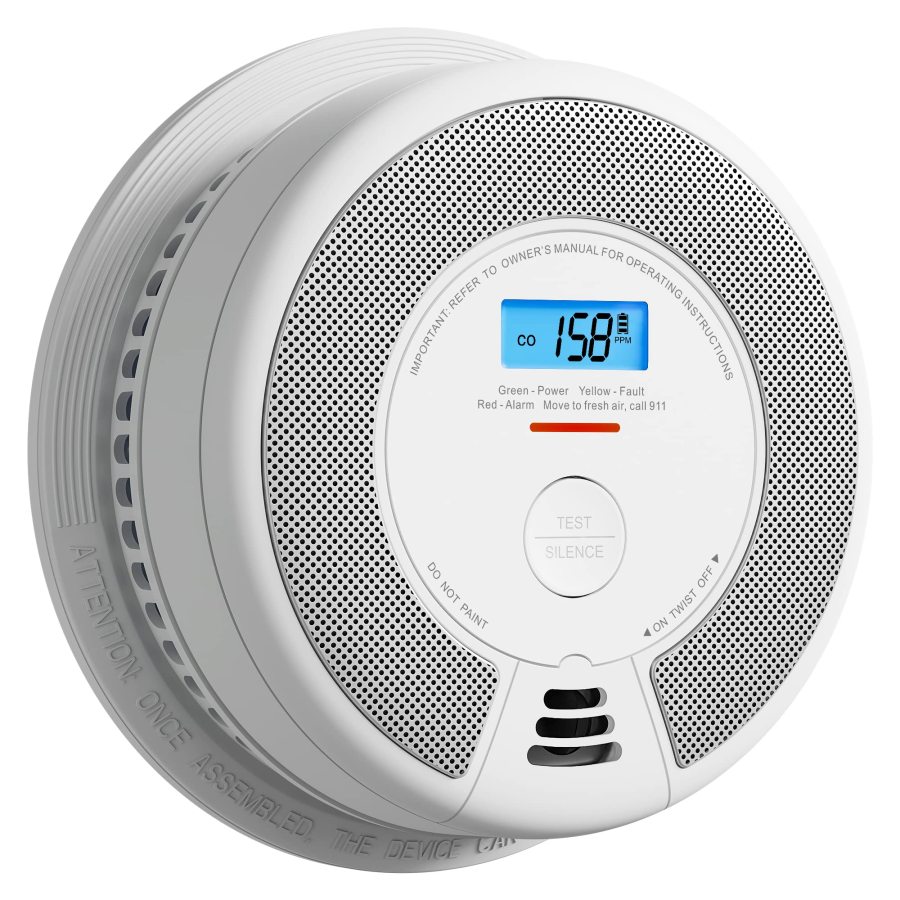
Combination smoke and carbon monoxide detectors are integrated home safety devices that detect both smoke (photoelectric or ionization) and carbon monoxide (electrochemical) gases. Their core function is real-time monitoring of potential hazards and issuing alarms, providing dual protection for life safety. The market includes basic battery-powered models, hardwired models with battery backup, and smart interconnected models supporting advanced features like Wi-Fi connectivity, app remote notifications, voice alerts, and professional monitoring. The following table illustrates the key characteristics of consumer behavior in this category.
| Dimension | Segment | Description |
|---|---|---|
| Need Driver Type | Planned Purchase/Emergency-driven Purchase | Purchases are primarily driven by planned needs such as new home construction or old device replacement, or emergency purchases triggered by discovering safety hazards or regulatory requirements. The decision-making cycle is long. |
| Purchase Frequency | Low | Product lifespan is typically 5-10 years, representing a long-term investment, resulting in extremely low purchase frequency unless the device malfunctions or regulations change. |
| Decision Complexity | Complex | Consumers need to thoroughly research sensor types, power supply methods, smart features, brand reputation, certification standards, and false alarm rates. The decision process is extremely cautious, as it concerns life safety. |
| Price Sensitivity | Medium | Safety is the primary concern. Users are willing to pay a premium for reliability and additional features, but still weigh options between different feature sets and brands. |
| Emotional Dependency | High | The product directly concerns family life and property safety. Purchase decisions are strongly emotionally driven, with the core goal of achieving peace of mind and worry-free living. |
II. User Personas & Usage Scenarios
2.1 Traditional Family Focused on Home Safety
🎯 Focuses on family health and property safety, has basic security requirements for the living environment, and prefers stable, reliable, easy-to-maintain safety devices with certifications.
| Typical Usage Scenarios | Core Pain Points | Primary Purchase Drivers |
|---|---|---|
|
|
|
2.2 Smart Home User Pursuing Convenient Living
🎯 Pursues modern, interconnected home experiences, aiming to enhance residential safety and life efficiency through smart technology, and integrate with existing smart ecosystems.
| Typical Usage Scenarios | Core Pain Points | Primary Purchase Drivers |
|---|---|---|
|
|
|
III. User Needs Hierarchy (KANO Model)
3.1 Basic Needs (Must-Haves)
- Accurate Smoke and CO Detection: The device must reliably detect smoke and carbon monoxide. This is the most fundamental life safety guarantee.
- Loud Alarm Sound: The alarm sound must be sufficiently loud (e.g., above 85 decibels) to ensure it can be heard during sleep or in noisy environments, waking users promptly.
- Stable Power Supply: Whether battery-powered or hardwired, stable power must be ensured to prevent device failure due to power loss.
- Simple Operation: Test and silence functions should be one-button operations with intuitive logic, facilitating easy daily maintenance for users.
3.2 Performance Needs (Linear Satisfiers)
- 10-Year Long-Lasting Battery: Users expect the battery to last 10 years, avoiding the hassle and cost of frequent replacements.
- Reduced False Alarms: The device should employ advanced sensing technology to effectively distinguish non-hazardous sources like cooking steam and shower vapor, lowering the false alarm rate.
- Status Indicators & LCD Display: Clearly displays device status, battery level, and CO concentration via LED lights or an LCD screen for easy real-time viewing.
- Interconnectivity: Multiple devices can wirelessly interconnect, so when one detector triggers, all detectors sound an alarm simultaneously, achieving whole-house alerting.
3.3 Excitement Needs (Delighters)
- App Remote Notifications & Control: Receives real-time alerts, remotely tests, or silences the device via a mobile app, keeping track of home safety from anywhere.
- Voice Announcement of Hazard Information: Clearly announces the hazard type (smoke/CO) and location during an alarm, helping users quickly judge and respond.
- Integration with Other Smart Home Ecosystems: Seamlessly integrates with smart platforms like Alexa, Google Home, etc., enabling smarter scene automation.
- Sleek Design: More aesthetically pleasing, compact, and discreet product design that better blends into modern home environments.
3.4 Unmet Needs & Opportunities
-
High False Alarm Rate: Numerous user feedback indicates that daily activities like cooking and showering easily trigger false alarms, severely impacting user experience and trust in the product.
User Reviews (VOC) Worked at First, Then it Kept Waking us up etc: Company bought out and build of detector was cheapened. This company used to be untouchable in the industry, but now I have to reset this detector multiple random times of the day, detector alarms for no reason, alarms every time my wife cooks and only steam in the air, alarms at 1am freaking my kids out during a dead sleep, alarms when we shower, etc. // CONSTANT FALSE ALARMS: I've installed around 30 of these detectors on homes since this new model came out and now my customers have been calling me complaining of false alarms during the night.
-
Actual Product Lifespan Shorter Than Expected: Many reviews point out product failures within months or a few years, far short of the promised 10-year lifespan.
User Reviews (VOC) Failed in one year!: Bought a four-pack of these. One failed after one year of operation. It was not in an area of high humidity, and there was no smoke. Nevertheless, the smoke alarm went off (3 long beeps, repeating). // I do not trust these C02/Smoke Detectors: I bought three of them less than a year ago and now two of them do not work. I'm not even sure I can trust the one that still seems to be working!
-
Poor Stability of Smart Features: Difficult App connections, unstable Wi-Fi leading to failed remote notifications, diminishing the value of the smart experience.
User Reviews (VOC) Started to get false alarms recently ...: ...one of the detectors just started giving false alarms after 1 year in service. So I am working through that issue with their support folks who so far have been responsive. Easy to set up App is pretty good. Integration with other types of sensors is good. Not sure how long the batteries will last - and wondering about durability/reliability.
-
Nighttime LED Indicator Light Pollution: The operational indicator lights on some devices are too bright or flash too frequently at night, severely affecting sleep quality in bedrooms.
User Reviews (VOC) Good value but has annoying flashing light: Good value, but has annoying unnecessary flashing green light every 30 seconds that I will have to cover with tape or something to block it. // Smoke and carbon detectors: Great price. Just wish they didn't flash in the dark..werid
IV. User Decision Drivers
4.1 Key Decision Factors
- Reliability & Accuracy: Whether the device can promptly and accurately alarm during real hazards while avoiding frequent false alarms is the user's most core consideration. It concerns life safety and is a deal-breaker.
- Battery Life/Power Supply Stability: Long-term, no-battery-change operation (10-year sealed battery) or hardwired with battery backup ensures continuous device operation, reducing maintenance burden and nighttime disturbances.
- Alarm Clarity & Type Identification: The alarm sound is loud enough, and ideally clearly indicates the hazard type (e.g., via voice announcement) for quick judgment and response.
- Safety Certifications & Brand Reputation: Authoritative UL/ETL certifications and well-known brands (e.g., First Alert, Kidde) significantly enhance user trust and reduce purchase hesitation.
4.2 Secondary Decision Factors
- Ease of Installation: A quick and easy installation process, especially for battery-powered models that don't require complex wiring or professional tools.
- Smart Features & App Experience: Remote notifications, app control, and smart integration features enhance convenience and modernity, but stability must be ensured.
- Product Design & Aesthetics: Attractive, sleek, discreet design that blends better into the home environment without being obtrusive, enhancing overall home aesthetics.
- Value for Money: Obtaining a product with higher value at a reasonable price, under the premise of meeting the above core needs.
V. Selling Points & Competitive Landscape
5.1 Selling Point Analysis
5.1.1 Standard Features (Points of Parity)
- 2-in-1 Protection: Simultaneously detects smoke and carbon monoxide, providing dual safety protection.
- Easy Installation: No professional tools or electrician needed; users can install it quickly themselves.
- Battery Powered/Backup: Ensures continuous operation during power outages or simplifies the installation process.
- Loud Alarm Sound: Alarm volume greater than 85dB, sufficient to attract attention.
- Test/Silence Button: Convenient for users to perform function tests and quickly silence the device during false alarms.
5.1.2 Key Differentiators
- 10-Year Long-Lasting Battery: Offers a promise of 10 years without battery replacement, reducing maintenance hassles.
- Smart Interconnectivity/Wireless Linking: Multiple devices can wirelessly connect to achieve whole-house synchronized alarms.
- App Remote Control & Notifications: Receives alarms, remotely tests, and checks device status via a mobile app.
- Voice Announcement: Clear voice prompts for hazard type and location, improving response efficiency.
- Sleek Design: More compact and aesthetically pleasing appearance, easy to blend into home decor.
- False Alarm Reduction Technology: Employs advanced sensing technology to reduce false alarms caused by cooking or steam.
5.1.3 Unique Selling Propositions (USPs)
- Professional Monitoring Service: Optional subscription to 24/7 professional monitoring service that automatically contacts fire departments when an alarm is triggered (some X-Sense products).
- Customizable Room Voice Location: Smart alarms allow custom room names, with voice announcements specifying the exact location of the hazard (X-Sense Smart Interconnected series).
- Compatibility with Old Mounting Bases: Some brands (e.g., Kidde, First Alert) maintain compatibility of new products with old mounting bases or wiring, simplifying upgrade installations.
5.2 Competitive Landscape
5.2.1 Market Maturity
The combination smoke and carbon monoxide detector market has a medium-to-high maturity level. Competition is fierce for basic functionality products, with higher price sensitivity. Leading brands seek differentiation through technological innovations like smart features, long-lasting batteries, and false alarm reduction. The market is gradually evolving from basic safety towards smart, convenient, and highly reliable directions. New entrants without significant advantages will find it difficult to stand out in this red ocean.
5.2.2 Innovation Trends
Innovation trends are mainly reflected in smart features and interconnectivity, achieved through apps and Wi-Fi for remote control, real-time notifications, and whole-house linking. User experience optimization is also a core direction, including longer battery life, lower false alarm rates, clearer voice alert prompts, and more sleek, home-environment-integrated designs. Additionally, simplifying installation (e.g., compatibility with existing mounting structures) and improving after-sales service (e.g., promises of free battery or whole-unit replacement) have become important differentiation strategies.
VI. Marketing Claims vs. Reality Check
The table below analyzes the gap between common marketing claims and actual user experiences in this category:
| Dimension | Marketing Claim | User Reality | Verdict |
|---|---|---|---|
| False Alarm Rate | Advanced sensing technology reduces cooking false alarms, enabling precise detection. | Numerous users report frequent false alarms triggered by cooking, shower steam, or even with no apparent cause, disturbing sleep and severely impacting user experience. Even professional installers report customer complaints about false alarms after bulk installations. | Sellers have severely breached trust on the core promise of 'zero false alarms,' creating false user expectations through exaggerated claims of advanced sensing technology. This transforms the product from a 'safety guardian' into a 'nuisance source,' directly damaging brand reputation. |
| Product Lifespan & Battery Life | 10-year sealed battery, 10-year product lifespan, no replacement needed. | Many users report product failures (e.g., continuous chirping, complete failure) or batteries depleting prematurely within months or a year, far short of the promised 10-year lifespan. | '10-year maintenance-free' is a core selling point, but actual performance is concerning. This is not just a quality issue; it's an overdraw on long-term user trust. Consumers pay for long-term peace of mind but receive short-term failure, constituting serious commercial fraud. |
| Smart Interconnectivity Stability | App remote control, Wi-Fi interconnectivity, real-time alerts. | Some users report complex App connections, unstable Wi-Fi causing devices to go offline, and failed remote notifications. There are even cases of difficult system installation and inability to interconnect all devices. | Smart features are meant to enhance convenience, but due to their own instability and setup complexity, they become a source of 'user friction,' turning 'smart' into a pseudo-need that fails to deliver its core value. |
| Built-in LED Indicator | LED indicator for clear status visibility. | Users report overly frequent flashing or excessively bright green/red LED indicators at night, causing significant sleep disruption in bedrooms. | Product design failed to fully consider user needs in low-light environments like bedrooms, turning a functional indicator into experience-disrupting light pollution. This is a classic case of design being detached from usage scenarios. |
Key Takeaway: This category market suffers from widespread parameter inflation and overpromised experiences, especially regarding core safety features (false alarm rate, product lifespan). The chasm between seller claims and actual user feedback is striking.
VII. Supply-Demand Misalignment Analysis
The table below highlights mismatches between seller focus and buyer priorities:
| Dimension | Seller Behavior | User Focus | Verdict |
|---|---|---|---|
| Core Function Reliability (False Alarm Rate/Actual Lifespan) | Sellers commonly emphasize 'precise detection, reduced false alarms' and '10-year lifespan/battery,' but listings lack transparent, credible data support and avoid addressing negative feedback. | Users care most about whether the device works correctly during critical moments, doesn't false alarm, and truly lasts 10 years. However, reviews are filled with complaints about 'false alarms,' 'failures,' and 'short battery life.' | Sellers have delivered an unsatisfactory performance on the core trust foundation of 'reliability,' which users care about most, leading to fundamental user doubt about product value and brand promises. |
| Ease of Use for Smart Interconnectivity | Some sellers heavily promote advanced smart features like app remote control and Wi-Fi interconnectivity as core differentiators. | While users are interested in smart features, their real pain points are 'complex setup,' 'unstable connections,' and 'poor app usability.' If the basic experience is poor, smart features become a burden. | Sellers 'self-indulgently' tout smart features but overlook the most basic pain points of smart devices: 'ease of use' and 'stability,' causing premium features to become a detractor from user experience. |
| Voice Announcement vs. Vague Alarms | Some smart interconnected products offer voice announcement features, but not all sellers highlight it as a core selling point. | Users generally highly praise the 'voice announcement of hazard type and location' feature, believing it significantly reduces confusion and panic during emergencies, buying precious time. | Sellers fail to fully leverage the highly valuable, user emergency response-enhancing differentiator of 'voice announcement,' missing an opportunity to build stronger user trust. |
| Nighttime LED Indicator Design | Most products include LED indicators showing operational status but do not mention their nighttime brightness or offer brightness adjustment. | Multiple users complain that nighttime indicators are too bright or flash too frequently, severely affecting sleep, even requiring tape to cover them. This indicates designers overlooked the special needs of bedroom scenarios. | Sellers lack insight into micro-details of user experience, causing a simple functional design to become a 'pain point' affecting user quality of life. |
Key Takeaway: Sellers generally over-supply basic features and smart capabilities while collectively under-addressing the most core aspects: reliability, lifespan, and user experience details (e.g., false alarm handling, indicator light interference). There is a severe misalignment between supply focus and demand focus.
VIII. Strategic Opportunities & Recommendations
8.1 Disruptive Low-False-Alarm/True 10-Year Battery Detector
8.1.1 Target Audience & Pain Points
⚡️ Pain Points Addressed: High false alarm rate, actual product lifespan shorter than expected.
8.1.2 Action Plan
Invest in R&D for multi-spectrum or AI-powered filtering sensing technology to achieve precise differentiation between steam, cooking fumes, and real smoke, reducing the false alarm rate to the industry's lowest level. Employ automotive-grade or medical-grade long-life lithium batteries, optimize power management ICs to ensure both battery and sensors truly achieve a 10-year lifespan. Obtain the latest authoritative third-party UL/ETL standard certifications and offer a verifiable 10-year warranty with an unconditional replacement promise.
| Tech Complexity | High |
| Cost Impact | High Impact |
| Trade-off Warning | To accommodate more advanced sensors and higher-quality batteries, product dimensions may slightly increase but must remain within acceptable limits. |
| Price Band | Only viable above $49.99 (single unit) |
8.1.3 Marketing Strategy
Lead with the disruptive promise of 'Historically Lowest False Alarm Rate, True 10-Year Protection'; publish independent lab test reports for comparison, showcasing leadership in false alarm rate and lifespan. Emphasize 'Install Once, Peace of Mind for Ten Years, Never Disturbed.'
8.2 End-to-End Smart Interconnectivity Optimization Solution
8.2.1 Target Audience & Pain Points
⚡️ Pain Points Addressed: Complex smart feature setup, unstable network connections, poor compatibility with other smart devices.
8.2.2 Action Plan
Optimize App UI/UX, simplify Wi-Fi pairing process (e.g., NFC tap-to-connect or QR code quick setup), support 2.4/5.0 GHz dual-band Wi-Fi. Be compatible with Matter/Thread protocols for seamless integration with mainstream smart home platforms (Alexa, Google Home). Provide in-app smart diagnostics and alerts, and support remote firmware updates.
| Tech Complexity | Medium |
| Cost Impact | Medium Impact |
| Trade-off Warning | No significant physical side effects; primarily involves software and communication module optimization. |
| Price Band | Only viable above $79.99 (with base station or multi-pack) |
8.2.3 Marketing Strategy
Highlight 'Simplified Pairing, Whole-Home Smart Linking in Seconds'; showcase product integration scenarios with smart lighting, door locks, etc., through videos, emphasizing 'Safety in Your Palm, Smart Living Without Worry.' Provide detailed compatibility lists and setup tutorials.
8.3 Human-Centric, Nighttime Non-Disturbing Voice Announcement Detector
8.3.1 Target Audience & Pain Points
⚡️ Pain Points Addressed: Nighttime LED indicator interference, vague alarm information.
8.3.2 Action Plan
Add LED indicator brightness adjustment or a 'Night Mode' that automatically dims or turns off lights during specific hours. Make voice announcement a standard feature, providing multiple clear hazard type and location voice prompts with multi-language support. Consider playing a gentle pre-alert tone (e.g., 'Attention, potential anomaly detected') a few seconds before the full alarm sounds.
| Tech Complexity | Low |
| Cost Impact | Low Impact |
| Trade-off Warning | No significant physical side effects; primarily involves minor hardware and software adjustments. |
| Price Band | Only viable above $29.99 (single unit) |
8.3.3 Marketing Strategy
Emphasize 'Undisturbed Sleep, Clear Alarms'; demonstrate through scenario-based videos the difference in emergency response with/without voice announcement; highlight 'The Safety Guardian That Understands You.'
8.4 Ultra-Portable Travel/RV-Specific Detector
8.4.1 Target Audience & Pain Points
⚡️ Pain Points Addressed: Market lacks professional safety products tailored for mobile scenarios like travel/RVs.
8.4.2 Action Plan
Design more compact (smaller, thinner), lightweight, shock-resistant, and dust/water-resistant products with higher IP ratings. Optimize battery life for extended mobile use, potentially adding solar charging or USB-C charging capabilities. Provide no-drill adhesive mounting solutions (e.g., 3M tape) and clearly state compliance with RV/travel safety standards.
| Tech Complexity | Medium |
| Cost Impact | Medium Impact |
| Trade-off Warning | To achieve lightness and shock resistance, some battery life or feature integration might be sacrificed, but this is acceptable. |
| Price Band | Only viable above $24.99 (single unit) |
8.4.3 Marketing Strategy
Lead with 'Safety on the Go, Explore Freely'; showcase product convenience through travel and RV scenario imagery; emphasize 'Small Size, Big Protection, Fearless of Power Outages.'