Amazon US Market Analysis: 360° Rotating Book Stands Category
📊 Executive Summary
📈 Market Trends
Ergonomics and multi-functional integration are mainstream, but user expectations for detailed experience are rising. 360° Rotating Book Stands are favored for enhancing reading comfort and multi-scenario applicability. The market commonly emphasizes adjustability, hands-free use, and versatility, but consumers are no longer satisfied with basic functions; they demand higher standards for refined experiences like operation feel, quietness, and thick book compatibility. Homogeneous competition is intensifying. Those who can solve these 'invisible' pain points will win word-of-mouth and market share.
⚡ Major Pain Points
Stiff adjustment feel, poor thick book compatibility, marketing promise vs. reality gap. Users commonly complain about stiff, laborious adjustment with accompanying noise, affecting usage fluidity. For very thick books, inadequate page holder and bottom tray design leads to unstable fixing or page damage. Additionally, some products have false 'no assembly' claims and cognitive dissonance between 'lightweight' marketing and actual weight, severely damaging brand integrity and constituting core reasons for negative reviews and returns.
💡 Selection Opportunities
Deeply focus on user experience details, solve pain points, and communicate transparently. Sourcing opportunities lie in: 1. Optimizing the adjustment mechanism for smooth, quiet operation, enhancing the core user experience and supporting product premium pricing. 2. Strengthening compatibility and protection for very thick books by widening trays and improving page holder design to meet the rigid needs of heavy book users. 3. Considering developing a premium lightweight product line using new materials to meet extreme portability demands. Simultaneously, ensure marketing content is truthful and transparent, avoiding functional exaggeration to build long-term user trust.
I. Analysis Overview
1.1 Introduction & Report Scope
This report analyzes the 'Book Stands' category (360° Rotating Book Stands) in the US Amazon market, focusing on target user personas, core needs, decision drivers, market communication, and potential opportunities.
1.2 Category Snapshot
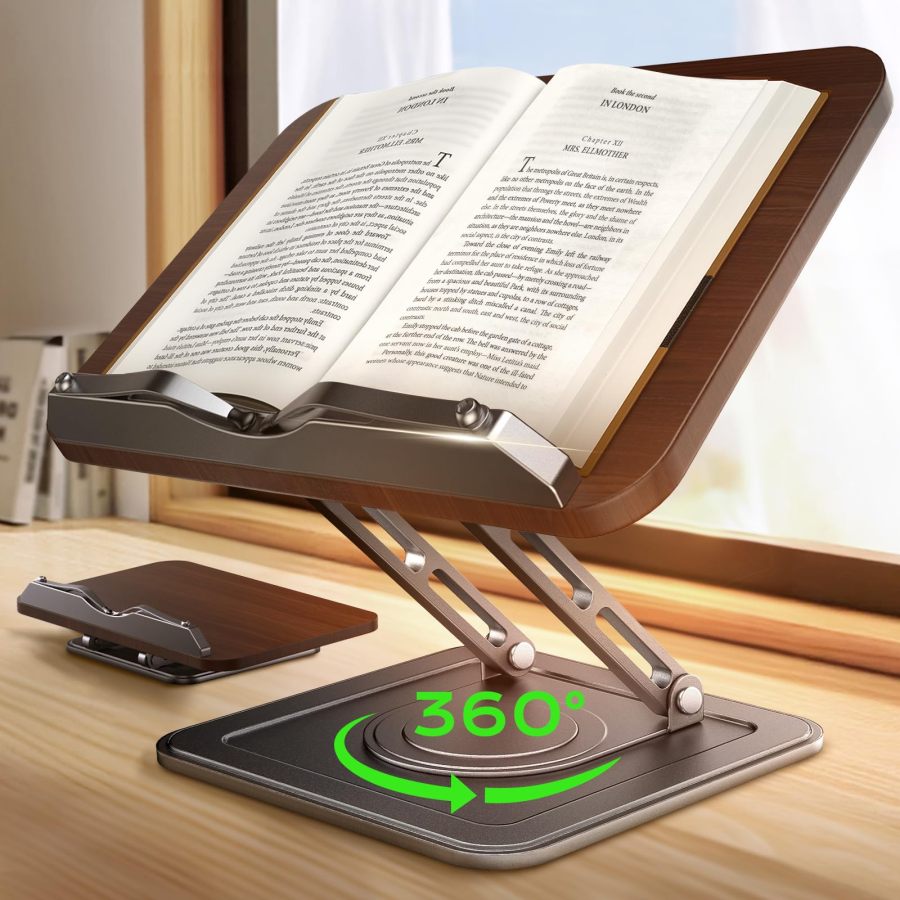
The 360° Rotating Book Stand is an innovative form of desktop book holder. Its core function is to provide a hands-free reading experience and optimize ergonomic posture through adjustable height, angle, and a 360° rotating base, thereby alleviating neck, shoulder, and back fatigue. These products are typically made from materials like wood, metal, or acrylic, aiming to enhance comfort and efficiency in reading or device use across various scenarios such as studying, working, or cooking, and often feature foldable designs for space-saving storage. The following table illustrates the key characteristics of consumer behavior in this category.
| Dimension | Segment | Description |
|---|---|---|
| Need Driver Type | Planned Purchase / Gift-giving | Purchases are typically made to improve long-term reading or working posture, enhance efficiency, or as practical gifts for friends and family. |
| Purchase Frequency | Low Frequency | As a durable good, users typically make a one-time purchase with low replacement frequency, unless the existing product is damaged or its performance no longer meets new needs. |
| Decision Complexity | Medium | Consumers compare product stability, adjustment range, material, weight capacity, and additional features but do not conduct deep research, tending to prioritize overall value for money. |
| Price Sensitivity | Medium | Price is an important consideration, but users are willing to pay a reasonable premium for better stability, adjustment experience, and material quality, rather than just seeking the lowest price. |
| Emotional Dependency | Medium | The product not only provides functional support but also delivers a healthy, comfortable reading experience, a tidy desktop environment, and pleasant user emotions. |
II. User Personas & Usage Scenarios
2.1 Deskbound Learner / Professional Worker
🎯 Engages in long hours of desk-based reading, studying, or using laptops/tablets, with high demands for healthy posture, work efficiency, and desktop organization.
| Typical Usage Scenarios | Core Pain Points | Primary Purchase Drivers |
|---|---|---|
|
|
|
2.2 Home Cook / Leisure Reading Enthusiast
🎯 Needs hands-free reference for recipes or books while cooking in the kitchen or relaxing at home, prioritizing convenience, versatility, and aesthetics.
| Typical Usage Scenarios | Core Pain Points | Primary Purchase Drivers |
|---|---|---|
|
|
|
III. User Needs Hierarchy (KANO Model)
3.1 Basic Needs (Must-Haves)
- Stable Structural Support: The stand must securely hold books or electronic devices, not easily tipping or wobbling, ensuring safety.
- Hands-Free Reading Function: Ability to firmly secure book pages or devices, freeing the user's hands, is the core reason for purchasing such a product.
- Basic Non-Slip Design: Features non-slip pads on the base to prevent sliding on the desktop and protect the surface from scratches.
- Easy-to-Clean Surface: Especially for kitchen use, requires panel materials that can be easily wiped clean of grease and water stains.
3.2 Performance Needs (Linear Satisfiers)
- Smooth 360° Rotation: Base rotation should be smooth without catching, allowing easy perspective adjustment or content sharing, enhancing interactive experience.
- Flexible Height & Angle Adjustment: Sufficiently large adjustment range to accommodate sitting, standing, or desks of varying heights, meeting personalized ergonomic needs.
- Reliable Load Capacity: Ability to stably support various heavy books, tablets, or lightweight laptops without becoming unstable at high angles.
- Effective Page Holder/Clamp: The page holder should securely grip pages of different thicknesses, be easy to operate, and not damage books.
- High-Quality Material & Craftsmanship: Materials feel good to the touch, with no burrs or odors; joints are sturdy and durable, enhancing overall perceived quality.
3.3 Excitement Needs (Delighters)
- Silent Adjustment Mechanism: No noticeable mechanical noise during height or angle adjustment, not disrupting focused reading or work environments, providing a more immersive experience.
- Built-in Multi-Functional Storage: Base integrated with pen slots, note areas, or phone slots for organizing small desktop items, improving space utilization and convenience.
- Integrated Rechargeable Reading Light: Built-in dimmable, rechargeable reading light providing auxiliary lighting in low-light environments, reducing eye strain.
- Ultra-Thin Folding & Portability: Compact and lightweight when folded, easily fitting into backpacks or drawers, suitable for frequent movement and storage.
- Removable/Hidden Page Holder: Page holder can be completely hidden or removed when not in use, making the panel more suitable as a tablet stand or drawing board.
3.4 Unmet Needs & Opportunities
-
Stiff Adjustment & Noise: Many users report needing significant force to adjust height or angle, accompanied by mechanical friction or ratchet 'clicking' sounds, impacting usage smoothness and quiet experience.
User Reviews (VOC) It takes a bit of force to change its position // it is really difficult to wedge in and turn // it's a little stiff for adjusting the position // The pivot points were somewhat stiff, but I prefer it this way as it feels more secure. The rotation point is on ratchet system and can be a little noisy // It takes a little extra effort to do so. // Can do without the Clicking // it is a bit inadequate for very thick books.
-
Insufficient Compatibility for Very Thick Books: For extremely heavy books (e.g., large textbooks, Bibles), the bottom tray width or page holder design is poor, causing unstable placement, poor grip, or damage to the book spine.
User Reviews (VOC) The only point I noted is that while the page holding wires are thin enough to be unobtrusive while reading, they are a bit inadequate for very thick books. // Too small for large college textbooks. // It doesn't hold heavy or large books. // Too narrow for extra large books!
-
Limited Height Adjustment Range: Some users report the maximum height is insufficient to reach ideal eye level, especially when standing, requiring additional propping.
User Reviews (VOC) The highest it will raise is only 4 and a half inches. // I STILL HAVE TO PROP IT UP ON SOMETHING SO IT IS AT EYE LEVEL FOR NO STRAIN ON NECK OR EYES.
-
Page Holder Design Flaws: Some product page holders are fragile and prone to breakage, or cannot be hidden when used as a tablet/drawing board stand, obstructing the screen or operation area, affecting versatility.
User Reviews (VOC) the plastic arms breaking // the little arms didn't feel like they could handle the movement // the page holder pins seem a little fragile // I wish the page holders were removable so that the unit was more versatile // I wish it could be fixed on my unit.
-
Assembly Experience Mismatches Marketing: Despite marketing 'No Assembly Required,' some users report needing self-assembly with mismatched tools, leading to poor initial experience.
User Reviews (VOC) Needs some assembly! Wrong sized Allen wrench! // I was a little disappointed to find the bookstand came not hooked together. There were no instructions on how to do it
IV. User Decision Drivers
4.1 Key Decision Factors
- Structural Stability & Load Capacity: Core factor determining if the product can safely and reliably support books or devices; users are most concerned about tipping or wobbling.
- Ergonomic Adjustment Range: Ability to provide sufficient height and angle adjustment for comfortable, eye-level reading, directly related to alleviating neck/shoulder strain and fatigue.
- Page Holding Effectiveness & Compatibility: Whether the page holder can securely grip various books (including thick ones) without damaging pages is key to measuring the reading experience.
- Material Quality & Durability: The perceived quality of the product's appearance and its reliability for long-term use affect user perception of value and purchase confidence.
4.2 Secondary Decision Factors
- 360° Rotation Smoothness: Whether the base rotation is smooth and quiet, facilitating sharing and task switching, enhancing convenience.
- Folding Portability & Storage Convenience: Whether it is easy to fold and store when not in use, saving desktop space, and convenient for moving and carrying.
- Multi-Device Compatibility: Ability to simultaneously support books, tablets, laptops, etc., meeting different scenario needs, improving value for money.
- Additional Features (e.g., storage, reading light): Extra integrated features like pen slots or reading lights can provide additional convenience, serving as value-adds.
- Aesthetic Design & Style: Whether the product coordinates with home or office environments, satisfying user aesthetic preferences, and enhancing desktop aesthetics.
V. Selling Points & Competitive Landscape
5.1 Selling Point Analysis
5.1.1 Standard Features (Points of Parity)
- 360° Rotating Base & Multi-Angle Adjustment: Almost all products emphasize this feature for providing flexible viewing angles and ergonomic comfort, a core category selling point.
- Ergonomic Design, Alleviates Neck/Shoulder Fatigue: By elevating reading materials, aims to improve user posture and reduce physical discomfort, a key communication point for attracting target users.
- Multi-Device Compatibility: Commonly promoted for use with books, textbooks, recipes, sheet music, tablets, laptops, etc., emphasizing versatility and expanding usage scenarios.
- Stable Structure & High-Quality Materials: Most products promote the use of wood, metal, or aluminum alloy materials, emphasizing sturdiness, durability, and stable support.
- Foldable Design, Saves Space: Emphasis on foldable storage for easy stowing, suitable for users with limited desktop space, addressing a key pain point.
5.1.2 Key Differentiators
- Built-in Storage Compartment: Some products integrate a storage box in the base for pens, notes, phones, etc., improving desktop organization (e.g., Viozon).
- Integrated Rechargeable Reading Light: Few products include a detachable or integrated reading light, providing night-time auxiliary lighting, enhancing the night reading experience (e.g., FLINKYE).
- Specific Material Emphasis (e.g., Transparent Acrylic/Titanium Steel): Some brands use unique materials like transparent acrylic or titanium steel to emphasize modernity, lightness, or extreme sturdiness, seeking visual or functional differentiation.
- Page Holder Detail Optimization: Some products promote page holder designs that don't damage books, have strong elasticity, or can be hidden, addressing user concerns about book protection.
- No Assembly Required / Ready-to-Use: A few products market 'No Assembly Needed' as a selling point, emphasizing plug-and-play convenience and saving user time.
5.1.3 Unique Selling Propositions (USPs)
- Detachable Splash Guard (Kitchen-Specific): LOXP product uniquely features a detachable splash guard, providing extra protection specifically for kitchen cooking scenarios, a highly segmented functional innovation.
- Precise Height/Angle Adjustment Locking Positions: LOXP mentions 15 locking positions, implying finer angle adjustments and more secure positioning, a potentially valuable feature though not widely adopted.
5.2 Competitive Landscape
5.2.1 Market Maturity
The 360° Rotating Book Stand category is in a rapid development stage with intense competition. Products have become highly homogeneous in core functions (rotation, adjustment, hands-free). Sellers universally emphasize ergonomics and versatility, but genuine innovation in user experience details (e.g., adjustment smoothness, thick book compatibility) is still uncommon. The current market is saturated with similar products, urgently needing differentiation through deep optimization of user pain points and providing unique value.
5.2.2 Innovation Trends
Current innovation trends focus on refining the user experience, such as integrating desktop storage, providing auxiliary lighting (reading lights), or adding protective features for specific scenarios (e.g., kitchen splash protection). Future innovation may concentrate on smarter, lighter, quieter adjustment mechanisms, better solutions for very thick book compatibility, and seeking higher added value and differentiation in materials and design.
VI. Marketing Claims vs. Reality Check
The table below analyzes the gap between common marketing claims and actual user experiences in this category:
| Dimension | Marketing Claim | User Reality | Verdict |
|---|---|---|---|
| Adjustment Feel & Quietness | Claims of 'smooth adjustment,' 'quiet operation,' 'easy angle and height adjustment.' | Users commonly report stiff, laborious adjustment processes or noticeable 'clicking' mechanical noises, contradicting 'smooth' and 'quiet' marketing claims. | Sellers fail to effectively balance the structural stability required by the mechanical design with user expectations for operational fluidity and quietness. They market the physical damping as 'secure' rather than improving the structural design to achieve both, resulting in poor user experience. |
| Thick/Heavy Book Compatibility | Claims of 'supports all types of books,' 'heavy textbooks,' 'large tablets,' with maximum load capacity up to 5kg. | Multiple users report page holders provide insufficient support for very thick books, easily damaging pages or failing to secure them fully; bottom trays are too narrow for extra-large books, causing instability or tipping. | While marketing broad compatibility, sellers have not optimized key structural dimensions (e.g., page holder arm length, bottom tray width) for thick books, causing core functionality to fail for heavy book users. |
| Assembly Convenience | Claims of 'No Assembly Required,' 'Ready-to-Use out of the box.' | Users explicitly state the product requires self-assembly, and the included wrench size does not match, severely contradicting the 'no assembly' promise. | This is typical false marketing, directly damaging consumer trust in the brand and causing unnecessary assembly hassle, a serious issue regarding product integrity. |
| Product Weight & Portability | Claims of 'lightweight design,' 'foldable and portable,' convenient for carrying around. | Most products weigh 3-5 lbs (approx. 1.4-2.3 kg). Users report them as 'heavy' or 'not very portable,' affecting actual willingness to move them as a 'portable' device. | In pursuit of the stability and premium feel from metal/wood structures, sellers inevitably increased product weight but still over-promoted 'lightness,' failing to objectively balance the physical compromise between function and portability. |
Key Takeaway: Marketing commonly exaggerates functionality and glosses over details of the actual experience, especially regarding adjustment feel, thick book compatibility, and convenience. A significant gap exists between claims and actual user feedback.
VII. Supply-Demand Misalignment Analysis
The table below highlights mismatches between seller focus and buyer priorities:
| Dimension | Seller Behavior | User Focus | Verdict |
|---|---|---|---|
| Adjustment Experience (Feel & Noise) | Commonly promote 360° rotation and multi-angle adjustment but rarely mention or effectively address stiffness and noise during the adjustment process. | Users frequently complain about difficult adjustment or noticeable 'clicking' sounds, disrupting immersion during reading or work, perceiving the operation as not smooth enough. | Sellers emphasize 'having the feature' but overlook the user's core experience of 'how well the feature works,' failing to effectively address pain points at the operational level. |
| Support & Protection for Very Thick Books | Commonly promote compatibility with various book sizes but do not specifically optimize bottom tray width, page holder strength, or protective features for heavy, very thick books in product design. | Users with heavy textbooks or Bibles report page holders easily damage pages, provide poor grip, or bottom trays are too narrow causing book instability, limiting the product's practical applicability. | In pursuit of 'broad' compatibility claims, sellers fail to deeply understand and solve the rigid pain points of specific high-value user groups (e.g., students, professionals) regarding very thick books, creating a supply gap in the market. |
| Portability vs. Weight Balance | Most sellers, when promoting foldability and portability, fail to objectively or clearly state the product's actual weight, over-glamorizing 'portability.' | Some users feel the product is 'heavy' upon receipt, affecting their original intention to move or carry it out, creating a mismatch with expectations set by marketing. | Sellers misrepresent the physical attribute of product weight, overemphasizing the portability advantage of 'foldability' without fully considering the decisive impact of 'weight' on the portable experience, leading to user cognitive dissonance. |
Key Takeaway: Sellers generally over-emphasize product versatility and ergonomic concepts but neglect users' deeper needs for operational details, load-bearing/fixing effectiveness in specific scenarios, and the balance between portability and weight.
VIII. Strategic Opportunities & Recommendations
8.1 Optimize Adjustment Mechanism for Smooth, Quiet Operation
8.1.1 Target Audience & Pain Points
⚡️ Pain Points Addressed: Stiff adjustment feel and noise, impacting usage fluidity and immersion.
8.1.2 Action Plan
Redesign adjustment joints using high-precision hydraulic dampers or multi-stage gear structures to ensure smooth, snag-free adjustment; integrate sound-absorbing buffer materials to minimize rotation and adjustment noise.
| Tech Complexity | Medium |
| Cost Impact | Medium Impact |
| Trade-off Warning | Achieving both extreme stability and absolute quietness is costly, but experience can be significantly improved within a reasonable range by optimizing bearings, damping materials, and mechanical structure. |
| Price Band | Only viable above $29.99 |
8.1.3 Marketing Strategy
Emphasize 'Silent & Smooth, One-Finger Control.' Use comparison videos to showcase adjustment fluidity and quietness, highlighting 'Library-Quiet Experience,' precisely targeting quality-conscious users.
8.2 Enhance Compatibility & Protection for Very Thick Books
8.2.1 Target Audience & Pain Points
⚡️ Pain Points Addressed: Poor page holder compatibility for thick books, narrow bottom tray, easily damaging pages or causing instability.
8.2.2 Action Plan
Increase bottom tray width to at least 2 inches for more stable support; design longer, extendable page holder arms with soft silicone protection capable of securely gripping books 8-10cm thick without damaging spines. Consider removable or rotatable/hidden designs to accommodate tablet use.
| Tech Complexity | Low to Medium |
| Cost Impact | Low Impact |
| Trade-off Warning | Widening the tray and lengthening page holder arms may slightly increase product volume/weight but can be controlled within an acceptable range through material optimization. |
| Price Band | No Price Band Jump |
8.2.3 Marketing Strategy
Highlight 'Guardian of Tomes, Steady as a Rock, Book-Safe.' Showcase scenarios of easily supporting Bibles, large textbooks, etc., reinforcing professionalism and reliability. Emphasize 'Innovative Page Holder Design, Perfectly Protects Every Page.'
8.3 Develop Premium Lightweight/Multi-Functional Product Line
8.3.1 Target Audience & Pain Points
⚡️ Pain Points Addressed: Excessive product weight impacting portability; relatively single functionality, lacking premium added value.
8.3.2 Action Plan
Use aerospace-grade carbon fiber or high-strength ultra-thin aluminum alloy to control product weight under 1kg while ensuring structural stability and load capacity. Integrate a detachable, steplessly dimmable reading light with color temperature adjustment, and consider built-in wireless charging or a USB hub.
| Tech Complexity | High |
| Cost Impact | High Impact |
| Trade-off Warning | Using aerospace-grade lightweight materials (e.g., carbon fiber, thinner high-strength aluminum alloy) will significantly increase costs. The optimal balance between lightweighting and stability must be found, potentially with slight compromise on ultimate load capacity. |
| Price Band | Only viable above $49.99 |
8.3.3 Marketing Strategy
Position as 'Mobile Reading Studio, Luxury on the Go.' Emphasize premium materials, extreme lightweighting, and smart integrated features. Use scenario-based imagery (e.g., cafes, airplanes, meeting rooms) to highlight its premium and portable nature.
8.4 Optimize Product Information for Transparency
8.4.1 Target Audience & Pain Points
⚡️ Pain Points Addressed: Assembly instructions mismatch marketing; discrepancies between actual product functions and claims.
8.4.2 Action Plan
Update product manuals to match actual assembly requirements. Clearly state in the listing: actual product weight, thick book compatibility range (e.g., max thickness limit), adjustment damping characteristics (e.g., 'secure adjustment, may require slight force'), and provide detailed usage videos.
| Tech Complexity | Low |
| Cost Impact | Low Impact |
| Trade-off Warning | None. |
| Price Band | No Price Band Jump |
8.4.3 Marketing Strategy
Emphasize 'Integrity First, What You See Is What You Get.' Build brand trust through transparent, pragmatic communication to reduce negative reviews and returns caused by information asymmetry.