Amazon US Market Analysis: Heated Towel Racks Category
📊 Executive Summary
📈 Market Trends
Portability and integration are mainstream, demand for comfort experience is upgrading. The heated towel rack market is mature, with products generally emphasizing fast heating, wall-mounting, and timer functions. Consumer demand for seamless connectivity, multi-functionality, and smart features continues to grow, driving product evolution towards greater integration and intelligence, while demands for aesthetic appeal and installation convenience are increasingly rising.
⚡ Major Pain Points
Exaggerated heating performance and concerns over installation stability. Users commonly report uneven heating, actual temperature not meeting expectations, leading to poor core 'warm towel' experience. Additionally, complex installation processes and unstable brackets are frequent complaints. High failure rates within a short period severely damage brand trust, and poor power cord design affects overall bathroom aesthetics.
💡 Selection Opportunities
Deepen core experience, solidify trust and aesthetics. Market opportunities lie in solving consumer pain points regarding actual heating uniformity and providing a 'foolproof' installation experience with an ultra-stable structure. Simultaneously, rebuild trust by enhancing long-term operational reliability and extending warranty periods. In product design, optimize power cord aesthetics for extreme concealed wiring, winning with details to meet users' dual demands for functionality and aesthetics.
I. Analysis Overview
1.1 Introduction & Report Scope
This report analyzes the 'Towel Warmers' category (electrically heated towel racks) within the Amazon US market, focusing on target user personas, core needs, decision drivers, market communication, and potential opportunities.
1.2 Category Snapshot
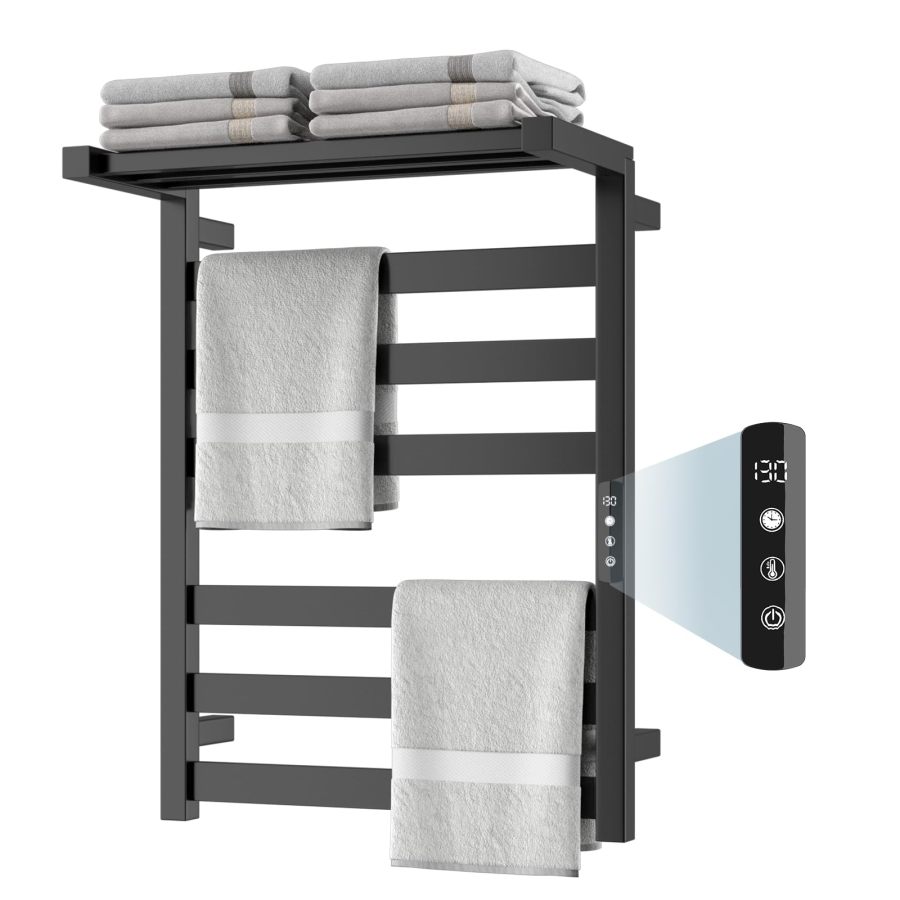
A heated towel rack is an appliance specifically designed for bathrooms, using internal heating elements to provide uniform warmth to fabrics like towels and bathrobes while accelerating the drying process. The core function of this product is to enhance user comfort after bathing and effectively solve the problems of towels being prone to mold and odor in humid environments. Most heated towel racks on the market feature wall-mounted designs, with some offering floor-standing models or rotating functions, integrated with features like timers, temperature controls, and even smart controls. The following table illustrates the key characteristics of consumer behavior in this category.
| Dimension | Segment | Description |
|---|---|---|
| Need Driver Type | Planned Purchase / Impulsive Purchase | Purchases typically stem from planned needs like bathroom renovation upgrades or solving humidity issues, but can also be impulsive driven by the pursuit of a higher quality of life, social media influence, and the desire for immediate comfort. |
| Purchase Frequency | Low Frequency | Heated towel racks are durable home appliances with very low purchase frequency, primarily occurring during initial purchase, replacement of old items, or bathroom renovation periods; they are not fast-moving consumer goods. |
| Decision Complexity | Moderately Complex | Consumers comprehensively consider heating efficiency, installation method, material, smart features, and appearance design, investing time in information gathering and comparative evaluation. |
| Price Sensitivity | Medium | Users have some price sensitivity but are willing to pay a reasonable premium for better heating performance, product reliability, safety, and additional features. |
| Emotional Dependency | Medium to High | The product not only provides the functional benefit of towel drying but also delivers a sense of comfort, security, cleanliness, and the pleasure of an enhanced quality of life after bathing. |
II. User Personas & Usage Scenarios
2.1 Modern Households Focused on Quality of Life
🎯 Pursue a high-quality lifestyle, aiming to enhance home comfort and hygiene through smart home solutions, with particular attention to improving the bathroom environment.
| Typical Usage Scenarios | Core Pain Points | Primary Purchase Drivers |
|---|---|---|
|
|
|
2.2 Homeowners Focused on Design Aesthetics
🎯 Have high requirements for home design, preferring modern, minimalist styles, and hope that bathroom accessories can perfectly integrate with the overall decor while maintaining practicality.
| Typical Usage Scenarios | Core Pain Points | Primary Purchase Drivers |
|---|---|---|
|
|
|
III. User Needs Hierarchy (KANO Model)
3.1 Basic Needs (Must-Haves)
- Safe and stable operation: The product must have an IPX4 or higher waterproof rating, overheat protection, ensuring electrical safety in humid bathroom environments to prevent electric shock or fire hazards.
- Basic heating function: Ability to generate stable heat, making towels perceivably warm and effectively removing moisture to prevent mold growth.
- Secure and stable installation: Wall-mounted products must be installed securely, safely bearing the weight of multiple wet towels, avoiding the risk of falling.
- Rust and corrosion-resistant material: Made of stainless steel or other rust-proof treated materials, ensuring the product does not rust or deform during long-term use in humid environments.
3.2 Performance Needs (Linear Satisfiers)
- Fast and uniform heating: Reaching ideal temperature within a relatively short time (5-15 minutes), with heat evenly distributed to every corner of the towel, not just localized warmth.
- Smart timer and temperature control: Having multiple temperature settings and flexible auto-off timer functions, allowing users to preset according to needs for energy savings and personalized experience.
- Simplified installation process: Providing clear and easy-to-understand installation instructions, precise drilling templates, or video tutorials to reduce user installation difficulty and time cost.
- Adaptation to various installation needs: Supporting both plug-in and hardwired (concealed) power supply options to accommodate different bathroom electrical layouts and decoration styles.
- Reasonable capacity and space utilization: Under a wall-mounted design, effectively holding and heating multiple standard towels or bathrobes while minimizing bathroom space usage as much as possible.
3.3 Excitement Needs (Delighters)
- Multi-functional integrated design: The towel rack top features a storage shelf or removable hooks, providing additional storage space, achieving multi-purpose use, and enhancing bathroom practicality.
- Independently rotating heating bars: Multiple heating bars can rotate 180° independently, facilitating the drying of different-sized fabrics, optimizing drying efficiency, and improving accessibility.
- Smart home integration: Supporting remote control via mobile app or smart voice assistants (e.g., Alexa, Google Home), enabling scheduling, scene automation, and other advanced features for an enhanced smart experience.
- Extreme concealed wiring: After hardwired installation, the power cord is completely embedded in the wall with no external cables exposed, presenting a high-end, seamless visual effect and elevating bathroom aesthetics.
3.4 Unmet Needs & Opportunities
-
Heating performance falls short of expectations: Users commonly report poor heating performance, with towels only partially warm, failing to meet the core need for 'warm towels,' significantly below market expectations and mainstream competitors, impacting user satisfaction.
User Reviews (VOC) It never gets hot enough to warm the towel beyond where it lands on the bar. Does not radiate much heat. Even if I weave one towel through all the bars and keep it on there for two hours, the towel is just a little warm in spots. // Didn't heat enough.
-
Unintuitive interface or missing functionality: Existing products have complex operations, lack one-touch memory functions, and have unresponsive touch panels, leading to poor daily user experience and failing expectations for convenient smart features.
User Reviews (VOC) There's not a one touch memory? Every time you use it, you have to reset the temperature and the time. Teenagers won't even bother. // Buttons are a bit finicky. Like... I wish there were acutal physical buttons instead of just a touch panel. I feel like it takes me a couple of tries to get it going, every time.
-
High installation difficulty or poor stability: Despite claims of easy installation, the actual process is difficult, with bracket design flaws causing the product to wobble or even fall off the wall, severely impacting user safety and product usability.
User Reviews (VOC) This does not securely mount to the wall. Even after finding a stud to install it to. The mount has slack inside of it so the rack is wobbly. It has ripped out of the wall once already and will a second time. // The installation directions did not match the product received. There were mounting brackets referenced that weren't included.
-
Short product lifespan or high failure rate: Multiple users report the product stopping working or displaying error codes within a short period, exposing potential early-stage quality control risks, severely damaging consumer trust for new brands.
User Reviews (VOC) Had it sitting around for a year in its package before we finally had it installed in our new home. We enjoyed it for alllllllllmmmost 3 months before it stopped working and I got an "E1" error message and it no longer works. // Works for about 3 hours and stopped working.
-
Poor power cord design: For plug-in products, the power cord's color, length, and storage issues affect the overall bathroom aesthetics, forcing users to find their own solutions to hide the cables.
User Reviews (VOC) The cord is black and visually it looks obtrusive on a light colored background. // The cord should at least be longer!
IV. User Decision Drivers
4.1 Key Decision Factors
- Actual heating performance: Whether the towel rack can truly make towels uniformly warm and dry, and reach the expected temperature, is the core consideration for users, directly impacting the post-bathing experience.
- Safety assurance: In humid bathroom environments, the product's waterproof, overheat protection, and anti-leakage design, and whether it has authoritative safety certifications like UL, are users' bottom-line concerns.
- Installation simplicity and long-term stability: Users expect the installation process to be straightforward, and the product to remain securely and stably fixed to the wall long-term without wobbling or falling, ensuring safety.
- Product quality and lifespan: Consumers worry about product failure within a short period, especially for hardwired installations where replacement costs and effort are significant, affecting long-term value.
4.2 Secondary Decision Factors
- Timer and temperature control: Flexible timer and multi-level temperature adjustment features enhance convenience, personalization, and energy efficiency.
- Appearance design and material: Whether the product's color, finish, number of bars, and overall shape match the bathroom decor; stainless steel is favored for its durability and ease of cleaning.
- Space efficiency and capacity: Whether the wall-mounted design effectively saves floor space while providing sufficient heating bars and spacing to accommodate multiple towels.
- Power cord management: For plug-in products, the power cord's length, color, and ease of concealment, and the overall aesthetics of hardwired installation, are key to bathroom visual tidiness.
- Energy consumption performance: Whether the product's power and heating efficiency balance warming effectiveness with electricity costs is an economic factor users consider.
V. Selling Points & Competitive Landscape
5.1 Selling Point Analysis
5.1.1 Standard Features (Points of Parity)
- Stainless steel material: Commonly advertised as using 304 or 201 stainless steel, emphasizing rust-proof, corrosion-resistant, durable, and easy-to-clean properties suitable for humid bathroom environments.
- Wall-mounted design: Highlighting the product's advantage of saving bathroom floor space, suitable for bathrooms of various sizes, improving space utilization.
- Built-in timer: Offering multiple timer options like 2/4/8 hours, allowing users to preset heating duration for energy savings and automation.
- Fast heating: Emphasizing the product reaches preset or optimal working temperature in a short time (typically 5-15 minutes), providing instant warmth.
- Safety certifications and protection: Advertising compliance with IPX4 waterproof rating and overheat protection features, ensuring safe use in bathroom environments.
- Dual installation methods: Most products offer both plug-in and hardwired installation choices to suit different user needs and bathroom setups.
5.1.2 Key Differentiators
- Adjustable temperature control: Providing multiple temperature settings (e.g., 100°F-160°F), allowing users to adjust warmth level based on personal preference for a personalized experience.
- Different bar counts and sizes: Offering choices of 5-bar, 8-bar, 10-bar, or even more, with varying widths and heights to meet different household towel quantities and bathroom space needs.
- Various surface finishes/colors: Such as brushed nickel, matte black, polished chrome, gold, etc., to match different bathroom decor styles, enhancing aesthetics and compatibility.
- Carbon fiber heating technology: Some products advertise using carbon fiber heating to emphasize more uniform, efficient, and safe heating as a technological selling point.
- Easy installation (with template/video): Promising to simplify user self-installation difficulty by providing installation templates, detailed instructions, or online video tutorials, lowering the installation barrier.
5.1.3 Unique Selling Propositions (USPs)
- 180° rotating bar design: A few products offer independently rotating heating bars, facilitating the drying and retrieval of multiple towels or small garments, enhancing flexibility and practicality.
- Integrated shelf: Individual products feature an additional storage shelf above the towel rack for placing folded towels or other bathroom items, adding storage functionality.
- Smart APP/voice control: Very few high-end products support remote control via mobile app or smart speakers (e.g., Alexa, Google Home), enhancing the smart experience.
- Memory function: Some products have a memory function that automatically restores the last settings after a power outage, improving convenience and reducing repetitive setup.
5.2 Competitive Landscape
5.2.1 Market Maturity
The overall market maturity for heated towel racks is high, with core heating, drying, and wall-mounting functions being standard. Most sellers segment the market by offering different bar counts, sizes, surface finishes, and basic timer/temperature controls. This indicates a high degree of product homogenization, with strong consumer choice at the basic level. Competition mainly manifests in price, service, and marketing details. Some brands are beginning to build differentiation through more premium materials, finer temperature control, and installation convenience.
5.2.2 Innovation Trends
Current innovation trends primarily revolve around 'user experience enhancement.' On one hand, it's about smart integration, such as adding APP remote control, voice assistant integration, etc., integrating the towel rack into the smart home ecosystem. On the other hand, it's about functional integration and design flexibility, such as rotating bar designs for multi-angle hanging and drying, and top shelves for additional storage. Additionally, optimizing installation convenience and aesthetics is increasingly valued, like providing more precise installation templates and hardwiring for complete cable concealment, meeting consumer demands for modern bathroom minimalist aesthetics.
VI. Marketing Claims vs. Reality Check
The table below analyzes the gap between common marketing claims and actual user experiences in this category:
| Dimension | Marketing Claim | User Reality | Verdict |
|---|---|---|---|
| Heating effectiveness and uniformity | Heats up in 8 minutes, reaches 130°F, provides uniform warmth all over the towel, offering instant comfort. | Users commonly report poor heating, with towels only partially warm, failing to meet the core need for 'warm towels,' even after prolonged placement or weaving through bars. | Typical substitution of ideal lab data or specific area effects for the overall experience. The contradiction between over-marketing and actual energy limitations leads to a severe mismatch between user perception and the core functional experience. |
| Installation ease and structural stability | Comes with installation template, 5-minute quick install, simple and fast, secure and wobble-free. | Users report difficult installation, mismatched screws or missing parts, bracket design flaws causing the product to wobble or even fall off the wall, posing safety risks. | Sellers underestimate the actual difficulty of user DIY installation, oversimplifying the process and structural design, leading to severely frustrated user experience and even safety risks due to instability. |
| Product reliability and lifespan | Premium stainless steel, long-lasting durability, 2-year warranty, provides a worry-free user experience. | Multiple users report the product stopping work within just a few months, displaying E1 error codes or tripping circuit breakers, severely contradicting the advertised 'long-lasting durability.' | Marketing claims fail to cover the actual product quality control shortcomings. A huge gap exists between promised durability and actual failure rates, severely damaging brand trust. |
Key Takeaway: The market exhibits a prevalent tendency to exaggerate heating efficiency and installation ease. False promises lead to user experience gaps, with core selling points often mismatched with actual perceptions.
VII. Supply-Demand Misalignment Analysis
The table below highlights mismatches between seller focus and buyer priorities:
| Dimension | Seller Behavior | User Focus | Verdict |
|---|---|---|---|
| Actual heating effectiveness and uniformity | Commonly emphasize 'fast heating' (e.g., 8 minutes to 130°F), 'larger heating area,' or 'more heating bars' to dry multiple towels. | Users commonly report towels not being hot enough, only warming where they touch the bar, or requiring long preheating, with incomplete drying failing to achieve overall warmth and fluffiness. | Sellers fail to understand that users' true perception of 'warm towels' is 'uniform warmth and dryness overall,' not merely the stacking of temperature parameters or the number of heating bars. |
| Usability of smart controls and memory function | Emphasize 'smart timer and temperature control,' 'LED display,' some products advertise APP/voice control, highlighting feature richness. | Users complain about having to reset temperature and time every use, unresponsive or mis-triggered touch buttons, lack of one-touch memory function, cumbersome operation, not meeting 'smart and convenient' expectations. | Sellers add features in terms of 'function presence' but subtract in terms of 'function usability,' neglecting users' desire for 'seamless, intuitive' operation, rendering features gimmicky. |
| Installation stability and component consistency | Commonly advertise 'easy to install,' 'includes all parts,' 'provides template or video.' | Users report unstable installation, product wobbling, instructions not matching the product, even missing parts (like wall anchors, screws), leading to significant installation difficulties severely impacting the first-time experience. | Sellers lack quality control and provide inaccurate information at the installation stage, which is most likely to leave a first impression, causing the user experience to collapse from the start and increasing return risk. |
Key Takeaway: Sellers generally over-supply on visible parameters like heating power and material grade, while neglecting to address users' deeper pain points regarding actual heating uniformity, operational convenience, and long-term reliability, leading to a supply-demand mismatch.
VIII. Strategic Opportunities & Recommendations
8.1 Heated Towel Rack with Superior Uniform Heating and Visual Feedback
8.1.1 Target Audience & Pain Points
⚡️ Pain Points Addressed: Heating performance falls short of expectations, towels dry unevenly and aren't warm enough.
8.1.2 Action Plan
Focus R&D on new heating technologies, such as using more densely distributed heating rods, optimizing internal thermal conduction design, or incorporating smart sensors to ensure towels are heated comprehensively, quickly, and uniformly. Integrate real-time heat distribution indicators (e.g., thermal imaging graphics) or more intuitive temperature displays to let users clearly perceive heating effectiveness. Simultaneously, strengthen the product's efficacy in 'drying' rather than just 'heating,' addressing dampness and odor issues.
| Tech Complexity | Medium |
| Cost Impact | Medium Impact |
| Trade-off Warning | No significant physical side effects, primarily involves optimizing heating elements and thermal conduction efficiency. |
| Price Band | Only viable above $199.99 |
8.1.3 Marketing Strategy
Emphasize 'All-dimensional uniform heating, every inch feels sun-baked'; showcase third-party test reports on heating uniformity, comparing heat distribution maps with traditional racks; provide product demonstration videos drying thick bath towels, highlighting rapid moisture removal, creating a warm, comforting brand image.
8.2 Foolproof Installation Experience and Ultra-Stable Structure
8.2.1 Target Audience & Pain Points
⚡️ Pain Points Addressed: High installation difficulty or poor stability, users find the installation process troublesome.
8.2.2 Action Plan
Redesign the mounting bracket, adopting modular snap-fit or one-click locking structures to significantly simplify installation steps. Provide oversized installation templates with self-adhesive positioning aids, paired with high-quality wall anchors or screws to ensure the rack is firmly installed without wobbling. For hardwired versions, design a larger concealed junction box for easier electrician operation, reducing installation errors.
| Tech Complexity | Low |
| Cost Impact | Low Impact |
| Trade-off Warning | No physical side effects, primarily achieved by optimizing structural design and components for a more convenient experience. |
| Price Band | Only viable above $129.99 |
8.2.3 Marketing Strategy
Highlight 'Zero-skill quick install, military-grade stability, wobble-free promise'; release challenge videos of users completing installation within 5 minutes; provide close-up images of the mounting bracket highlighting its reinforced design; promise free professional-grade wall anchor replacements, emphasizing the product's peace of mind and hassle-free installation.
8.3 Enhancing Long-Term Operational Reliability and After-Sales Support
8.3.1 Target Audience & Pain Points
⚡️ Pain Points Addressed: Short product lifespan or high failure rate, users are concerned about long-term use.
8.3.2 Action Plan
In product design and manufacturing, select more heat-resistant, stable internal heating elements and circuit boards, conduct stricter aging tests and quality control. Extend the warranty period to 3+ years and provide responsive after-sales service, including professional troubleshooting guidance, convenient part replacement, or whole-unit exchange processes.
| Tech Complexity | Medium |
| Cost Impact | Medium Impact |
| Trade-off Warning | No significant physical side effects, primarily achieved by selecting higher-quality components and strengthening quality control. |
| Price Band | Only viable above $179.99 |
8.3.3 Marketing Strategy
Emphasize '3-year warranty for peace of mind, upgraded core components, rigorous durability testing'; showcase product certifications like UL/ETL and third-party durability test reports; highlight the brand's long-term warranty policy and localized customer support to build user trust.
8.4 Optimizing Power Cord Design for Bathroom Aesthetic Upgrade
8.4.1 Target Audience & Pain Points
⚡️ Pain Points Addressed: Poor power cord design affects overall bathroom aesthetics.
8.4.2 Action Plan
For plug-in products, offer replaceable power cord options in different lengths and colors (e.g., white, gray) to match different wall backgrounds. Or design clever built-in cable channels to partially conceal the cord. For hardwired products, ensure the junction box can be fully recessed into the wall and provide a seamless cover plate to completely hide all cables, emphasizing its 'wireless' aesthetic effect.
| Tech Complexity | Low |
| Cost Impact | Low Impact |
| Trade-off Warning | No obvious physical side effects, mainly involves aesthetic design and accessory selection. |
| Price Band | Only viable above $139.99 |
8.4.3 Marketing Strategy
Highlight 'Concealed wiring design, goodbye messy cables, the epitome of bathroom aesthetics'; showcase before/after comparison images of hardwired installations, emphasizing completely hidden cables; provide scene images of multi-color cords paired with different wall backgrounds, emphasizing the product's harmonious integration with the home environment.