Amazon US Market Analysis: Chicken Shredder Category
📊 Executive Summary
📈 Market Trends
Efficiency and convenience are the core drivers; the market suffers from severe homogeneity. Demand in the chicken shredder category centers on saving time and effort. However, current product functions are highly convergent, with competition mainly revolving around marketing points rather than substantive innovation. Consumer expectations for a seamless experience are rising, urging future products to focus on details.
⚡ Major Pain Points
Slip resistance failure, cleaning difficulty, and material fragility are high-frequency user pain points. Despite marketing claims of 'powerful non-slip' and 'easy to clean,' users commonly complain about product sliding, internal meat residue being hard to clean, and plastic parts breaking easily. These core defects severely impact user experience and product reputation, being primary causes for returns and negative reviews.
💡 Selection Opportunities
Deeply address core pain points and solidify user experience as the key to breaking out. Market opportunities lie in resolving consumers' trust crisis regarding product stability, cleaning convenience, and long-term durability. Developing a 'rock-solid' non-slip base, optimizing a 'rinse-clean' modular cleaning design, and enhancing product durability through hybrid materials will be effective strategies for achieving premium pricing and building brand advantage.
I. Analysis Overview
1.1 Introduction & Report Scope
This report analyzes the 'Meat & Poultry Tools' category (chicken shredder) in the US Amazon market, focusing on target user personas, core needs, decision drivers, market communication, and potential opportunities.
1.2 Category Snapshot
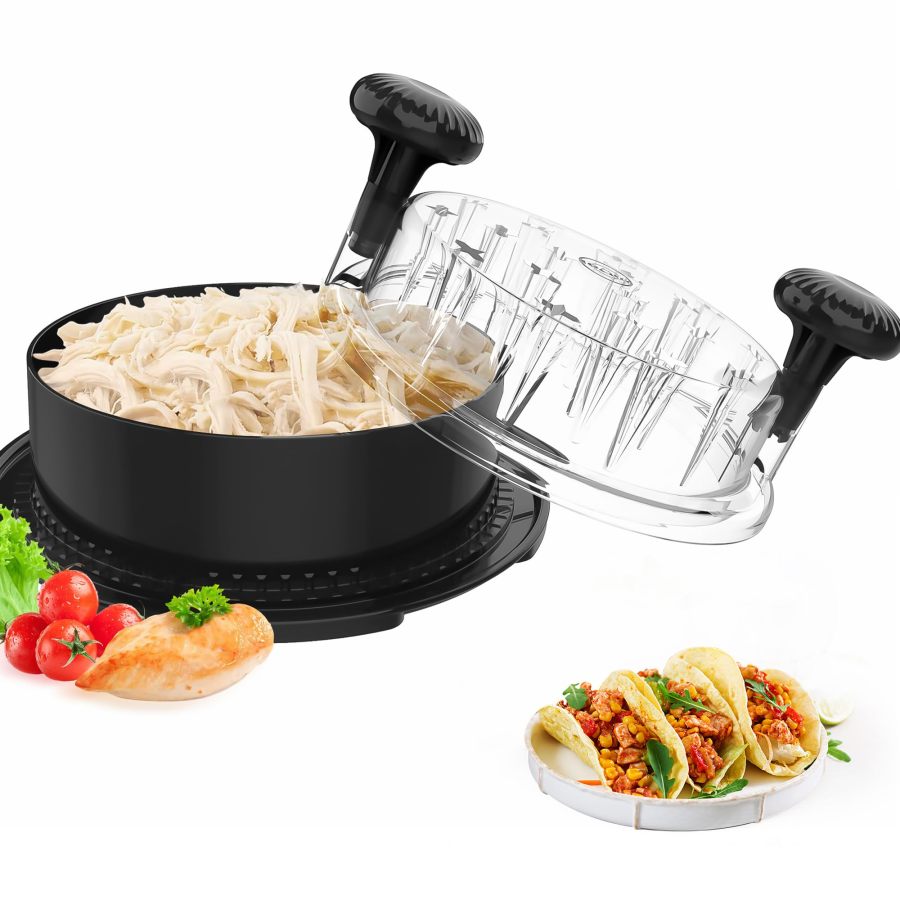
A chicken shredder (also known as a meat shredder or meat grinder) is a manually operated kitchen tool. It primarily uses a rotating mechanism to quickly and evenly shred cooked chicken, pork, beef, etc., into strips or chunks. It aims to simplify the time-consuming and inconvenient traditional method of shredding meat by hand, improving meal prep efficiency. It is widely used for making salads, burrito fillings, BBQ sandwiches, and pet food. The following table illustrates the key characteristics of consumer behavior in this category.
| Dimension | Segment | Description |
|---|---|---|
| Need Driver Type | Planned Purchase / Emergency-driven Purchase | Primarily triggered by daily meal prep needs (e.g., fitness meal preparation) and the pain point of shredding meat during cooking (e.g., hot, laborious). There are also temporary or impromptu usage needs. |
| Purchase Frequency | Low Frequency | Typically a one-time purchase of a durable kitchen tool. The repurchase cycle is long unless there is damage or an upgrade need. |
| Decision Complexity | Medium | Consumers compare product efficiency, ease of use, cleanliness, slip resistance, and price. However, they do not conduct in-depth research, instead evaluating based on intuitive information. |
| Price Sensitivity | Medium to High | Price is an important consideration, but users are willing to pay a reasonable premium for significant upgrades in convenience, efficiency, and durability. |
| Emotional Dependency | Medium | Primarily based on functionality and practicality. However, the sense of security and pleasure derived from 'saving time and effort,' 'freeing up hands,' and 'saying goodbye to hot, greasy hands' carries certain emotional value. |
II. User Personas & Usage Scenarios
2.1 Efficiency-First Home Cook
🎯 Busy individuals who value efficiency and convenience, aiming to prepare healthy and delicious meals for their family in a short time.
| Typical Usage Scenarios | Core Pain Points | Primary Purchase Drivers |
|---|---|---|
|
|
|
2.2 Health Management / Fitness Enthusiast
🎯 Active individuals focused on dietary health and protein intake, needing to conveniently and quickly prepare fitness meals.
| Typical Usage Scenarios | Core Pain Points | Primary Purchase Drivers |
|---|---|---|
|
|
|
2.3 Pet Lover
🎯 Owners who prepare homemade cooked meat food for pets (mainly cats and dogs), concerned about ingredient safety and pet palatability.
| Typical Usage Scenarios | Core Pain Points | Primary Purchase Drivers |
|---|---|---|
|
|
|
III. User Needs Hierarchy (KANO Model)
3.1 Basic Needs (Must-Haves)
- Effectively Shred Meat: The ability to easily shred cooked chicken, pork, etc., into strips or chunks is the product's core function.
- Simple, Intuitive Operation: No complex learning required; users can start using it quickly right out of the box, reducing the operational barrier.
- Food-Grade Safe Materials: Parts in contact with food must be BPA-free, heat-resistant, ensuring food safety and user health.
3.2 Performance Needs (Linear Satisfiers)
- Efficient & Fast Shredding: Significantly increases shredding speed and efficiency compared to traditional hand-shredding or using forks, saving meal prep time.
- Effortless & Easy Operation: Easy to operate even for users with insufficient hand strength or joint discomfort, reducing physical burden.
- Stable, Non-Slip Base: Firmly stays in place on the countertop during use, preventing sliding and wobbling, enhancing operational safety.
- Easy Disassembly & Cleaning: Structural design facilitates thorough cleaning, prevents meat residue buildup and bacterial growth, and is dishwasher-safe.
- Shredding Uniformity: Produces meat strips or chunks with a uniform texture, improving dish texture and aesthetics.
3.3 Excitement Needs (Delighters)
- See-Through Lid: A transparent lid allows users to observe the shredding progress in real-time, precisely adjusting to personal preference for personalized shredding.
- Additional Cleaning Accessories: Includes a dedicated cleaning brush or meat tongs, further simplifying the cleaning and meat removal process, enhancing convenience.
- Innovative Internal Structure: Optimized teeth position and quantity to maximize shredding efficiency, reduce meat jamming, and enhance core function experience.
- Multi-Functional Usage Range: Beyond common meats, can also handle some vegetables or serve as a pet food grinder, increasing product value.
3.4 Unmet Needs & Opportunities
-
Lasting & Reliable Slip Resistance: Some product suction cups easily detach or slip resistance is unstable, causing the product to slide during use, affecting operational smoothness and safety.
User Reviews (VOC) Customers report issues with the slicer's suction cups detaching. // Customers report significant issues with the chicken shredder's slide resistance, noting that it keeps sliding on the counter, doesn't grip properly, and has no place to hold it steady. // Good product but slides around during use // Not super
-
Residue-Free Cleaning Without Dead Spots: Meat residue easily gets stuck in internal teeth gaps and edges. Even with a cleaning brush or being dishwasher-safe, achieving a completely clean wash remains challenging, posing hygiene risks.
User Reviews (VOC) cleaning is a bit tricky, but the spongey side of the dish sponge, some Power Dish Dawn soap and a bottle brush made it a simple clean up. // it's somewhat difficult to clean. Despite the inclusion of a bristle brush, I found that getting all the meat remnants out of the nooks and crannies can be a bit of a task. // Great shredder, some chicken gets stuck on the outer edges and you have to stop and use a fork to push it toward the center to be shredded. It's a little tough to clean, a dish scrubber brush makes it a little easier.
-
Enhanced Product Durability: Plastic internal shredding teeth or the main body risk breaking under long-term, high-intensity use, affecting product lifespan and user confidence.
User Reviews (VOC) The red handles snap in, and I'm a bit concerned that they may eventually snap. // the base cracks after first use // customers report issues with the prongs breaking off and the clear top part cracking after just three uses. // on the sides, was a black powder. It was from shredding and the plastic was being powdered and getting inside where I was shredding.
-
More Optimized Capacity Design: Existing product capacities may not be perfect for small-batch or very large-batch users, presenting processing efficiency bottlenecks.
User Reviews (VOC) This is a decent (small) shredder // A little small // Doesn't hold a lot at a time // I really wish it was just a little larger to accommodate a whole chicken.
IV. User Decision Drivers
4.1 Key Decision Factors
- Shredding Effectiveness: Whether the product can evenly and thoroughly shred meat to the desired texture without large chunks remaining is the most core functional consideration for users.
- Ease of Operation: Whether the usage process is effortless and easy, especially for users with insufficient hand strength or joint discomfort, directly impacts the user experience.
- Cleaning Difficulty: Whether the product is easy to clean thoroughly, avoiding meat residue and bacterial growth, is a key factor for long-term usage willingness.
- Product Stability: Whether it can be firmly fixed on the countertop during use without sliding or wobbling directly affects operational efficiency, safety, and user confidence.
4.2 Secondary Decision Factors
- Shredding Speed: The faster, the better, while ensuring effectiveness, to save cooking and prep time and improve efficiency.
- Material Durability: Whether the product is sturdy, whether internal shredding teeth are prone to breaking; users expect it to be durable and offer value for money.
- Capacity Size: Whether it can process enough meat at once, reducing the need for batch operations, especially suitable for users who batch-prep meals.
- Additional Accessories: Whether cleaning brushes, meat tongs, and other accessories are practical, further enhancing the overall user experience and product value.
- Price: When functions are similar and performance meets requirements, price is an important horizontal comparison factor influencing the final purchase decision.
V. Selling Points & Competitive Landscape
5.1 Selling Point Analysis
5.1.1 Standard Features (Points of Parity)
- Efficient & Fast Shredding: Most products emphasize shredding meat in seconds, significantly saving meal prep time, bidding farewell to traditional laborious methods.
- Easy to Clean: Commonly highlight that the product is dishwasher-safe and claim easy cleaning, reducing daily maintenance burden.
- Food-Grade Safe Materials: Almost all products advertise using BPA-free, food-grade materials to ensure user health and food safety.
- Non-Slip Base: Most products claim the base has a non-slip design (e.g., suction cups or non-slip strips) to provide stable operation and prevent sliding.
- Ergonomic Handle: Emphasize handle design conforms to ergonomics, ensuring comfortable grip and effortless operation, reducing hand fatigue.
- Multi-Functionality: Commonly advertised as suitable for various cooked meats like chicken, pork, beef, turkey, and even some vegetables.
5.1.2 Key Differentiators
- Transparent See-Through Lid: Some products feature a transparent lid design, allowing users to observe shredding progress in real-time and precisely control coarseness.
- Upgraded Internal Structure: Some products claim optimized internal tooth position, quantity, or a cross-design to improve shredding efficiency and uniformity.
- Includes Cleaning Brush/Meat Tongs: Some sellers provide additional accessories like a dedicated cleaning brush or meat tongs, aiming to enhance user experience and convenience.
- Large Capacity Design: A few products emphasize larger processing capacity, claiming to handle more meat chunks at once, suitable for batch meal prep.
- Enhanced Slip Resistance: Some products specifically highlight upgraded non-slip designs, such as increasing suction cup count or using stronger non-slip strips, to improve stability.
5.1.3 Unique Selling Propositions (USPs)
- Removable Inner Tray: Very few products feature a removable inner tray designed for easy shredded meat removal and further simplifying the cleaning process.
- Stainless Steel Teeth/Blades: A few higher-priced products use stainless steel spikes or blades as the shredding core to enhance sharpness and long-term durability, differentiating from the common all-plastic teeth.
- Unique Aesthetic Design: Some products attempt to differentiate visually from peers through unique appearance designs like diamond facets, flower shapes, etc., enhancing product aesthetics.
5.2 Competitive Landscape
5.2.1 Market Maturity
The chicken shredder category market is relatively mature, with product forms and core functions highly convergent. Most products emphasize similar selling points in their marketing, leading to intense homogeneous competition. Brands primarily seek differentiation through detailed design (e.g., anti-slip solutions, internal structure), additional accessories, and price, but there is a lack of truly breakthrough innovation.
5.2.2 Innovation Trends
Current innovation trends mainly revolve around improving user experience details, aiming to address existing product pain points. For example, optimizing internal tooth shape, quantity, and arrangement to improve shredding efficiency and uniformity; introducing removable inner trays, more reliable non-slip base designs (e.g., large-area silicone or vacuum suction cups), and including professional cleaning tools to address users' high-frequency pain points regarding cleaning and operational stability. Additionally, some products are beginning to integrate aesthetic design into kitchen tools to enhance product appeal, moving beyond purely functional orientation.
VI. Marketing Claims vs. Reality Check
The table below analyzes the gap between common marketing claims and actual user experiences in this category:
| Dimension | Marketing Claim | User Reality | Verdict |
|---|---|---|---|
| Non-Slip Stability | Powerful non-slip base, firmly stays in place, ensuring safe and stable operation. | Users commonly report product suction cups easily detach, and the product slides on the countertop during use (mentioned in multiple reviews), especially on wet surfaces or during forceful operation, requiring manual stabilization. | Sellers overemphasize anti-slip performance under ideal conditions, overlooking the complexity of real kitchen environments (e.g., countertop moisture, operation force), leading to a severe disconnect between the core stability promise and actual user experience. |
| Product Durability & Material Reliability | High-quality food-grade materials, sturdy and durable, long-lasting, promising extended service life. | User feedback includes broken plastic parts, cracked bases, and even plastic wear producing powder (e.g., ASIN B0CP6XX8KC), questioning the quality ceiling of plastic materials under long-term, high-intensity use. | The definition of 'high-quality' and 'sturdy and durable' in marketing deviates from the physical limits of plastic materials under mechanical torsion and friction, underestimating users' high expectations for product lifespan and food safety. |
| Cleaning Convenience & No Residue | Dishwasher-safe, easy to clean, includes cleaning brush, rinses clean with no residue. | Users report meat residue easily gets stuck in internal tooth gaps and edges. Even with a brush or dishwasher, achieving 'no residue' thorough cleaning is difficult, with hygiene dead spots. | Sellers equate 'dishwasher-safe' with 'easy to clean without dead spots,' failing to fundamentally solve the inherent cleaning challenges of the product structure. This leads to users still experiencing significant pain points during cleaning, contradicting the promise of 'easy cleaning.' |
Key Takeaway: The market exhibits widespread parameter inflation and scenario-based experience exaggeration tendencies, especially regarding suction/stability and material durability. There is a significant gap between marketing promises and actual user experience.
VII. Supply-Demand Misalignment Analysis
The table below highlights mismatches between seller focus and buyer priorities:
| Dimension | Seller Behavior | User Focus | Verdict |
|---|---|---|---|
| Genuine & Lasting Non-Slip Stability | Commonly advertise 'powerful non-slip base' or 'suction cups,' but downplay actual usage issues like cup detachment and product sliding, lacking robust solutions. | Users strongly complain about 'suction cups falling off,' 'slides on the counter, needs hand holding to use,' 'product doesn't grip firmly.' These are high-frequency complaints affecting safety and operational smoothness. | Sellers failed to elevate slip resistance from a marketing point to a core reliability guarantee, causing the most basic stability need to frequently fail during use, severely impacting user experience. |
| Residue-Free Thorough Cleaning of Internal Structure | Market 'easy to clean,' 'dishwasher-safe,' and include cleaning brushes, but the complex internal tooth structure design fails to fundamentally solve meat residue and cleaning dead spot issues. | Users report 'meat gets stuck in crevices hard to wash,' 'need to pick at it with a brush for a long time,' 'dishwasher doesn't get it clean.' Cleaning becomes a psychological burden for frequent use. | Sellers' understanding of 'easy to clean' remains superficial, failing to fundamentally solve users' most painful cleaning dead spot issues. They invested in accessories like cleaning brushes but didn't address the problem at the design source. |
| Long-Term Material Durability & Reliability | While pursuing cost and lightweight, sellers failed to effectively enhance the structural strength and wear resistance of plastic materials at critical stress points. This leads to mismatched product lifespan expectations versus actual experience, damaging brand trust. |
Key Takeaway: Sellers lack supply on core pain points (e.g., actual non-slip stability, dead-spot-free cleaning) while over-investing in secondary or insufficiently validated needs (e.g., 'diamond design,' ineffective freebies), leading to supply-demand misalignment.
VIII. Strategic Opportunities & Recommendations
8.1 "Rock-Solid" High-Strength Non-Slip Shredder
8.1.1 Target Audience & Pain Points
⚡️ Pain Points Addressed: Lasting & reliable slip resistance.
8.1.2 Action Plan
Use large-area, reusable vacuum suction cups or multi-point high-friction silicone pads. Conduct rigorous wet-surface testing to ensure firm fixation on various kitchen surfaces (including wet ones). Consider suction cup design with a quick-release mechanism for easy removal.
| Tech Complexity | Medium |
| Cost Impact | Medium Impact |
| Trade-off Warning | Stronger suction may make removal slightly more effortful or leave minor marks on some countertop materials (e.g., painted surfaces), requiring clear instructions. |
| Price Band | Only viable above $14.99 |
8.1.3 Marketing Strategy
Highlight 'Say goodbye to sliding, stable as a rock-safer kitchen operation, double the efficiency!'; showcase comparison videos demonstrating operational stability on wet surfaces; emphasize 'Safe for elderly and children to use, worry-free cooking.'
8.2 "Rinse-Clean" Modular Easy-Clean Shredder
8.2.1 Target Audience & Pain Points
⚡️ Pain Points Addressed: Residue-free cleaning without dead spots.
8.2.2 Action Plan
Design a fully disassemblable modular structure into 3-4 large pieces. Optimize tooth shape and internal cavity to ensure no hidden crevices or cleaning dead spots, allowing water to directly rinse all surfaces. Consider non-stick treatment for areas prone to meat sticking.
| Tech Complexity | Medium |
| Cost Impact | Medium Impact |
| Trade-off Warning | Modular design may increase part count. Assembly must ensure secure and easy-to-align clips, avoiding user-unfriendly design. Adding non-stick coating may slightly increase cost. |
| Price Band | Only viable above $12.99 |
8.2.3 Marketing Strategy
Emphasize 'Fully disassemblable, no dead spots for bacteria-say goodbye to cleaning hassles, enjoy your food!'; publish intuitive 'one-minute cleaning' comparison videos; highlight 'Rinses residue-free, goodbye to grease and bacterial growth.'
8.3 "Ironclad" High-Performance Hybrid-Material Shredder
8.3.1 Target Audience & Pain Points
⚡️ Pain Points Addressed: Enhanced product durability, material reliability.
8.3.2 Action Plan
Embed food-grade stainless steel in shredding teeth and core transmission components (e.g., handle connection points), while retaining food-grade PC/PP material for the outer shell to maintain lightness and cost advantage. Offer a longer warranty (e.g., 5 years).
| Tech Complexity | High |
| Cost Impact | High Impact |
| Trade-off Warning | Adding metal parts may slightly increase product weight or affect microwave suitability (if metal is embedded). Need to balance strength and lightness. |
| Price Band | Only viable above $29.99 |
8.3.3 Marketing Strategy
Highlight 'Core stainless steel, lasting sharpness, goodbye to plastic breakage-one investment, kitchen peace of mind!'; showcase videos of the product passing extreme stress tests (e.g., high-torque twisting); emphasize 'Professional-grade quality, empowering culinary masters.'
8.4 "Size-Flexible" Multi-Size Professional Shredder Series
8.4.1 Target Audience & Pain Points
⚡️ Pain Points Addressed: More optimized capacity design, meeting processing needs of different user groups.
8.4.2 Action Plan
Develop two or three size specifications: Mini (diameter ~15cm, suitable for single-serving prep, pet food, camping portability) and Pro Max (diameter 25cm+, suitable for batch prep, large gatherings).
| Tech Complexity | Medium |
| Cost Impact | Medium Impact |
| Trade-off Warning | Launching more sizes increases inventory management and mold costs but has no direct physical side effects. May require packaging optimization for different sizes. |
| Price Band | Only viable above $9.99 (small size), above $19.99 (large size) |
8.4.3 Marketing Strategy
Emphasize 'There's a size for you-from mini portions to family size, precisely meeting your every shredding need!'; showcase situational images demonstrating the convenience of different-sized products in various households and scenarios; highlight 'Personalized choice, no more compromise.'