Amazon US Market Analysis: Mini Fitness Trampolines Category
📊 Executive Summary
📈 Market Trends
Portability and integration are mainstream, but user demands for actual experience are higher. The mini fitness trampoline market pursues compactness, multi-functionality, and home suitability. Bungee cord systems are becoming mainstream due to quietness and joint-friendliness. User focus on product ease of use and health benefits continues to rise.
⚡ Major Pain Points
Durability and convenience are two major shortcomings. Most products fail to deliver on promises regarding bounce system lifespan, folding convenience, and assembly difficulty, leading to frequent negative reviews about cords breaking, folding difficulties, laborious assembly, and wobbly handlebars, severely damaging user trust and purchase experience.
💡 Selection Opportunities
Deepen focus on user experience details, build quality trust. Address storage pain points with 'one-second fold, no disassembly,' establish brand trust with 'core bounce system lifetime durability,' optimize the 'zero-frustration assembly' process, and provide 'ultra-stable adjustable handlebars.' Surpass competitors on key experience points to achieve premium pricing.
I. Analysis Overview
1.1 Introduction & Report Scope
This report analyzes the 'Fitness Trampolines' category (Mini Fitness Trampolines) within the Amazon US market, focusing on target user personas, core needs, decision drivers, market communication, and potential opportunities.
1.2 Category Snapshot
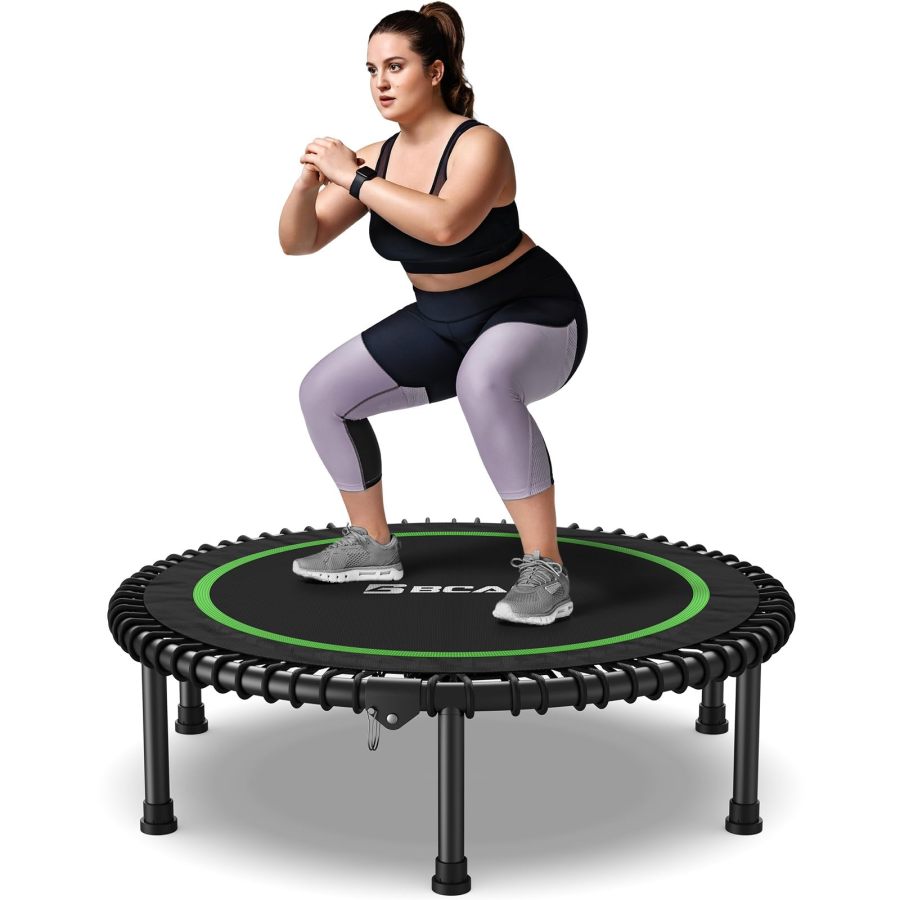
Mini Fitness Trampolines (also known as Rebounders) are compact indoor fitness equipment, typically measuring between 36-51 inches in diameter. They are primarily used for low-impact cardio, lymphatic drainage, core muscle, and lower body strength training. Products commonly feature foldable designs, handlebars, or silent bungee cord systems, aiming to meet multiple user needs such as home fitness, space optimization, and joint protection. The following table illustrates the key characteristics of consumer behavior in this category.
| Dimension | Segment | Description |
|---|---|---|
| Need Driver Type | Health-Driven / Fun-Seeking / Problem-Solving Oriented | User purchase motivations are diverse, encompassing long-term health improvement plans, immediate impulses for exercise fun, or purchases aimed at solving specific exercise pain points (e.g., joint discomfort). |
| Purchase Frequency | Low-Frequency / Durable Goods | This product type falls under durable consumer goods with an extremely low purchase frequency. Users expect a single purchase to deliver long-term, stable value. |
| Decision Complexity | Medium / Moderately Complex | Users compare multiple factors when selecting, including size, bounce system (spring/bungee), weight capacity, presence of handlebars, and storage convenience, requiring some research and evaluation. |
| Price Sensitivity | Medium / Rational Value-Seeking | Price is an important consideration but not the sole deciding factor. Users are inclined to pay a reasonable premium for higher quality, better experience, and more comprehensive after-sales service within their budget. |
| Emotional Dependency | Medium-High | Beyond functionality, the emotional value derived from the product-such as 'fun exercise,' 'pain-free movement,' 'home convenience,' and 'health improvement'-significantly influences purchase decisions. |
II. User Personas & Usage Scenarios
2.1 Urban Home Fitness Enthusiast
🎯 Young to middle-aged individuals living in apartments or small homes, eager to exercise efficiently at home while avoiding strain on their joints.
| Typical Usage Scenarios | Core Pain Points | Primary Purchase Drivers |
|---|---|---|
|
|
|
2.2 Active Family with Kids
🎯 Families with preschool or school-age children seeking a healthy indoor outlet for their kids' energy, while also accommodating adult fitness and family interaction.
| Typical Usage Scenarios | Core Pain Points | Primary Purchase Drivers |
|---|---|---|
|
|
|
2.3 Active Senior Lifestylers
🎯 Middle-aged and older adults focused on joint health, balance, and mild exercise, seeking safe, gentle, and health-beneficial home activities.
| Typical Usage Scenarios | Core Pain Points | Primary Purchase Drivers |
|---|---|---|
|
|
|
III. User Needs Hierarchy (KANO Model)
3.1 Basic Needs (Must-Haves)
- Stable, Non-Wobbly Product Structure: The trampoline must remain stable at any bouncing intensity, with no sense of tipping or swaying, providing basic safety assurance.
- Reliable Core Bounce System: Springs or bungee cords must provide sufficient support, not breaking or deforming easily, ensuring effective bounce.
- Weight Capacity Meets Expectations: Ability to safely support the user's weight, with product-labeled capacity being truthful and reliable.
- Durable Material for Key Components: Materials for the jumping mat, frame, and bounce system should resist wear, aging, and withstand frequent daily use.
3.2 Performance Needs (Linear Satisfiers)
- Comfortable, Shock-Absorbing Bounce Experience: Smooth, gentle bouncing sensation that effectively reduces impact on knees, ankles, and back, enhancing exercise comfort.
- Quiet Design, No Noise Disturbance: Minimal noise during bouncing, not disturbing family members or neighbors, suitable for apartment environments.
- Effortless, Time-Saving Assembly: Even if minimal assembly is required, it should be clear and intuitive, ideally with some pre-assembly or efficient tools provided.
- Adjustable/Stable Handlebars: Providing safety support, height-adjustable to suit different heights, with handlebars themselves being non-wobbly.
- Non-Slip Feet Protecting Floors: Bottom feet with effective non-slip properties, preventing movement, and protecting wood floors or tiles from scratches.
3.3 Excitement Needs (Delighters)
- Truly No-Assembly/Highly Pre-Assembled: Requiring almost no assembly out of the box, or only a few simple steps, greatly simplifying the user setup process.
- Innovative Folding/Storage Design: Ability to fold and unfold easily, quickly, and effortlessly, occupying minimal space when stored.
- Smart Interactive Fitness Features: Equipped with counters, connectivity to fitness apps, offering personalized workouts, data tracking, or gamified experiences.
- Extended Warranty & Hassle-Free Service: Providing warranty periods far exceeding industry standards and responsive, efficient customer service.
3.4 Unmet Needs & Opportunities
-
Truly Easy Fold/Unfold Mechanism: Many products claim easy folding, but users report operational difficulties, requiring significant force, two people, or disassembly of key parts. Lacks a convenient, efficient folding solution.
User Reviews (VOC) Customers have mixed experiences with the trampoline's foldability - while some find it easy to fold and store, while others report it being extremely difficult to unfold. // This is not an item that you can store after each use, that being said it is doable. I gave it 3 stars because of the forestated issues I had. I myself would not purchase another one.
-
Bounce System Long-Term Durability: Many reviews mention bungee cords/springs breaking or wearing out within months to a year, especially for frequent users, leading to premature product failure.
User Reviews (VOC) After my 11 years old son, 31 KG boy used for 3 months, 3 springs were already broken, and it is unusable. It's waste money. // My trampoline straps broke in 2 different areas. Would like to get a replacement. I weigh 112 lbs.. This should have never ripped out of the area where i jog.
-
Assembly Process Optimization: Even with some pre-assembly, installing bungee cords and aligning screws remain common pain points. Users frequently encounter misaligned screw holes, difficulty stretching cords, leading to frustration.
User Reviews (VOC) This was painful to set up as many of the holes required to bolt the frame together were not drilled / punched. My drill wouldn't go through the steel so I had to use an angle grinder to cut the pieces. // The installation was pure hell. But don't sweat it just yet as I figure it can be less painful, especially for a solo woman.
-
More Stable Handlebars Structure: Some products with handlebars receive feedback about handlebars being wobbly or unstable, affecting user confidence and safety.
User Reviews (VOC) The handle is flimsy in my opinion. // The handle bar is slightly wobbly, but we have tightened the screws, so I still feel comfortable using it for balance reasons.
IV. User Decision Drivers
4.1 Key Decision Factors
- Product Safety & Stability: Whether the trampoline frame is sturdy and if it will tip or slide during jumping is the user's primary concern, directly impacting safety and confidence.
- Bounce Comfort & Joint Protection: The shock absorption of the bounce system, the gentleness of the bounce, and the degree of protection for knees and back are key considerations for users.
- Product Durability & Lifespan: Users expect the trampoline to last. The wear and fatigue resistance of bungee cords/springs and the jumping mat are crucial to avoid frequent replacement.
- Assembly Convenience: Whether installation is simple and quick, and the level of tools and physical effort required, significantly impacts initial user satisfaction.
4.2 Secondary Decision Factors
- Noise Level: The amount of noise generated during bouncing, especially for users living in apartments or with families, is an important plus.
- Storage Convenience: Whether the folding feature is truly practical and allows for easy storage in small spaces affects product appeal for space-constrained users.
- Size & Footprint: The trampoline's diameter, suitability for home space, and whether the jumping area is spacious enough affect exercise freedom.
- Price & Brand Reputation: After basic needs are met, users compare prices among similar products and tend to choose brands with good reputations and after-sales service.
- Additional Features (e.g., Handlebars): The presence of handlebars, along with their adjustability and stability, is an important auxiliary function for beginners, seniors, or users performing specific training.
V. Selling Points & Competitive Landscape
5.1 Selling Point Analysis
5.1.1 Standard Features (Points of Parity)
- High Weight Capacity: Commonly claims of 330-550 lbs capacity to attract a broader, larger user base, emphasizing sturdiness.
- Foldable Design: Almost all products highlight their folding feature, promoting easy storage and portability, catering to home users with limited space.
- Low-Impact/Joint Protection: Emphasizes that the bounce system effectively reduces joint impact, suitable for all ages and fitness levels, especially those with joint issues.
- Efficient Fitness/Full-Body Workout: Promotes calorie-burning effects and multi-muscle engagement, e.g., '10 minutes on a trampoline equals 30 minutes of jogging.'
- Easy Assembly: Promises a simple installation process, often mentioning pre-assembled parts and provided tools to lower user barriers.
5.1.2 Key Differentiators
- Silent Bungee Cord System: Compared to traditional spring trampolines, emphasizes using bungee cords for a quieter, smoother jumping experience, avoiding noise.
- Adjustable Handlebars: Providing multi-height adjustable handlebars to enhance balance and safety, especially suitable for beginners and seniors.
- Level of Pre-Assembly: Emphasizes that some components (e.g., bungee cords) are pre-installed, further reducing user setup time.
- Special Size/Shape: Such as octagonal trampolines or sizes offering larger jumping areas, aiming to provide better stability and bounce experience.
- Extended Warranty/Customer Service: Some brands build trust by offering longer warranty periods or emphasizing their responsive customer service.
5.1.3 Unique Selling Propositions (USPs)
- Customizable Bounce Tension: A few high-end products offer multi-level bounce tension adjustment, allowing users to tailor the trampoline's elasticity to training intensity and preference.
- Matching Smart App/Workouts: Provides exclusive fitness apps or video workouts for personalized guidance, data tracking, and interactive experiences.
- Patented Arch-Leg Design: Specific brands use patented arch-shaped legs, claiming superior stability and anti-tip protection.
5.2 Competitive Landscape
5.2.1 Market Maturity
The mini fitness trampoline market is currently in a mature competitive stage. Product homogenization is high, with core features (e.g., size, weight capacity, shock absorption method) becoming standard. Brand competition mainly focuses on price, claimed ease of use (assembly, storage), durability promises, and after-sales service. The overall market lacks disruptive innovation, with more emphasis on micro-innovations and detail optimization.
5.2.2 Innovation Trends
Current innovation is mainly reflected in the following aspects: Bungee cord systems are gradually replacing traditional springs, becoming the mainstream solution for providing quiet and joint-friendly experiences. Pre-assembly and no-assembly designs are key trends for improving user satisfaction. Simultaneously, optimization of handlebar features (more stable, easier to adjust) is also receiving significant attention. A few high-end brands are beginning to explore smart connectivity, integrating fitness trampolines into digital fitness ecosystems through apps providing guided workouts.
VI. Marketing Claims vs. Reality Check
The table below analyzes the gap between common marketing claims and actual user experiences in this category:
| Dimension | Marketing Claim | User Reality | Verdict |
|---|---|---|---|
| Product Durability | High-strength steel frame and durable bungee cords/springs, tested for thousands of jumps, suitable for long-term use. | Multiple users report bungee cords/springs breaking within months, jumping mat wear, and loose or damaged frame connections. Product actual lifespan falls far short of expectations. | Sellers over-promise on the durability of core product components. Actual materials or craftsmanship fail to support high-frequency use intensity, severely damaging user trust and becoming the root cause of returns and negative reviews. |
| Folding & Storage Convenience | Unique foldable design, quick storage, easily fits under beds, behind sofas, or in car trunks. | Users report difficulty folding, requiring leg and handlebar disassembly, and risk of pinching during unfolding, making it unsuitable for frequent daily folding. | Marketing claims are detached from actual usage scenarios, simplifying 'foldable' to 'easy to store,' ignoring the inherent complexity and inconvenience of the folding process, leading to a severe mismatch between user expectations and experience. |
| Assembly Difficulty | 70% pre-assembled, 10-minute quick setup, professional tools and video guides provided. | Many users complain about the significant physical effort required to install bungee cords, misaligned screw holes, unclear instructions, even needing an angle grinder, making solo assembly difficult. | Sellers underestimate users' practical abilities and the physical challenges of product installation, oversimplifying the assembly description, leading to a frustrating and insecure initial experience for consumers. |
| Handlebars Stability | Adjustable handlebars provide stable support, enhancing balance and safety. | Multiple users report handlebars being wobbly even after installation, with loose or missing screws, failing to provide the promised stable support. | As a key safety component, the handlebar's structural design or quality control has flaws, causing it to fail in delivering its core promised function, directly impacting user sense of safety and product reliability. |
Key Takeaway: There is widespread marketing exaggeration and information ambiguity in the market, especially regarding product durability, folding convenience, and assembly difficulty, creating a significant gap with user actual experience.
VII. Supply-Demand Misalignment Analysis
The table below highlights mismatches between seller focus and buyer priorities:
| Dimension | Seller Behavior | User Focus | Verdict |
|---|---|---|---|
| Product Long-Term Durability | Sellers commonly emphasize material and structural advantages like 'high-strength,' 'thickened steel,' 'tested,' but are vague about actual product lifespan and guarantees for key wear parts (e.g., bungee cord/spring connection points). | Users are most concerned about whether the trampoline will last, not verbal claims of 'durability.' Early breakage of cords or connectors is a frequent negative review point, indicating products fail to meet basic reliability expectations. | This is fundamental to the category's survival. Sellers fail to provide sufficient guarantees and transparency on this core trust point, leading users to repeatedly encounter issues, making brand trust difficult to establish. |
| Fold/Unfold Operational Convenience | All foldable products present 'easy folding, space-saving' as a core selling point, with images showing compact storage, implying simple operation. | Users report complex, time-consuming, labor-intensive operations requiring part disassembly and posing pinching risks, with most abandoning folding altogether. The promise of 'convenience' is severely disconnected from actual experience. | Sellers over-promote the 'convenience' brought by the 'folding' feature but ignore the high friction users encounter in actual operation, creating a massive gap between buyer expectations and real-world experience. |
| Assembly & Setup Experience | Commonly marketed as 'pre-assembled X%,' '10-minute quick assembly,' 'tools and video provided,' minimizing perceived difficulty. | Users complain about difficult-to-use tools, misaligned holes, hard-to-stretch cords, even requiring two people or DIY drilling. The initial setup frustration greatly impacts product perception. | Sellers are overly optimistic or deliberately simplistic about assembly convenience, failing to effectively address the practical operational resistance users face during their 'first contact' with the product, significantly diminishing the initial experience. |
Key Takeaway: There is a clear mismatch between market supply and demand: Sellers generally downplay the core pain point of product durability while over-marketing 'feature stacking' and 'superficial convenience.'
VIII. Strategic Opportunities & Recommendations
8.1 'One-Second Fold, No Disassembly' Mini Trampoline
8.1.1 Target Audience & Pain Points
⚡️ Pain Points Addressed: Truly easy fold/unfold mechanism; limited home space, storage difficulty.
8.1.2 Action Plan
Redesign the frame folding hinge and locking mechanism, introducing quick-release or lever-assisted systems enabling one person to fold/unfold rapidly without tools or disassembling legs/handlebars. Use stronger, lighter alloy frames to balance structural strength and portability.
| Tech Complexity | High |
| Cost Impact | High Impact |
| Trade-off Warning | To achieve a smoother folding mechanism, more precise hinges and locking structures may be needed, increasing manufacturing cost and component complexity. This may have a minor impact on final product weight and volume (when unfolded), but likely acceptable to users. |
| Price Band | Only viable above $129.99 |
8.1.3 Marketing Strategy
Focus on 'Say goodbye to disassembly hassles, fold in one second, use and store instantly.' Showcase the smooth folding process through high-definition video, emphasizing ultimate space utilization and seamless integration into life scenarios.
8.2 Core Bounce System 'Lifetime Durability' Promise
8.2.1 Target Audience & Pain Points
⚡️ Pain Points Addressed: Poor bounce system durability; short product lifespan; low brand trust.
8.2.2 Action Plan
Adopt aerospace-grade polymer composite bungee cords or specially treated anti-corrosion, anti-fatigue springs, with reinforced connection point designs. Implement stricter quality inspection standards and explicitly promise 'Lifetime Warranty on Core Bounce System' or '5+ Year Warranty' in listings.
| Tech Complexity | Medium |
| Cost Impact | Medium Impact |
| Trade-off Warning | Using more wear-resistant, fatigue-resistant materials (e.g., high-quality latex composite bungee cords or special steel) increases unit manufacturing cost but has no significant physical side effects. Main challenge lies in supplier management and quality control. |
| Price Band | Only viable above $89.99 |
8.2.3 Marketing Strategy
Emphasize 'Buy once, rest assured for life.' Showcase exceptional durability through third-party authoritative test reports (e.g., million-cycle stretch tests) and comparative experiments. Launch 'Old-for-New' trade-in services to reinforce brand trust.
8.3 'Zero-Frustration' Assembly Experience Trampoline
8.3.1 Target Audience & Pain Points
⚡️ Pain Points Addressed: Complex, difficult assembly process; misaligned screw holes; strenuous bungee cord installation.
8.3.2 Action Plan
Fully pre-assemble 100% before leaving the factory, requiring users only to attach legs and insert handlebars (if applicable). Provide ergonomic, easy-to-use dedicated tools, along with clear, color-coded picture instructions and multilingual video tutorials. Implement fool-proof design for parts.
| Tech Complexity | Low |
| Cost Impact | Low Impact |
| Trade-off Warning | Primarily involves product design optimization, process control, and user guidance materials, with no significant physical side effects. Main costs are R&D and quality control investment. |
| Price Band | Only viable above $69.99 |
8.3.3 Marketing Strategy
Highlight 'Open box and jump, say goodbye to tedious assembly.' Showcase '5-minute ultra-fast assembly' through timed comparison videos. Emphasize 'Designed for beginners, easy for everyone.'
8.4 'Ultra-Stable Adjustable' Handlebars Trampoline
8.4.1 Target Audience & Pain Points
⚡️ Pain Points Addressed: Poor handlebars stability, wobbling affects safety; inconvenient height adjustment for different users.
8.4.2 Action Plan
Use thicker-walled, sturdier steel tubing for the handlebar main material. Redesign the connection mechanism between handlebars and main frame, employing multi-point fixation or dovetail locking structures to eliminate wobble. Optimize adjustment knobs for easier tightening and locking, ensuring stability at all heights.
| Tech Complexity | Medium |
| Cost Impact | Medium Impact |
| Trade-off Warning | More stable handlebars may require thicker tubing, more complex connection structures, and more precise machining, increasing material costs and production complexity, with a slight impact on overall product weight. |
| Price Band | Only viable above $89.99 |
8.4.3 Marketing Strategy
Emphasize 'Aerospace-grade stable handlebars, worry-free balance training.' Provide third-party load and wobble test reports. Showcase handlebars providing solid support under various intensities through user experience videos.