Amazon US Market Analysis: Camping Propane Stoves Category
📊 Executive Summary
📈 Market Trends
Portable dual-burner stoves are mainstream, users pursue all-around experience. The camping propane stove market is highly competitive; portable folding, dual burners, and high heat output are standard. Consumers not only focus on basic functions but increasingly seek versatile products offering diverse cooking possibilities and adaptability to complex outdoor environments, with rising demands for reliability, safety, and added value.
⚡ Major Pain Points
Fragile igniters, poor low-flame control, inferior accessory quality are critical flaws. Users widely report short lifespans and easy failure of piezo igniters, causing inconvenience. Simultaneously, many stoves struggle with stable low simmering. Included griddles and accessories are often criticized for thin material, warping, and poor non-stick performance. Additionally, inflated product weight, vulnerable gas connections, and lack of effective wind resistance are frequent complaints.
💡 Selection Opportunities
Deepen focus on reliability and refined experience to build differentiated advantages. Market opportunities lie in enhancing the reliability and durability of key components (like igniters and gas connections), and achieving precise low-flame control through valve optimization. Simultaneously, pursue technological breakthroughs in wind resistance and provide high-quality, versatile integrated accessories (like warp-resistant, evenly heating griddles). By delivering on core experiences rather than just marketing claims, brands can effectively build trust and differentiation, winning over high-value users.
I. Analysis Overview
1.1 Introduction & Report Scope
This report analyzes the 'Camping Stoves' category (specifically Camping Propane Stoves) on the Amazon US market, focusing on target user personas, core needs, decision factors, market communication, and potential opportunities.
1.2 Category Snapshot
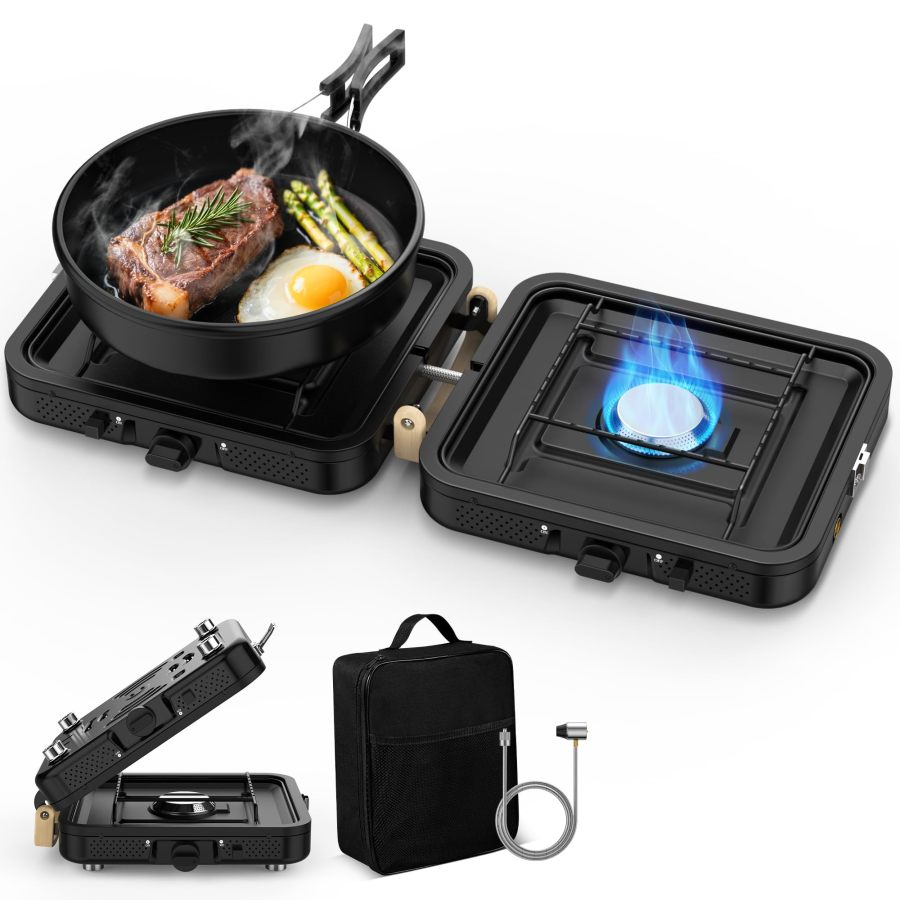
Camping Propane Stoves (or portable dual-burner gas stoves) are cooking appliances specifically designed for outdoor use, typically using propane as the primary fuel. Characterized by compact folding design, dual burners, adjustable flame, and convenient ignition, they are widely used for camping, road trips, picnics, and as emergency backup cooking solutions. Many products come with a carrying case, wind deflector, or griddle. The following table illustrates the key characteristics of consumer behavior in this category.
| Dimension | Segment | Description |
|---|---|---|
| Need Driver Type | Planned Purchase / Emergency-driven Purchase | Purchases are typically driven by anticipated outdoor activity needs (camping, road trips) but also consider the stove's utility as a backup cooking device during home power outages or emergencies. |
| Purchase Frequency | Low Frequency / Seasonal | Typically a one-time or infrequent purchase (every few years), with potential peaks during spring/summer seasons and holidays. |
| Decision Complexity | Medium | Consumers compare different products based on portability, heat output, number of burners, durability, safety features, additional functions (like wind deflectors, griddles), and price. |
| Price Sensitivity | Medium-High | Price is a significant consideration; users expect high value for money and reliability within a reasonable price range but show some willingness to pay a premium for superior features and durability. |
| Emotional Dependency | Low-Medium | Primarily based on practical functionality and convenience, but the experiential aspect of outdoor cooking and the social value of sharing meals with family/friends also contribute some emotional attachment. |
II. User Personas & Usage Scenarios
2.1 Family Camping Enthusiasts
🎯 Enthusiastic about weekend or holiday short-distance road trips and camping with family and friends, enjoying outdoor family time and culinary experiences.
| Typical Usage Scenarios | Core Pain Points | Primary Purchase Drivers |
|---|---|---|
|
|
|
2.2 Outdoor Adventurers / Road Trippers
🎯 Prioritize lightweight design and reliability; frequently engage in long-distance road trips, motorcycle camping, or expeditions to remote areas, requiring independent and efficient cooking solutions.
| Typical Usage Scenarios | Core Pain Points | Primary Purchase Drivers |
|---|---|---|
|
|
|
III. User Needs Hierarchy (KANO Model)
3.1 Basic Needs (Must-Haves)
- Safety: Secure gas connections without leaks, safe and reliable operation preventing accidents, compliant with US safety certifications like UL/CSA.
- Ignition Function: Reliable ignition system (e.g., piezoelectric ignition), eliminating the need for an external fire source, with a high success rate.
- Stable Support: Ability to stably place cookware without tipping, ensuring cooking safety; stable burner grates.
- Fuel Compatibility: At least compatible with standard 1-lb propane cylinders, preferably adaptable to larger propane tanks via an adapter.
3.2 Performance Needs (Linear Satisfiers)
- Portable Folding Design: Stove is foldable, includes a carrying case for easy transport and space saving, with a stable structure when folded.
- Dual-Burner Design: Capable of cooking two dishes simultaneously, improving efficiency; reasonable spacing between burners to accommodate two medium/large pots.
- Flame Adjustment: Independent flame control for each burner to meet different cooking needs; good ability to switch between high and low heat.
- Sufficient Heat Output: High BTU rating (typically 16,000-20,000 BTU or above) for rapid heating/boiling, reducing wait times.
- Easy to Clean: Removable grates or non-stick coatings facilitate post-use cleaning, minimizing grease residue.
3.3 Excitement Needs (Delighters)
- Integrated Wind Deflector: Built-in or detachable, effective all-around wind deflector that significantly enhances outdoor cooking stability and thermal efficiency.
- Versatile Griddle/Accessories: Includes a high-quality, versatile griddle (e.g., dual-sided for frying/grilling) or innovative accessories like coffee stands, matching utensils, enhancing cooking diversity.
- Compact Integrated Set: Beyond the stove, integrates lightweight cookware (e.g., frying pan, kettle), cleaning tools, etc.; all accessories fit perfectly within the stove body or a dedicated carry case for a complete solution.
- Durable Material Construction: Use of high-quality stainless steel, cast iron grates, etc., providing exceptional durability and stability for complex outdoor environments.
3.4 Unmet Needs & Opportunities
-
Precise Low-Flame Control: User feedback indicates difficulty achieving a very low simmer, easily burning food; need for finer, more stable flame adjustment, especially at low settings.
User Reviews (VOC) While the flame looks powerful, it didn't seem to boil water faster than my Coleman. // achieving a very low simmer is still challenging. // Flame adjustability is not easy. // burner control knobs gave inconsistent burner performance.
-
Auto-Igniter Reliability: Auto-igniters have short lifespans or are prone to failure, forcing users to light manually, severely impacting convenience and safety.
User Reviews (VOC) On the second use, one of the ignition buttons came off completely and I couldn't put it back. // Both igniter levers broke on the first trip. // the igniter worked more than once. // Sparker broke after 1 strike.
-
Griddle Quality & Function Optimization: Included griddles are often thin, prone to warping, have poor non-stick coatings, uneven heat distribution, or low edges, impairing the actual grilling experience and making cleaning cumbersome.
User Reviews (VOC) The steel griddle plate is only 1mm thick and the non-stick coating... is not very durable. // after only one use the griddle is bent weirdly 😫 // the griddle is easily get chip. // heat is not distributed equally, so temperature is too high in the middle, and too low in the corner.
-
Fuel Line Connection Durability & Protection: Fuel connections or hoses protrude from the stove body or are poorly designed, susceptible to impact damage, lacking effective protection, compromising long-term reliability.
User Reviews (VOC) The non-standard fuel line attachment at the stove is a concern. It is both non-standard (meaning probably non-repairable/serviceable) but also sticks out from the body of the stove about 3/4" - making it very susceptible to damage. // The needle tip of the gas input sticks out at the bottom when it is in its closed carrying state.
-
Burner Spacing & Workspace Optimization: Some products have burners too close together or a workspace that's too small, making it difficult to place two large pots simultaneously, limiting efficiency for group cooking.
User Reviews (VOC) I was worried that the space between the two burners was too tight. // Although this is smaller than our big brand three burner camping stove it is also HEAVIER than that stove. // Extremely small. You can cook one burger on the grill side.
IV. User Decision Drivers
4.1 Key Decision Factors
- Portability & Packability: Whether the stove is lightweight, compact when folded, and fits easily into a carry bag is the primary consideration for choosing an outdoor stove.
- Cooking Efficiency & Heat Output: Whether dual burners work efficiently simultaneously, and if the heat is sufficiently powerful and stable, directly impacts outdoor cooking speed and the meal experience.
- Safety & Durability: Secure gas connections without leaks, sturdy product structure, and materials capable of withstanding outdoor use form the core trust foundation for purchase.
- Ease of Use: Reliable and convenient ignition, intuitive and simple operation, and easy post-cooking cleaning directly influence user willingness to use the product.
4.2 Secondary Decision Factors
- Wind Resistance: Ability to maintain a stable flame in windy conditions, reducing fuel consumption and cooking interruptions, is a key value-added feature enhancing the outdoor experience.
- Precise Flame Control: Ability to achieve precise control from low simmer to high stir-fry, meeting diverse cooking needs and avoiding burnt food.
- Additional Cooking Functions: Inclusion of high-quality griddles, frying pans, coffee stands, or integrated cookware sets, offering more cooking possibilities and increasing product value.
- Fuel Compatibility: Ability to use butane or other fuels besides standard propane cylinders, increasing flexibility.
- Brand Reputation / Price: Well-known brands or high value-for-money products are more favored, especially when functionality is similar.
V. Selling Points & Competitive Landscape
5.1 Selling Point Analysis
5.1.1 Standard Features (Points of Parity)
- Portable Folding Design: All products emphasize compact size, lightweight, easy portability and storage, typically including a carry bag.
- Dual-Burner Design: Highlighting the ability to cook simultaneously with two burners, improving efficiency; a standard feature for this stove type.
- Adjustable Flame: Emphasizing independent control knobs for different cooking needs; a basic function.
- Piezo Ignition: No matches/lighter needed, one-button ignition for easy operation; now a mainstream configuration.
- High Heat Output (BTU): Most products claim high power (between 16,000-20,000 BTU) to emphasize fast heating and cooking capability.
- Material Durability: Commonly highlight materials like stainless steel, alloy steel, emphasizing corrosion resistance and heat tolerance.
5.1.2 Key Differentiators
- Integrated Wind Deflector: Some products emphasize built-in or included independent wind deflectors to enhance outdoor adaptability, but actual effectiveness varies.
- Multi-Fuel Compatibility: A few products, besides propane, can also use butane or isobutane (with adapter), offering more fuel options.
- Included Griddle/Frying Pan/Kettle Set: Some products offer an all-in-one cooking solution, adding product value, but accessory quality varies greatly.
- Burner Spacing Optimization: Some products mention sufficient spacing between burners in their marketing to accommodate two large pots, addressing family cooking needs.
5.1.3 Unique Selling Propositions (USPs)
- ETL Certification: Very few brands emphasize third-party safety certification to enhance consumer trust as a differentiator.
- Magnetic Closure Design: Individual products use innovative magnetic folding latches to enhance convenience and safety.
- Extended Fuel Hose / Integrated Storage: Few products offer longer hoses for safe propane tank placement away from the stove, or unique storage slots to integrate the fuel canister.
- Upgraded One-Touch Ignition: Emphasize more convenient, safer one-hand ignition designs to optimize user experience.
5.2 Competitive Landscape
5.2.1 Market Maturity
The camping propane stove market is highly mature, with significant product feature homogenization. Basic selling points like dual burners, foldable portability, piezo ignition, and high heat output are now standard. Competition primarily revolves around price, aesthetic design, minor functional optimizations (e.g., smoother adjustment), the practicality of included accessories, and brand premium.
5.2.2 Innovation Trends
Current innovation trends primarily focus on 'All-in-One Outdoor Kitchen Solutions' and 'Core Experience Micro-Innovations'. The former provides richer, more convenient cooking experiences by integrating high-quality, versatile accessories like griddles and matching cookware (e.g., kettles). The latter focuses on improving the reliability and detail optimization of existing functions, such as achieving one-hand operation for ignition systems, optimizing wind resistance for better extreme environment adaptability, or building higher trust barriers through third-party safety certifications. Additionally, differentiation in product aesthetics and materials is emerging to meet varying consumer aesthetic preferences.
VI. Marketing Claims vs. Reality Check
The table below analyzes the gap between common marketing claims and actual user experiences in this category:
| Dimension | Marketing Claim | User Reality | Verdict |
|---|---|---|---|
| Portability vs. Product Weight | Ultra-lightweight, only 5.5 lbs (~2.5 kg), easy to carry in a backpack. | Significant discrepancies exist between the advertised weight (e.g., 5.5 lbs, 3.98 lbs) and actual specifications (e.g., 8.91 lbs, 8.64 lbs) for multiple products; some users report the stove being heavier than older models, unsuitable for lightweight backpacking. | Typical marketing exaggeration through selective data; fails to honestly inform consumers of the actual weight, leading to significant unmet portability expectations and impacting suitability for intended use cases. |
| Igniter Reliability | One-button piezo ignition, no matches needed, quick and safe ignition. | Users widely report short lifespans and easy failure of piezo igniters, malfunctioning after first use or a few times, buttons falling off, even burn risks during ignition, necessitating reliance on external lighters. | |
| Griddle/Accessory Quality | Multi-functional integrated griddle, easily cook various delicacies. | Included griddles commonly suffer from thin material, easy warping, poor non-stick coating performance, uneven heat distribution, or low edges, resulting in insufficient functionality and difficult cleaning, leading to poor user experience. | |
| Gas Connection Design Flaws | Sturdy and durable, well-designed. | Some products have non-standard gas connections that protrude from the stove body, prone to impact damage, limiting compatibility, and lagging behind mainstream products in terms of universality and durable design. |
Key Takeaway: The market exhibits widespread parameter inflation and exaggeration of scenario-based experiences, particularly regarding portability (weight), igniter reliability, and griddle quality.
VII. Supply-Demand Misalignment Analysis
The table below highlights mismatches between seller focus and buyer priorities:
| Dimension | Seller Behavior | User Focus | Verdict |
|---|---|---|---|
| Wind Resistance | Some sellers mention 'wind-resistant design' or 'includes wind deflector', but most lack in-depth demonstration or proof of actual wind resistance effectiveness; some products don't mention it at all. | Users strongly desire stoves that work stably in windy conditions, complaining 'flame is unstable in wind', 'need to buy a separate wind deflector', indicating existing designs or effectiveness are inadequate. | Sellers undervalue this core pain point of windy outdoor environments, failing to provide sufficiently effective or convincing wind resistance solutions, leading to compromised user experience in key scenarios. |
| Igniter & Gas Connection Reliability | Sellers universally emphasize 'one-touch ignition', 'quick start', but collectively downplay the long-term durability of igniters and the protective design of gas connections. | Users frequently report igniter failures and protruding, easily damaged gas connections – pain points concerning basic functionality and safety that are overlooked in seller communication. | Sellers over-focus on initial-use convenience, neglecting the long-term reliability and safety design of critical components, resulting in a significant trust deficit regarding product durability. |
| Low-Flame Cooking Precision | Most sellers claim 'adjustable flame', 'precise control', but very few products detail their low-flame stability and precise adjustment capability. | User feedback indicates difficulty achieving a stable low simmer, easily burning food, showing that the sellers' claimed 'adjustable' does not meet the actual user need for 'precision'. | Sellers provide generic claims about flame adjustment but fail to deeply understand the real user pain point for precise heat control in outdoor cooking, leading to a mismatch between marketing messages and actual needs. |
Key Takeaway: Sellers generally fail to elevate the actual durability of wind resistance, igniters, and griddles to the same level of promotional importance as 'portability' and 'high heat output', leading to a supply-demand mismatch.
VIII. Strategic Opportunities & Recommendations
8.1 Develop All-Weather Stable Wind-Resistant Stoves
8.1.1 Target Audience & Pain Points
⚡️ Pain Points Addressed: Outdoor wind affects flame stability, reducing cooking efficiency and ignition reliability, impacting user experience.
8.1.2 Action Plan
Design a more efficient, foldable, three or four-sided integrated wind deflector that fully encloses the burners, using high-strength alloy steel. Optimize burner structure to enhance wind resistance, ensuring flame stability even in Force 5 winds. Also, improve burner spacing to accommodate two 10-12 inch pots.
| Tech Complexity | Medium |
| Cost Impact | Medium Impact |
| Trade-off Warning | Integrated wind deflector may slightly increase folded volume and weight, requiring careful design to balance portability. |
| Price Band | Only viable above $79.99 |
8.1.3 Marketing Strategy
Emphasize 'Fearless in strong winds, all-weather outdoor kitchen'; use simulated wind tunnel test videos, comparative images of flame stability under different wind speeds to quantify wind resistance. Highlight the reassurance of 'cook with confidence, rain or shine', and showcase scenarios of cooking two large dishes simultaneously.
8.2 Enhance Ignition System & Low-Flame Precision Control
8.2.1 Target Audience & Pain Points
⚡️ Pain Points Addressed: Auto-igniters are prone to failure; low flame is difficult to control precisely, easily burning food.
8.2.2 Action Plan
Adopt more heat-resistant, reliable ceramic or metal piezo igniters, with modular design for easy replacement. Improve gas valves and knobs for more linear, precise flame adjustment, ensuring stable burning at very low settings without extinguishing. Consider adding intuitive flame level indicators on the knobs.
| Tech Complexity | Medium |
| Cost Impact | Medium Impact |
| Trade-off Warning | Upgrading valves and igniters slightly increases component cost but has no significant physical side effects. |
| Price Band | Only viable above $69.99 |
8.2.3 Marketing Strategy
Promote 'Lights instantly, precise flame control, suitable for simmering and stir-frying'; showcase videos of the product operating stably at very low flame, emphasizing the advantage of not burning food. Highlight long-term warranty and reliability of the igniter to alleviate user concerns.
8.3 Provide High-Quality Versatile Integrated Griddle Sets
8.3.1 Target Audience & Pain Points
⚡️ Pain Points Addressed: Current included griddles are poor quality, prone to warping, have inferior non-stick coatings, are difficult to clean, and lack true versatility.
8.3.2 Action Plan
Develop a sturdy, evenly heating griddle with a genuine, durable non-stick coating and resistance to warping, ideally reversible (fry/grill). Griddle edge height should accommodate liquid foods like eggs. The set could integrate high-quality, lightweight frying pans and kettles, with dedicated storage positions designed.
| Tech Complexity | Low |
| Cost Impact | Medium Impact |
| Trade-off Warning | High-quality griddle increases overall set weight and volume, requiring coordinated optimization with stove storage design. |
| Price Band | Only viable above $89.99 |
8.3.3 Marketing Strategy
Highlight 'Upgrade your outdoor cooking experience, versatile griddle, enjoy delicious meals'; use high-quality images/videos demonstrating the griddle's frying/grilling results, non-stick properties, easy cleaning. Emphasize 'Easily handle everything from breakfast pancakes to dinner steak', raising user expectations for outdoor cuisine.
8.4 Recessed Gas Connection & Reinforced Hose
8.4.1 Target Audience & Pain Points
⚡️ Pain Points Addressed: Protruding fuel connections are easily damaged; hoses are fragile, increasing transport and usage risks.
8.4.2 Action Plan
Redesign the stove side panel to feature a recessed gas input connection or one with a protective cover to prevent damage during transport/falls. Include a high-quality, heat-resistant, anti-kink braided steel fuel hose. Ensure connections to both stove and propane tank are robust and reliable, providing universal standard adapters.
| Tech Complexity | Medium |
| Cost Impact | Low Impact |
| Trade-off Warning | Recessed connection may increase mold cost and design complexity but has no significant usage side effects. |
| Price Band | Only viable above $64.99 |
8.4.3 Marketing Strategy
Emphasize 'Worry-free safety, sturdy durability – quality shows in the details'; showcase the protective design of the connection, validate impact resistance through pressure tests. Highlight the promise of safe use even in complex outdoor environments.