Amazon US Market Analysis: Handheld Vacuum Sealers Category
📊 Executive Summary
📈 Market Trends
Handheld vacuum sealers address household daily meal-prep and RV/small-space pain points through cordless compactness, 30+ included bags, and out-of-the-box value, with mainstream prices at $20-$45. However, the market has fallen into a specification-inflation race over 60-100KPa suction and 1,000-cycle runtime, while underweighting core stability and juicy-food boundaries.
⚡ Major Pain Points
The top buyer pain point is slow valve leakage and re-inflation after a few days in the freezer, undermining preservation. Second is the lack of effective overflow shutoff in micro air pumps, so juices from juicy foods are easily back-sucked and damage the motor. In addition, short- to mid-term battery degradation, occasional button lockups, and difficulty drying greasy reusable bags (leading to mold) also reduce retention.
💡 Selection Opportunities
Given the core boundary of drawer storage compactness, do not blindly enlarge the body. Prioritize developing a kit with a silicone self-alignment guide nozzle and color-changing sealing clip to secure the airtightness baseline. Include wet/dry and fragile-food dual-mode pressure control and a quick-release liquid collection chamber, and include a foldable drying rack to close the cleaning-and-reuse loop.
I. Analysis Overview
1.1 Introduction & Report Scope
This report analyzes the Vacuum Sealers category (handheld vacuum sealers) in the Amazon US market, focusing on target user personas, core needs, decision factors, market communication, and potential opportunities.
1.2 Category Snapshot
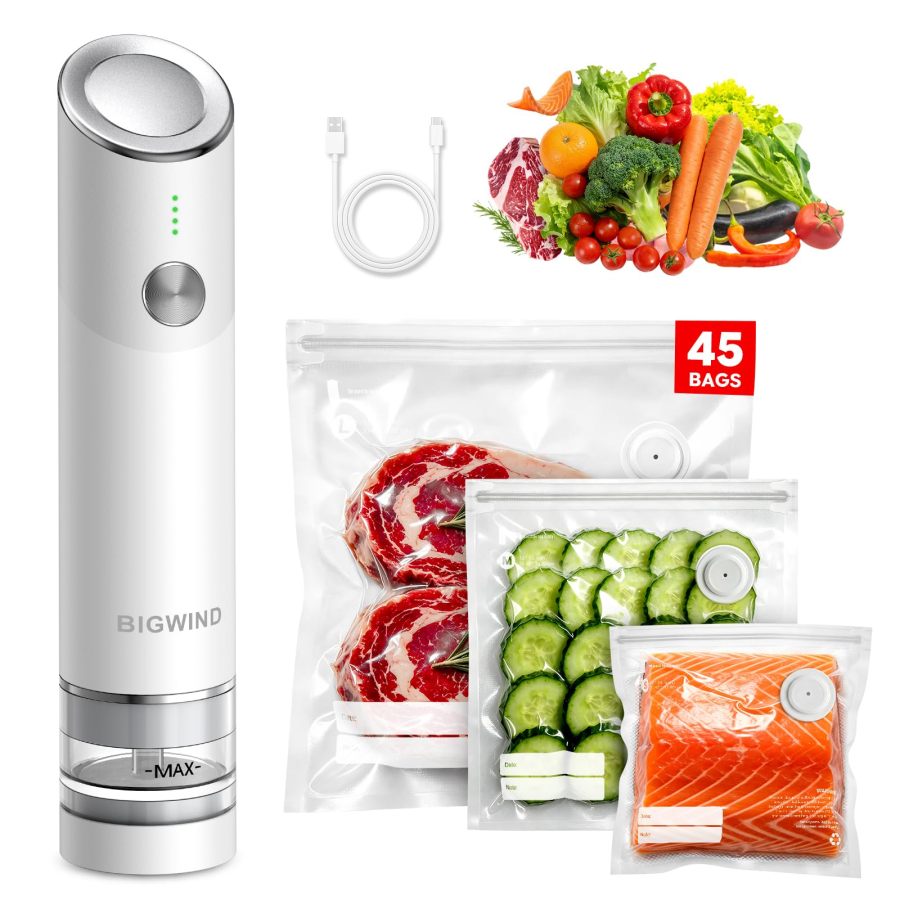
Handheld vacuum sealers in this segment use a micro air pump to extract air from one-way valve bags to extend food freshness. The mainstream products in this batch are lithium-battery cordless handheld models, typically bundled with 10-45 reusable valve bags; some models include a liquid collection chamber. Compared with traditional countertop heat sealers, their advantages are compact storage and cordless portability, but they face physical constraints such as low fault tolerance in valve alignment, strong dependence on proprietary consumables, and strict boundaries for liquid protection during wet vacuuming. The following table illustrates the key characteristics of consumer behavior in this category.
| Dimension | Segment | Description |
|---|---|---|
| Need Driver Type | Planned Purchase/Habitual Purchase | Mostly for periodic household bulk meal-prep purchases, portioning large fresh foods, or daily leftover preservation, as well as habitual food-preservation needs during RV camping and mobile lifestyles. |
| Purchase Frequency | Low | The main unit is a durable small kitchen appliance with low repurchase frequency; however, there is potential ongoing demand for consumables such as proprietary valve sealer bags. |
| Decision Complexity | Medium | Users focus on comparing rated suction power, included bag quantity and sizes, liquid collection and backflow prevention design, and compact portability. The parameter threshold is low, but reviews heavily influence decisions. |
| Price Sensitivity | Medium | Mainstream products cluster in the $20-$45 range. Buyers seek out-of-the-box value with 30 included bags; premium models need clear durability and quality-control endorsement. |
| Emotional Dependency | Low | The focus is solving food spoilage, freezer burn and dehydration, and refrigerator odor transfer. It is a purely rational functional tool that provides a sense of control over reducing waste and organizing storage. |
II. User Personas & Usage Scenarios
2.1 Budget-Savvy Meal Preppers
🎯 Habitually buys meat, fruits, and vegetables in bulk and portions them on weekends, focusing on limiting freezer burn and dehydration, reducing food waste, and freeing up freezer space.
| Typical Usage Scenarios | Core Pain Points | Primary Purchase Drivers |
|---|---|---|
|
|
|
2.2 Small-Space & Mobile Lifestylers
🎯 Lives in a compact apartment, lives alone, or frequently travels by RV and camps outdoors, where countertop space is extremely precious and power is limited.
| Typical Usage Scenarios | Core Pain Points | Primary Purchase Drivers |
|---|---|---|
|
|
|
III. User Needs Hierarchy (KANO Model)
3.1 Basic Needs (Must-Haves)
- Establish Effective Airtight Negative Pressure: The pump body fits tightly against the valve and quickly removes air from the bag to form a tight, body-hugging seal, inhibiting aerobic bacterial growth.
- Reliable Basic Zipper Seal: The included sealing clip fully presses the dual-track zipper, ensuring the physical seal does not split during vacuuming, freezing, or handling.
- Compact Handheld Cordless Architecture: The body is small and light, with a built-in rechargeable battery supporting multiple consecutive sealing batches, and it can be easily stored in a shallow kitchen drawer.
3.2 Performance Needs (Linear Satisfiers)
- Auto Shutoff & Smooth Pressure Release: After reaching the preset vacuum level, the unit intelligently cuts off the pump and provides automatic pressure release, so the nozzle easily detaches from the bag valve without tearing the patch.
- Wet-Food Protection & Removable Washable Chamber: A transparent independent liquid collection chamber or backflow prevention structure blocks liquid from entering the motor when slightly wet meat juices overflow, and it can be unscrewed for rinsing.
- Truly Reliable Battery Runtime: A full charge supports weeks of household use or dozens of portioning sessions, with intuitive battery display and no risk of excessive self-discharge or failure to power on after a few months.
- Thick, Puncture-Resistant Reusable Consumables: Standard bags are made of thick material (e.g., rated 90um), with valves that adhere firmly and withstand low freezer temperatures and repeated washing and wiping.
3.3 Excitement Needs (Delighters)
- Pulse/Manual Dual-Mode Crush Prevention: Provides MANUAL/Pulse control modes for soft, fragile foods such as berries, chips, and soft bread, precisely adjusting air removal to prevent crushing.
- Smart Liquid-Level Sensor Probe Auto Shutoff: A metal probe embedded in the liquid collection chamber immediately triggers electronic shutoff when it detects juice contact, completely preventing accidental liquid suction into the main air path.
- External Drain Tube or Multi-Purpose Adapter: Includes an active external drain tube or a vacuum adapter for preservation containers, expanding use to fresh marinating jars or wine stopper preservation scenarios.
3.4 Unmet Needs & Opportunities
-
Poor Long-Term Valve Pressure Retention: Multiple buyers report that vacuuming works well at the time, but after several days in the refrigerator air leaks back into the bag and it re-inflates. The valve is extremely sensitive to fine dust and grease and prone to seal failure.
User Reviews (VOC) Sealed this product yesterday and now it's releasing adding back the air 🥴
-
Short- to Mid-Term Quality Control & Sudden Battery Failure: Buyers report that after several weeks to two or three months, the unit will not charge, buttons do not respond, or the motor stops running. Consistency of low-cost lithium batteries and micro air pumps remains to be verified.
User Reviews (VOC) Broke after 2 months. I don't know how. It just won't work now. I loved it at first....
-
Extremely Low Fault Tolerance for Juicy Foods: Although marketed as wet/dry, the micro liquid collection chamber is very small (e.g., 15mL) or only a passive buffer. Slight juice rise is sucked into the nozzle or even causes the juice pull reported by buyers, creating significant concern when handling raw meat.
User Reviews (VOC) Works great. If you go beyond when machine shuts off then you will end up with a juice pull....
IV. User Decision Drivers
4.1 Key Decision Factors
- Long-Lasting Seal Preservation: Whether the seal can remain airtight for weeks or even months without re-inflation directly determines whether food suffers freezer burn and dehydration, and is the foundation of buyer trust.
- Completeness of Included Consumables: Whether the standard kit includes 30+ BPA-free reusable bags in S/M/L sizes and sealing clips, enabling out-of-the-box use without extra consumable purchases.
- Compact, Portable Body & Cordless Convenience: Whether it is as small as a grinder and can fit in a drawer, and whether cordless lithium power eliminates the hassle of finding outlets and running cables on the countertop; this is the core motivation for replacing traditional countertop machines with handheld models.
- Operational Fault Tolerance & Auto Start/Stop: One-button start, automatic stop when vacuum is complete, and automatic pressure release for detachment determine whether household members can use it without a learning curve and without tedious manual monitoring.
4.2 Secondary Decision Factors
- Anti-Liquid Suction Protection Design: Whether it has a visible, removable water collection chamber or probe-based shutoff, determining whether it can comfortably handle slightly wet raw meat and marinated ingredients.
- Battery Capacity & LED Power Display: Whether it is equipped with a 1200-2200mAh battery and percentage or level LED display to avoid sudden power loss mid-use.
- Long-Term Consumable Replacement Cost & Compatibility: Over long-term use, the market replacement price of proprietary one-way valve sealer bags and the degree to which third-party bag valves are compatible.
- Operating Noise & Handheld Vibration: Whether the motor is harsh-sounding and whether it disturbs family members during early-morning or late-night meal prep.
V. Selling Points & Competitive Landscape
5.1 Selling Point Analysis
5.1.1 Standard Features (Points of Parity)
- Compact Handheld Cordless Architecture: All samples claim a compact size (pepper grinder size) and built-in lithium battery, emphasizing drawer storage and cordless operation anytime, anywhere.
- Standard Reusable Valve Bag Kit: Most use 20-45 multi-size BPA-free zipper valve bags as the primary conversion hook, claiming out-of-the-box use, eco-friendliness, and reduced plastic.
- Strong Suction & X-Times Longer Preservation: Rated 60-80kPa suction, claiming air removal in seconds and extending food preservation by 5-8 times, preventing freezer burn.
- One-Touch Automatic Vacuum Start/Stop: Focuses on minimalist single-button operation, claiming automatic shutoff when negative pressure is reached, eliminating manual guesswork.
5.1.2 Key Differentiators
- Removable Transparent Liquid Collection Chamber & Probe: Models such as B0GY4MSJM9, B0GKP8QDDB, and B0HDZJM5PG feature a visible liquid collection chamber, with some adding a metal probe that cuts power on water contact to establish a wet-vacuum safety barrier.
- Pulse/Manual Dual-Mode Adjustment: Models such as B0GXXMJ3LJ, B0H9LCYTV7, and B0HDZJM5PG offer AUTO and MANUAL/Pulse modes, balancing tight sealing for hard foods and crush prevention for soft, fragile foods.
- LED Digital Display & Child Safety Lock: For example, B0G9HZ9XC7 requires a 3-second long press to lock against accidental activation, while B0HD5YP1CD and B0FKZKDM3W display battery level and progress, improving carry-along safety and power control.
- Metal Body Upgrade: For example, B0HDZJM5PG uses an aluminum alloy body shell, breaking away from all-plastic looks and improving perceived quality and drop resistance.
5.1.3 Unique Selling Propositions (USPs)
- Active Drain Hose System: Models such as B0H5HKG8R5 and B0H5J1YVMR connect to an active external drain tube and include a UV cleaning light, attempting to fundamentally solve juice accumulation with wet foods.
- 100KPa Industrial-Grade Large Motor Claim: For example, B0H1R96QWJ claims a 100KPa ultra-strong motor as an extreme suction differentiation angle (though user feedback disputes slow vacuuming and insufficient battery).
- Included Foldable Drying Rack Accessory: For example, B0FH69WJ7R adds a dedicated foldable draining rack for bags to the kit, solving the hygiene pain point of having nowhere to dry reusable bags after washing.
5.2 Competitive Landscape
5.2.1 Market Maturity
The category is transitioning from rough homogenization to refined experience. Generic tooling and 30 included bags have become standard, but core functional reliability (slow valve leakage, batteries failing within months) remains unresolved. Buyers are shifting from focusing on 'suction numbers' to 'seal durability and wet-vacuum safety'.
5.2.2 Innovation Trends
In hardware, products are evolving from passive suction pumps to active overflow-prevention liquid collection chambers, pulse pressure control, and digital-display fast charging. In service, brands are enhancing the full washing-and-reuse experience by including bag drying racks, sealing clips, markers, and other accessories.
VI. Marketing Claims vs. Reality Check
The table below analyzes the gap between common marketing claims and actual user experiences in this category:
| Dimension | Marketing Claim | User Reality | Verdict |
|---|---|---|---|
| Power Supply Method vs Cable Configuration Contradiction | Some models (e.g., B0HG4N9VSF) claim in the five bullet points that a rechargeable battery can vacuum 1,000 bags per charge, emphasizing cordless portability. | The specification table for this model (B0HG4N9VSF) clearly lists Power Source as Corded Electric, voltage 120V, and power 120W. In addition, some models marketed as Type-C (e.g., B0H1R96QWJ) are reported by actual buyers to ship with only a Micro-USB cable. | This is a core listing parameter entry error and a supply-chain accessory inconsistency that can easily make consumers who bought for cordless portability feel deceived and trigger direct returns. |
| Spec Inflation in Seals per Charge | Commonly claims that one full charge can seal 1,000 to 1,800 bags, implying months of continuous high-intensity meal prep. | The body battery capacity is only 1000-2200mAh. Based on the power draw of continuous vacuum operation per cycle, the thousand-cycle figure is only an ideal laboratory extreme for very small bags or no load. Multiple buyers report that after several weeks the battery no longer holds a charge or that one full charge only supports a few operations. | Extreme parameters divorced from actual load inflate buyer expectations, then quality-control degradation leads to a large number of negative reviews focused on battery life. |
| Wet/Dry Dual-Use & Liquid Overflow Prevention Promise | Claims all-around wet/dry use, automatic liquid blocking, and unrestricted vacuuming of marinated meats and juicy fruits and vegetables. | The handheld pump body is small, and the liquid collection tank volume is generally only around 15mL or even just a channel buffer. Buyers report that with slightly more juice, liquid is sucked into the air path (juice pull), or a tiny amount of liquid touching the probe causes an abrupt stop and incomplete vacuuming. | This is a physical compromise constrained by the size of the micro handheld chamber. Forcing an 'all-carefree wet vacuuming' promise is a scenario mismatch; brands need to honestly communicate the usage boundaries requiring pre-freezing or liquid control. |
Key Takeaway: The market is flooded with severe specification inflation and contradictory marketing claims. Motor power is generally only 3-6W, yet brands excessively claim up to 80-100KPa and 1,000+ ultra-long runtimes. Some models claim wireless charging in the five bullet points, while the specification table lists 120V corded AC power. Brands gloss over physical trade-offs such as slow valve leakage and liquid back-suction.
VII. Supply-Demand Misalignment Analysis
The table below highlights mismatches between seller focus and buyer priorities:
| Dimension | Seller Behavior | User Focus | Verdict |
|---|---|---|---|
| Suction Limit vs Long-Term Valve Pressure Retention | Brands compete to claim 60kPa, 70kPa, 80kPa, or even 100kPa strong suction, trying to prove fast air removal. | Buyers report that no matter how flat the bag is pulled at the time, after a few days in the refrigerator it frequently leaks and softens, causing freezer burn and spoilage; aligning with the tiny valve is difficult and fault tolerance is extremely low. | Instant suction negative pressure is not the same as long-term airtightness. Sellers should focus on valve-structure leak prevention and alignment/sealing accessories rather than an endless peak-negative-pressure race. |
| Number of Reusable Bags Included vs Washing/Drying Reuse Burden | Uses 30, 32, or 45 included bags as the core value selling point, promoting eco-friendly washable reuse. | Bags that held raw meat and grease are extremely hard to clean by hand; water hides in valve corners and mold grows; without dedicated tools it is hard to prop them open to dry. Some buyers give up using them for meat due to hygiene concerns. | Ignores the cleaning and maintenance cost behind 'reusable.' Competing purely on bag quantity is inferior to providing easy-cleaning draining solutions or antibacterial guidance. |
| Automatic One-Touch Vacuum/Stop vs Food Deformation & Pulse Fine-Tuning | Commonly promotes one-touch fully automatic sensor stop, emphasizing foolproof operation. | Buyers complain that strong automatic vacuum pressure easily dries, hardens, and crushes bread and small rolls, and crushes berries until they leak juice; they urgently need flexible pulse pressure reduction. | One-size-fits-all automatic sensing lacks tolerance for soft, fragile foods. Product definition needs to retain a simple, reliable manual pulse (Pulse) interaction. |
Key Takeaway: Sellers over-emphasize extreme negative-pressure numbers and inflated runtime, while giving little engineering or communication attention to the high-frequency end-to-end usage pain points buyers actually encounter, such as valve leakage and re-inflation, difficulty pinching the bag zipper, and hard-to-clean greasy inner walls.
VIII. Strategic Opportunities & Recommendations
8.1 Valve Self-Alignment Aid & High-Fault-Tolerance Sealer Bag Kit Go
8.1.1 Target Audience & Pain Points
⚡️ Pain Points Addressed: Solves the core seal-failure pain point of difficult nozzle-to-valve alignment and tiny misalignment causing leakage and re-inflation.
8.1.2 Action Plan
Optimize the soft silicone bowl structure of the handheld pump nozzle and add a physical stop self-alignment groove. Upgrade the kit with an edge-pressing clip featuring a dual-track color-changing slider so buyers can visually confirm the zipper is 100% locked. Prototype and test the improved valve patch for dust-resistant sealing.
| Tech Complexity | Low |
| Cost Impact | Low Impact |
| Trade-off Warning | A candidate silicone guide nozzle ring (estimated outer diameter increase of 2-3mm) has no substantive impact on overall lightweight portability. |
| Price Band | Break-even price cannot be estimated from public information alone. |
8.1.3 Marketing Strategy
Lead with 'Self-aligning, zero-error, long-lasting freshness without re-inflation.' Use comparison graphics to show how the dual-track sealing clip completely eliminates leak-prone dead zones and builds a high-reliability sealing mindset.
8.2 Wet/Dry & Fragile-Food Dual-Mode Pressure Control with Quick-Release Overflow Prevention Collection Chamber Go
8.2.1 Target Audience & Pain Points
⚡️ Pain Points Addressed: Solves the physical-scenario conflict between juicy marinated meat back-suction damaging the motor and automatic vacuuming crushing berries and bread.
8.2.2 Action Plan
Provide independent physical pulse buttons for AUTO and MANUAL/Pulse. Design a twist-lock transparent liquid collection cup at the bottom (with a prominent MAX warning line) and add a micro labyrinth-style anti-back-suction air-blocking structure. Include replaceable juice-blocking cotton consumables for verification.
| Tech Complexity | Medium |
| Cost Impact | Medium Impact |
| Trade-off Warning | A candidate 20-30mL transparent water collection chamber and micro float/probe shutoff valve would increase body length by an estimated 10-15mm. |
| Price Band | Break-even price cannot be estimated from public information alone. |
8.2.3 Marketing Strategy
Promote 'Soft or hard, wet or dry, controlled at will; protects the machine from back-suction.' Show in video the physical blocking when handling marinated meat juices and the twist-and-rinse cleaning, demonstrating confident wet-vacuuming capability.
8.3 Closed-Loop Meal Prep Cleaning Kit (with Foldable Drain Rack & Classification as Standard) Go
8.3.1 Target Audience & Pain Points
⚡️ Pain Points Addressed: Eliminates buyer hygiene and reuse concerns about raw-meat bags being hard to clean thoroughly and water accumulating inside valves, causing mold and odor.
8.3.2 Action Plan
Add a raw-meat zone (colored bag-edge identifiers) and fruit/vegetable zone color-coded management to the 30-bag pack. Include a simple foldable bag-support draining rack as standard to solve the chronic inability to dry valve dead zones. The manual should clearly state dishwasher temperature ranges and valve-protection cleaning instructions.
| Tech Complexity | Low |
| Cost Impact | Low Impact |
| Trade-off Warning | The packaging box must accommodate an additional simple foldable food-grade PP draining stand, slightly increasing shipping volume. |
| Price Band | Break-even price cannot be estimated from public information alone. |
8.3.3 Marketing Strategy
Lead with 'Raw/cooked color separation, hygienic drying for true reuse.' Emphasize full-process health and hygiene management, upgrading from simply 'selling a machine' to 'a complete ingredient preservation management system.'
8.4 Enhanced Battery Quality Control & Multi-Scenario Adapter Ecosystem Caution
8.4.1 Target Audience & Pain Points
⚡️ Pain Points Addressed: Curb high-frequency negative reviews about sudden failure to hold a charge after two or three months and expand to preservation jars and wine-stopper vacuum scenarios.
8.4.2 Action Plan
Prioritize comparative aging tests of cell suppliers under room-temperature cycling and low self-discharge to investigate the root cause of button lockups. Design a detachable silicone adapter at the nozzle end compatible with commonly sold universal vacuum preservation containers and wine-stopper valves. Strictly audit Type-C cable batch consistency.
| Tech Complexity | Medium |
| Cost Impact | Medium Impact |
| Trade-off Warning | Using A-grade power cells and overcharge/overdischarge protection boards slightly increases cost; adapters are packaged as optional accessories. |
| Price Band | Break-even price cannot be estimated from public information alone. |
8.4.3 Marketing Strategy
Highlight 'A-grade long-life cells, one machine for a multi-purpose preservation-container ecosystem.' Honestly state real charge-discharge cycle counts and win retention through stable performance within the warranty period.