Amazon US Market Analysis: Incline-Handle Walking Pads Category
📊 Executive Summary
📈 Market Trends
The incline-handle walking pad market is upgrading from pure flat walking to a hybrid form of "incline efficiency + handle protection." Mainstream supply sits in the $90–$200 manual-incline range, while $300+ models have already taken the lead in adopting electric incline and voice smart control. Consumers maintain high standards for under-furniture storage and quiet operation, and there is strong demand for tool-free quick folding and more supportive handles.
⚡ Major Pain Points
Core pain points center on three contradictions: first, "pseudo-folding" where portability is claimed but the folding handle requires unscrewing four bolts; second, fixed low handles forcing taller users to hunch forward; third, manual incline requiring stopping and getting off to adjust, fragmenting exercise rhythm. In addition, some low-priced models have inflated speed/horsepower claims, inverted parameter specifications across locations, and physical limitations such as short/narrow belts.
💡 Selection Opportunities
Priority recommendation is to build a "tool-free quick-lock folding + three-position height-adjustable handle" structure to completely solve storage and ergonomic hard flaws; for $200–$280 electric-incline models, recommend cautious entry after verifying actuator lifespan. Constrained by the core bottom line of compact under-bed storage, the belt should not be blindly lengthened; instead, tighten speed claim messaging to manage expectations for walking scenarios.
I. Analysis Overview
1.1 Introduction & Report Scope
This report analyzes the "Treadmills" category (incline-handle walking pads) in the Amazon US market, focusing on target user personas, core needs, decision factors, market communication, and potential opportunities.
1.2 Category Snapshot
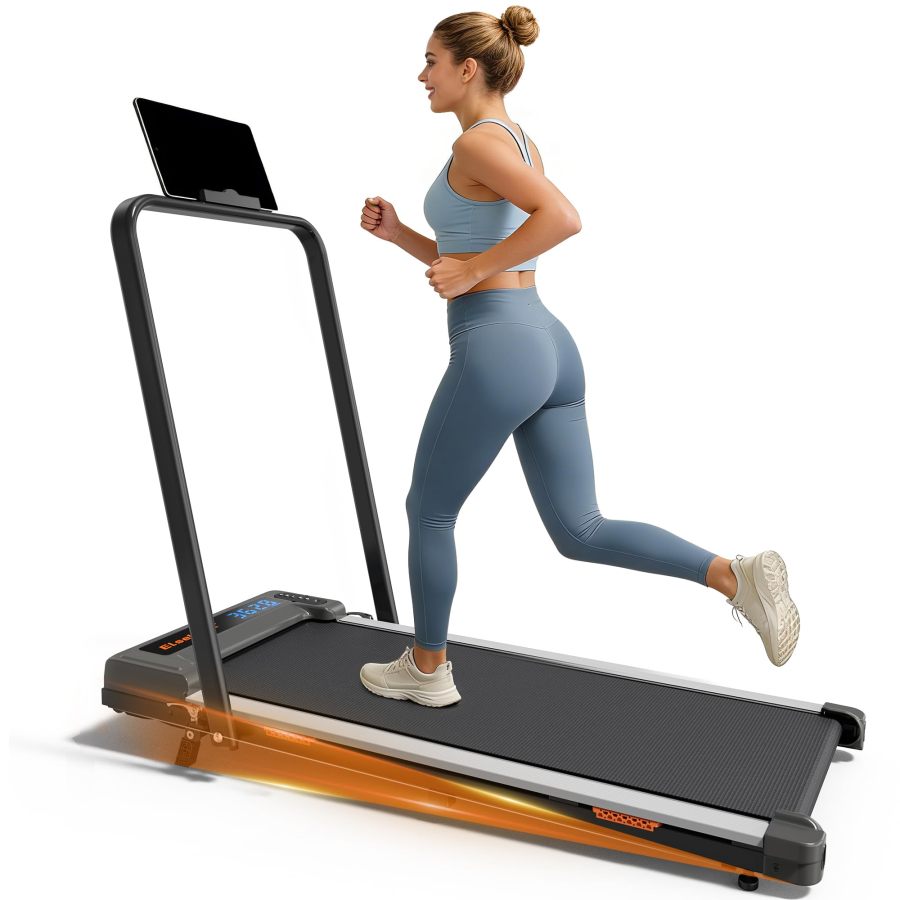
Incline-handle walking pads combine compact walking pads, low-incline fat burning, and upper-body balance support, primarily meeting the low-impact exercise needs of home and remote-office users in limited spaces. Current supply is concentrated in $90–$200 manual-incline models, while higher-end electronically controlled incline models are positioned in the $300–$500 range. Core demands revolve around quiet operation, tool-free storage, and ergonomics. The following table illustrates the key characteristics of consumer behavior in this category.
| Dimension | Segment | Description |
|---|---|---|
| Need Driver Type | Planned Purchase / Habitual Purchase | Most consumers are motivated by breaking sedentary habits, substituting exercise during bad indoor weather, or lightweight fat-loss plans, with clear goals for achieving daily activity levels. |
| Purchase Frequency | Low Frequency | This is durable small home fitness equipment; replacement cycles are mostly over 2 years, driven mainly by damage replacement or advanced exercise needs. |
| Decision Complexity | Moderate | Buyers mainly balance and compare storage thickness, handle folding method, motor quietness, incline adjustment method (manual vs electric), and weight capacity parameters. |
| Price Sensitivity | Medium-High | The main buyer base is highly concentrated in the sub-$200 high-value segment, but there is clear willingness to pay a premium for significant experience upgrades such as electric incline, tool-free quick release, and wider walking belt. |
| Emotional Dependency | Moderate | Primarily tied to psychological expectations around body health management, a sense of self-discipline at home, and safe activity for family members (including seniors). |
II. User Personas & Usage Scenarios
2.1 Remote-Work Sedentary Workers
🎯 Spend long hours at a workstation and want to walk while typing or between video meetings using a sit-stand desk, breaking sedentary sluggishness.
| Typical Usage Scenarios | Core Pain Points | Primary Purchase Drivers |
|---|---|---|
|
|
|
2.2 Small-Apartment Home Light-Fitness Users
🎯 Live in apartments or small homes without dedicated gym space, seeking multi-scenario aerobic brisk walking and incline fat burning for the whole family (including older adults).
| Typical Usage Scenarios | Core Pain Points | Primary Purchase Drivers |
|---|---|---|
|
|
|
III. User Needs Hierarchy (KANO Model)
3.1 Basic Needs (Must-Haves)
- Stable Walking and Safety Protection: The motor delivers stable torque at low speeds (0.6–3.8 MPH), the belt does not slip or jam, and a safety magnetic pull-out stop device is included.
- Compact Flat Body: The body is moderately thick and equipped with assist wheels, allowing it to be pushed under beds with normal clearance, under sofas, or stood beside cabinets.
- Basic Weight Capacity and Durable Rigidity: The metal frame does not twist or shake severely under the foot impact of normal adult weight (200–265 lbs).
3.2 Performance Needs (Linear Satisfiers)
- Low-Noise Low-Vibration Control: Motor and belt friction noise is controlled, and silicone shock-absorbing pads isolate floor resonance, suitable for multi-story apartments and neighbor-sensitive environments.
- Multi-Level Resistance Incline Adjustment: Provides perceptible incline elevation (e.g., 5%–12%) to increase metabolic burn and glute/leg muscle work without substantially increasing running speed.
- Convenient Folding Mechanism: The handle has a quick-lock latch or rotating folding structure, eliminating the hassle of using wrenches or screwdrivers to remove fasteners for daily use.
- Clear Data Display and Dual-Mode Controls: The panel intuitively shows speed/time/calories, while providing both physical handle shortcut buttons and a loss-proof remote control as backup controls.
3.3 Excitement Needs (Delighters)
- Electric Automatic Incline Change: Supports seamless incline elevation during exercise via console buttons or voice, avoiding the rhythm break of stopping and getting off.
- Multi-Position Ergonomic Handle Height Adjustment: Handle height adjusts from 38 inches to over 48 inches, allowing family members of different heights to grip naturally while standing upright.
- Maintenance-Free Self-Aligning Belt Technology: Mechanical rollers or guide structures help the belt self-center, greatly reducing the maintenance frequency of repeatedly using an Allen wrench to correct misalignment.
3.4 Unmet Needs & Opportunities
-
Fake Folding and Cumbersome Disassembly Experience: Some models claiming easy storage require buyers to repeatedly unscrew four bolts or knobs when folding the handle; daily storage is time-consuming and laborious, making it pseudo-folding.
User Reviews (VOC) Max speed is definitely not 10MPH and folding it requires 4 screws so it's not as convenient as advertised....
-
Handle Too Low Restricts Posture: Many fixed handles are only about 36 inches high; taller adults must hunch and lean forward to grip them, losing the balance-assist purpose and causing back pain.
User Reviews (VOC) I'm 5'5" and the bar is way too short. I have to bend over and it hurts my back. The machine is not as high quality as I was hoping.
-
Manual Incline Interrupts Exercise Flow: Mainstream sub-$200 models rely on mechanical flip-up foot pads and cannot change incline resistance during walking, forcing stops that affect interval training experience.
User Reviews (VOC) ...It also has an incline. To change the incline it is a manual process. I wish this was not the case....
-
Core Speed and Mileage Readings Distorted: Some models advertise support for speeds above 7.6 MPH, but multiple buyers report that high settings still feel like brisk walking, with the display metrics disconnected from actual pace.
User Reviews (VOC) The treadmill reads the incorrect speed which gives you the incorrect distance completed and calories. It’s off by 1.5-2mph. 5mph felt like 3-3.5mph....
IV. User Decision Drivers
4.1 Key Decision Factors
- Storage Thickness and Folding Convenience: Whether the body can be folded quickly without tools and smoothly pushed under a bed or sofa directly determines whether the equipment will sit unused because it takes up space.
- Operating Noise and Apartment Friendliness: In shared living and office environments, high-frequency motor whine and foot impact on the floor are key veto factors determining whether buyers can use it with confidence.
- Handle Support Safety and Ergonomics: Whether the handle height fits and the structure is stable without wobbling is the core safety threshold for families with seniors or buyers with weaker balance.
4.2 Secondary Decision Factors
- Incline Adjustment Method and Levels: Buyers weigh the price-benefit ratio between low-cost manual mechanical feet and high-premium electronically controlled automatic elevation.
- Maximum Speed and Effective Stride Space: Based on whether they mainly use it for office slow walking or jogging, buyers evaluate belt length/width (e.g., 36"x15" vs 40"x16") and motor power limits.
- Control Method and Accessory Layout: Details such as body buttons, loss-proof remote, tablet holder, and power cord length add or subtract from actual usability.
V. Selling Points & Competitive Landscape
5.1 Selling Point Analysis
5.1.1 Standard Features (Points of Parity)
- Compact Folding and Under-Furniture Storage: Across the batch, samples commonly claim ultra-thin thickness (4.5–6 inches) and built-in moving wheels, emphasizing push-and-hide under beds and sofas.
- Low-Noise Motor and Multi-Layer Shock Absorption: Almost all listings claim quiet operation below 45 dB or even 40 dB, paired with 5–7 layers of anti-slip belt and silicone columns to reduce knee stress.
- Incline-Enhanced Fat-Burning Claims: Commonly marketed with raising the body to simulate mountain climbing and increase calorie burn, with claimed inclines ranging from 4% to 15%.
5.1.2 Key Differentiators
- Electric Automatic Incline (Auto Incline): Models such as B0H6PLWDJZ, B0H6WZD58J, and B0H6ZZL44M support smooth electric elevation during exercise via panel/remote/voice, completely eliminating stopping to manually flip feet.
- Multi-Position Handle Height Adjustment: For example, B0FXXHGGZT offers a five-position handle adjusting from 38.5"–48.5", greatly improving ergonomic fit for family members of different heights.
- Self-Aligning Anti-Deviation Technology: Models such as B0G3W39ZMG and B0FT38DHTT advertise automatic belt centering technology, directly addressing the common pain point of frequently using an Allen wrench to correct traditional walking pads.
5.1.3 Unique Selling Propositions (USPs)
- 40% Extra-Large Incline Mechanical Climbing: LONTEK B0HHDJCFT3 stands out with a manual pin-based incline of up to 40% (about 22°), focused on high-resistance hiking simulation training.
- Intelligent Voice Control: Some WELLFIT and Cardirun models introduce hands-free intelligent voice command interaction, supporting voice speed adjustment and start/stop during exercise.
5.2 Competitive Landscape
5.2.1 Market Maturity
The category is in a mature differentiation phase, rapidly moving from basic flat walking pads to a hybrid "incline + handle" form. Basic walking and manual incline have become standard at the sub-$200 level, and competition is gradually shifting to deeper experience layers such as electric elevation, tool-free quick folding, and ergonomic details.
5.2.2 Innovation Trends
Supply is evolving in two major directions: first, sub-$200 models are becoming more widely equipped with true tool-free quick-release folding and multi-position height-adjustable handles; second, the $300+ price band is creating an experience gap through automatic electronic incline, self-aligning belts, and multi-modal smart interaction without mandatory app binding.
VI. Marketing Claims vs. Reality Check
The table below analyzes the gap between common marketing claims and actual user experiences in this category:
| Dimension | Marketing Claim | User Reality | Verdict |
|---|---|---|---|
| Misalignment in the Definition of Folding Storage | Claim easy folding storage, saving time and effort, perfectly fitting compact spaces. | Some models (e.g., B0GGB87JKZ, B0HDSSGJGP) require buyers to use a screwdriver or wrench to completely remove four fixing bolts and knobs before lowering the handle; daily storage is extremely cumbersome. | Sellers confuse mechanical disassembly with convenient daily folding; under frequent use this easily triggers buyer resistance and returns, so product trust must be rebuilt with quick-release latches. |
| Inflated Speed and Horsepower Parameters | Claim a 3.0–3.5HP high-power motor with a maximum speed of 7.6–10 MPH for running. | Multiple buyers report measured top speed equivalent only to brisk walking (about 4 MPH); some spec tables list input power of only 120W (B0H74WFLM5) or 1000W (B0H6WZD58J), contradicting the high horsepower, and stride length is clearly limited at high speed. | The physical chassis of a compact walking pad cannot support true high-speed sprinting; forcibly advertising high running speeds leads to strong buyer disappointment with speed accuracy. |
| Contradictory Weight Capacity and Incline Specifications | Titles prominently claim 400 LB weight capacity or 10%–15% incline. | Many samples have chaotic parameters across titles, bullet points, and backend spec tables: for example, B0GZWHZVHV lists 265 lbs in bullets but 220 lbs in specs; B0DNZ3GPB8 lists 220 lbs in bullets but 200 kg in specs; B0G49BRST6 shows three incline figures-8%, 9%, and 10%-on the same page. | Sloppy listing data entry exposes the seller's lack of quality control over core physical parameters, directly undermining purchase confidence among heavier buyers. |
Key Takeaway: The market largely delivers on basic slow walking and storage footprint, but there is widespread exaggeration and confusion in maximum parameter claims, the definition of folding actions, and consistency between horsepower and speed; parameter conflicts frequently appear across pages.
VII. Supply-Demand Misalignment Analysis
The table below highlights mismatches between seller focus and buyer priorities:
| Dimension | Seller Behavior | User Focus | Verdict |
|---|---|---|---|
| Handle Height and Ergonomics | Sellers generally market the handle as a fall-prevention highlight, but most use fixed low uprights, and the model proportions in promotional images appear distorted. | Many buyers (e.g., users over 5'5") complain that the handle is too low; they must hunch over to grip it while walking, causing lower-back discomfort, and the holder is also below normal sightline. | Sellers ignore the gripping baseline for different height groups; fixed handles should be upgraded to multi-position height-adjustable structures to unlock real safety value. |
| Continuity of Incline Adjustment | Focus on marketing theoretical calorie values from multiplied incline fat burning, while downplaying the actual physical operation of manually adjusting feet. | Buyers report that every incline change requires stopping the machine, getting off the belt, and bending down to flip the feet, interrupting exercise flow and reducing incline usage frequency. | Manual incline can hardly support dynamic interval training; product definition should clearly distinguish the slow-walking incline positioning or iterate toward seamless electric elevation. |
| Initial Startup and Network Setup Barrier | Emphasize smart ecosystem; some models (e.g., B0H74WFLM5) require mandatory download of a specific app and registration/activation before the machine will run. | Older adults, children, or buyers seeking plug-and-play encounter operating obstacles; some users complain that the remote comes without batteries or that Bluetooth network setup is cumbersome. | A walking pad is fundamentally a high-convenience home device; mandatory app activation adds unnecessary after-sales friction, and an offline pure-physical control baseline should be retained. |
Key Takeaway: Sellers over-focus on aggressive gimmicks such as high horsepower, high speed, and flashy app connectivity, while severely neglecting the basic experiences most relevant to buyers: handle height, power cord length, and quick-release mechanisms.
VIII. Strategic Opportunities & Recommendations
8.1 Quick-Lock Folding Handle and Three-Position Height Adjustment Assembly Go
8.1.1 Target Audience & Pain Points
⚡️ Pain Points Addressed: Completely solves the "fake folding" pain point of requiring tools to remove screws and eliminates the ergonomic flaw of low handles causing back soreness.
8.1.2 Action Plan
Replace traditional through-bolts with a tool-free eccentric quick-release lever to flatten the uprights in 3 seconds; design the upright with a 38"–46" three-position telescoping ball-lock mechanism, and validate lateral wobble when gripping at medium and high positions during sampling.
| Tech Complexity | Medium |
| Cost Impact | Medium Impact |
| Trade-off Warning | Adding a telescoping tube and eccentric lever quick-lock mechanism slightly increases the weight of the front upright section (estimated candidate spec weight gain 1.5–2 kg); it is necessary to ensure overall folded thickness remains within 5.5 inches. |
| Price Band | Break-even price cannot be estimated from public information alone |
8.1.3 Marketing Strategy
Use video to visually demonstrate the "true one-pull folding" process of pushing it under a bed, and use models of different heights (5'0" to 6'2") to demonstrate an upright, head-up walking posture, highlighting lumbar-friendliness and whole-family fit.
8.2 Development of a Mainstream Mid-Low-Price Electric Incline Walking Pad Caution
8.2.1 Target Audience & Pain Points
⚡️ Pain Points Addressed: Breaks the pain point of manual foot adjustment interrupting exercise rhythm and fills the configuration gap of missing electric elevation in the mainstream price band.
8.2.2 Action Plan
Among this batch, models in the $180–$260 range remain manual-incline, while electric-incline models are concentrated above $300 (e.g., B0H6WZD58J at $299.99, B0H6PLWDJZ at $499.99). It is recommended to first sample the small-actuator electric mechanism and conduct drop/damage tests, assessing feasibility of downward price extension while ensuring body thickness does not exceed limits.
| Tech Complexity | Medium |
| Cost Impact | High Impact |
| Trade-off Warning | A small linear actuator and hinge arm need to be added to the front of the chassis; overall machine weight will increase, placing higher demands on the load-bearing capacity of front wheels for pushing. |
| Price Band | Break-even price cannot be estimated from public information alone |
8.2.3 Marketing Strategy
Market with "exercise without stopping, one-touch incline elevation," highlighting high fat-burning efficiency without increasing running speed and disturbing neighbors, and emphasizing space savings versus expensive large treadmills.
8.3 Belt Self-Alignment Assistance and Quiet-Guide Optimization Go
8.3.1 Target Audience & Pain Points
⚡️ Pain Points Addressed: Alleviates beginners' anxiety about belt deviation rubbing the housing, reduces daily Allen wrench calibration frequency, and improves quiet-operation reputation.
8.3.2 Action Plan
Optimize the drum's slight-curvature self-aligning guide design, standardize an external quick oiling port and anti-static grounding conductive sheet; strictly perform off-center dynamic balancing and belt centering quality checks before shipment.
| Tech Complexity | Low |
| Cost Impact | Low Impact |
| Trade-off Warning | Slight adjustment of front/rear drum crown or adding self-lubricating limit blocks at the belt deck edges requires mold precision but adds almost no overall machine weight. |
| Price Band | Break-even price cannot be estimated from public information alone |
8.3.3 Marketing Strategy
Promote "low-maintenance, worry-free design," include a visual maintenance guide and anti-static protection, and eliminate user concerns about belt deviation wear and friction-induced static electricity.