Amazon US Market Analysis: Solar-Powered Cooling Hats Category
📊 Executive Summary
📈 Market Trends
Strong demand for integrated sun protection and cooling, but significant technology vs. experience gap. The solar-powered cooling hat market is growing rapidly by addressing a dual outdoor pain point. Consumers seek lighter, more versatile products that provide sustained coolness. However, there is a clear chasm between product marketing and actual user experience, especially regarding solar efficiency and core functional stability.
⚡ Major Pain Points
Exaggerated solar claims, fragile fans, heavy and noisy wear. Users are generally disappointed with the actual performance of solar charging, finding it only works marginally in strong light. Fans that are not securely fixed, easily detach or break, loud operation, and hats that are too heavy causing discomfort and brim droop are the core hard issues driving returns and negative reviews, severely impacting product reputation and user trust.
💡 Selection Opportunities
Deep dive into user experience details, solidify core functionality, return to pragmatic marketing. The opportunity lies in: improving brim support and fan fixation to solve stability and comfort issues; developing quieter, more realistically long-lasting fan technology to meet user quality demands; and adjusting the marketing strategy for the solar feature, positioning it as 'emergency auxiliary' rather than 'primary unlimited runtime' to build a more trustworthy brand image. Refining details is key to standing out in a homogenized market.
I. Analysis Overview
1.1 Introduction & Report Scope
This report analyzes the 'Fishing Hats' category (specifically solar-powered cooling hats) in the US Amazon market, focusing on target user personas, core needs, decision drivers, market communication, and potential opportunities.
1.2 Category Snapshot
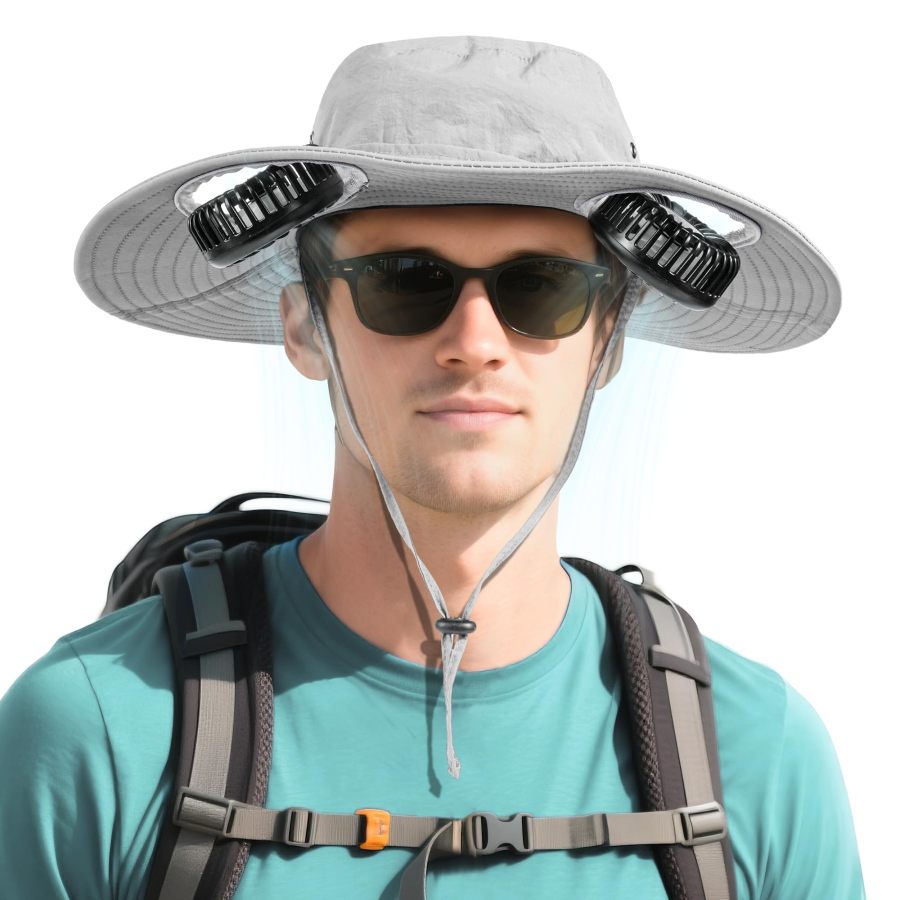
A solar-powered cooling hat is an innovative outdoor headwear that combines a sun hat with a built-in fan. Its purpose is to provide dual protection for users in hot outdoor environments: blocking UV rays through a wide brim and UPF 50+ fabric, while using a battery-powered or solar-charged fan to deliver cool air to the face or neck, alleviating head heat and enhancing comfort during outdoor activities. This type of product is widely used in scenarios such as fishing, gardening, hiking, and outdoor work. The following table illustrates the key characteristics of consumer behavior in this category.
| Dimension | Segment | Description |
|---|---|---|
| Need Driver Type | Planned Purchase / Emergency-driven Purchase | Purchases typically stem from anticipated outdoor activities, work requirements, or sudden hot weather, with a clear need for sun protection and cooling. A significant proportion are also bought as gifts. |
| Purchase Frequency | Low Frequency / Seasonal | As a durable good, it's usually purchased once. Demand significantly increases during the peak spring and summer seasons for outdoor activities and in hot regions (e.g., the southern US). |
| Decision Complexity | Medium | Consumers compare comprehensive factors across different products, such as sun protection rating, fan performance, battery life, charging methods (solar/USB), and wearing comfort, but they do not conduct deep research. |
| Price Sensitivity | Medium | Price is an important consideration in the decision-making process. However, if the product offers a significant experiential upgrade or solves a core pain point, users are willing to pay a reasonable premium. |
| Emotional Dependency | Medium | It satisfies the physiological comfort derived from functional sun protection and cooling needs, while also providing the emotional value and peace of mind associated with 'beating the heat and enjoying the outdoors.' |
II. User Personas & Usage Scenarios
2.1 Outdoor Workers/Laborers in Extreme Heat
🎯 Engage in prolonged outdoor manual labor under the scorching sun (e.g., gardening, mowing, construction, mail delivery) and have a rigid need for sun protection, continuous cooling, and hands-free operation.
| Typical Usage Scenarios | Core Pain Points | Primary Purchase Drivers |
|---|---|---|
|
|
|
2.2 Vacation Travelers & Casual Outdoor Enthusiasts
🎯 Focus on travel experiences, hoping to enjoy both sun protection and comfort during outdoor leisure or vacations. They have certain requirements for product portability, versatility, and appearance.
| Typical Usage Scenarios | Core Pain Points | Primary Purchase Drivers |
|---|---|---|
|
|
|
III. User Needs Hierarchy (KANO Model)
3.1 Basic Needs (Must-Haves)
- Basic sun protection function: The hat must provide UPF 50+ level UV protection, ensuring the face and neck are shielded from sunburn. This is the fundamental premise for purchasing this type of product.
- Wide brim: The brim must be wide enough to effectively block sunlight, providing sufficient shade coverage for the face and neck, preventing direct sun exposure.
- Basic heat dissipation and ventilation: The hat material itself should be breathable, and the built-in fan should provide some airflow to alleviate head heat and prevent heat buildup.
- Secure fit: The hat should fit securely on the head, not wobbling or falling off due to slight movement or wind, ensuring reliability for outdoor use.
3.2 Performance Needs (Linear Satisfiers)
- Powerful and stable fan airflow: The fan should produce a noticeable, stable cool breeze that effectively lowers the perceived temperature, not just a weak airflow.
- Long battery life: After a full charge, the fan should operate for several hours (at least 4-8 hours), meeting the needs of prolonged outdoor activities and reducing charging frequency.
- Multiple charging methods: Support for both USB charging and solar charging increases convenience and emergency preparedness for outdoor use, ensuring uninterrupted power.
- Lightweight design and comfortable fit: The overall hat weight should be light, with no burden during wear. Adjustable designs should ensure a secure fit for different head sizes without wobbling, and be comfortable for extended periods.
3.3 Excitement Needs (Delighters)
- 2-in-1 detachable fan design: The fan can be detached from the hat to be used as a standalone neck fan, increasing product versatility and flexibility, offering more value for money.
- Anti-droop brim design: The brim has a built-in support structure to prevent sagging due to fan weight or sweat, maintaining clear vision and enhancing wearing comfort and safety.
- Quiet fan technology: The fan maintains low noise levels even at high speeds, not interfering with user conversation, listening to music, or enjoying quiet outdoor experiences, providing a more immersive feel.
- Integrated mosquito net protection: Some products include a stowable mosquito net or face shield, providing additional protection against insects, especially suitable for marshes, woodlands, or buggy environments.
3.4 Unmet Needs & Opportunities
-
Low actual efficiency of solar charging: User feedback indicates the solar fan only works effectively under strong, direct sunlight. Once in shade or under insufficient light, the airflow weakens significantly or stops, limiting practicality and failing to meet the advertised 'unlimited runtime' effect.
User Reviews (VOC) The solar on works if the sun is direct on it. So if your facing the sun you have to turn your head so the fan comes on, but it will only come on the 1 side that the sun is hitting. // The solar option was useless, although it seems to be a good idea, the solar panels are not big enough to capture the sunlight depending on the relative angle to the sun, so after some minutes I used it solely on batteries.
-
Fans are not securely fixed or easily detach: Some products use a clip-on design for the fans, but the fixation is unstable. The fans easily wobble, tilt, or even fall out when the user moves or is active, affecting the user experience and product durability.
User Reviews (VOC) The fans that go in the circles do not stay in place at all. If you tilt your head forward they fall out. It has a plastic flimsy tiny clip that is supposed to secure it in place, but it can't possibly hold the fans in place. // Unfortunately, the fans don't stay in place well at all. Even with the slightest head movement, they fall out, which makes it frustrating to use.
-
Brim droop and uneven weight distribution: The weight of the fans causes the front of the brim to droop, blocking the user's line of sight; or the overall hat is too heavy, causing pressure on the forehead or neck discomfort during prolonged wear.
User Reviews (VOC) The fans are heavy enough to make the brim of the hat flop over the eyes of the wearer. // The hat already seems to bend in the front from the fans weight. It doesn't bother me, but it would be nice if it held shape.
-
Fan noise disturbance: Fans produce noticeable noise at high speeds, interfering with outdoor conversation, listening to ambient sounds, and even causing auditory fatigue.
User Reviews (VOC) The fans are loud! Can't hear a word anyone is saying (or cars coming while on a walk, etc.) especially if the hat is flipped and the fans are in the back, right next to your ears. // Good but noisy
-
Poor charging port durability: Some users report that the charging port is easily damaged or has poor contact, preventing normal charging and causing the core fan function to fail, impacting product lifespan.
User Reviews (VOC) the port was broken // a defect with the USB port making it very very difficult to insert the cable
IV. User Decision Drivers
4.1 Key Decision Factors
- Actual cooling effect: Consumers are most concerned about whether the fan provides a perceptible cool breeze and genuinely alleviates heat discomfort in hot environments. This is the core purpose of purchasing such a product.
- Sun protection factor and coverage: As the essential function of a sun hat, UPF 50+ and the facial/neck protection provided by a wide brim are the foundational considerations for purchase, directly related to skin health.
- Fan battery life: Users want the fan to operate long enough to cover their entire outdoor activity, avoiding frequent charging or battery anxiety.
- Wearing comfort and stability: Whether the hat can be worn comfortably for long periods without heaviness or pressure, and whether the brim stays stable without blocking vision, are key to user experience and frequency of use.
4.2 Secondary Decision Factors
- Flexibility of charging methods: Beyond USB charging, solar charging as a supplementary or emergency method increases product appeal, especially for prolonged outdoor users.
- Fan noise level: While meeting cooling needs, users want the fan noise to be within an acceptable range, not interfering with conversation or causing auditory fatigue.
- Fan speed settings: Multiple speed settings allow users to choose appropriate airflow based on the environment and personal preference, enhancing the personalized experience.
- Multifunctional design: Features like detachable fans, integrated mosquito nets, water resistance, and quick-drying materials can meet additional user needs in different outdoor scenarios, adding product value.
- Material quality and durability: The breathability, moisture-wicking properties of the fabric, and overall construction and wear resistance affect product lifespan and value for money.
V. Selling Points & Competitive Landscape
5.1 Selling Point Analysis
5.1.1 Standard Features (Points of Parity)
- UPF 50+ UV protection: The sun protection rating emphasized by almost all products, ensuring effective blocking of harmful UV rays. It is the core selling point of the category, meeting user health needs.
- Wide brim design: Provides comprehensive coverage for the face and neck, a visual feature for achieving sun protection and shade, and a basic function widely recognized by users.
- Dual power mode (Solar + USB): Combining solar and built-in battery/USB charging, emphasizing charging flexibility and battery life assurance. It is a common configuration in this category, aimed at alleviating user battery anxiety.
- Multi-speed fan settings: Offering 2-6 wind speed options allows users to adjust airflow based on needs, increasing usage flexibility and personalized comfort.
- Suitable for various outdoor scenarios: Products are commonly advertised as suitable for fishing, gardening, hiking, camping, travel, and other outdoor activities, emphasizing product versatility and multifunctionality.
5.1.2 Key Differentiators
- 2-in-1 detachable neck fan design: The fan unit can be detached from the hat to be used as a standalone neck fan, increasing product practicality and portability. Some brands emphasize this feature, offering more usage options.
- Anti-droop/Stable brim design: Addressing the issue of fan weight causing brim droop, some products emphasize their sturdy brim structure that remains upright, not blocking vision, enhancing wearing safety.
- Waterproof/Quick-dry/Moisture-wicking material: Emphasizing fabric functionality, such as resistance to rain and sweat, keeping the head dry and comfortable, improving adaptability in harsh environments.
- Integrated mosquito net: A few products offer a stowable mosquito net design, providing users with additional insect protection, meeting needs in specific scenarios (e.g., bug-infested areas).
5.1.3 Unique Selling Propositions (USPs)
- High-capacity battery (e.g., 5200mAh): A few products like those from AMACOOL offer battery capacities (e.g., 5200mAh) far exceeding competitors, emphasizing ultra-long runtime as a core competitive advantage to attract specific user groups.
- Flexible adjustable fan arms: AMACOOL's product specifically mentions fan heads on flexible arms that can be adjusted 360 degrees for more precise airflow direction, increasing personalized experience.
5.2 Competitive Landscape
5.2.1 Market Maturity
The solar-powered cooling hat category is in a rapid growth phase. Products have reached a basic consensus on core sun protection and cooling functions. Most product selling points are converging, focusing on basic features like wide brims, UPF 50+, dual power, etc., indicating initial homogenization. However, as the product integrates electronic components, user expectations for performance (e.g., airflow, battery life, noise) and quality are higher, and the market still needs further maturation and standardization.
5.2.2 Innovation Trends
Current innovation trends in the category mainly focus on enhancing user experience and solving existing pain points. Examples include increasing product flexibility through 2-in-1 detachable designs; reinforcing brim structure to address droop caused by fan weight; and exploring lighter, quieter fan technology to improve wearing comfort. Additionally, adding features like integrated mosquito nets for specific scenarios reflects attention to niche needs. In the long term, more efficient and stable solar charging technology (beyond just direct drive) will be a core competitive differentiator.
VI. Marketing Claims vs. Reality Check
The table below analyzes the gap between common marketing claims and actual user experiences in this category:
| Dimension | Marketing Claim | User Reality | Verdict |
|---|---|---|---|
| Solar charging efficiency | Efficient solar power supply, provides unlimited use/automatic charging in sunlight, eco-friendly and convenient. | Users widely report that the solar fan only works marginally under strong, direct sunlight. Once in shadow, under clouds, or when the head turns, airflow weakens significantly or stops. It cannot effectively charge the battery, making its practicality far below expectations. | A typical case of using the 'solar' concept as a marketing gimmick without adequately considering the physical limitations of actual sunlight conditions and solar panel conversion efficiency. This causes the core selling point to fail for users, creating a significant experience gap. |
| Product weight and wearing comfort | Ultra-lightweight design, weightless wear, light and comfortable. | Multiple users report the product (especially with built-in fans and solar panels) feels 'heavy.' Prolonged wear causes pressure on the forehead or neck discomfort, even leading to brim droop, severely contradicting the 'ultra-light' claim. | Integrating fans and batteries inevitably increases product weight. Sellers, however, over-promote 'ultra-light,' failing to objectively weigh the physical compromise between functionality and comfort, seriously misleading user expectations about the wearing experience. |
| Fan quietness effect | Built-in high-speed quiet fan, provides quiet cool air. | Users widely report noticeable fan noise at high speeds (e.g., 'buzzing sound,' 'a bit loud'), which interferes with conversation or peaceful outdoor experiences, contradicting the 'quiet' claim. | It's a physical fact that small, high-speed fans generate noise in confined spaces. Sellers exaggerate the 'quiet' effect, overlooking user expectations for an immersive outdoor experience, making noise a common complaint. |
| Stability of fan mounting structure | Stable anti-droop design, ensures fans are securely fixed and won't fall off. | Numerous users report that the plastic clips or connectors for the fans are fragile, easily breaking, loosening, or detaching during daily use or slight movement, causing the fans to become unfixed or non-functional. | To reduce costs or simplify structure, insufficiently strong plastic fasteners are used, creating a fatal flaw in the durability of a core functional component. This severely impacts long-term user experience and product reputation. |
Key Takeaway: The market exhibits a widespread tendency for parameter inflation and exaggerated scenario-based experience claims, especially regarding battery life, solar efficiency, and product weight. There is a significant gap between marketing promises and actual user experience.
VII. Supply-Demand Misalignment Analysis
The table below highlights mismatches between seller focus and buyer priorities:
| Dimension | Seller Behavior | User Focus | Verdict |
|---|---|---|---|
| Actual effectiveness of solar power supply | Widely promote 'solar power supply' as a core selling point, implying it provides continuous, unlimited outdoor cooling. | User feedback indicates the solar fan only works marginally under strong, direct light and stops in shade or low light, offering limited practical value. They rely more on USB charging. | Sellers are self-congratulatory about 'having the technology' but ignore how 'the technology's effectiveness' decisively impacts user experience. This leads to a huge gap between user expectations and the reality of solar functionality, causing a trust crisis. |
| Overall product weight and brim support | Commonly advertise products as 'lightweight,' 'anti-droop,' but fail to clarify the actual weight with fans and its impact on brim support. | Many users complain the hat is 'too heavy,' 'brim droops blocking vision,' causing discomfort during prolonged wear and affecting activity and safety. | Sellers are collectively silent on the most basic aspect of wearing comfort, failing to confront physical reality. This leads to poor user experience, a high-frequency reason for returns and negative reviews, severely hindering the functional value of the product. |
| Fan noise control | Some sellers advertise 'quiet fans,' but most avoid this topic, failing to position it as an important product optimization direction. | Users widely report noticeable fan noise interfering with outdoor conversation, listening to ambient sounds, and even causing auditory fatigue, affecting the relaxing outdoor experience. | Sellers fail to capture users' deep need for a 'quiet and comfortable' outdoor experience. The noise issue becomes a common but unresolved pain point, limiting the product's application potential in more scenarios. |
| Secure fixation of fans and components | Generally emphasize the fan's cooling effect but rarely mention how the fan is fixed to the hat and its durability. | Users frequently report fans easily detaching, brackets breaking, solar panels coming unglued, severely impacting product reliability and lifespan. | Sellers have a blind spot regarding the most basic structural reliability of the product, underestimating user requirements for product durability. This turns core functional components into 'fragile items,' directly impacting user confidence. |
Key Takeaway: Sellers generally over-rely on the 'solar' concept for marketing while ignoring its inefficiency in practical application. Simultaneously, there is a collective silence from sellers regarding critical flaws like product weight, noise, and fan fixation that impact core user experience.
VIII. Strategic Opportunities & Recommendations
8.1 Optimize Brim Support and Fan Security
8.1.1 Target Audience & Pain Points
⚡️ Pain Points Addressed: Brim droop and uneven weight distribution; fans not securely fixed or easily detaching.
8.1.2 Action Plan
Use lightweight memory metal or high-strength engineering plastic for the brim support skeleton to ensure the brim doesn't collapse under fan weight. Redesign the fan clip mechanism, using deeper, more wear-resistant locking structures or a magnetic + mechanical latch dual-fixation to enhance security.
| Tech Complexity | Medium |
| Cost Impact | Medium Impact |
| Trade-off Warning | Improving brim stiffness and fan fastener strength may slightly increase product weight, but structural optimization can minimize the impact. |
| Price Band | Only viable above $24.99 |
8.1.3 Marketing Strategy
Emphasize 'Stable as a rock, clear vision without obstruction.' Use comparison videos to show the hat remaining secure during vigorous activity. Highlight 'Crafted structure, born for reliability' to dispel user concerns about falling off and blocked vision.
8.2 Enhance Fan Quietness and Realistic Battery Life
8.2.1 Target Audience & Pain Points
⚡️ Pain Points Addressed: Fan noise disturbance; battery life not matching advertised claims.
8.2.2 Action Plan
Upgrade fan motors to high-quality brushless types, optimize blade aerodynamics, and add internal noise-dampening structures. Increase battery capacity to a level that genuinely achieves 8+ hours of runtime on high (e.g., 3500mAh), and clearly label real-world runtime per speed setting in the listing.
| Tech Complexity | Medium |
| Cost Impact | Medium Impact |
| Trade-off Warning | Using quieter brushless motors and optimizing blade design may slightly increase fan module cost. Increasing battery capacity brings a minor increase in weight and volume. |
| Price Band | Only viable above $29.99 |
8.2.3 Marketing Strategy
Highlight 'Whisper-quiet operation, pure outdoor enjoyment.' Provide authoritative noise decibel test reports. Emphasize 'Real battery life, unafraid of time challenges.' Showcase scenes of users conversing or reading easily while wearing the product.
8.3 Reposition Solar Charging as Emergency/Auxiliary, Not Primary
8.3.1 Target Audience & Pain Points
⚡️ Pain Points Addressed: Low solar charging efficiency and strong limitations; large user expectation gap.
8.3.2 Action Plan
Keep existing solar panels but optimize the power management chip to enable more efficient trickle charging in low light, allowing the battery to accumulate charge slowly even if it can't power the fan directly.
| Tech Complexity | Low |
| Cost Impact | Low Impact |
| Trade-off Warning | This is essentially a marketing strategy adjustment and user education, not a major product change. |
| Price Band | No Price Band Jump |
8.3.3 Marketing Strategy
Reposition solar as 'Smart emergency charging' or 'Extended standby time' rather than 'Unlimited runtime.' Emphasize 'Daylight micro-recharge, USB main charge on cloudy days,' clearly informing users of usage expectations under different light conditions to build a pragmatic and reliable brand image.
8.4 Enhance Product Universality and Fit Customization
8.4.1 Target Audience & Pain Points
⚡️ Pain Points Addressed: Insufficient size universality; imbalanced wearing center of gravity.
8.4.2 Action Plan
In addition to the existing drawstring, add removable inner padding or Velcro strips, allowing users to make finer adjustments based on head size and hairstyle, offering multiple thickness options. Optimize the hat's center of gravity for more even distribution of fan weight.
| Tech Complexity | Low |
| Cost Impact | Low Impact |
| Trade-off Warning | Adding adjustable components or structures may slightly increase manufacturing cost and part count. |
| Price Band | No Price Band Jump |
8.4.3 Marketing Strategy
Emphasize 'Customized comfort, fits all head shapes.' Use diagrams to illustrate how to use adjustment features for a perfect fit. Highlight 'No more head pressure, light and stable all day.'