Amazon US Market Analysis: Corner Tension Shower Caddy Category
📊 Executive Summary
📈 Market Trends
The shower caddy market is highly homogenized, with user demand for basic quality escalating. As consumers demand higher aesthetics and practicality in home environments, demand for no-drill, high-capacity shower caddies is strong. However, market products generally remain at the level of functional claims, lacking substantive quality breakthroughs, leading to a notable gap between user expectations for stability, rust-proofing, and installation ease and their actual experience.
⚡ Major Pain Points
Stability and rust-proofing are core weaknesses; installation experience urgently needs improvement. The most concentrated negative user feedback involves caddy rod wobbling, shelf slippage, or even total collapse, along with products rusting within a short period, severely impacting safety and aesthetics. Additionally, vague instructions and difficult size adaptation cause significant user frustration and returns. These pain points directly reveal the market's failure to deliver on basic product promises.
💡 Selection Opportunities
Deepen core functions, return to pragmatic marketing, build user trust. The real opportunity lies in: investing in R&D to enhance tension rod structural stability and shelf fixation security, fundamentally solving wobbling and falling; using genuinely high-quality rust-proof materials and transparent material information to rebuild user trust; optimizing instructions and providing detailed size adaptation guides to lower user barriers. In a homogenized competitive landscape, only by solidifying the product can one win the market and user loyalty.
I. Analysis Overview
1.1 Introduction & Report Scope
This report analyzes the 'Shower Caddies' category (specifically, corner tension shower caddies) in the Amazon US market, focusing on target user personas, core needs, decision drivers, market communication, and potential opportunities.
1.2 Category Snapshot
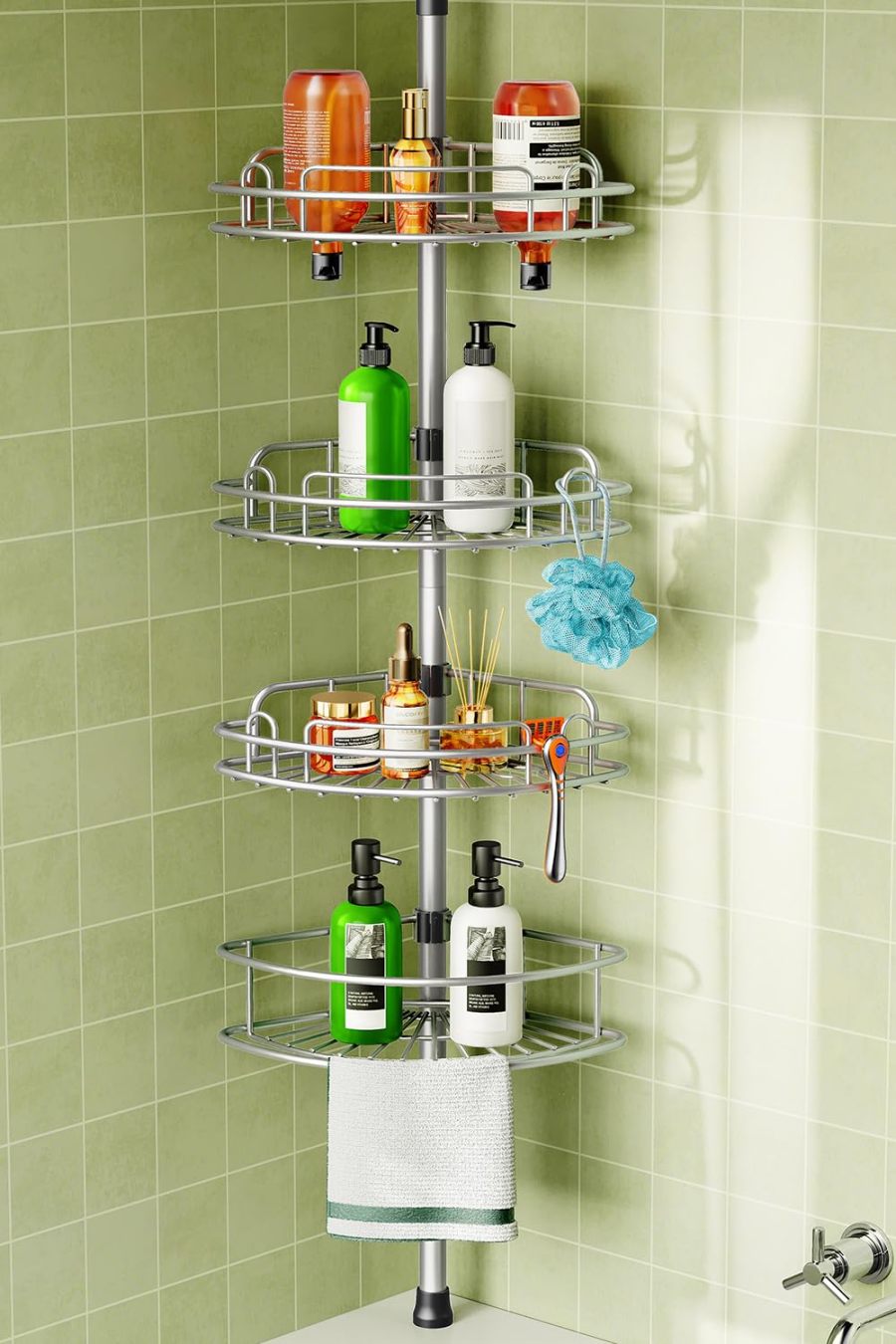
A corner tension shower caddy is a no-drill vertical storage solution for bathroom corners, utilizing a tension rod principle. It typically features multiple adjustable shelves for holding shower products like shampoo and body wash, aiming to solve the pain points of limited bathroom space and clutter. This product is a common organizational tool for modern bathrooms, especially in rental units or homes with compact bathrooms. The following table illustrates the key characteristics of consumer behavior in this category.
| Dimension | Segment | Description |
|---|---|---|
| Need Driver Type | Planned Purchase / Emergency-driven Purchase | Purchases typically stem from planned bathroom space organization, moving needs, or emergency replacement due to failure of existing solutions (e.g., rusting, collapsing). Users have clear considerations for functionality and convenience. |
| Purchase Frequency | Low | As durable goods, purchases are usually one-time. Replacement is considered only when the product is damaged, rusts, or during a move, resulting in a long repurchase cycle. |
| Decision Complexity | Medium | Consumers compare factors like stability, rust-proof materials, ease of installation, capacity, and price. They typically do not conduct in-depth research, preferring comprehensive evaluation and word-of-mouth. |
| Price Sensitivity | Medium to High | Price is an important consideration. However, users are willing to pay a reasonable premium for more reliable stability, longer rust-proof life, and a more convenient installation experience, rather than blindly pursuing low prices. |
| Emotional Dependency | Low to Medium | Primarily based on functionality (tidiness, convenience) and a sense of security (not collapsing, not rusting). Emotional value lies in the peace of mind and comfort derived from reducing bathroom clutter. |
II. User Personas & Usage Scenarios
2.1 Home Organization-Focused Family User
🎯 Multi-member households with a large volume and variety of bathroom products, urgently needing efficient, tidy storage space. They have high requirements for product durability and safety.
| Typical Usage Scenarios | Core Pain Points | Primary Purchase Drivers |
|---|---|---|
|
|
|
2.2 Renter / Small Space Dweller
🎯 Lives in an apartment or has a compact bathroom, requiring no-drill, easy-to-install, and portable storage solutions to maximize vertical space without leaving marks.
| Typical Usage Scenarios | Core Pain Points | Primary Purchase Drivers |
|---|---|---|
|
|
|
III. User Needs Hierarchy (KANO Model)
3.1 Basic Needs (Must-Haves)
- Core Stability: The caddy must firmly brace between the ceiling and floor without wobbling or tilting. This is the minimum requirement for its function as a freestanding storage tool.
- Basic Rust Resistance: The product material should not show significant rust in the short term in the humid bathroom environment, a common expectation for bathroom metal products.
- No-Drill Installation: As a tension rod design, installation without wall drilling is its core advantage and user expectation, differentiating it from traditional caddies.
- Basic Storage Capacity: Must at least hold a few basic shower items like shampoo and body wash for daily family use.
3.2 Performance Needs (Linear Satisfiers)
- High Load-Bearing Capacity: Ability to stably hold multiple large bottles (e.g., salon sizes) without deformation or shelf slippage, meeting high household demand.
- Height & Shelf Adjustability: The rod should adapt to different bathroom heights, and shelves should be independently adjustable to fit various bottle sizes and user heights.
- Shelf Non-Slip & Secure Fixing: Shelves should not easily slide or tilt when holding items, especially when pressing pump heads, to prevent items from falling.
- Quick Drainage & Easy Cleaning: Shelf bottom design should facilitate drainage, prevent water accumulation and bacteria growth, and material should be smooth and easy to wipe.
- Aesthetic Design & Material Quality: Product appearance should be modern and minimalist, blending with bathroom decor. Material feel and visual quality should match price expectations.
3.3 Excitement Needs (Delighters)
- Multi-Functional Integrated Accessories: Inclusion of separate soap dishes, toothbrush holders, towel bars, and multiple hooks for detailed organization of small items, enhancing convenience.
- Patented Lock/Innovative Fixing Mechanism: Unique stability technology, such as stronger spring structures or more reliable locking designs, providing unexpected stability and peace of mind.
- Efficient Space-Use Designs (L-Shaped/Diamond-Shaped): Non-traditional fan or arc designs that fit corners more tightly, maximizing shower space and enhancing aesthetics.
- Long-Term Warranty & Responsive Support: Providing warranty service exceeding one year with responsive customer service to effectively resolve installation and usage issues, boosting purchase confidence.
3.4 Unmet Needs & Opportunities
-
Shelf Slippage Failure: Multiple user reports indicate that shelves easily slide down or sink from the rod even under normal load, failing to stay at the set height and causing items to spill.
User Reviews (VOC) the shelves continually slide down. // the shelves don't stay put. // the shelves tend to slide down.
-
Insufficient Overall Tension Rod Stability: Widespread issues of tension rods failing to maintain sufficient tension, causing wobbling, loosening, or even sudden collapse during use, leading to item damage and safety hazards.
User Reviews (VOC) it keeps falling down every couple of days. // pole wobbles, shelves don't stay in place, and keep falling down. // the spring in the pole gave out and fell in our shower.
-
Brittle Plastic Connector Cracking: Plastic clips or brackets connecting shelves in some products are prone to brittle fracture, causing shelf failure or detachment, severely impacting product lifespan.
User Reviews (VOC) brittle plastic shelf holders breaking // one of the shelve pieces have cracked. // multiple parts break, including the plastic clips holding the shelves, and one customer mentions it literally disintegrated in the shower.
-
Installation Size Matching & Unclear Instructions: Users face time-consuming, difficult assembly due to complex rod combinations, confusing unit conversions (e.g., centimeters), or unclear diagrammatic instructions, preventing perfect fit or optimal tension.
User Reviews (VOC) the adjustment mechanism felt a little finicky at first, and the instructions could be clearer. // It was kind of a pain to put together, especially being 5’3” short. // instructions are confusing because they don't lable rods
-
Long-Term Rust Performance Mismatch with Claims: Despite most products claiming rust resistance, many users report rust appearing after months of use in humid bathrooms, indicating a significant gap from the seller's core promise.
User Reviews (VOC) it started to rust already. // it has rusted inside and the tension is no longer there!
IV. User Decision Drivers
4.1 Key Decision Factors
- Structural Stability & Anti-Tipping: Users' top concern is whether the caddy remains stable, without wobbling or collapsing during daily use (especially with heavy items or pump presses), ensuring item and personal safety. This is a deal-breaker.
- Material Rust-Proof Durability: Whether the product can remain rust-free and undeformed long-term in humid bathrooms directly determines its lifespan and user experience, a core consideration for avoiding frequent replacements.
- Installation Ease & No-Drill: A tool-free, quick, simple installation process that doesn't damage walls is a key decision factor for renters and users seeking hassle-free solutions.
- Actual Load-Bearing Capacity: Ability to stably hold multiple heavy items like large shampoo and body wash bottles is a key metric for measuring product practicality and reliability.
4.2 Secondary Decision Factors
- Height & Shelf Adjustability Flexibility: Whether the product adapts to different bathroom heights and whether shelves adjust flexibly to fit various bottle sizes and user needs.
- Large Capacity & Multi-Functional Accessories: Overall storage space and inclusion of extra hooks, soap dishes, toothbrush holders, etc., to enhance organization efficiency and convenience.
- Aesthetic Design & Material Quality: Whether the product is visually appealing, blends with bathroom style, and the actual material feel/visuals meet expectations.
- Drainage & Easy-Clean Design: Whether shelf bottoms facilitate drainage, prevent water/bacteria buildup, and surfaces are smooth and easy to wipe, reducing maintenance burden.
- After-Sales Service & Warranty: Whether the brand offers clear warranty policies and responsive customer support to mitigate purchase risk and resolve usage issues.
V. Selling Points & Competitive Landscape
5.1 Selling Point Analysis
5.1.1 Standard Features (Points of Parity)
- No-Drill, Quick Installation: Almost all products emphasize tool-free, minutes-long installation, catering to user demand for convenience.
- Stainless Steel/Coated Rust-Proof Material: Common claims of using stainless steel or coated metal with rust/water resistance to handle humid bathroom environments.
- 4-Tier Large Capacity/Adjustable Shelves: Most products offer four tiers, emphasizing large capacity and adjustability to meet diverse storage needs.
- Height Adjustable (e.g., 47-121 inch range): Widespread promotion of product adaptability to various bathroom ceiling heights, emphasizing broad applicability.
- Space-Saving/Corner Design: Emphasis on using vertical corner space to effectively solve small bathroom storage issues and free up floor space.
5.1.2 Key Differentiators
- Patented Lock/Upgraded Tension Technology: Some brands highlight unique locking designs or internal tension mechanisms to enhance post-installation stability and anti-slip performance.
- Integrated Multi-Functional Accessories: Some products offer extra toothbrush holders, soap dishes, towel bars, or multiple hooks for more detailed categorized storage.
- L-Shaped/Diamond-Shaped Shelf Design: Few products use L-shaped or diamond-shaped shelves, aiming for more efficient corner space use or enhanced visual appeal than traditional fan shapes.
- 304 Stainless Steel Material Emphasis: Some brands explicitly specify 304 stainless steel to reinforce rust-proof quality, differentiating from ordinary stainless or carbon steel.
- Flat Tray Shelves: Few products use flat trays instead of wire baskets, solving the issue of small items tipping over or falling through gaps.
5.1.3 Unique Selling Propositions (USPs)
- 360-Degree Rotating Shelves: Very few products offer 360-degree rotating shelves, aiming to facilitate access to items in the back (like Shuang Qing).
- 6-Tier Shelf Configuration: Some products (e.g., Vatex, Tondid) offer up to six tiers, far exceeding the mainstream four-tier configuration, to meet ultra-large capacity storage needs.
5.2 Competitive Landscape
5.2.1 Market Maturity
The corner tension shower caddy market has entered maturity, with high homogenization in core functions (no-drill, rust-proof, multi-tier storage). Competition now focuses on price, brand marketing, and minor feature points. However, widespread market issues of over-marketing and unstable product quality leading to user experience gaps indicate opportunities for products that genuinely solve core pain points to break through.
5.2.2 Innovation Trends
Current innovation trends focus on enhancing long-term stability and durability (e.g., more reliable tension mechanisms, authentic rust-proof materials) and optimizing installation experience and detail functions (e.g., clearer instructions, finer size adaptation). Some brands also attempt differentiation through special shape designs or integrating more accessories. The core challenge remains delivering on the promises of 'sturdy and non-collapsing' and 'never rusts'.
VI. Marketing Claims vs. Reality Check
The table below analyzes the gap between common marketing claims and actual user experiences in this category:
| Dimension | Marketing Claim | User Reality | Verdict |
|---|---|---|---|
| Stability & Anti-Tipping | Claims like 'never falls', 'sturdy anti-tip design', 'patented lock ensures rock-solid stability'. | Numerous user reports of tension rods loosening, wobbling, or even collapsing during daily use or pump presses, with shelves prone to slipping. Some products have brittle plastic connectors failing to maintain structural integrity. | Typical substitution of real-world dynamic usage stability with ideal lab conditions or static load data, ignoring the physical limits and material fatigue of tension rods in humid environments under long-term force and frequent interaction. This leads to a severe mismatch between user expectations and actual experience, constituting a safety hazard. |
| Rust-Proof Durability | Widespread promotion of 'stainless steel material, rust-proof and durable, lasting beauty', implying the product stays new for a long time. | Many users report rust appearing after months (even as short as two weeks) of use, especially with non-304 stainless steel or poor-quality coated products, severely contradicting the 'rust-proof' promise. | Sellers mislead consumers using the 'stainless steel' concept. Actual products may use low-grade steel or inferior coatings, unable to resist long-term humid bathroom erosion, leading to premature product failure and severely damaging brand trust and user satisfaction. |
| Installation Ease & Size Adaptation | Claims of '5-minute quick installation', 'no tools needed, fits all bathroom heights'. | User feedback cites unclear instructions (e.g., centimeter units, unlabeled parts), complex rod assembly, difficult height fine-tuning. Some users cannot install due to size mismatch or need extra strength/skill for top installation. | Sellers underestimate the learning curve and need for precise size matching during actual operation, oversimplifying installation difficulty without providing sufficient support (e.g., clear video tutorials). This leads to user frustration at the initial installation stage, negatively impacting first-use experience. |
Key Takeaway: The market is rife with parameter inflation and exaggerated scenario-based experiences, especially regarding product stability, rust-proof lifespan, and installation ease. There is a severe gap between marketing promises and actual user experience.
VII. Supply-Demand Misalignment Analysis
The table below highlights mismatches between seller focus and buyer priorities:
| Dimension | Seller Behavior | User Focus | Verdict |
|---|---|---|---|
| Core Tension Rod Stability | Widespread promotion of 'patented lock design', 'upgraded tension technology' as selling points, using exaggerated visuals (e.g., placing dumbbells) to emphasize load-bearing and stability. | Users most frequently complain about tension rod loosening, wobbling, collapse, and shelf slippage, indicating existing 'patents' and 'upgrades' haven't fundamentally solved stability issues. | Sellers indulge in 'in-house technology' hype without effectively translating it into a reliably perceivable stability experience for users. This gap between 'technology exists' promotion and 'technology effectiveness' absence creates a huge discrepancy, leaving users' core functional pain points unaddressed and becoming the root cause of trust collapse. |
| Long-Term Rust-Proof Performance | Almost all sellers claim 'stainless steel', 'rust-proof and durable' as standard features, lacking actual long-term performance promises or proof. | Numerous user reports of products rusting in a short time, severely contradicting claims. Rust-proofing is a basic, high-frequency user need for bathroom products, but market supply fails to truly meet it. | Sellers are collectively silent on this basic, high-frequency pain point, failing to provide truly reliable solutions or transparent material information. This leads to declining user trust and contributes to the vicious cycle of low-price competition. |
| Installation Instructions & Size Adaptation Details | Widespread promotion of '5-minute quick install', 'height adjustable fits all bathrooms', without providing clear, easy-to-understand guides or detailed size matching advice. | High-frequency complaints about vague instructions, difficult unit conversion, complex rod assembly, leading to time-consuming, laborious, or failed installations, diminishing first-use experience. | Sellers have a strategic blind spot regarding product ease of use (especially first-install experience), underestimating user needs for clear guidance and precise adaptation. This significantly reduces the 'out-of-box' experience, directly impacting user satisfaction and word-of-mouth. |
Key Takeaway: Sellers generally over-rely on homogeneous selling points like 'no-drill' and 'large capacity' for marketing, while collectively neglecting users' deeper pain points regarding core product stability, genuine rust-proof performance, and installation ease.
VIII. Strategic Opportunities & Recommendations
8.1 Enhance Core Structural Stability & Anti-Slip Design
8.1.1 Target Audience & Pain Points
⚡️ Pain Points Addressed: Shelf slippage failure, insufficient overall tension rod stability, brittle plastic connector cracking.
8.1.2 Action Plan
Redesign shelf fixing clips using sturdier engineering plastic or metal-embedded structures to ensure non-slip and crack resistance. Strengthen the internal spring mechanism of the telescopic rod, optimize rod connection tolerances to reduce wobble. Consider adding grooves or locking holes on the rod for more secure shelf clip locking. Explore introducing intermediate fixation points (e.g., wall suction cups or adhesive brackets) as auxiliary stability enhancers.
| Tech Complexity | Medium |
| Cost Impact | Medium Impact |
| Trade-off Warning | Thickening the rod or adding internal structures may slightly increase product weight and volume, but it's a worthwhile trade-off for functional improvement. |
| Price Band | Only viable above $45.99 |
8.1.3 Marketing Strategy
Emphasize 'Structural Upgrade, Steady as a Rock, Farewell to Wobbling and Falling'; showcase superior stability during heavy item placement and pump presses via slow-motion video; provide third-party load test reports and highlight a '10-Year Structural Warranty' promise.
8.2 Genuine Rust-Proof Promise & Material Transparency
8.2.1 Target Audience & Pain Points
⚡️ Pain Points Addressed: Long-term rust performance mismatch with claims.
8.2.2 Action Plan
Explicitly use 304 or 316 stainless steel for core rod materials and apply multi-layer high-quality anti-rust coatings (e.g., electrophoresis + powder coating) to all metal parts. Clearly label specific material grades and rust-proof processes in product descriptions and listings, avoiding vague claims.
| Tech Complexity | Low |
| Cost Impact | Medium Impact |
| Trade-off Warning | Using higher-grade stainless steel (e.g., 304/316) or superior coating processes increases cost but has no significant physical downsides. |
| Price Band | Only viable above $39.99 |
8.2.3 Marketing Strategy
Clearly mark 'Genuine 304 Stainless Steel, 10-Year Rust-Proof Promise'; showcase material certificates or rust test results via images; educate users on differentiating stainless steel grades, emphasizing the long-term value of 'One Investment, Ten Years Worry-Free'.
8.3 Optimize Installation Experience & Size Adaptation Guide
8.3.1 Target Audience & Pain Points
⚡️ Pain Points Addressed: Difficult installation size matching/unclear instructions.
8.3.2 Action Plan
Provide detailed bilingual (English/Spanish) instructions with clear illustrations, labeling all rods and parts with letters/numbers. Offer online installation videos (scannable QR code) and include detailed charts on 'How to choose rod combinations based on different bathroom heights' (inches/cm) and 'How to fine-tune tension' tips. Ensure foolproof design for rod connections to prevent misassembly.
| Tech Complexity | Low |
| Cost Impact | Low Impact |
| Trade-off Warning | Mainly involves instruction design and packaging content optimization, with no additional physical side effects. |
| Price Band | No Price Band Jump |
8.3.3 Marketing Strategy
Emphasize 'Foolproof Installation, Done in 5 Minutes'; promote 'Exclusive Installation Video, Step-by-Step Tutorial'; highlight 'Precise Height Adaptation, Farewell to Size Worries', making the convenience and success rate of the installation process a core selling point.
8.4 Adaptation Solution for Sloped Ceiling/Non-Level Surface Bathrooms
8.4.1 Target Audience & Pain Points
⚡️ Pain Points Addressed: Not suitable for sloped ceilings/non-level surfaces.
8.4.2 Action Plan
Develop top/bottom ends with ball joints or rotatable/tiltable bases to self-adapt to non-level top or bottom surfaces. May require stronger internal locking mechanisms to compensate for non-vertical force, ensuring stability on slopes. This necessitates new mold development and structural design.
| Tech Complexity | High |
| Cost Impact | High Impact |
| Trade-off Warning | Requires designing adjustable-angle top/bottom bases, potentially increasing part complexity, manufacturing cost, and slightly affecting overall simplicity. |
| Price Band | Only viable above $69.99 |
8.4.3 Marketing Strategy
Highlight 'Customized Adaptation, Solving Special Bathroom Challenges'; emphasize 'Unafraid of Sloped Ceilings, Perfectly Integrates into Any Space'; target B2B clients like designers and renovation companies, showcasing unique value in solving special scenarios through case studies.