Amazon US Market Analysis: Double Hammock with Stand Category
📊 Executive Summary
📈 Market Trends
Portability and integration are mainstream, but quality and authenticity need improvement. Demand for double hammocks with stands is strong, with consumers generally seeking leisure solutions that require no fixed points, are easy to assemble, and work in multiple scenarios. However, market products are becoming homogenized amid price competition, with innovation focused on minor details while core pain points remain unaddressed. The market is mature but suffers from a significant trust deficit.
⚡ Major Pain Points
Inflated weight capacity and structural flaws are the core critical issues. Users are generally skeptical of advertised weight capacities, with frequent negative feedback on stand bending, wobbling, or even breaking. Poor hammock-to-stand size fit, inadequate outdoor weather resistance of cotton fabrics, and low-quality carrying bags collectively form a minefield of high return rates and negative reviews, severely impacting user satisfaction.
💡 Selection Opportunities
Deepen quality details to rebuild trust and value. Category opportunities lie in fundamentally enhancing the two-person comfort experience by optimizing the precise fit and adjustment flexibility between hammock and stand. Simultaneously, develop more weather-resistant, easy-to-clean outdoor-specific materials and upgrade stand rust-proofing processes to solve durability challenges for outdoor use. Most importantly, promise and deliver authentic weight capacity, supported by reliable portable storage solutions, to establish brand advantage and achieve premium pricing on the safety and practicality users care about most.
I. Analysis Overview
1.1 Introduction & Report Scope
This report analyzes the 'Hammock Stands' category (specifically double hammocks with stands) in the Amazon US market, focusing on target user personas, core needs, decision factors, market communication, and potential opportunities.
1.2 Category Snapshot
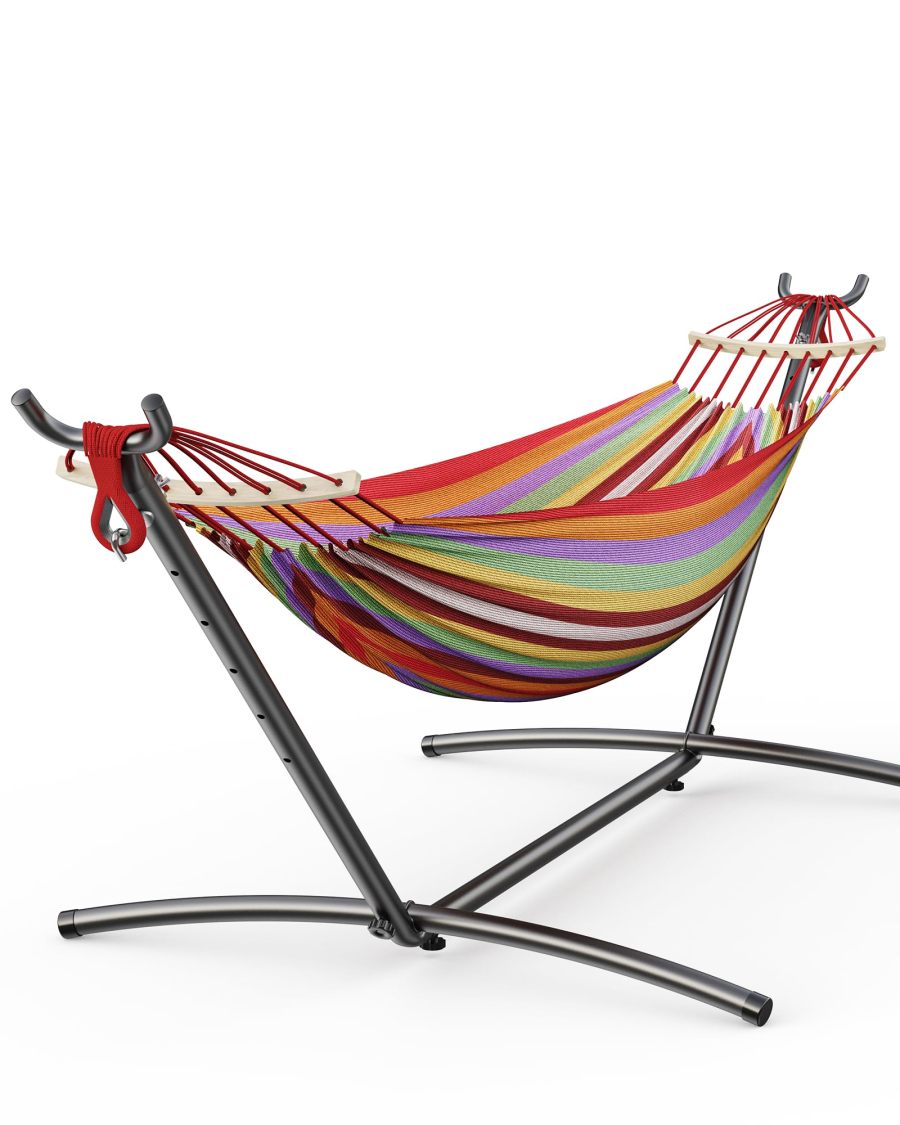
A double hammock with stand is an outdoor leisure furniture piece that can be used without relying on trees or other fixed points. It consists of a hammock bed for two people and an independently supported steel stand, typically including a carrying bag for easy transport and storage. Its core function is to provide a comfortable, relaxing space, commonly used in backyards, patios, balconies, camping, or for indoor leisure. The following table illustrates the key characteristics of consumer behavior in this category.
| Dimension | Segment | Description |
|---|---|---|
| Need Driver Type | Planned Purchase / Emotion-Driven / Emergency-driven Purchase | Purchases are typically driven by planned leisure activities or outdoor trips, or influenced by the comfortable atmosphere the product promises. For users without fixed hanging points, it is a problem-solving purchase. |
| Purchase Frequency | Low | As a leisure furniture item, hammocks typically have a long lifespan, resulting in low purchase frequency; they are not fast-moving consumer goods. |
| Decision Complexity | Medium | Consumers compare factors like weight capacity, materials, comfort, ease of assembly, and price but do not conduct deep research, making it a medium-complexity purchase decision. |
| Price Sensitivity | Medium | After basic functionality and comfort are met, price is a significant consideration. However, users are willing to pay a reasonable premium for products offering significant value in durability, portability, or functional innovation. |
| Emotional Dependency | Medium | Hammocks represent the user's aspiration for relaxation, comfort, and enjoying life, carrying moderate emotional and experiential value. However, practical functionality remains highly important in the decision-making process. |
II. User Personas & Usage Scenarios
2.1 Home Leisure Enthusiast
🎯 Users seeking to create a comfortable, relaxing space at home (in the yard, patio, balcony, or indoors) for reading, napping, or spending time with family.
| Typical Usage Scenarios | Core Pain Points | Primary Purchase Drivers |
|---|---|---|
|
|
|
2.2 Outdoor Activity Enthusiast
🎯 Individuals passionate about camping, beach trips, or park picnics who want to enjoy the comfort and fun of a hammock anytime, anywhere outdoors.
| Typical Usage Scenarios | Core Pain Points | Primary Purchase Drivers |
|---|---|---|
|
|
|
III. User Needs Hierarchy (KANO Model)
3.1 Basic Needs (Must-Haves)
- Safe Weight Capacity: The stand must be stable, and the hammock bed must be sturdy enough to safely support the advertised weight for two people, with no risk of wobbling or breaking, ensuring user safety.
- Easy Assembly: The assembly process must be simple and intuitive, requiring no complex tools and achievable in a short time (e.g., 10-20 minutes), lowering the user barrier to entry.
- Basic Comfort: The hammock bed material must be skin-friendly, not cause discomfort when lying down, and have no offensive odor, providing a fundamental relaxation experience.
3.2 Performance Needs (Linear Satisfiers)
- Good Durability: The stand should be rust and corrosion-resistant; the hammock bed should be wear and tear-resistant, capable of withstanding long-term outdoor use and seasonal changes.
- Excellent Portability: The product should include a reliable carrying bag, with a compact packed volume for easy car transport, short-distance movement, and storage.
- Appropriate Size: The width and length of the hammock bed should genuinely allow comfortable lying for two people without feeling cramped, and the overall dimensions should fit common placement spaces.
- High Adjustability: The stand should offer multiple height adjustment options to accommodate different user builds and lying preferences, enhancing personalized comfort.
3.3 Excitement Needs (Delighters)
- Exceptional Cocooning Feel: The hammock bed provides the perfect amount of envelopment, making the user feel secure and deeply relaxed, like being gently cradled in a 'cocoon,' offering an immersive experience.
- Thoughtful, Human-Centric Details: Features like non-slip feet on the stand, side pockets on the hammock, anti-tip-over design, or removable/washable components that significantly enhance convenience and peace of mind.
- Aesthetic & Stylish Design: The product's overall appearance is uniquely attractive, with colors, patterns, and stand lines that complement various home or outdoor styles, becoming a focal point.
3.4 Unmet Needs & Opportunities
-
Hammock-to-Stand Size Mismatch: Many users report that the hammock bed and stand dimensions are not perfectly matched, leading to difficult installation, a hammock that is too tight or too loose, or even touching the ground when lying down, severely impacting the core comfort experience.
User Reviews (VOC) The hammock provided is not long enough to hook onto the frame and illustrated in the documentation - it's about a foot too short. // Customers have mixed opinions about the hammock's size, with some finding it big enough, while others report that it doesn't quite fit totally.
-
Material Weather Resistance & Ease of Cleaning: Most cotton hammocks are prone to moisture and mildew after outdoor use and are inconvenient to clean and maintain; some metal parts of the stand rust easily, reducing the product's outdoor lifespan.
User Reviews (VOC) The frame rusted out and needs to be replaced already. // The fabric holds heat in. I really prefer a corded cotton hammock. But this is really comfortable.
-
Stand Stability & Wobbling During Long-Term Use: Some stands exhibit wobbling, creaking, or even bending/deformation during prolonged use or under the weight of multiple people, affecting the sense of safety and relaxation.
User Reviews (VOC) Customers report significant issues with the hammock frame bending, with multiple reviews noting that the metal arms bend completely inward and the poles bend straight up. // The frame is a little loose and jiggly when you aren't lying down in it. If you shift too much, it'll creak a bit, but it is sturdy.
-
Carrying Bag Quality Defects: Included carrying bags commonly suffer from easily broken zippers and weak, tear-prone materials, undermining the product's portability and storage experience.
User Reviews (VOC) The zippers on the carrying case have leather tabs which broke off on the first time we zipped it. // Both carrying cases ripped the first time we took them somewhere. It's made of thin, cheap plastic.
IV. User Decision Drivers
4.1 Key Decision Factors
- Weight Capacity & Structural Stability: Whether the hammock can safely support two people or the advertised weight, and the stand's stability on various surfaces (flat or slightly uneven), is the user's core purchasing consideration, directly related to safety.
- Ease of Assembly: Users prefer products that require no tools, have few assembly steps, and can be set up quickly to save time and effort, lowering the initial use barrier.
- Hammock Bed Material & Comfort: Whether the material is skin-friendly, breathable, odor-free, and provides a comfortable lying experience directly influences user willingness to use and satisfaction, key to achieving deep relaxation.
4.2 Secondary Decision Factors
- Portability & Storage Convenience: Whether a durable carrying bag is included, and if the packed volume is compact for seasonal storage and moving between locations (e.g., for camping).
- Size Fit & Spatial Footprint: Whether the hammock bed size comfortably accommodates two people, and if the overall stand dimensions fit the intended placement space (e.g., balcony, small yard) without being overly large.
- Price & Brand Trust: After core functionality and quality needs are met, product price competitiveness and trust in well-known brands influence the final purchase decision.
- Appearance Design & Color: The product's overall aesthetic and color scheme aligning with personal taste and home/outdoor style adds an emotional factor to the decision.
- After-Sales Service & Warranty: Robust after-sales guarantees (e.g., warranty period, part replacement) can reduce purchase hesitation and increase user trust and long-term peace of mind.
V. Selling Points & Competitive Landscape
5.1 Selling Point Analysis
5.1.1 Standard Features (Points of Parity)
- Easy Assembly, No Tools Required: Most products emphasize assembly in minutes without additional tools, promoting ease of use.
- Sturdy Steel Stand, High Weight Capacity: Widely advertised as using heavy-duty steel stands with weight capacities typically ranging from 450-600 lbs., emphasizing safety and durability.
- Double Space, Comfortable Enjoyment: Emphasis on a spacious hammock bed that accommodates two people, providing a relaxing, comfortable leisure experience to meet shared needs.
- Portable Design, Includes Carrying Bag: Products are typically designed to be disassembled and packed into a carrying bag for easy transport and storage, emphasizing flexibility.
- Multi-Scenario Use (Indoor/Outdoor): Emphasis on suitability not only for outdoor yards and camping but also for indoor spaces like bedrooms, broadening the usage scope.
5.1.2 Key Differentiators
- Material Upgrade & Weather Resistance: Some products emphasize thicker, more durable, breathable, or water-resistant cotton/polyester blend fabrics, or enhanced rust-proof coatings on the stand, improving outdoor adaptability.
- Height Adjustment Feature: Some stands offer multiple hook holes or positions, allowing users to adjust hammock height and tension based on personal height and preference, adding a personalized touch.
- Anti-Tip Design / Balance Bar: Some products highlight a balance bar or special structure that reduces the risk of the hammock tipping over, enhancing safety.
- Innovative Features (e.g., 2-in-1 Mode): A very few products offer unique designs where the stand can convert into a hammock chair mode (e.g., SUNCREAT), increasing product versatility.
5.1.3 Unique Selling Propositions (USPs)
- 600 lbs Ultra-High Weight Capacity (for specific products): A few products (e.g., ANGCHILUO, Everyfun) promote a 600 lbs weight capacity, exceeding the industry average and highlighting superior load-bearing strength.
- Specific Color/Design Style: Amazon Basics' multi-color stripes, or Brazilian-style designs emphasized by brands like PNAEUT and SZHLUX, cater to specific aesthetic preferences.
- Customer Support Guarantee / Extended Warranty: A few brands like BalanceFrom offer a two-year warranty, and ANGCHILUO offers 12-month free part replacement, building differentiation through service.
5.2 Competitive Landscape
5.2.1 Market Maturity
The hammock stand category has a relatively high market maturity with significant product homogenization. Most products show little differentiation in function, materials, and design, with core selling points concentrated on easy assembly, high weight capacity, and comfort. Competition between brands is mainly reflected in price, minor optimizations, and marketing packaging.
5.2.2 Innovation Trends
Current innovation trends are mainly reflected in material weather resistance upgrades (e.g., quick-dry, UV-resistant fabrics), structural multifunctionality (e.g., 2-in-1 hammock/chair), stronger weight capacities, and more human-centric design details (e.g., side pockets, non-slip feet, optimized adjustment systems). Additionally, brands are beginning to emphasize customer support and user assistance to build differentiation.
VI. Marketing Claims vs. Reality Check
The table below analyzes the gap between common marketing claims and actual user experiences in this category:
| Dimension | Marketing Claim | User Reality | Verdict |
|---|---|---|---|
| Weight Capacity | Claims of 450-600 lbs heavy-duty capacity, easily accommodating two adults. | Multiple user reports indicate stand bending, instability, or even breakage at weights far below the claimed capacity (e.g., 200-300 lbs); inconsistencies between listing data and instruction manuals, as seen in ASIN B01N74W25C. | A typical case of misleading parameter inflation, grafting a high-weight concept onto a low-cost structure, seriously threatening user safety and a core driver of high return rates and negative reviews. |
| Hammock-to-Stand Size Match | Claims of a spacious hammock bed that perfectly fits the stand, providing ultimate comfort for two. | Numerous users report the hammock bed being too short or too long, causing installation difficulties, improper tension, or sagging to the ground; feeling cramped for two people, failing to deliver the 'spacious' experience, as seen in ASIN B0D7VSR595. | A severe disconnect between design and marketing, failing to account for physical tension and ergonomics in real use, rendering the core comfort selling point ineffective and a direct source of user experience disappointment. |
| Outdoor Durability (Material & Rust Resistance) | Promises of durable fabric, sturdy stand, suitable for long-term outdoor use, weather-resistant. | Cotton hammocks are prone to moisture/mildew and slow to dry; metal components (especially bolts, chains) on stands rust easily; carrying bag quality is poor and tears easily, as seen in ASINs B07WTQXN7B and B07NPYDDKK. | Conflating the basic 'durability' of materials with 'all-weather outdoor' suitability, ignoring the inherent limitations of cotton and the cost of rust-proofing metal parts, resulting in short product lifespan and high maintenance costs in real outdoor environments. |
Key Takeaway: This category's market suffers from widespread parameter inflation and functional exaggeration, especially regarding weight capacity, size fit, and outdoor durability, leading to a severe disconnect between user expectations and actual experience.
VII. Supply-Demand Misalignment Analysis
The table below highlights mismatches between seller focus and buyer priorities:
| Dimension | Seller Behavior | User Focus | Verdict |
|---|---|---|---|
| Authentic Weight Capacity & Safety Promise | Sellers commonly highlight 450-600 lbs weight capacity limits in listing titles and bullet points to attract users seeking 'two-person' and 'safe' products. | User reviews frequently mention product weight capacity not matching claims, safety issues like stand bending/breaking, lack of trust in 'heavy-duty' promises, and raised safety concerns. | Sellers over-package weight capacity without providing matching product quality, failing to truly meet the user's core demand for safety and damaging the trust foundation. |
| Outdoor Maintenance Convenience of Hammock Material | Sellers commonly emphasize cotton fabric's 'comfort' and 'skin-friendliness' and promote 'multi-scenario use,' implying suitability for long-term outdoor placement. | Users frequently complain about cotton hammocks being prone to moisture, mildew, and slow drying outdoors, requiring frequent disassembly for storage; lack of clear cleaning and moisture-proof guidance increases maintenance burden, hindering the 'effortless leisure' experience. | While promoting cotton's comfort, sellers ignore its inherent maintenance pain points in outdoor environments, failing to provide a complete solution, leading to user friction. |
| Actual Quality & Function of Carrying Bag | Almost all products list 'includes carrying bag' as a selling point, emphasizing 'portability' and 'easy storage' to cater to outdoor usage scenarios. | Users widely report cheap bag materials, easily broken zippers, fragile handles, and the disassembled stand still being heavy and awkward to carry, significantly diminishing the promised 'portable' advantage in practice. | Sellers over-invest marketing in low-cost accessories without fundamentally solving the bag's quality and ergonomic design issues, turning what seems like a comprehensive selling point into a detractor from the user experience. |
Key Takeaway: Sellers are generally trapped in a cycle of feature-stacking and competing on low-cost selling points, overlooking users' deeper needs regarding weight capacity authenticity, outdoor material maintenance, and actual portability experience.
VIII. Strategic Opportunities & Recommendations
8.1 Enhance Hammock-to-Stand Fit & Adjustment Flexibility
8.1.1 Target Audience & Pain Points
⚡️ Pain Points Addressed: Hammock bed and stand size mismatch, difficult installation, insufficient comfort for two, and sagging/touching the ground when lying down.
8.1.2 Action Plan
Precisely design initial hammock bed and stand dimensions for seamless fit. Increase the number and density of adjustment holes on the stand, or implement a stepless adjustment system. Provide detailed graphic/video installation guides with recommended optimal height settings.
| Tech Complexity | Medium |
| Cost Impact | Low Impact |
| Trade-off Warning | No significant physical side effects; primarily involves design optimization and production precision control. |
| Price Band | Only viable above $79.99 |
8.1.3 Marketing Strategy
Emphasize 'Custom-fit matching, find your perfect comfort in a minute.' Use visuals/videos to demonstrate how users of different heights can easily adjust, highlighting 'Say goodbye to size anxiety, enjoy perfect envelopment.'
8.2 Develop All-Weather Outdoor-Resistant Hammock Sets
8.2.1 Target Audience & Pain Points
⚡️ Pain Points Addressed: Hammock bed prone to moisture/mildew and hard to clean; stand prone to rust, affecting long-term outdoor use.
8.2.2 Action Plan
Use quick-dry, UV-resistant, anti-mold, and anti-bacterial polyester or nylon blend fabrics (e.g., Solution-dyed Acrylic). Upgrade the stand to double-layer powder coating or electrophoretic painting; use stainless steel for all connectors. Include a lightweight rain cover as standard and provide clear outdoor care instructions.
| Tech Complexity | Medium |
| Cost Impact | High Impact |
| Trade-off Warning | New outdoor fabrics may have a slightly less soft initial feel compared to pure cotton, requiring a balance between softness and functionality. |
| Price Band | Only viable above $129.99 |
8.2.3 Marketing Strategy
Highlight 'Weather the elements, enjoy it year-round.' Use third-party weather resistance test reports (e.g., salt spray test) to emphasize 'Long-lasting rust protection, looks new for years.' Promote a 'Premium outdoor experience, free from frequent maintenance hassles.'
8.3 Strengthen Stand Structural Stability & Weight Capacity Authenticity
8.3.1 Target Audience & Pain Points
⚡️ Pain Points Addressed: Inflated weight capacity claims, stand wobbling during use, or even bending/deformation, affecting user safety and trust.
8.3.2 Action Plan
Use thicker tube diameters or higher-grade steel; optimize the stand's base connection structure (e.g., reinforced clasps or deeper insertion design) to reduce wobble. Provide authentic weight test videos with different weight combinations or third-party certifications in the listing.
| Tech Complexity | Medium |
| Cost Impact | Medium Impact |
| Trade-off Warning | Increasing steel tube thickness or using more complex structures (e.g., double-layer support) may slightly increase product weight, but users are willing to accept this for safety and stability. |
| Price Band | Only viable above $89.99 |
8.3.3 Marketing Strategy
Emphasize 'Real materials, solid as a rock.' Showcase structural details and stress-test videos to visually present 'Safety that exceeds expectations.' Promise 'No inflated claims, share with peace of mind.'
8.4 Ergonomically Optimized Carrying Bag & Storage Solution
8.4.1 Target Audience & Pain Points
⚡️ Pain Points Addressed: Poor-quality carrying bag prone to damage; disassembled components remain heavy and awkward to carry, undermining the 'portable' advantage.
8.4.2 Action Plan
Upgrade the carrying bag to 600D Oxford cloth or other high-wear-resistant materials. Reinforce all stitching, zippers, and handles. Add ergonomic, padded shoulder straps or backpack-style straps for easy single-person carrying. Optimize internal compartmentalization and provide a folding guide.
| Tech Complexity | Low |
| Cost Impact | Low Impact |
| Trade-off Warning | No significant physical side effects; primarily involves material upgrades and design optimization. |
| Price Band | Only viable above $69.99 |
8.4.3 Marketing Strategy
Highlight 'Ditch the cheap bag, travel light, go anywhere.' Showcase the backpack-style portable design, emphasizing 'Easy storage, saves space, comfort ready anytime.'