Amazon US Market Analysis: Apple Watch Portable Wireless Power Banks Category
📊 Executive Summary
📈 Market Trends
Strong demand for portable wireless charging, integrated multi-functionality is a trend. Apple Watch users have strong demand for portable, anytime-anywhere charging solutions, favoring keychain-style and mini power banks. Market competition is intense, with products commonly integrating magnetic charging, multi-color temperature/brightness adjustment, built-in mirrors, and other basic functions. Future trends will include larger battery capacities, faster charging speeds, and USB-C interface adoption, while exploring portable solutions compatible with multiple devices.
⚡ Major Pain Points
Inflated battery life claims and unstable quality are users' core complaints. Users are generally skeptical of sellers' advertised battery capacity and charging speed, with real-world experience falling far short of expectations. Insufficient magnetic strength causing charging interruptions, products easily failing within a short period (battery degradation or functional failure), and device overheating during charging are the main reasons for user dissatisfaction and negative reviews, severely damaging product reputation and brand trust.
💡 Selection Opportunities
Deeply focus on real user experience, build quality trust. Market opportunities lie in solving the user trust crisis regarding battery life, speed, and reliability. Specifically: 1. Improve actual battery life and quantify claims, using high-precision digital battery displays; 2. Optimize magnetic stability and implement smart charge termination, ensuring safety and efficiency; 3. Strengthen product durability and provide extended warranties, building long-term brand trust. These strategies should be guided by a 'unit economics model,' avoiding ineffective feature stacking and focusing on value points users are truly willing to pay for.
I. Analysis Overview
1.1 Introduction & Report Scope
This report analyzes the 'Smartwatch Cables & Chargers' category (Apple Watch Portable Wireless Power Banks) in the US Amazon market, focusing on target user personas, core needs, decision factors, market communication, and potential opportunities.
1.2 Category Snapshot
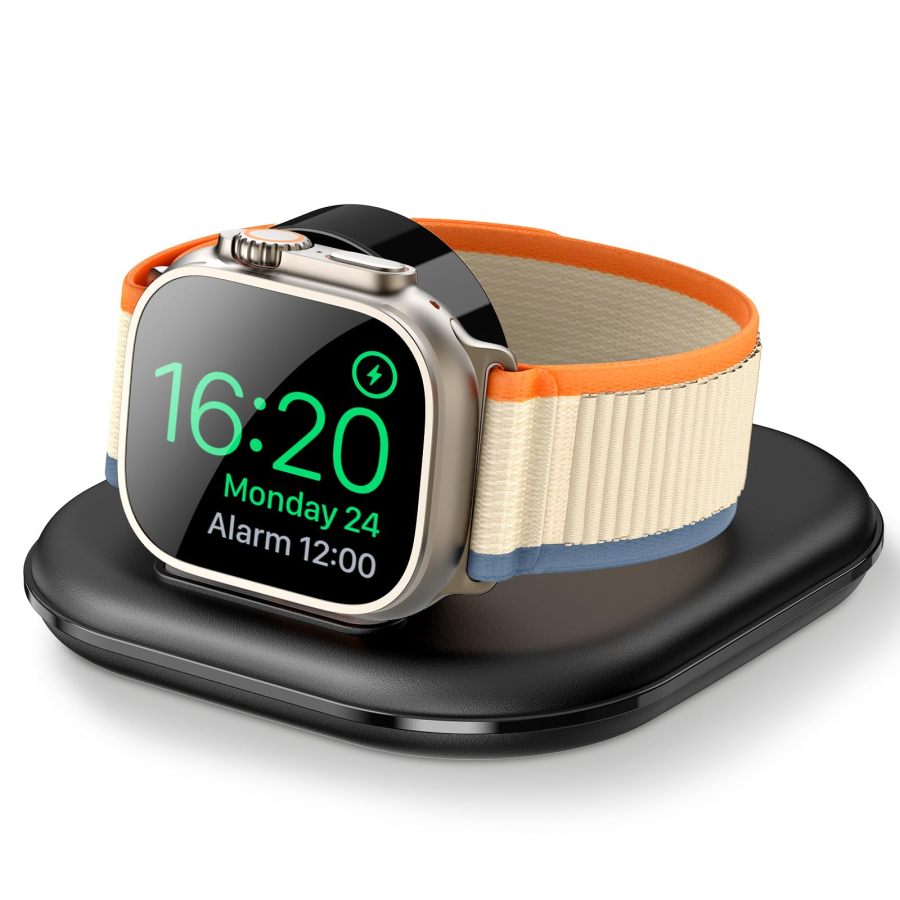
An Apple Watch portable wireless power bank is a compact, battery-powered magnetic wireless charging device specifically designed for the Apple Watch. It is typically small and easy to carry, aimed at providing emergency charging or backup power during travel, addressing the pain point of insufficient battery life during daily smartwatch use. This category also includes some small, plug-in USB charging heads and multi-device charging docks, but the core user demand revolves around the convenience of mobile charging for the Apple Watch. The following table illustrates the key characteristics of consumer behavior in this category.
| Dimension | Segment | Description |
|---|---|---|
| Need Driver Type | Emergency-driven Purchase / Planned Purchase | Purchases are often driven by sudden needs due to low watch battery or planned preparation for specific scenarios like travel or outdoor activities, seeking a solution. |
| Purchase Frequency | Low Frequency | As a phone accessory, it's typically a one-time purchase. However, users may buy additional units for different scenarios (e.g., office, car) or as backups, making it a non-high-frequency repurchase item. |
| Decision Complexity | Medium | Consumers compare battery capacity, charging speed, portability, compatibility, and user reviews but do not conduct deep technical research, focusing on practical evaluation. |
| Price Sensitivity | Medium | Price is an important consideration, but users are willing to pay a reasonable premium if the product effectively solves the core pain point and offers reliability. |
| Emotional Dependency | Medium | Primarily fulfills the functional need for supplemental power but also provides a sense of security ('always online,' 'worry-free use') and convenience, enhancing quality of life to some extent. |
II. User Personas & Usage Scenarios
2.1 Commuters / Business Travelers
🎯 Users who value efficiency, travel frequently, rely on their Apple Watch for daily management and payments, and do not want to be troubled by battery issues.
| Typical Usage Scenarios | Core Pain Points | Primary Purchase Drivers |
|---|---|---|
|
|
|
2.2 Outdoor Enthusiasts / Explorers
🎯 Users who frequently engage in outdoor activities, rely on their Apple Watch for fitness tracking and navigation, and value stable battery life in wilderness environments.
| Typical Usage Scenarios | Core Pain Points | Primary Purchase Drivers |
|---|---|---|
|
|
|
III. User Needs Hierarchy (KANO Model)
3.1 Basic Needs (Must-Haves)
- Broad Compatibility: Must be compatible with all mainstream Apple Watch models (Series 1 to Ultra 3, all sizes), ensuring users don't need to worry about compatibility issues.
- Secure Magnetic Charging: Ensures the Apple Watch securely attaches to the charger and begins charging immediately without easily shaking loose or detaching.
- Safe Charging Protection: Includes overcharge, overvoltage, overheating, and short-circuit protection to ensure safety for both the watch and the charger during charging, preventing device damage.
- Basic Charging Function: Capable of stably charging the Apple Watch to restore it to a usable battery level, meeting basic battery life needs.
3.2 Performance Needs (Linear Satisfiers)
- Actual Fast Charging Speed: Charging efficiency should be close to or match the speed of the original charger, reducing wait time for a quick 'battery boost,' rather than 'trickle charging.'
- Sufficient Battery Capacity: The built-in battery should provide at least 1-2 full charges for the Apple Watch, meeting needs for short trips or multi-day emergencies, avoiding battery anxiety.
- Extremely Compact & Lightweight: Design must be exceptionally small and lightweight, easily fitting into a small bag or attaching to a keychain for burden-free, anytime-anywhere portability.
- Clear Battery Level Display: Clear LED indicators or a digital display to intuitively show the power bank's remaining charge and charging progress, helping users plan.
3.3 Excitement Needs (Delighters)
- Multi-Device Emergency Charging: In addition to the Apple Watch, can also provide low-current emergency charging for AirPods or other small USB-C devices, adding product value.
- Dual USB Interface: The power bank itself supports USB-A and USB-C dual input/output interfaces, adapting to different power sources and devices without extra adapters, improving universality.
- Stylish & Premium Design: Fashionable colors, unique keychain or mini designs, high-quality materials that enhance the pleasure of use and sense of style as a lifestyle accessory.
- Simultaneous Charge & Discharge: The power bank can charge the Apple Watch while its own battery is being charged, increasing convenience and saving user time.
3.4 Unmet Needs & Opportunities
-
Actual Charging Speed is Slow: Many products advertise fast charging, but users widely report charging speeds far below expectations, with excessively long wait times, especially when unable to quickly replenish battery in emergencies.
User Reviews (VOC) It charges slowly, but I have found it to be great in a pinch. // S-L-O-W but does the job just fine and is easily pocketable! // It's almost a trickle charge.
-
Actual Battery Capacity Inflated / Insufficient: The actual number of charges or capacity provided by the power bank is lower than advertised, especially for Apple Watch Ultra models, failing to meet user expectations and causing disappointment.
User Reviews (VOC) The battery doesn't hold up to the claimed capacity of being able to charge the watch 2-3 times. // Only holds one charge though which is a shame. // It completely ran out of battery with doing the above.
-
Weak Magnetism or Easy Detachment: Magnetic attachment is unstable, the watch easily slides off or disconnects accidentally, affecting charging effectiveness and safety, especially while moving or carrying.
User Reviews (VOC) The watch slides off in any position that doesn't allow the band to hang freely. // Magnet is very weak and this product looks better in the picture than in person.
-
Poor Product Reliability: Numerous products are reported by users to malfunction, stop working, experience rapid battery degradation, or fail to hold a charge after just a few months or uses, with lifespans far below expectations, leading to reduced user trust.
User Reviews (VOC) Device stopped working after 3 months. Short term use product. // Mine lasted less than a year and died. // It stops working after 6 weeks.
-
Severe Charging Heat: The device heats up noticeably during charging, raising user concerns about safety hazards and device wear, negatively impacting the user experience.
User Reviews (VOC) It heats up so fast. // Customers report that the charger gets hot during use.
IV. User Decision Drivers
4.1 Key Decision Factors
- Charging Effectiveness & Stability: Whether it can effectively, stably, and continuously charge the Apple Watch, and how many full charges it can actually provide, are the primary considerations for users.
- Portability & Design: Product size and weight suitability for carrying, ease of fitting into a small bag or attaching to a keychain, and overall aesthetic appeal are key determinants of convenience.
- Broad Compatibility: Ensuring the product fully adapts to the user's specific Apple Watch model and version, avoiding the risk of buying the wrong product or one that doesn't work, is a basic purchase prerequisite.
- Long-Term Reliability & Safety: Product stability, safety during charging (e.g., overheating, overcharge protection), and durability over long-term use are core concerns for users to mitigate risk and ensure worry-free use.
4.2 Secondary Decision Factors
- Actual Charging Speed: After meeting core functionality, faster charging speed significantly enhances user experience, reduces fragmented wait times, and improves efficiency.
- Battery Level Display Method: Clear, intuitive battery display (e.g., digital percentage) is more helpful than simple indicator lights for users to understand usage and plan charging.
- Price & Value for Money: As an accessory, users have medium price sensitivity; they weigh price against the features, quality, and brand reputation offered, seeking optimal value.
- Multi-Functionality & Interfaces: Whether it supports emergency charging for other devices or provides USB-A/C dual interfaces can increase product use cases and convenience as a value-add.
V. Selling Points & Competitive Landscape
5.1 Selling Point Analysis
5.1.1 Standard Features (Points of Parity)
- Compatible with All Apple Watch Series: Almost all products emphasize broad compatibility with various Apple Watch series and sizes (from Series 1 to Ultra 3), which is the basic market entry requirement.
- Compact & Portable Design: Highlights the product's mini size, lightweight, and ease of carrying for travel and commuting; common forms include keychain-style and mini cube shapes.
- Magnetic Wireless Charging: Emphasizes the convenience of wireless charging and the stability of magnetic attachment, eliminating cable clutter and providing a 'place-and-charge' experience.
- Multiple Safety Protections: Commonly advertises protection mechanisms against overcharge, overvoltage, overheating, and short circuits to alleviate user safety concerns about non-original chargers.
5.1.2 Key Differentiators
- Built-in Battery Capacity: Ranging from 1000mAh to 2500mAh, some products emphasize providing more charges (e.g., 2-4 times) to meet different battery life needs.
- Advertised Charging Speed: Uses terms like 'fast charge,' 'efficient charging,' promising quick battery recovery, but actual performance varies, becoming a competitive differentiator.
- Battery Level Display Method: Ranging from simple 3-4 LED indicators to precise digital percentage displays, improving user awareness of remaining charge for better planning.
- Integrated Cable or Multi-Interface: Some products feature a built-in USB-C cable for self-charging or provide both USB-A/C interfaces to enhance universality and adapt to different charging environments.
5.1.3 Unique Selling Propositions (USPs)
- Integrated Multi-Device Charging Function: A few products are designed as 3-in-1 charging stations (but typically require external power, leaning more towards desktop use) that can simultaneously charge a phone, watch, and headphones, offering more comprehensive functionality.
- Ultra-Thin Card-Style Design: A very few products pursue extreme thinness, with a thickness close to a card, making them easy to fit into a wallet or small cardholder for truly 'unnoticeable' carrying.
5.2 Competitive Landscape
5.2.1 Market Maturity
The Apple Watch portable wireless power bank market has reached a medium maturity stage, with product functions and forms becoming homogenized. Portability, compatibility, and safety are now baseline competitive elements for all sellers. Brands mostly compete for market share by increasing built-in battery capacity, optimizing charging speed (or at least the marketing language), improving battery displays, and offering minor multi-functionality, resulting in intense price competition.
5.2.2 Innovation Trends
Current innovation trends are mainly evident in two areas: first, developing larger-capacity portable power banks while striving to maintain a compact form; second, popularizing USB-C interface compatibility, even achieving USB-C bidirectional input/output. A few products attempt to integrate multi-device charging into portable designs, but this typically increases size and may shift its core positioning from a pure 'emergency power bank' towards a 'travel charging station.'
VI. Marketing Claims vs. Reality Check
The table below analyzes the gap between common marketing claims and actual user experiences in this category:
| Dimension | Marketing Claim | User Reality | Verdict |
|---|---|---|---|
| Battery Life | Long-lasting battery life, can charge Apple Watch 3-4 times, Ultra series 2 times; genuine 2000-2500mAh capacity, worry-free travel. | Users widely report that under actual high-brightness/heavy usage, the power bank only provides 1-1.5 full charges (less than 1 for Ultra series), far below claims; some products have poor self-discharge, losing charge even when idle. | Sellers typically mislead consumers with data from ideal test conditions or minimal power consumption, failing to deliver on the core promise of long battery life for extended outings, leading to a significant gap in the user's most critical pain point. |
| Charging Speed | Fast charging, fully charges Apple Watch in 2-3 hours, or matches original charger speed, eliminating long waits. | Users widely report slow charging speeds; some products even take 2-4 hours to fully charge the watch, far from original fast-charging efficiency; user tests show output power as low as 0.5W, severely inconsistent with 'fast charge' claims. | Sellers engage in widespread exaggeration of charging speed, failing to meet consumers' general understanding of 'fast charge,' leading to inefficient use and long wait times during charging, undermining the value of emergency power top-ups. |
| Product Durability & Stability | Rugged and durable, multiple safety protections, providing a long-term reliable charging experience. | User feedback heavily focuses on products failing, ceasing to charge, experiencing rapid battery degradation, or overheating within a short period (e.g., 3 months or after a few uses), with reliability far below expectations. | Sellers are collectively silent on product quality and lifespan, overlooking the core consumer demand for long-term reliability of electronics, leading to high return rates and negative word-of-mouth, severely damaging brand reputation and market health. |
Key Takeaway: This category market exhibits widespread parameter inflation and scenario-based experience exaggeration, especially regarding battery life, charging speed, and product durability.
VII. Supply-Demand Misalignment Analysis
The table below highlights mismatches between seller focus and buyer priorities:
| Dimension | Seller Behavior | User Focus | Verdict |
|---|---|---|---|
| Actual Battery Life & Capacity Transparency | Sellers generally emphasize the 'large capacity' of the built-in battery (e.g., 2000mAh, 2500mAh) and claim multiple charges for the watch but rarely provide real-world battery life data under different watch models, battery health levels, or charging modes, resulting in opaque information. | Users strongly complain that actual charge counts are far lower than advertised, especially for high-capacity watches like the Apple Watch Ultra. They need clear, trustworthy battery life data for purchase decisions. | Sellers lack transparency and honesty on core performance metrics, avoiding the product's actual shortcomings in specific usage scenarios, directly leading to unmet user expectations and a trust crisis. |
| Magnetic Strength & Charging Stability While Moving | Sellers commonly advertise 'strong magnetic attraction' and 'place-and-charge' but rarely mention whether the watch remains securely attached with thick phone cases, during vigorous movement, or when the power bank is hanging from a bag, generally lacking commitment to stability in specific usage scenarios. | Users repeatedly mention insufficient magnetic strength, the watch easily sliding off or disconnecting during charging; effective charging while moving is almost impossible, contradicting the promise of 'anytime, anywhere' portability. | Sellers over-promote the magnetic function under ideal conditions, neglecting users' core need for secure watch attachment and continuous charging in real, complex scenarios, leading to insufficient reliability in key experiences. |
| Long-Term Product Quality & Lifespan Assurance | Sellers commonly emphasize 'multiple safety protections' to ensure charging safety, but few brands mention actual product lifespan and long-term stability in marketing, nor do they provide sufficiently long warranty periods to support their quality claims. | One of users' biggest pain points is products easily failing, stopping working, or experiencing sharp performance decline within a short period (weeks or months). They desire products that are durable, not disposable consumables. | While pursuing low prices and feature stacking, sellers fail to fundamentally address the core durability issue of products. This strategic blind spot is the underlying cause of user negative reviews and brand trust erosion. |
Key Takeaway: Sellers generally oversupply on basic selling points like 'compact and portable' and 'universal compatibility,' while collectively underperforming or remaining silent on users' most critical pain points: 'actual battery life,' 'charging speed,' and 'product reliability,' leading to a severe misalignment between supply and demand focus.
VIII. Strategic Opportunities & Recommendations
8.1 Enhance Actual Battery Life & Transparent Power Management
8.1.1 Target Audience & Pain Points
⚡️ Pain Points Addressed: Power bank actual capacity is inflated/insufficient, users doubt battery life, battery display is not intuitive.
8.1.2 Action Plan
Adopt higher energy-density lithium polymer batteries, increasing actual capacity to 2500mAh or above, and integrate a high-precision digital battery level display. Clearly label on packaging and listings the actual number of charges for each Apple Watch series (especially Ultra) and precise battery life times under different brightness settings.
| Tech Complexity | Medium |
| Cost Impact | Medium Impact |
| Trade-off Warning | Increasing battery capacity may slightly increase product size (e.g., thickness by 1-2mm) or weight by 5-10g, requiring a balance between portability and battery life. |
| Price Band | Only viable above $20.99 |
8.1.3 Marketing Strategy
Highlight 'Real High Capacity, No More Inflated Claims'; emphasize 'Digital Battery Level, Precise Control, Travel Worry-Free'; provide multi-scenario real-world test videos showcasing reliable battery life.
8.2 Optimize Magnetic Stability & Smart Charge Termination
8.2.1 Target Audience & Pain Points
⚡️ Pain Points Addressed: Weak magnetism or easy detachment, severe charging heat, lack of auto-stop feature leading to overcharge or power bank self-discharge.
8.2.2 Action Plan
Use N52-grade magnet arrays, optimize magnetic circuit design to ensure the Apple Watch remains securely attached at multiple angles even with slight movement, reducing accidental detachment. Integrate a smart power management chip to achieve auto-stop when fully charged, and introduce overheating auto-power reduction or cut-off protection.
| Tech Complexity | Medium |
| Cost Impact | Medium Impact |
| Trade-off Warning | Increasing magnetic strength may make removing the watch slightly more effort or leave a slight imprint on very thin phone cases, but the value of improved stability far outweighs this. |
| Price Band | Only viable above $18.99 |
8.2.3 Marketing Strategy
Emphasize 'Secure as Native, Charging Without Dropouts'; promote 'Smart Protection, No More Overcharge or Overheat, Extends Battery Life'; use animated GIFs to demonstrate strong magnetic attachment.
8.3 Improve Product Durability & Quality Control, Offer Extended Warranty
8.3.1 Target Audience & Pain Points
⚡️ Pain Points Addressed: Poor product reliability, short lifespan, widespread user skepticism about quality.
8.3.2 Action Plan
Adopt higher-quality flame-retardant ABS/PC material for the housing and connection parts, optimize internal soldering processes to ensure structural stability and reliable component connections. Implement stricter quality control standards and provide a warranty period longer than the industry average (e.g., 18-24 months) to enhance user confidence.
| Tech Complexity | Low |
| Cost Impact | Low Impact |
| Trade-off Warning | No significant physical side effects, primarily involves optimizing material selection and production processes. |
| Price Band | Only viable above $16.99 |
8.3.3 Marketing Strategy
Highlight 'Craftsmanship Quality, Long-Lasting Durability'; promote 'Extended Warranty, Worry-Free Replacement, Upgraded After-Sales Service'; showcase the product undergoing rigorous tests (e.g., drop, high/low temperature, plug/unplug cycles).
8.4 Universal Dual-Interface Plug-In Fast Charging Adapter
8.4.1 Target Audience & Pain Points
⚡️ Pain Points Addressed: Slow charging speed, charging heat, insufficient USB-A/C interface universality.
8.4.2 Action Plan
Design as a plug-in USB-C/A dual-interface adapter supporting PD fast charging protocol, with output power of at least 5W to achieve fast charging for Apple Watch Series 7 and later models. Optimize internal circuitry and cooling design to ensure temperature stays within a reasonable range during charging.
| Tech Complexity | Medium |
| Cost Impact | Medium Impact |
| Trade-off Warning | Improving charging efficiency and heat dissipation may slightly increase product size or require more complex cooling structures but does not affect core portability. |
| Price Band | Only viable above $14.99 |
8.4.3 Marketing Strategy
Emphasize 'Dual-Interface Universal, Plug-and-Charge, Eliminate Cable Clutter'; promote 'Efficient Fast Charge, Minimalist Desktop, Lightweight Travel'; highlight its portability and ease of use through clean visual design.