Amazon US Market Analysis: Indoor Plant Grow Lights Category
📊 Executive Summary
📈 Market Trends
Quality and Aesthetics Go Hand-in-Hand, Smart Convenience Emerges as New Direction. The indoor plant grow light market is evolving from single-function supplemental lighting towards integrated, intelligent, and aesthetic solutions. Consumers now care not just about light effectiveness, but also product reliability, ease of use, and integration with home environments. With the rise of smart homes, APP control and data monitoring are poised to become new growth drivers.
⚡ Major Pain Points
Exaggerated Lifespan and Poor Stability are Core Flaws. Despite widespread seller claims of 'ultra-long lifespan' and 'powerful performance,' user feedback is dominated by complaints about short-term product failures (LEDs, power supplies, timers). Additionally, the misleading nature of 'equivalent wattage,' lack of scientific parameter transparency, and insufficient clamp/stand stability severely impact user experience and trust in the category.
💡 Selection Opportunities
Deep Dive into User Pain Points, Build Brand on 'Authentic Reliability.' Market opportunities lie in addressing the product reliability crisis, such as offering grow lights that 'Enhance Core Component Reliability and Warranty System.' Simultaneously, meet professional needs by 'Introducing Smart APP Control and Scientific Parameter Transparency,' improve foundational experience via 'Structural Optimization for More Stable and Flexible Installation Solutions,' and expand the market through 'Aesthetic Upgrade, Launching Home-Integrated 'Invisible' Grow Light Series,' achieving differentiated competition.
I. Analysis Overview
1.1 Introduction & Report Scope
This report analyzes the 'Grow Lights' category (Indoor Plant Grow Lights) on the Amazon US market, focusing on target user personas, core needs, decision factors, market communication, and potential opportunities.
1.2 Category Snapshot
Indoor plant grow lights are artificial lighting devices specifically designed to compensate for insufficient natural light indoors. They utilize specific light spectra (typically full-spectrum, red-blue combination, or warm white) to promote plant photosynthesis, supporting healthy development across various stages such as seedling, vegetative growth, and flowering/fruiting. Market products come in diverse forms, including high-power panel lights, bar lights, desktop clip-on lights, floor-standing ring lights, and E26 bulbs, aiming to meet the needs of different plant sizes and growing environments. The following table illustrates the key characteristics of consumer behavior in this category.
| Dimension | Segment | Description |
|---|---|---|
| Need Driver Type | Planned Purchase / Habitual Purchase | User purchases typically stem from long-term indoor gardening planning or addressing seasonal light deficiencies, with a regular need for daily light cycles for plants. |
| Purchase Frequency | Low Frequency | As durable goods, the main light fixtures are purchased infrequently, but repurchases may occur due to an increase in plant count or functional upgrades. |
| Decision Complexity | Moderately Complex | Consumers compare various factors such as light spectrum, wattage, coverage area, features (timer/dimming), and installation methods. |
| Price Sensitivity | Medium | Price is an important consideration, but users focus more on value for money and are willing to pay a premium for effectiveness, convenience, and durability. |
| Emotional Dependency | Low to Medium | Primarily based on functionality and practicality, but the sense of achievement and joy from plant health offers psychological value for serious enthusiasts. |
II. User Personas & Usage Scenarios
2.1 Professional Indoor Gardening Enthusiast
🎯 Passionate about indoor plant cultivation, pursuing optimal plant growth and yield, willing to invest time and effort in research.
| Typical Usage Scenarios | Core Pain Points | Primary Purchase Drivers |
|---|---|---|
|
|
|
2.2 Home Plant Enthusiast
🎯 New to plant care, hoping to keep indoor greenery healthy and attractive, with limited knowledge of complex equipment and expertise, while also valuing home aesthetics.
| Typical Usage Scenarios | Core Pain Points | Primary Purchase Drivers |
|---|---|---|
|
|
|
III. User Needs Hierarchy (KANO Model)
3.1 Basic Needs (Must-Haves)
- Providing Basic Light: The fundamental need to emit sufficient light to ensure plants can perform photosynthesis.
- Easy Installation and Setup: Plug-and-play, clip-on, insert-into-pot, and other simple installation methods.
- LED Light Source: Energy-saving, low heat output, suitable for long-term indoor use.
- Safety and Stability: The product does not overheat, short-circuit, or pose safety risks during use.
3.2 Performance Needs (Linear Satisfiers)
- Full-Spectrum Light: Mimicking natural sunlight, covering all wavelengths needed for plant growth, promoting development across all stages.
- Timer Function: Automatic on/off cycling, eliminating manual operation, facilitating daily management.
- Multi-Level Brightness / Spectrum Adjustment: Adjusting light intensity and red/blue/white light ratios based on plant type and growth stage.
- Good Heat Dissipation: Ensuring fixtures do not overheat during prolonged operation, preventing plant scorching.
- Adjustable Height / Angle: Designs like gooseneck arms, telescopic rods for easy adjustment of light coverage and distance.
- Low Power Consumption: High energy efficiency, reducing long-term usage costs.
3.3 Excitement Needs (Delighters)
- Aesthetic and Integrated into Home Design: Product has a stylish appearance, can serve as part of home decor, not just an obtrusive gardening tool.
- Quiet Operation: Fans or other cooling systems operate with minimal noise, not disturbing the indoor environment.
- Extended Warranty and Reliable After-Sales Service: Service promises exceeding industry standards, providing worry-free purchase.
- Smart Integration: Remote control and data monitoring via smart home systems or apps.
3.4 Unmet Needs & Opportunities
- Product Actual Lifespan and Stability: Some products fail within months (e.g., damaged power adapters, dead LEDs, malfunctioning timers), not matching the advertised 'ultra-long lifespan,' leading to frequent user replacements or returns.
- Insufficient Clamp/Stand Stability: Small clip-on or insertable lights easily tip over in lightweight pots, or gooseneck arms lack flexibility, failing to maintain fixed angles, affecting light effectiveness and safety.
- Lack of Transparency on Actual Light Efficacy: Consumers are confused by 'equivalent wattage,' finding it difficult to discern the actual light intensity and effectiveness of products. They desire more intuitive, scientific parameter references like PPFD rather than vague comparisons.
- Power Cord Length and Inconvenient Cable Management: Cords that are too short limit placement options, while overly long ones are difficult to manage neatly, affecting aesthetics and convenience.
IV. User Decision Drivers
4.1 Key Decision Factors
- Plant Growth Results: Whether the light truly promotes healthy plant growth is the user's core purchase motivation and evaluation criterion.
- Light Spectrum and Intensity: Whether it's full-spectrum, meets plant needs at different growth stages, and provides sufficient brightness, directly impacting plant health.
- Timer and Dimming Functions: Whether it can cycle automatically and if brightness/light color is adjustable are key metrics for product convenience and adaptability.
- Ease of Use and Installation Convenience: Users prefer products that are simple to install and operate intuitively, avoiding the learning curve of complex setups.
4.2 Secondary Decision Factors
- Heat Dissipation and Energy Efficiency: Whether the fixture overheats during long operation and the actual electricity cost impact user experience and long-term costs.
- Product Design and Appearance: Whether it's aesthetically pleasing, coordinates with the indoor environment, and doesn't look obtrusive is especially important for users who value home aesthetics.
- Brand Reputation and After-Sales Service: Well-known brands, good customer service, and warranty promises increase purchase confidence and reduce perceived risk.
- Durability and Lifespan: Although a selling point, user reviews frequently mention failures, making it a secondary factor affecting satisfaction rather than a primary purchase decision factor.
V. Selling Points & Competitive Landscape
5.1 Selling Point Analysis
5.1.1 Standard Features (Points of Parity)
- Full-Spectrum Light: Simulates natural sunlight, covering wavelengths needed for all plant growth stages, a standard feature for most grow lights.
- Energy-Efficient LED: Emphasizes low energy consumption, high efficiency, saving electricity costs compared to traditional lighting.
- Timer Function: Automatic 3/6/9/12-hour (even 16-hour) cycling, eliminating manual operation.
- Adjustable Brightness / Spectrum Modes: Offers multiple brightness levels and various spectrum combination modes (red, blue, white).
- Easy Installation: Emphasizes plug-and-play, or provides various installation accessories like clips, telescopic rods, stands.
- Good Heat Dissipation: Marketing highlights use of aluminum materials or built-in fans to ensure low-temperature operation.
5.1.2 Key Differentiators
- Multi-Head / Multi-Bar LED Design: E.g., dual-head, quad-head gooseneck lights or connectable light bars, providing wider coverage or adaptability for more plants.
- Specific White Light Color Temperature: E.g., 4000K, 5000K, 6000K warm white light, emphasizing natural light feel and visual comfort.
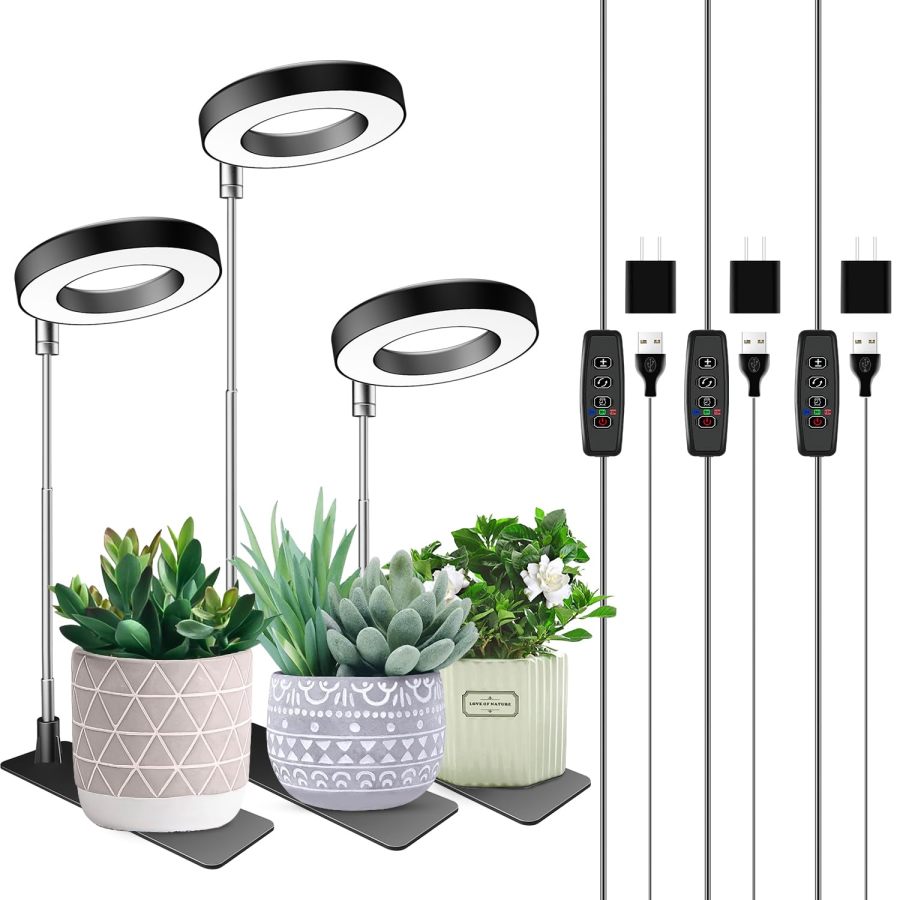
- Unique Installation Form: E.g., insertable 'halo grow lights,' floor-standing stand lights, differentiating from traditional clip-on or hanging styles.
- External Controller / Remote: Providing an additional remote control beyond wired controls, increasing operational convenience.
5.1.3 Unique Selling Propositions (USPs)
- Ceramic Encapsulation Technology: SANSI brand's unique ceramic technology, marketed for higher light efficiency and heat dissipation.
- Wood-Grain / Minimalist Appearance Design: Brands like Kullsinss offer wood-grain or minimalist white designs, emphasizing home decor appeal.
- Extra-Long Power Cord: Some floor-standing lights provide 7-13 foot long power cords, greatly increasing placement flexibility.
- Bamboo Exterior: Some brands use a bamboo exterior, appealing to eco-friendly and natural home styles.
5.2 Competitive Landscape
5.2.1 Market Maturity
The indoor plant grow light market has reached a moderate level of maturity. Core functions like full-spectrum light, timers, dimming, and LED energy efficiency have become standard features, leading to high product homogenization. Competition now focuses on brand recognition, pricing strategies, and incremental improvements over basic functions. Simultaneously, the market has many new entrants with varying quality levels. Consumer complaints about product lifespan and actual performance indicate ongoing issues with inconsistent quality and information asymmetry, presenting opportunities for brands focused on quality and innovation.
5.2.2 Innovation Trends
Trends include aesthetics and home integration (e.g., halo lights, wood-grain), convenient installation and multi-scenario applicability (e.g., insertable, floor-standing), and light parameter transparency (emphasizing PPFD). Additionally, brands are beginning to explore smart controls for more precise, personalized light management and are gradually placing greater importance on improving product durability and after-sales service to address user pain points regarding product lifespan.
VI. Marketing Claims vs. Reality Check
The table below analyzes the gap between common marketing claims and actual user experiences in this category:
| Dimension | Marketing Claim | User Reality | Verdict |
|---|---|---|---|
| Product Lifespan and Reliability | Fixtures have an ultra-long lifespan of 50,000 hours, are stable and reliable, requiring no frequent replacement. | Multiple user feedback points indicate failures of LEDs, power adapters, or timer functions within months, with actual lifespan far below claims. | Sellers overpromise on product lifespan, failing to deliver on core durability, severely damaging user trust and leading to frequent negative reviews and returns. |
| Light Power and Efficacy | '1000W equivalent' or 'replaces 500W,' achieving growth effects comparable to high-power fixtures with low energy consumption. | User feedback indicates insufficient actual light intensity; some low-wattage lights struggle to meet the needs of high-light plants, causing leggy growth or slow development. Listings often have confusing or conflicting statements about actual vs. equivalent wattage. | The 'equivalent wattage' concept is vague and misleading, failing to provide key scientific parameters like PPFD for professional users, leading to consumer misperceptions about actual efficacy. |
| Structural Stability and Usage Scenarios | Powerful clamps, flexible gooseneck, base-included design, can be stably placed on any desk/pot. | User feedback notes clamps not adhering well to thick desks or smooth surfaces; gooseneck arms prone to drooping; insertable lights easily tip over in lightweight pots; bases lack sufficient weight. | Product design fails to adequately account for varied usage scenarios and physical limitations, causing core stability and adjustability features to underperform in real-world use, impacting user experience and safety. |
Key Takeaway: The market exhibits a widespread tendency towards parameter inflation and scenario-based experience exaggeration, particularly regarding 'equivalent wattage' and 'ultra-long lifespan,' leading to information asymmetry and mismatched user expectations.
VII. Supply-Demand Misalignment Analysis
The table below highlights mismatches between seller focus and buyer priorities:
| Dimension | Seller Behavior | User Focus | Verdict |
|---|---|---|---|
| Product Actual Lifespan and Warranty | Common claims of '50,000-hour lifespan' or '3-year warranty,' but without providing reliable proof or quick, effective after-sales support; sometimes specifications conflict with reality. | Users strongly complain about short product lifespans, timers or LEDs failing within months, complex repair/replacement processes, and lack of genuine peace-of-mind promises. | Sellers fail to translate the marketing promise of 'ultra-long lifespan' into a user-perceivable 'reliable and durable' experience, leading to a core lack of trust, a high-frequency trigger for returns and negative reviews. |
| Transparency of Actual Light Parameters | Listings heavily emphasize 'full-spectrum,' 'high brightness,' 'equivalent wattage,' but rarely provide professional scientific data like PPFD, PAR values, spectral graphs, or present such data in a confusing manner. | Professional users and serious enthusiasts want to understand actual light intensity and spectral composition to develop scientific lighting plans for different plants, rather than being misled by vague 'equivalent wattage.' | Sellers' lack of transparency on key scientific parameters makes decision-making difficult for professional users and hinders correct product evaluation for novices, limiting the category's progression towards greater professionalism. |
| Product Appearance and Home Integration | Some products attempt selling points like 'wood-grain,' 'minimalist design,' but most products retain an industrial appearance, or design details clash with home decor styles. | Many home users want grow lights to blend aesthetically into the indoor environment, not look like lab equipment. Some designs (e.g., harsh red-blue glare) even negatively impact home comfort. | Sellers' understanding of home aesthetics remains superficial, failing to provide products that truly integrate with modern home styles, missing consumers with high appearance requirements. |
Key Takeaway: Sellers generally overemphasize abstract selling points like 'equivalent wattage' and 'ultra-long lifespan,' while collectively remaining silent or glossing over users' most pressing concerns: 'actual performance stability' and 'transparency of scientific parameters.'
VIII. Strategic Opportunities & Recommendations
8.1 Enhance Core Component Reliability and Warranty System
8.1.1 Target Audience & Pain Points
⚡️ Pain Points Addressed: Insufficient product actual lifespan and stability; user doubts about after-sales service and reliability.
8.1.2 Action Plan
Select higher-quality, LM-80 certified LED chips and UL/ETL certified power adapters. Optimize PCB design and soldering processes to improve moisture/dust resistance. Reinforce the timer module. Extend the standard warranty to 2 years, provide clear troubleshooting guides and online customer support.
| Tech Complexity | Medium |
| Cost Impact | Medium Impact |
| Trade-off Warning | Selecting more durable LED chips and power management ICs may slightly increase product size or weight, but impact is minimal. |
| Price Band | Only viable above $24.99 |
8.1.3 Marketing Strategy
Emphasize 'Built to Last, Quality Assured.' Build trust through authoritative certifications (e.g., UL/ETL) and real user testimonials. Promote the long-term value of 'Say goodbye to frequent replacements, save hassle and money.' Promise responsive local after-sales service.
8.2 Introduce Smart APP Control and Scientific Parameter Transparency
8.2.1 Target Audience & Pain Points
⚡️ Pain Points Addressed: Lack of precise brightness/spectrum adjustment; lack of transparency on actual light efficacy; complex device operation and maintenance.
8.2.2 Action Plan
Develop a Bluetooth or Wi-Fi connected smart APP enabling stepless dimming, custom spectrum ratios, multi-phase timer programming. Integrate a plant growth database into the APP, recommending lighting plans based on plant type, and displaying real-time PPFD/PAR values. Clearly label PPFD test data and detailed spectral graphs in product descriptions.
| Tech Complexity | High |
| Cost Impact | High Impact |
| Trade-off Warning | Adding smart modules slightly increases BOM cost and R&D cycle, may require more complex UI design, but no significant physical side effects. |
| Price Band | Only viable above $49.99 |
8.2.3 Marketing Strategy
Position as 'Smart Plant Caretaker, Custom Sunlight.' Demonstrate powerful control and monitoring features via APP interface demos. Highlight 'Scientific Cultivation, Multiply Your Yield' and 'Professional Data at a Glance' to attract professional users pursuing optimal growth and tech experiences.
8.3 Structural Optimization for More Stable and Flexible Installation Solutions
8.3.1 Target Audience & Pain Points
⚡️ Pain Points Addressed: Insufficient clamp/stand stability; weak gooseneck structure load-bearing; inconvenient power cord length and management.
8.3.2 Action Plan
Redesign clamps to increase contact area, add non-slip silicone pads, and stronger spring mechanisms for stability on desktops/pot edges of varying thickness. Optimize internal support of gooseneck arms using memory metal or thicker steel to prevent drooping. Provide retractable cable channels or Velcro straps. Develop weighted base accessories to improve stability of insertable/floor-standing lights.
| Tech Complexity | Low |
| Cost Impact | Low Impact |
| Trade-off Warning | Reinforcing structures may slightly increase product weight but significantly enhance user experience and safety. |
| Price Band | Only viable above $14.99 |
8.3.3 Marketing Strategy
Emphasize 'Stable as a Rock, Adjust at Will.' Use videos demonstrating anti-shake and anti-tip performance across various scenarios. Highlight 'Precision Positioning, Light Stays Put.' Promote 'Tidy Cable Management, End the Clutter' desktop solutions.
8.4 Aesthetic Upgrade, Launching Home-Integrated 'Invisible' Grow Light Series
8.4.1 Target Audience & Pain Points
⚡️ Pain Points Addressed: Fixtures look obtrusive and disrupt aesthetics; some product designs lean industrial.
8.4.2 Action Plan
Collaborate with industrial designers to develop minimalist, Scandinavian, or hidden-design grow lights. Examples include ultra-thin light strips integrated under shelves, styles disguised as regular table/floor lamps, or use of premium metals, natural wood, ensuring the product serves as an art piece even when off.
| Tech Complexity | Medium |
| Cost Impact | Medium Impact |
| Trade-off Warning | New designs may require mold creation and finer materials but do not affect core functionality. |
| Price Band | Only viable above $29.99 |
8.4.3 Marketing Strategy
Highlight 'More Than a Light, It's Art.' Use high-quality home scene imagery to showcase seamless integration into various decor styles. Emphasize the dual value of 'Illuminate Your Plants, Not Your Aesthetics' to attract clients with high aesthetic demands.