Amazon US Market Analysis: Baby Gyms Category
📊 Executive Summary
📈 Market Trends
Aesthetic Upgrades and Functional Integration Advance Side-by-Side. The baby gym market is evolving from basic functions towards high-design aesthetics and multifunctional integration to meet modern parents' dual demands for home aesthetics and parenting efficiency. Smart interactivity and eco-friendly materials are also becoming trends.
⚡ Major Pain Points
Durability of Electronic Components is Questionable, Insufficient Mat Cushioning is a Major Flaw. Users commonly express dissatisfaction with the stability of electronic components, battery life, and actual comfort level of mats in products with sound/light features. Additionally, structural stability after multifunctional conversion and convenient storage are 明显痛点,affecting long-term user experience.
💡 Selection Opportunities
Focus on 'Reliable Smart' and 'Aesthetic Practicality'. Market opportunities lie in developing truly 'durable and reliable smart interactive gyms' that solve electronic component pain points and provide scientific parenting guidance. Simultaneously, through 'minimalist aesthetic wooden' or 'ultra-portable storage' designs, enhance product texture, practicality, and home integration to meet the core demands of different parent segments.
I. Analysis Overview
1.1 Introduction & Report Scope
This report analyzes the 'Baby Gyms & Playmats' category (baby gyms) in the Amazon US market, focusing on target user personas, core needs, decision drivers, market communication, and potential opportunities.
1.2 Category Snapshot
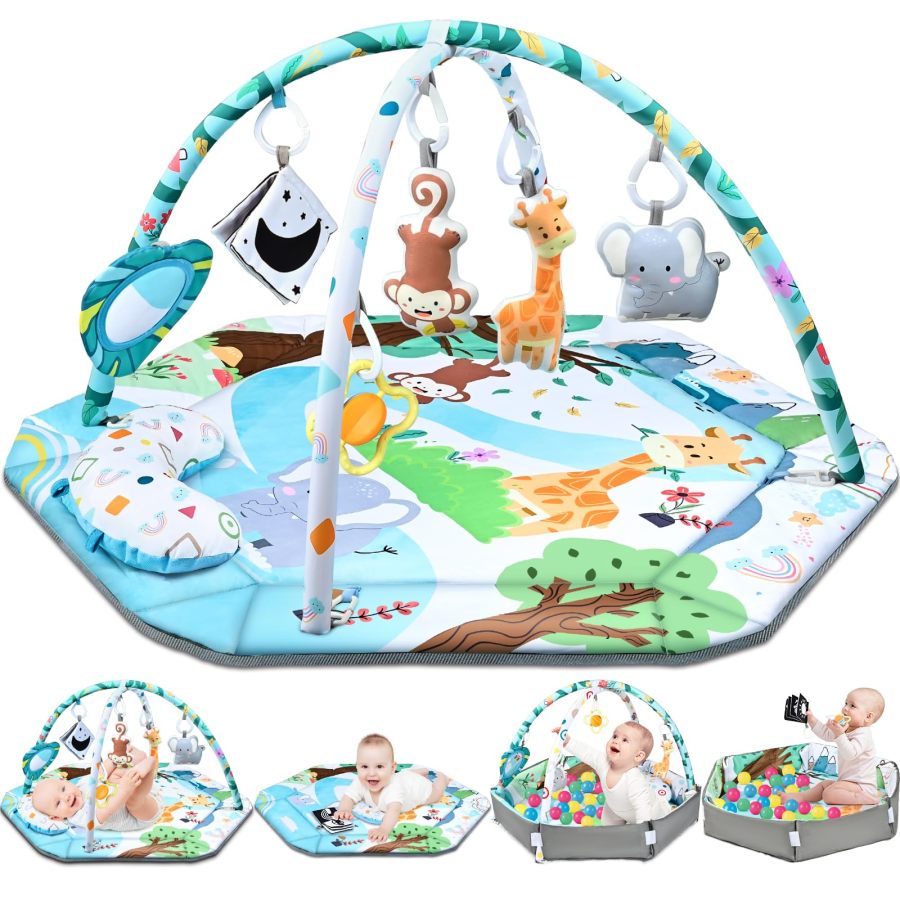
A baby gym (or baby activity mat) is an early activity center designed for infants aged 0-18 months. It typically consists of a soft mat, a suspended arch, and interactive toys, with some models integrating sound/light features or converting into ball pits, playpens, etc. Its aim is to stimulate an infant's sensory, cognitive, and motor skill development through a safe, comfortable environment, while also providing parents with brief hands-free time. The following table illustrates the key characteristics of consumer behavior in this category.
| Dimension | Segment | Description |
|---|---|---|
| Need Driver Type | Planned Purchase / Gift-giving | Parents typically plan purchases in advance, either before the baby's birth or at specific milestones (e.g., starting tummy time), or make ad-hoc purchases due to early development needs or to alleviate caregiving pressure. As a gift, its gifting attribute is strong. |
| Purchase Frequency | Low Frequency | Typically a one-time purchase made during infancy, with minimal repurchases. The replacement cycle is tied to the baby's developmental stage or product wear. |
| Decision Complexity | Medium | Parents need to carefully evaluate product safety, materials, functional diversity, ease of use, and design style, requiring a moderate level of effort for purchase comparison. |
| Price Sensitivity | Medium | Price is an important consideration, but for safety, materials, and key functions, parents tend not to compromise and are willing to pay a reasonable premium for high quality and trusted brands. |
| Emotional Dependency | Medium to High | Product selection is strongly driven by the emotional factor of 'what's best for the baby.' It carries parents' hopes for their baby's healthy, happy growth and early development, and embodies a sense of parenting achievement. |
II. User Personas & Usage Scenarios
2.1 Savvy & Practical First-Time Parents
🎯 First-time parents, curious yet cautious about baby products, aiming to provide a high-quality growth environment for their baby while being highly focused on product safety, multifunctionality, and value for money.
| Typical Usage Scenarios | Core Pain Points | Primary Purchase Drivers |
|---|---|---|
|
|
|
2.2 Trendy & Aesthetic Home-Centric Parents
🎯 Pursuing high-quality living and refined parenting experiences, valuing not only product function but also requiring baby products to coordinate with modern home decor, reflecting taste and style.
| Typical Usage Scenarios | Core Pain Points | Primary Purchase Drivers |
|---|---|---|
|
|
|
III. User Needs Hierarchy (KANO Model)
3.1 Basic Needs (Must-Haves)
- Safe, Non-Toxic Materials: Products must use certified, baby-safe materials, be odor-free, and have no risk of small parts detaching.
- Soft, Comfortable Mat: Providing a mat with sufficient thickness and softness to protect the baby's comfort during floor play or tummy time and prevent chills.
- Sturdy, Tip-Resistant Structure: The gym's arch must be stable, able to withstand the baby's pulling and kicking without wobbling or tipping over, ensuring play safety.
- Easy to Clean & Maintain: The mat should be machine-washable or easy to wipe, facilitating daily hygiene maintenance for the baby's environment.
3.2 Performance Needs (Linear Satisfiers)
- Multi-Mode Play Conversion: The product supports various play modes (back-lying, tummy time, seated play) to meet different developmental stages, extending its usable life.
- Sensory & Motor Stimulation: Providing diverse hanging toys (e.g., mirrors, rattles, teethers, cloth books) to effectively stimulate the baby's sight, hearing, touch, and hand-eye coordination.
- Easy Assembly & Storage: The product design should allow for quick assembly and disassembly without tools, facilitating daily storage or travel.
- Detachable/Replaceable Toys: Hanging toys can be easily detached for independent play or replaced according to the baby's preferences and developmental stage.
3.3 Excitement Needs (Delighters)
- Interactive Piano with Lights & Sounds: A kickable or pressable piano that triggers music and lights, surprising the baby and stimulating early music and cause-effect cognition.
- High-Design, Home-Integrated Aesthetics: Using soft color schemes, minimalist styles, or natural wood elements to perfectly blend with modern home environments, enhancing home aesthetics.
- Expert Parenting Guide/Milestone Cards: Including expert-designed play guides or milestone tracking cards to help parents better understand and utilize the product for baby development.
- Innovative Multi-Function Expansion: Features like conversion into a ball pit, small playpen, or story tent, providing unexpected play expansion functions.
3.4 Unmet Needs & Opportunities
-
Electronic Component Stability & Durability: For gyms with sound/light features, user feedback indicates electronic components (e.g., the piano) are prone to malfunction, fast battery drain, or unstable sound/light effects.
User Reviews (VOC) 钢琴玩了一段时间就不响了 // 电池很快就没电了
-
Mat Thickness & Anti-Slip Effectiveness: Some products have mats that are too thin, offering insufficient cushioning, requiring users to add extra padding; also, mats may lack good anti-slip properties, sliding easily on smooth floors.
User Reviews (VOC) 垫子太薄了,需要另外铺 // 在地板上容易打滑,宝宝不太安全
-
Toy Height & Angle Adjustability: Lack of flexible adjustment for hanging toy height and angle may make it difficult for babies of different ages to comfortably reach or play with them.
User Reviews (VOC) 宝宝还太小够不到玩具 // 希望玩具可以调低一点或者角度更适合趴玩
-
Balance Between Overall Portability & Structural Stability: Some products overly emphasize portability at the expense of structural stability, or multifunctional designs result in a still-bulky size when folded, hindering portability.
User Reviews (VOC) 虽然可折叠但还是挺占地方的 // 折叠后支架不够稳固,有点晃
IV. User Decision Drivers
4.1 Key Decision Factors
- Infant Safety & Comfort: Whether materials are non-toxic and skin-friendly, the mat's softness and cushioning, and the gym's structural stability are parents' primary purchase considerations.
- Promoting Baby Development: Whether the product effectively stimulates the baby's sensory development, gross and fine motor skills, such as improving tummy time tolerance, promoting grasping, and cognitive development.
- Ease of Cleaning & Daily Maintenance: Given how easily baby products get dirty, features like machine-washability, easy wiping, and convenient disassembly for cleaning are extremely important to parents.
4.2 Secondary Decision Factors
- Entertainment Value & Baby Appeal: Whether hanging toys, sound/light interactions, etc., can hold the baby's attention for extended periods, reducing the need for constant parental involvement.
- Product Durability & Quality: Expecting the product to withstand daily play, kicking, and cleaning, not easily breaking, being durable for potential use by a second child or gifting.
- Easy Assembly & Storage: Parents prefer products requiring no tools, quick assembly, and easy foldable storage to adapt to various life scenarios.
- Design Style & Aesthetics: Whether the product's appearance matches home decor, has pleasant color combinations, and blends into the home environment rather than looking突兀.
- Brand Trust & User Reviews: Products from well-known brands or with a large number of positive reviews are more likely to gain parents' trust and be chosen.
V. Selling Points & Competitive Landscape
5.1 Selling Point Analysis
5.1.1 Standard Features (Points of Parity)
- Comprehensive Early Development: Emphasizing the product promotes the baby's all-around development of senses (sight, hearing, touch), motor skills (gross, fine), and cognitive abilities.
- Safe, Skin-Friendly Materials: Highlighting the use of soft, non-toxic, baby-skin-friendly materials like polyester, cotton, ensuring safe play.
- Easy Assembly & Cleaning: Promoting tool-free, quick assembly and mats that are often machine-washable or easy to wipe for daily maintenance.
- Multifunctional Use: e.g., '8-in-1', '5-in-1', emphasizing functional diversity from tummy time and back play to seated play, even conversion to ball pits or playpens.
- Detachable Hanging Toys: Highlighting accompanying sensory toys (mirrors, rattles, teethers, cloth books) are detachable, increasing play flexibility.
5.1.2 Key Differentiators
- Interactive Piano/Sound & Light Features: Featuring a detachable kick-piano or light-up device, providing musical and visual stimulation, enhancing entertainment value.
- Aesthetic Design/Neutral Color Palette: Emphasizing fashionable design, soft colors (e.g., sage green, beige), use of natural wood, or simple geometric patterns to blend into modern homes.
- Specific Themes/Cartoon Characters: e.g., Disney Nemo, dinosaurs, farm, ocean, zebra themes, increasing product appeal to both babies and parents.
- Additional Parenting Accessories: e.g., including milestone cards, tummy time pillows, or expert-written play guides.
5.1.3 Unique Selling Propositions (USPs)
- FSC-Certified Wood: Emphasizing wooden parts are made from FSC-certified wood, highlighting environmental and sustainability credentials.
- Exclusive Foldable Storage Design: Folding the mat or entire gym quickly into a tote bag shape, or a unique compact storage solution.
- Multilingual Educational Piano: A piano that not only makes sounds but also teaches colors, shapes, and numbers in multiple languages (e.g., English, Spanish, French, German).
- Montessori-Inspired Design: Emphasizing the product design follows Montessori early education principles, promoting baby-led exploration and learning.
5.2 Competitive Landscape
5.2.1 Market Maturity
The baby gyms & playmats market has matured. Basic functions like safety, comfort, easy cleaning, multifunctionality, and early education attributes have become standard. Product homogenization is relatively high. Competition mainly focuses on price, design aesthetics, brand trust, and minor functional innovations (e.g., electronic interactivity or material upgrades). Leading brands have stable market share, but emerging brands still have opportunities to capture market share through micro-innovations and precise positioning.
5.2.2 Innovation Trends
Current market innovation primarily focuses on two major trends: First, Functional Diversification & Integration, merging gyms with more functions like ball pits, playpens, and tummy time pillows to attract efficiency-focused parents with 'all-in-one' solutions. Second, Aesthetic Upgrades & Material Optimization, shifting from traditional bright cartoons to softer, neutral, home-integrated design styles, and emphasizing natural (e.g., wood), organic, and skin-friendly materials, catering to young parents' pursuit of home aesthetics and parenting quality. Additionally, some products are beginning to offer more guided parenting content to enhance product value-add.
VI. Marketing Claims vs. Reality Check
The table below analyzes the gap between common marketing claims and actual user experiences in this category:
| Dimension | Marketing Claim | User Reality | Verdict |
|---|---|---|---|
| Electronic Component Stability & Durability | Multifunctional music piano, providing 25+ minutes of continuous sound & light interaction, aiding baby's early learning. | User feedback indicates pianos are prone to malfunction, have poor volume control, or drain batteries too quickly, far from the claimed duration. | Typical exaggeration of electronic function reliability and battery life, failing to adequately consider durability in infant use environments, packaging potential failure points as core selling points, damaging user trust. |
| Mat Thickness & Cushioning | Soft, thick mat providing ultimate comfort and safety, protecting baby during play. | Users commonly report mats being too thin, offering insufficient cushioning on hard floors, requiring extra padding, with comfort not matching宣传. | Sellers宣传 'soft comfort' without delivering adequate cushioning performance, leading to a gap between user experience and expectations, adding extra cost and inconvenience. |
| Structural Stability | Sturdy, durable wooden frame, safe and stable, can withstand baby's play. Or multifunctional conversion, stable and safe ball pit playpen. | Wooden frames are reported to have cracking, screw stripping, or rope connections not sturdy enough, posing tipping risks. For multifunctional conversion products, the sides are not sturdy enough when used as a ball pit, easily becoming loose. | In pursuit of material aesthetics or functional diversity, core structural stability was compromised, failing to fully ensure infant play safety, constituting a potential risk. |
Key Takeaway: The baby gym market exhibits widespread functional stacking and experience exaggeration, with a particular disconnect between user expectations and the reality of electronic component reliability and mat cushioning.
VII. Supply-Demand Misalignment Analysis
The table below highlights mismatches between seller focus and buyer priorities:
| Dimension | Seller Behavior | User Focus | Verdict |
|---|---|---|---|
| Actual Lifespan & Stability of Electronic Interactive Features (e.g., Piano) | 普遍强调声光电互动功能带来的乐趣和早期学习益处,但对电子元件的寿命、耐用性和故障率避而不谈. | 用户抱怨"钢琴很快就坏了"、"声音时有时无",对产品长期使用价值失望. | Sellers use electronic interactivity as an eye-catching selling point but fail to deliver matching quality and reliability, leading to unmet user expectations and impacting brand trust. |
| Mat Thickness & Anti-Slip Performance | 普遍宣传"柔软舒适",但对地垫的实际填充厚度、缓冲效果和防滑设计关注度不足,缺乏量化或对比说明. | 用户反馈"垫子太薄,需要额外垫毯子"、"在地板上容易打滑",认为产品在基础舒适和安全上未达预期. | Sellers fail to adequately meet user needs for the most basic comfort and safety experience, forcing users to make additional investments to solve problems, highlighting product design shortcomings. |
| Actual Stability of Multifunctional Conversions (e.g., Ball Pit) | 多数产品高调宣传"8合1"、"球池"等多种功能转换,但对转换后形态的结构支撑和安全性(如围栏高度、强度)描述不足. | 用户反馈"球池围边不够坚固"、"宝宝容易翻出去",多功能噱头大于实际可用性. | Sellers pursue 'big and comprehensive' in terms of feature quantity, but neglect the actual usability and safety of converted functions, leading to a disjointed user experience and significantly diminished functional value. |
Key Takeaway: Sellers overemphasize feature stacking and low-value detail claims, overlooking users' deep-seated pain points regarding the long-term stability of electronic components, actual mat cushioning, and structural stability in specific scenarios.
VIII. Strategic Opportunities & Recommendations
8.1 Reliable & Smart Interactive Baby Gym
8.1.1 Target Audience & Pain Points
⚡️ Pain Points Addressed: Electronic component stability & durability, stimulating baby's long-term interest.
8.1.2 Action Plan
Use industrial-grade reliable electronic components to ensure long-term stability of piano/light modules; integrate rechargeable lithium batteries with Type-C fast charging instead of disposable AA batteries; develop a visual, easy-to-use app offering stage-based interactive modes. Conduct strict electronic component lifespan testing during product development.
| Tech Complexity | Medium |
| Cost Impact | High Impact |
| Trade-off Warning | Adding electronic modules may slightly increase product weight or affect cleaning methods (requires detachable modules). |
| Price Band | Only viable above $69.99 |
8.1.3 Marketing Strategy
Emphasize 'Accompanying baby's安心成长, smart tech助力每一次探索'; highlight product's rigorous quality testing, long battery life, and safety certifications; showcase the app's educational interactive content and customizability.
8.2 Premium Aesthetic Wooden Multifunctional Play Center
8.2.1 Target Audience & Pain Points
⚡️ Pain Points Addressed: Tacky traditional designs, cheap-looking materials, arch structural stability, inconvenient toy height adjustment.
8.2.2 Action Plan
Use FSC-certified beech/maple wood with fine sanding, finished with no paint or eco-friendly wood oil/wax; design a hanging bar with multi-height adjustments, or provide various lengths of natural material (organic cotton, silicone) toy straps; use organic cotton for the mat with neutral color schemes and add a non-slip bottom.
| Tech Complexity | Medium |
| Cost Impact | High Impact |
| Trade-off Warning | Wooden frame may be slightly heavier than plastic, but offers clear advantages in texture and eco-friendliness; folding mechanism requires clever design to balance aesthetics and portability. |
| Price Band | Only viable above $89.99 |
8.2.3 Marketing Strategy
Emphasize 'Natural beauty, integrated into home life, accompanying baby's pure growth'; highlight 'FSC-certified环保原木', 'Minimalist Nordic design', 'Natural, skin-friendly materials'; showcase the product's harmonious搭配 with modern home environments.
8.3 Ultra-Portable & Storable 'Ball Pit + Playpen' Play Mat
8.3.1 Target Audience & Pain Points
⚡️ Pain Points Addressed: Balance between overall portability & structural stability, mat thickness & anti-slip effect, actual usability of multifunctional conversions.
8.3.2 Action Plan
Design an innovative quick-detach/fold playpen structure that folds compactly like a tote bag; use high-density memory foam for the mat core, achieving 2-3cm thickness, with a machine-washable outer layer and strong anti-slip bottom; include 100 eco-friendly plastic balls and a storage bag for ready-to-use setup.
| Tech Complexity | Medium |
| Cost Impact | Medium Impact |
| Trade-off Warning | Increasing thickness may slightly increase weight, requiring optimal balance between volume and cushioning; the playpen needs sufficient height and sturdiness, which may affect folded thickness. |
| Price Band | Only viable above $49.99 |
8.3.3 Marketing Strategy
Emphasize 'One-second收纳,随心转换,居家外出两不误'; demonstrate the product's quick switching between different forms (gym, ball pit, playpen) and its stability; highlight 'Thickened anti-slip mat, providing多重保护 for baby'.
8.4 Segmented Adjustable-Height Hanging Toy Design
8.4.1 Target Audience & Pain Points
⚡️ Pain Points Addressed: Toy height & angle adjustment.
8.4.2 Action Plan
Integrate multi-height adjustment loops or strap systems on the arch; provide toy connection straps with telescopic or hook-and-loop adjustments to ensure comfortable reach for both newborns lying on their back and sitting babies.
| Tech Complexity | Low |
| Cost Impact | Low Impact |
| Trade-off Warning | No significant physical side effects, primarily an optimization of structural design. |
| Price Band | Only viable above $35.99 |
8.4.3 Marketing Strategy
Highlight 'Scientific parenting,随龄调节'; showcase scenarios of babies at different ages interacting with adjustable toys, emphasizing the product's effective promotion of fine motor skills and hand-eye coordination.