Amazon US Market Analysis: Camping Hammock Chairs Category
📊 Executive Summary
📈 Market Trends
Portability and comfort remain highly sought after, with personalized experience becoming a new growth driver. The camping hammock chair market is mature. Consumers not only pursue basic comfort and stability but also desire features beyond the traditional (like rocking, rotation) and personalized adjustments for different body types and scenarios. The market is evolving towards lighter weight, multi-functional integration, and ultimate user experience.
⚡ Major Pain Points
'Pseudo-portability' and 'safety hazards' severely damage user trust. Despite widespread marketing of 'lightweight and portable', actual products are often cumbersome and difficult to store. Additionally, non-intuitive locking mechanisms during assembly lead to safety falls. Poor durability and low practicality of add-on features like footrests and cup holders are also frequent complaints, dragging down overall user satisfaction.
💡 Selection Opportunities
Deeply address user pain points, break through with differentiated real value. Opportunities lie in developing an 'Ultra-Portable High-Performance' hammock chair to solve the physical paradox of weight vs. capacity; launching a 'Full-Body Tall User-Friendly' product to meet the ergonomic needs of a niche segment. Simultaneously, by implementing 'Foolproof Safety Locking & Storage Guidance' and a 'Durability & Modular Upgrade Solution', deliver on product experience and quality promises, building long-term brand trust.
I. Analysis Overview
1.1 Introduction & Report Scope
This report analyzes the 'Lounge Chairs' category (Camping Hammock Chairs) within the Amazon US market, focusing on target audience personas, core needs, decision drivers, market communication, and potential opportunities.
1.2 Category Snapshot
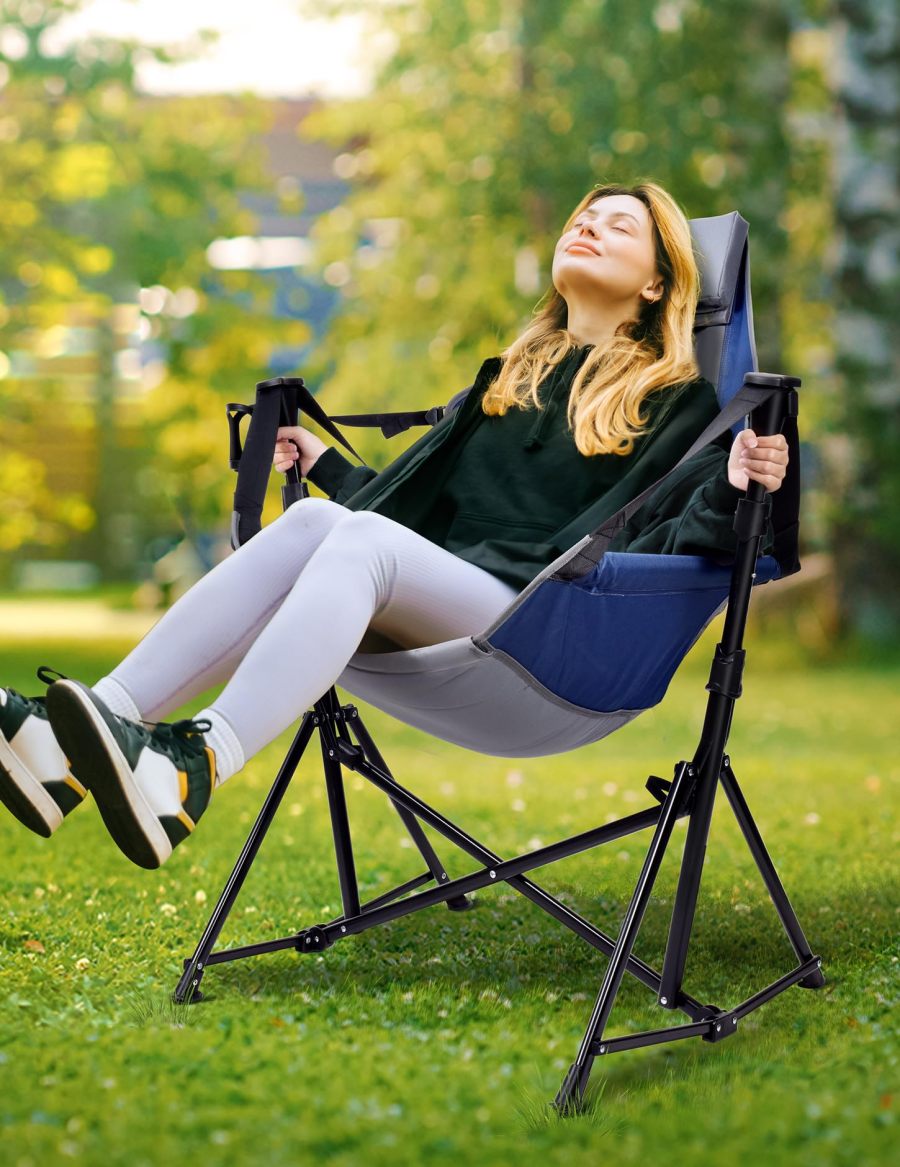
A camping hammock chair is a portable seat that combines the comfort of a traditional hammock with the form of an outdoor chair, often featuring rocking, swinging, or 360-degree rotation capabilities. It is designed to provide an immersive, relaxing experience outdoors (e.g., camping, beach, backyard) or indoors (as a cozy nook), favored for its unique comfort and portability. The following table illustrates the key characteristics of consumer behavior in this category.
| Dimension | Segment | Description |
|---|---|---|
| Need Driver Type | Planned Purchase / Impulsive Purchase | Users typically plan purchases based on a desire for outdoor comfort and relaxation, but can also be impulsively driven by unique product features. |
| Purchase Frequency | Low Frequency / Seasonal | As durable outdoor furniture, purchase frequency is low, but sales peaks may occur during summer and holiday seasons. |
| Decision Complexity | Medium | Users need to weigh comfort, portability, weight capacity, functional features, and price, requiring a moderate level of information comparison. |
| Price Sensitivity | Medium | Price is an important consideration, but users are willing to pay a premium for exceptional comfort, experience, and reliable quality. |
| Emotional Dependency | Medium-High | The product embodies the user's aspiration for a relaxing, leisurely lifestyle, holding significant emotional value and experiential dependency. |
II. User Personas & Usage Scenarios
2.1 Outdoor Leisure Explorer
🎯 Enthusiasts of camping, beach outings, picnics, and sporting events who seek to escape the rigidity of traditional chairs. They pursue deep relaxation and unique fun, while also valuing equipment portability and quick deployment.
| Typical Usage Scenarios | Core Pain Points | Primary Purchase Drivers |
|---|---|---|
|
|
|
2.2 Backyard & Patio Enjoyer
🎯 Individuals with a yard, balcony, or spacious indoor area who wish to create a comfortable, aesthetically pleasing relaxation corner to enjoy a slower pace of life.
| Typical Usage Scenarios | Core Pain Points | Primary Purchase Drivers |
|---|---|---|
|
|
|
2.3 Quality & Capacity Demander
🎯 Larger-framed individuals or family users with extremely high demands for structural stability, high weight capacity, and long-term durability. They scrutinize details and brand promises.
| Typical Usage Scenarios | Core Pain Points | Primary Purchase Drivers |
|---|---|---|
|
|
|
III. User Needs Hierarchy (KANO Model)
3.1 Basic Needs (Must-Haves)
- Stability & Safety: The chair must have a sturdy structure and reliable weight capacity (300-450 lbs), with no significant wobbling or tipping risk during use.
- Basic Seating Comfort: Providing fundamental cushioning, a headrest, and back support that conforms to body curves. Sitting should not feel stiff or cause pressure points.
- Durable Materials: Frames and fabrics should withstand outdoor elements (sun, moisture), resisting wear, tearing, or rust.
- Portable & Easy Storage: Product should fold and fit easily into an included storage bag, facilitating transport and compact storage.
3.2 Performance Needs (Linear Satisfiers)
- Multi-Angle Adjustability: Backrest angle freely adjustable (commonly 90°-168°), even allowing a reclined position, to accommodate different needs like reading or napping.
- Spacious, Deep Seat: Seat should be sufficiently wide and deep to comfortably envelop the body, even allowing cross-legged sitting without constraint, suiting various body types.
- Quick & Simple Assembly: Design should enable 'instant-open' or minimal-step setup (1-3 steps), requiring no complex tools or multiple people.
- Additional Practical Features: Features like removable cup holders, side storage pockets, or thickened headrests that enhance convenience and free up hands.
- Superior Weather Resistance: Waterproof, UV-resistant fabric; rust-proof (powder-coated) frames, adaptable to various harsh outdoor conditions.
3.3 Excitement Needs (Delighters)
- Integrated/Retractable Footrest: A seamlessly integrated, adjustable footrest providing leg support for ultimate full-body relaxation. Detachable designs offer more flexibility.
- Unique Rocking/Swinging/Rotation Mechanism: Providing smooth, quiet, and stable rocking or 360-degree rotation, delivering surprising interactive experiences and immersion.
- Premium Comfort Materials: Use of high-density memory foam cushions, extra-thick padding, or advanced breathable mesh for a luxurious feel and lasting comfort.
- Height/Lumbar Adjustability: Seat height or lumbar support fine-tunable for individual body types, offering customized comfort, especially beneficial for taller users.
3.4 Unmet Needs & Opportunities
-
Footrest Design Misfit: Some product footrests have fixed or overly short lengths, unsuitable for taller users; or connection parts are fragile, affecting durability.
User Reviews (VOC) Footrest not ideal for taller users-their feet may extend past it // The foot rest is a key part of this design but isn't very far out from the chair - even at 5' 7" my feet stuck out past the door rest. // The foot stool broke. Mine broke pretty fast.
-
Storage/Folding Difficulty: Products remain bulky when folded, difficult to fit perfectly back into storage bags; or the storage bag itself is low-quality or ill-fitting.
User Reviews (VOC) Bulky as heck! These are not as portable as I was hoping. They are a pain to put up and break down. // The storage bag is a bit too small to easily fit all the parts. // I have such a hard time fitting it back into the carrying bag without a struggle.
-
Poor Backrest Adjustment Stability: Backrest adjustment mechanism is not smooth, fails to lock securely, or the backrest flips up/hits the user when sitting down, disrupting the relaxation experience.
User Reviews (VOC) I wish the back didn't flip up when you go to sit down. // The back of the chair hits you when getting up. // Seating low & back two rods pop out so useless
-
Actual Durability Below Expectations: Despite claims of high weight capacity, users report issues like fabric seam tears, broken plastic parts, and frame warping, impacting product lifespan and safety.
User Reviews (VOC) The straps snapped on my first use of this chair. // One of the chairs had a missing plastic tube that the foot rest is supposed to go into. // Bent on the 2nd use and now the chair is useless. Weight capacity 330 lbs? Ya... No way. Not even close. // This chair popped a seam the very first weekend.
-
Mismatch Between Weight & Portability: Some heavy-duty chairs, while sturdy, are still cumbersome to carry, contradicting 'portable' marketing, making them unsuitable for scenarios requiring frequent movement.
User Reviews (VOC) It is heavier that a normal, stationary, camping chair but it's also a lot sturdier. // It's a bit heavy to carry, I use a wagon to transport // Very comfy but heavy.
IV. User Decision Drivers
4.1 Key Decision Factors
- Overall Comfort: Includes cushion softness, body envelopment, comfort during prolonged sitting, and smoothness of rocking/rotation. Directly impacts the user's relaxation experience.
- Product Stability & Safety: Whether the chair structure is solid, if high weight capacity claims are genuine and reliable, and if there are safety hazards like wobbling or tipping. This is the foundation of the purchase.
- Actual Portability & Storage: The real-world weight and volume of the folded product, ease of transport to destination (especially by car), and convenience of storage.
- Assembly Ease & Intuitiveness: Whether the setup process is simple and intuitive, with clear instructions and automatic locking mechanisms, avoiding time consumption or operational errors.
4.2 Secondary Decision Factors
- Usefulness of Additional Features: Whether features like footrests, cup holders, and storage pockets are actually useful and enhance the experience, rather than becoming nuisances.
- Material Durability & Maintenance: Whether fabrics and frames are long-lasting, can withstand repeated use and outdoor conditions, and are easy to clean.
- Price & Value for Money: Whether the product price is reasonable and offers good value, especially for heavy-duty products, assuming core needs are met.
- Aesthetic Design & Brand: Whether the product's color and style align with personal taste and coordinate with the usage environment (e.g., patio, home decor), as well as brand recognition.
V. Selling Points & Competitive Landscape
5.1 Selling Point Analysis
5.1.1 Standard Features (Points of Parity)
- Comfortable Seating: Emphasizes padded cushions, headrests, and ergonomic design for a relaxing experience, e.g., 'Padded Headrest and Seat'.
- Sturdy & High Weight Capacity: Highlights steel/aluminum frames, high-density fabrics to ensure stability and high load-bearing ability (typically 300-450 lbs).
- Portable Folding Design: Claims the product folds easily and comes with a carry bag for convenient transport and storage, e.g., 'Folds compactly into the included carry bag'.
- Multi-Scenario Applicability: Stresses suitability for various outdoor settings like camping, beach, tailgating, lawn, and even indoors, e.g., 'for Camping, Beach, Tailgating'.
- Adjustable Backrest: Allows users to adjust the backrest angle for sitting or reclining, e.g., 'Adjustable Backrest'.
5.1.2 Key Differentiators
- Integrated/Detachable Footrest: Some products offer a footrest to enhance full-body relaxation comfort, e.g., 'Detachable Footrest'.
- Unique Rocking/Swinging/Rotation Function: Emphasizes hammock-like rocking or 360-degree rotation, adding fun and immersion, e.g., 'Swinging Hammock Chair', '360 Degrees Swivel'.
- Quick Assembly/One-Step Setup: Highlights simple, fast installation without complex tools, even claiming '5-Second Set Up' or 'One-Step Setup'.
- Oversized/Wide Seat: Offers more spacious seating to accommodate different body types or increase comfort, e.g., 'Oversized Hammock Chair'.
5.1.3 Unique Selling Propositions (USPs)
- 360-Degree Trackless Rotation: A feature in very few products allowing free 360-degree rotation, ideal for viewing scenery or socializing.
- Specific Ergonomic Design: E.g., designed specifically for users with back pain or sciatica, offering targeted relief solutions.
- 3-Level Height Adjustment: Provides multiple height settings to suit users of different heights, improving seating comfort and ease of getting in/out.
5.2 Competitive Landscape
5.2.1 Market Maturity
Medium-High Maturity. The category shows significant homogenization on basic selling points, with intense price competition. Some brands are seeking differentiation by enhancing comfort experience, integrating more features (e.g., footrests, rotation), and balancing weight capacity with portability. Innovation space remains.
5.2.2 Innovation Trends
Innovation trends focus on 'Ultimate User Experience' and 'Feature Integration'. Examples include evolving from simple rocking to 360-degree rotation, from fixed posture to multi-angle adjustability, and integrating features like footrests, cup holders, and storage pockets. Future breakthroughs may involve smart assistance (e.g., heating, massage) or the application of more eco-friendly, lightweight new materials.
VI. Marketing Claims vs. Reality Check
The table below analyzes the gap between common marketing claims and actual user experiences in this category:
| Dimension | Marketing Claim | User Reality | Verdict |
|---|---|---|---|
| Portability vs. Weight | "Ultra-lightweight", "Easy to carry", "Instantly folds, takes up no space". | Most products weigh 12-16 lbs or more, remaining bulky when folded. User feedback includes "Bulky as heck", "heavier than a normal camping chair", and even needing a wagon for transport, making them far from easy to carry. | Typical marketing hyperbole, packaging relative lightness as 'ultra-light'. This creates a severe mismatch with user expectations of true 'portability', leading to experience disappointment. |
| Assembly Ease & Locking Safety | "5-second setup", "One-step installation", "No tools needed, deploy in seconds". | Users report a learning curve for assembly. Locking mechanisms on some products are not intuitive ("make sure to hear the clicking sounds", "push down near the yellow tags until you hear a click"). Incidents of falls and injuries due to improper locking occur ("fell the first time but that was user error", "nearly dumping me on my head backwards twice", "It fell apart. I have a concussion"). | Sellers oversimplify assembly descriptions, neglecting the user learning curve and the need for intuitive safety lock design. They incorrectly attribute potential safety risks to 'user error'. |
| Durability & Practicality of Add-on Features (Footrest/Cup Holder) | "Detachable footstool for ultimate relaxation", "Built-in cup holder for convenience". | Users report footrest buckles breaking easily ("footrest buckle part broke", "The straps snapped on my first use"), sometimes damaging after just a few uses. Cup holders are unstable, leading to spills, and some reviews mention "cup holder arrived broken". | Add-on features are superficial, failing to deliver promised value in real use. Quality issues turn these 'conveniences' into pain points, severely damaging user trust in overall product quality. |
Key Takeaway: The market is rife with vague marketing language and exaggerated claims, particularly regarding 'portability', 'assembly ease', and 'durability of add-on features'. There is a significant gap between these claims and the user's actual experience, even leading to safety hazards.
VII. Supply-Demand Misalignment Analysis
The table below highlights mismatches between seller focus and buyer priorities:
| Dimension | Seller Behavior | User Focus | Verdict |
|---|---|---|---|
| Actual Portability | Sellers widely emphasize 'lightweight and portable', 'easy to carry and store', positioning product weight and folded volume as core selling points. | User feedback includes "Bulky as heck", "heavier than a normal, stationary, camping chair", "a bit heavy to carry", indicating the product is actually cumbersome to transport, far from the advertised ease. | Sellers excessively embellish product portability in marketing, failing to acknowledge its physical limitations as a heavy-duty chair. This leads to unmet user expectations for 'lightweight travel'. |
| Safety & Ease of the Assembly Process | Sellers mostly emphasize 'quick assembly', 'one-step setup', but pay insufficient attention to clear instructions for critical safety locking mechanisms and fail-safe design, sometimes even complicating them. | Users complain about the assembly learning curve, non-intuitive locking mechanisms, and even falls/injuries from improper locking. They call for clearer instructions and safer open/close designs. | Sellers prioritize 'speed' over 'safety and intuitiveness', overlooking the cognitive barriers for first-time users and potential safety risks. This is a critical blind spot leading to negative experiences and safety incidents. |
| Reliability & Ergonomics of Add-on Features (Footrest, Cup Holder) | Sellers commonly promote the footrest's 'ultimate relaxation' and the cup holder's 'convenience', but give insufficient consideration to the material strength, connection stability of these components, and their fit for users of different heights and builds. | Users frequently report footrest connectors breaking easily, insufficient length (for taller users), and unstable cup holders causing spills. These 'convenient' features become 'troublesome' or even 'useless'. | Sellers over-supply in terms of feature presence (the function exists but quality/design is poor), failing to start from actual user scenarios to improve the durability and ergonomic design of these core components. This drastically reduces perceived value. |
Key Takeaway: Sellers commonly over-promise or gloss over key user pain points like 'lightweight portability' and 'quick assembly', while simultaneously showing an imbalance between investment and return in the detailed design of add-on features. This fails to accurately address users' deeper expectations.
VIII. Strategic Opportunities & Recommendations
8.1 Ultra-Portable High-Performance Camping Hammock Chair
8.1.1 Target Audience & Pain Points
⚡️ Pain Points Addressed: Mismatch between product weight & portability, difficulty storing/folding.
8.1.2 Action Plan
Utilize higher-grade, ultra-lightweight aerospace-grade 7075 aluminum alloy frames, optimize geometry to maintain 400 lbs capacity while reducing weight. Design a more compact, integrated folding mechanism and include a high-strength, waterproof, wear-resistant compression storage bag, reducing folded volume by 50% compared to market average.
| Tech Complexity | Medium |
| Cost Impact | High Impact |
| Trade-off Warning | Achieving extreme lightness may require sacrificing some luxurious padding materials, but comfort can be maintained through structural optimization. |
| Price Band | Only viable above $149.99 |
8.1.3 Marketing Strategy
Emphasize 'Revolutionary Lightweight, Performance Uncompromised'. Use comparison videos to showcase one-handed carrying and quick storage. Provide third-party authoritative material strength certifications.
8.2 Full-Body Tall User-Friendly Hammock Chair
8.2.1 Target Audience & Pain Points
⚡️ Pain Points Addressed: Footrest design misfit, ergonomic adaptation deviation.
8.2.2 Action Plan
Redesign the footrest with multi-section telescoping or extendable structure to fit users of different heights, using metal clasps instead of fragile plastic parts. Design the headrest to be vertically adjustable to ensure proper neck support. Increase seat height adjustment range.
| Tech Complexity | Medium |
| Cost Impact | Medium Impact |
| Trade-off Warning | Adding telescoping mechanisms may slightly increase product weight and requires ensuring the stability and durability of the adjustment mechanism. |
| Price Band | Only viable above $99.99 |
8.2.3 Marketing Strategy
Emphasize 'Say Goodbye to Dangling Legs, Designed for Tall Users'. Use demonstration videos with models of different heights to highlight the perfect fit of footrest and headrest, enhancing the brand's user-centric image.
8.3 Foolproof Safety Locking & Storage Guidance
8.3.1 Target Audience & Pain Points
⚡️ Pain Points Addressed: Time-consuming, complex assembly; assembly ease & locking safety; difficulty storing/folding.
8.3.2 Action Plan
Optimize the frame locking mechanism for a clearer 'click' sound and more intuitive visual indicators (e.g., red/green zones). Mandate clear graphic/text instructions for assembly/storage printed or stuck on the product and packaging. Create high-quality short video tutorials (with QR code) demonstrating correct, safe assembly and the most effective folding/storage method.
| Tech Complexity | Low |
| Cost Impact | Low Impact |
| Trade-off Warning | No significant physical side effects, primarily enhances user experience. |
| Price Band | Only viable above $69.99 |
8.3.3 Marketing Strategy
Emphasize 'One-Step Setup, Sit Back with Confidence'; highlight 'Even Beginners Can Become Outdoor Pros in Seconds'; promote the 'Safety First, Operation Worry-Free' philosophy to reduce user decision anxiety.
8.4 Durability & Modular Upgrade Solution
8.4.1 Target Audience & Pain Points
⚡️ Pain Points Addressed: Actual durability below expectations; footrest design misfit; fragile cup holders.
8.4.2 Action Plan
Use military-grade reinforced stitching at all stress points and seams. Upgrade fabric to 600D+ tear-resistant Oxford cloth. Replace all plastic connectors with high-strength nylon or small aluminum alloy parts. Offer detachable, replaceable footrest and cup holder modules, allowing users to upgrade or replace damaged parts as needed.
| Tech Complexity | Medium |
| Cost Impact | Medium Impact |
| Trade-off Warning | No significant physical side effects, primarily enhances product lifespan and user confidence. |
| Price Band | Only viable above $89.99 |
8.4.3 Marketing Strategy
Emphasize 'Hardcore Quality, Battle-Tested'. Use data like 'XXX open/close tests', 'Military-Grade Stitching' to prove durability. Highlight the eco-friendly concept of 'Modular Design, Easy Upgrades, Say Goodbye to Disposable Consumption'.