Amazon US Market Analysis: Automotive Snow Chains Category
📊 Executive Summary
📈 Market Trends
Convenience and reliability are core market drivers. The automotive snow chain market is maturing, with consumers highly focused on product ease of installation, traction, and material durability. Modular, self-tightening designs are becoming mainstream, but user demand for verification of actual performance is strong, especially in extreme weather and diverse road conditions. The market calls for more professional, scenario-specific solutions.
⚡ Major Pain Points
Poor fit, installation difficulty, and frequent breakage are industry-wide flaws. The 'easy installation' and 'universal fit' commonly advertised by sellers severely contradict users' actual experience in cold, harsh environments. Many products break, loosen, or detach on first use or short drives, even damaging vehicles, severely undermining consumer trust in product safety and reliability.
💡 Selection Opportunities
Deeply address pain points to build a 'Truly Reliable' brand. Market opportunities lie in resolving consumer trust crises around core product pain points: achieve 'True Simple Installation' through innovative design with detailed scenario-based tutorials; create 'Zero-Rim-Damage' ultra-durable products using high-strength materials and protective designs; develop a 'Smart Precision-Fit' system to completely solve size selection issues; and enhance added value and user peace of mind through multi-function emergency kits.
I. Analysis Overview
1.1 Introduction & Report Scope
This report analyzes the 'Car' category (automotive snow chains) within the Amazon US market, focusing on target user personas, core needs, decision factors, market communication, and potential opportunities.
1.2 Category Snapshot
Automotive snow chains are auxiliary devices specifically designed to enhance vehicle traction on slippery surfaces such as snow, ice, mud, or sand. This product category is diverse, mainly including traditional metal link chains, cable chains, and the increasingly popular modular strap-on chains. Their core function is to ensure driving safety and vehicle mobility under extreme weather conditions, making them essential emergency equipment for winter driving or navigating complex road conditions. The following table illustrates the key characteristics of consumer behavior in this category.
| Dimension | Segment | Description |
|---|---|---|
| Need Driver Type | Emergency-driven / Planned Purchase / Seasonal | User purchases are typically driven by winter travel plans, mandatory legal requirements, or safety needs during sudden snow and ice conditions, exhibiting clear seasonal characteristics and emergency attributes. |
| Purchase Frequency | Low Frequency / Seasonal | Snow chains are durable goods, usually purchased every few years, primarily influenced by product lifespan, vehicle replacement cycles, and seasonal demand. |
| Decision Complexity | Moderately Complex | Consumers need to carefully consider multiple dimensions such as tire size, ease of installation, material durability, potential damage to the vehicle, brand reputation, and legal compliance. |
| Price Sensitivity | Medium to High | Driving safety is the core concern; users are willing to pay a premium for more reliable, convenient, and vehicle-friendly snow chains, but they still compare performance against price. |
| Emotional Dependency | High | The purchase behavior is strongly driven by fear and uncertainty about driving on snow and ice. The product's ability to provide a 'sense of security' and 'sense of control' is a significant emotional value. |
II. User Personas & Usage Scenarios
2.1 Winter Traveler / Snow Belt Commuter
🎯 Drivers who reside in areas with heavy winter snowfall or plan trips to ski resorts, mountainous regions, and other icy/snowy routes.
| Typical Usage Scenarios | Core Pain Points | Primary Purchase Drivers |
|---|---|---|
|
|
|
2.2 Emergency-Preparedness Car Owner
🎯 Drivers who rarely encounter snow/ice but keep a set of chains for unexpected needs or sudden extreme weather events.
| Typical Usage Scenarios | Core Pain Points | Primary Purchase Drivers |
|---|---|---|
|
|
|
III. User Needs Hierarchy (KANO Model)
3.1 Basic Needs (Must-Haves)
- Provide Effective Traction: The product must significantly increase tire friction on snow, ice, and mud to prevent skidding; this is the fundamental value of snow chains.
- Match Tire Size: Chain size must perfectly match the vehicle's tires for proper installation and function; otherwise, it's unusable or poses a safety risk.
- Sturdy, Durable Material: Able to withstand wear and impact during vehicle operation, resistant to breakage or deformation, ensuring driving safety.
- No Damage to Tires & Rims: The chains should not cause scratches or damage to tire sidewalls, rims, or other vehicle parts during installation and use.
3.2 Performance Needs (Linear Satisfiers)
- Quick & Simple Installation: Installation and removal can be completed within minutes without moving the vehicle or using a jack, especially in bad weather.
- Automatic Tightening Function: After installation, no manual readjustment is needed; the chains self-tighten to ensure a snug fit and prevent loosening while driving.
- Low Noise / Smooth Ride: Minimizes noise and vibration during use, improving driving comfort and reducing stress.
- Compact, Portable Storage: Includes a sturdy, durable storage bag or case for convenient long-term storage and access in the vehicle without taking up excessive space.
- Multi-Vehicle Compatibility: The product is compatible with different vehicle types (e.g., cars, SUVs, pickup trucks) within a certain size range, increasing purchase value.
3.3 Excitement Needs (Delighters)
- Rust-Resistant Material: Uses stainless steel or special coatings to effectively resist corrosion from melting snow/ice and road salt, extending lifespan and maintaining appearance.
- Low Clearance Design: Suitable for modern vehicles with minimal tire-to-fender clearance, avoiding interference issues and broadening product applicability.
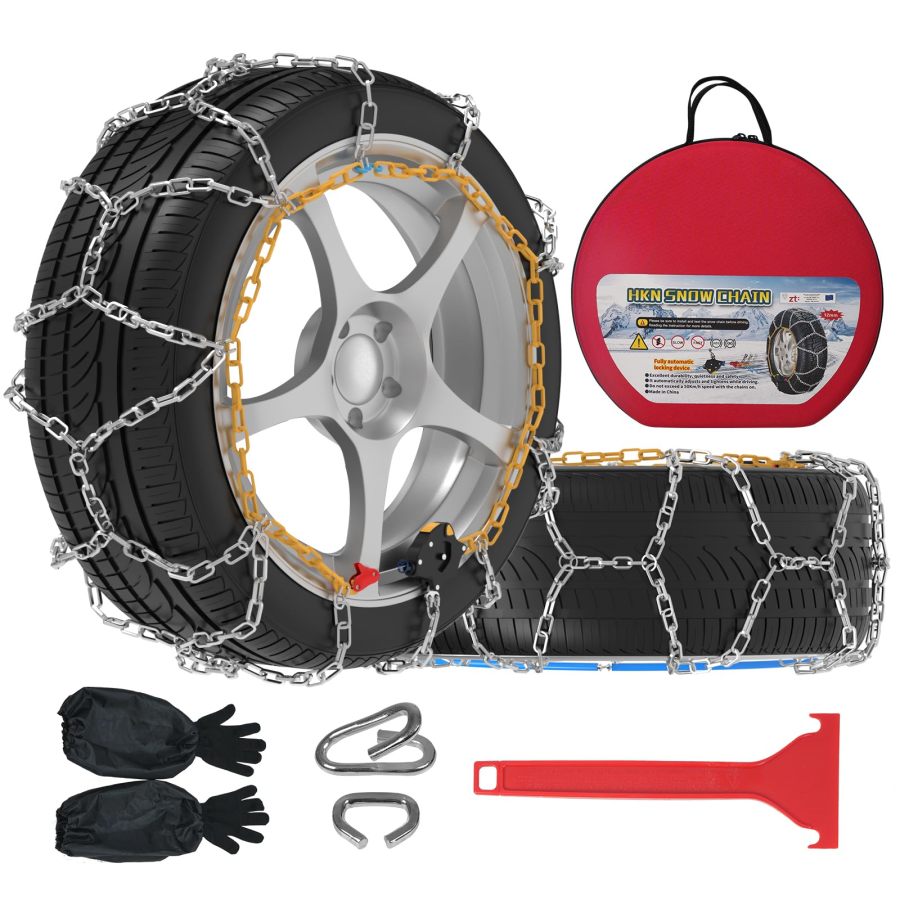
- Complete Emergency Toolkit: Includes gloves, a snow shovel, spare fasteners, etc., providing a one-stop emergency solution and enhancing user experience.
- Visual Installation Guidance: Video tutorials, color-coded markings, or clear pictorial instructions significantly reduce first-time installation difficulty and boost user confidence.
3.4 Unmet Needs & Opportunities
-
High Actual Installation Difficulty: Even when advertised as 'easy to install,' the process remains time-consuming and laborious in real-world harsh conditions (cold, dark, snow), often dirtying clothes, creating a significant gap from marketing expectations.
User Reviews (VOC) I don't think I could install/uninstall out in the cold snow, so I'd have to call for help if they broke while driving. // It took me somewhere between 5-10 minutes to put the set on, and that's probably because I was being extra cautious.
-
Inaccurate Size Compatibility: Seller-provided size charts do not match actual tire dimensions, causing chains to be too tight or too loose, making installation difficult or causing them to fall off during use, leading to returns and negative reviews.
User Reviews (VOC) Don't trust the fit information. Verify that they actually fit while you still can return them. // These chains are for a car when clearly ordered 4x4 285/70 r17 they do not fit or match packaging size
-
Insufficient Product Durability: Many chains break, loosen, or get damaged after the first use or a short drive, even causing secondary damage to the vehicle, severely impacting safety.
User Reviews (VOC) I only used them once and some of the chains broke within 20 minutes. // It doesn't work, it kept coming off. We ended up digging our car out of the snow! I'm so disappointed! // This product is not safe at all. I used the product for 20 minutes and the chains broke and got tangled around the suspension As a result, it destroyed my car.
-
Potential Damage to Rims: Some metal chains scratch rims during use, leaving permanent marks, which is a major drawback for owners of expensive rims, affecting vehicle aesthetics and value.
User Reviews (VOC) Unfortunately they scratched the hell out of my wheels on my new car. Every single chain link is now visible on my rim. Not a happy customer. // They work but they'll destroy your wheel's paint job.
-
Automatic Tightening Function Failure: The self-tightening mechanisms advertised by some products fail to maintain proper tension in actual use, causing chains to loosen, shift, or detach, increasing safety risks.
User Reviews (VOC) The self-tightening mechanisms don't actually do anything in my case because the chains were fully tight the moment I managed put them on; I had no slack to work with. // It doesn't work, it kept coming off.
IV. User Decision Drivers
4.1 Key Decision Factors
- Tire Size Match Accuracy: Whether the product precisely matches the user's tire size is the fundamental prerequisite for purchase and use, directly impacting safety and performance.
- Actual Traction Performance: Whether the chains provide reliable traction on snow/ice/mud to ensure driving safety is the user's primary core consideration when purchasing.
- Product Sturdiness/Reliability: Users fear chains breaking or detaching at critical moments, placing high demands on material and structural integrity, which relates to life and property safety.
- Ease of Installation: The ability to install quickly and easily in cold, harsh outdoor environments is one of the most significant user pain points, affecting emergency response efficiency and user experience.
4.2 Secondary Decision Factors
- Potential Damage to Vehicle/Rims: Whether the chain design effectively avoids scratching rims or interfering with other vehicle components is an important value-add, affecting vehicle aesthetics and potential repair costs.
- Lifespan & Corrosion Resistance: How long the product lasts and its susceptibility to rust affect long-term ownership costs and repurchase intent, reflecting product value-for-money.
- Brand Reputation & User Reviews: High sales volume and numerous positive reviews build consumer trust, especially for safety products; brand background also provides assurance.
- Storage Portability: Whether the product includes a suitable storage bag and is compact enough for convenient long-term storage in the vehicle without taking up extra space.
- Price: Users compare prices once core functionality is met, but safety and reliability take priority over low price to avoid major losses for minor savings.
V. Selling Points & Competitive Landscape
5.1 Selling Point Analysis
5.1.1 Standard Features (Points of Parity)
- Easy to Install & Remove: Most products emphasize no need to move the vehicle or use tools, completing the operation in a short time, addressing a key user pain point.
- Excellent Traction: Commonly advertised to provide superior grip on snow, ice, and mud, ensuring driving safety, which is the product's core function.
- High-Quality Durable Material: Most products emphasize using high-strength materials like alloy steel, manganese steel, or carbon steel to ensure sturdiness and alleviate user concerns.
- Automatic Tightening Design: Advertised as having a self-tightening mechanism, eliminating the need for manual readjustment after installation, offering convenience and peace of mind.
- Broad Compatibility: Claimed to be suitable for various vehicle types (cars, SUVs, pickups) and tire sizes to expand the target customer base.
5.1.2 Key Differentiators
- Diamond/Herringbone Pattern: Highlights unique tread design, claimed to provide a smoother driving experience and stronger grip, enhancing comfort.
- Low Clearance Design: Emphasizes suitability for vehicles with minimal tire clearance, addressing a pain point for some modern car models and broadening applicability.
- Complete Emergency Accessories: Includes gloves, a snow shovel, storage bag, spare fasteners, etc., enhancing perceived value and one-stop solution capability.
- Anti-Corrosion Treatment: Some products emphasize galvanizing or special coating treatments to enhance rust resistance and extend product life.
- Specific Vehicle Line Optimization: A few products emphasize optimization for specific models (e.g., Tesla Model Y, off-road SUVs) for targeted marketing.
5.1.3 Unique Selling Propositions (USPs)
- DOT Certification: Very few products (e.g., heavy-duty truck chains) explicitly state they have passed U.S. Department of Transportation (DOT) certification, emphasizing compliance with safety standards and regulations.
- Patented Tensioning System: Products like SCC Auto-Trac highlight their patented ratchet tensioning system as a core technological advantage, difficult to imitate.
- Specific High-Temperature Quenching Process: Individual products mention undergoing a 900-degree high-temperature penetration quenching process to enhance material wear resistance and hardness, highlighting technical barriers.
5.2 Competitive Landscape
5.2.1 Market Maturity
The automotive snow chain market has a medium-high maturity level. Core functional needs are clear, but product homogenization remains significant. Brands primarily compete on 'ease of installation,' 'material durability,' and 'self-tightening functionality.' The market features multiple technological paths, including traditional link chains and strap-on designs. Users place extremely high importance on product quality and actual performance, indicating there is still room to enhance competitiveness by addressing user pain points.
5.2.2 Innovation Trends
Current innovation trends mainly revolve around 'improving installation convenience' (e.g., self-tightening systems requiring no vehicle movement, modular strap designs) and 'enhancing product reliability and durability' (e.g., alloy steel materials, anti-corrosion coatings, low-clearance design). Additionally, product bundling (providing gloves, shovels, etc.) and more precise tire size compatibility (especially for SUVs/pickups and specific luxury models) are also differentiation directions. The future may see more intelligent installation assistance, lighter-weight composite materials without performance loss, or solutions integrated with smart connectivity (e.g., app-based fitting guidance).
VI. Marketing Claims vs. Reality Check
The table below analyzes the gap between common marketing claims and actual user experiences in this category:
| Dimension | Marketing Claim | User Reality | Verdict |
|---|---|---|---|
| Product Durability & Safety | High-strength alloy/manganese steel, sturdy and durable, safe and reliable, not prone to breakage. | Users widely report products breaking, loosening, or detaching after short-term use, even tangling around axles and causing severe damage to vehicle radiators, brake lines, etc., posing major safety hazards. | Sellers' false advertising regarding the core safety promise breaches the product's fundamental integrity, severely contradicting consumer safety expectations; it is a fatal credibility issue. |
| Size Compatibility & Universality | Universal design, widely compatible with various vehicle types and tire sizes, fits snugly after installation. | Numerous users report product size not matching claims, causing them to be too small to install or too large and loose; seller-provided size charts are inaccurate, and customer service may even recommend the wrong size. | Sellers over-market 'universality' but fail to provide accurate compatibility information and product tolerance management, causing the core purchase premise to fail for users and directly triggering return waves and a trust crisis. |
| Installation Convenience | 1-minute quick installation, no need to move the car, effortless, extremely simple operation, goodbye to frantic scrambling. | User feedback indicates installation remains time-consuming and laborious (5-15 minutes or more) in real harsh environments (cold, snow), requiring skill and strength, and often dirties clothes; some self-tightening mechanisms are ineffective or prone to jamming. | Sellers generalize ideal lab installation times as actual user experience, failing to deliver the core promise of 'extreme speed and convenience in extreme scenarios,' seriously misleading user expectations. |
| Rim Protection | Does not damage tires or rims, protects your vehicle. | Some users report rims being scratched by chains after use, leaving permanent marks, especially when chains shift during driving, increasing the likelihood of abrasion. | While ensuring traction, the product design fails to effectively address friction between metal chains and rims. Marketing claims are disconnected from actual product design, damaging user vehicle property. |
Key Takeaway: The market exhibits widespread parameter inflation and exaggerated scenario-based experience claims, particularly regarding installation ease, product durability, and size compatibility, leading to significant gaps between marketing and actual user experience.
VII. Supply-Demand Misalignment Analysis
The table below highlights mismatches between seller focus and buyer priorities:
| Dimension | Seller Behavior | User Focus | Verdict |
|---|---|---|---|
| Convenience in Real Installation Environments | Sellers commonly emphasize theoretical installation convenience like '1-minute quick install' and 'no need to move the car,' showcasing ideal operations through carefully edited videos. | Users repeatedly complain in reviews that in real scenarios (sub-zero temperatures, darkness, snow, mud), installation is still very difficult, time-consuming, freezing for hands, and messy, far from the marketing claims. | Sellers fail to consider user pain points from the user's perspective in real scenarios, overly beautifying the installation experience, leading to a severe mismatch between user expectations and actual operation, causing strong negative experiences. |
| Accuracy of Product Size Compatibility | Sellers often claim 'universal fit' or provide a broad size range in listings, lacking clear, reliable fitting guidance, shifting selection risk to the user. | User complaints about 'inaccurate size compatibility' are a high-frequency pain point. Many report that even following size charts may lead to poor fit, causing installation difficulty or chain looseness/detachment. | For safety products, size matching is fundamental. Sellers' vagueness and irresponsibility on this point directly damage user trust and increase return costs and brand reputation risk. |
| Product Durability & Safety Promise | Sellers commonly advertise material advantages like 'high-strength alloy steel' and 'sturdy and durable' but rarely provide authoritative durability test data or long-term warranty promises. | Users' greatest fear is chains breaking or detaching at critical moments, causing vehicle damage or even accidents. Existing reviews contain numerous reports of 'broke on first use' and 'caused secondary vehicle damage.' | Sellers fail to provide sufficient support for their core safety promises, leading to deep-seated user doubts about product reliability. This lack of trust is a major barrier to winning market share. |
| Rim Protection Measures | Some sellers mention 'does not damage rims,' but product design often lacks specific details or cushioning protection, creating a disconnect between claims and actual results. | Reports of scratched rims are common, especially for owners of expensive rims, representing an unacceptable pain point. | Sellers' promise of 'no rim damage' remains verbal, failing to genuinely solve this pain point through product design and material innovation, leading to user property damage and a significantly degraded experience. |
Key Takeaway: Sellers in the snow chain market commonly engage in 'self-indulgent' marketing, overemphasizing theoretical convenience and universality while collectively neglecting users' core pain points and trust crises in real harsh environments.
VIII. Strategic Opportunities & Recommendations
8.1 True Simple-Installation Snow Chains for All Scenarios
8.1.1 Target Audience & Pain Points
⚡️ Pain Points Addressed: High actual installation difficulty, especially in harsh weather; lack of visual installation guidance.
8.1.2 Action Plan
Redesign the connection system using large, frost-proof, anti-slip material quick-lock buckles, enabling one-handed connection within 30 seconds in cold conditions. Color-code key connection points and include extended, thick anti-slip/cold-weather gloves and a waterproof knee pad. Provide an AR-assisted installation app or waterproof instructions with QR codes.
| Tech Complexity | Medium |
| Cost Impact | Medium Impact |
| Trade-off Warning | Pursuing ultimate convenience may slightly sacrifice absolute tensile strength under extreme heavy loads, but this can be compensated for through material optimization. |
| Price Band | Only viable above $49.99 |
8.1.3 Marketing Strategy
Emphasize 'One-hand quick install even at -20°F!'; highlight 'Goodbye to cold, wet, frantic scrambling.' Publish short videos of users easily installing in real extreme scenarios (nighttime, heavy snow, ice) to build a 'foolproof' installation mindset.
8.2 Zero-Rim-Damage Ultra-Durable Snow Chains
8.2.1 Target Audience & Pain Points
⚡️ Pain Points Addressed: Potential damage to rims; insufficient product durability (breaking, loosening).
8.2.2 Action Plan
Use aerospace-grade high-strength composite materials or nano-coated alloy steel, offering a 5+ year warranty against rust and breakage. Integrate high-elasticity, wear-resistant soft TPE or PU material to fully encase all chain parts contacting the rim, ensuring zero scratches. Validate durability through third-party lab extreme pressure and long-term wear tests.
| Tech Complexity | Medium |
| Cost Impact | High Impact |
| Trade-off Warning | Rim protection design may slightly increase required chain-to-tire clearance or add some weight, requiring optimization of chain thickness for balance. |
| Price Band | Only viable above $99.99 |
8.2.3 Marketing Strategy
Focus on 'Protect your precious rims, zero damage guaranteed'; emphasize 'Industry-first rim protection technology,' 'Military-grade materials, lifetime fracture resistance.' Showcase design details ensuring tight fit without contact points and reinforce reliability with extreme test videos.
8.3 Smart Precision-Fit Snow Chain Ecosystem
8.3.1 Target Audience & Pain Points
⚡️ Pain Points Addressed: Inaccurate size compatibility, vague seller information; user difficulty in selection.
8.3.2 Action Plan
Develop an AI-based tire size smart matching tool (app or web). Users input vehicle year/model or take a photo to get the most compatible model recommendation with detailed installation diagrams. All products include a unique ID code; users can scan it in the app for exclusive installation videos and real-time support. Offer a 'First install mismatch, free exchange/return' policy.
| Tech Complexity | Medium |
| Cost Impact | Low Impact |
| Trade-off Warning | Primarily software/service investment, no direct physical side effects. Requires building a vast vehicle/tire database. |
| Price Band | Only viable above $59.99 (value体现在服务而非单品) |
8.3.3 Marketing Strategy
Emphasize 'End selection anxiety, your car gets its专属 snow chains'; highlight 'Smart matching, zero-error shopping'; promote 'Scan code for video, installation made simple.' Build trust with 'Industry's most comprehensive vehicle database.' Elevate snow chains to an 'Intelligent Travel Companion' providing full-service support.
8.4 Self-Rescue Multi-Function Emergency Traction Kit
8.4.1 Target Audience & Pain Points
⚡️ Pain Points Addressed: Needs of emergency-preparedness car owners; lack of usage experience; inconvenient storage.
8.4.2 Action Plan
Bundle snow chains (choose strap-on or modular designs for lighter weight) with a high-lumen LED flashlight, high-quality anti-slip gloves, a foldable snow shovel, a portable first-aid kit, a whistle, an emergency blanket, etc. Design a waterproof, shockproof, modular internal compartment portable storage case for easy access. Include a winter emergency self-rescue guide.
| Tech Complexity | Low |
| Cost Impact | Medium Impact |
| Trade-off Warning | Bundling increases overall volume and weight, requiring clever storage design to maintain portability. |
| Price Band | Only viable above $79.99 |
8.4.3 Marketing Strategy
Promote 'Essential for winter driving-more than just chains, it's complete emergency preparedness'; emphasize 'Be prepared, handle winter emergencies calmly.' Showcase the kit's value in various emergency scenarios (snow, mud), highlighting its one-stop convenience and peace of mind.