Amazon US Market Analysis: Multi-Function Steam Mop Category
📊 Executive Summary
📈 Market Trends
Multifunctionality and healthy cleaning are the market's main themes. The steam mop market is evolving from single-surface floor cleaning towards whole-house, multi-surface, chemical-free cleaning solutions. Consumer demand for efficient, immediate, and eco-friendly cleaning methods is strong, especially among families with children and pets, who show high concern for sterilization and residue-free cleaning.
⚡ Major Pain Points
Insufficient durability and poor water tank runtime are critical weaknesses. Users commonly complain about short product lifespans (especially handles and steam generators), high failure rates, and small water tank capacities that lead to frequent refills, severely disrupting cleaning continuity. Additionally, while multi-function attachments are plentiful, inconvenient storage and low practical utility reduce user satisfaction.
💡 Selection Opportunities
Deeply address core pain points and deliver a solid user experience. Product selection opportunities lie in enhancing the durability of core components and offering longer warranties to build trust; designing larger capacity water tanks and intelligent power cord management to optimize cleaning efficiency; and improving detailed experience through ergonomics and integrated storage. Furthermore, providing specialized, chemical-free customized cleaning solutions for pet families presents a chance to stand out in a niche market.
I. Analysis Overview
1.1 Introduction & Report Scope
This report analyzes the 'Steam Mops' category on the Amazon US market (focusing on multi-function steam mops), concentrating on target user personas, core needs, decision drivers, market communication, and potential opportunities.
1.2 Category Snapshot
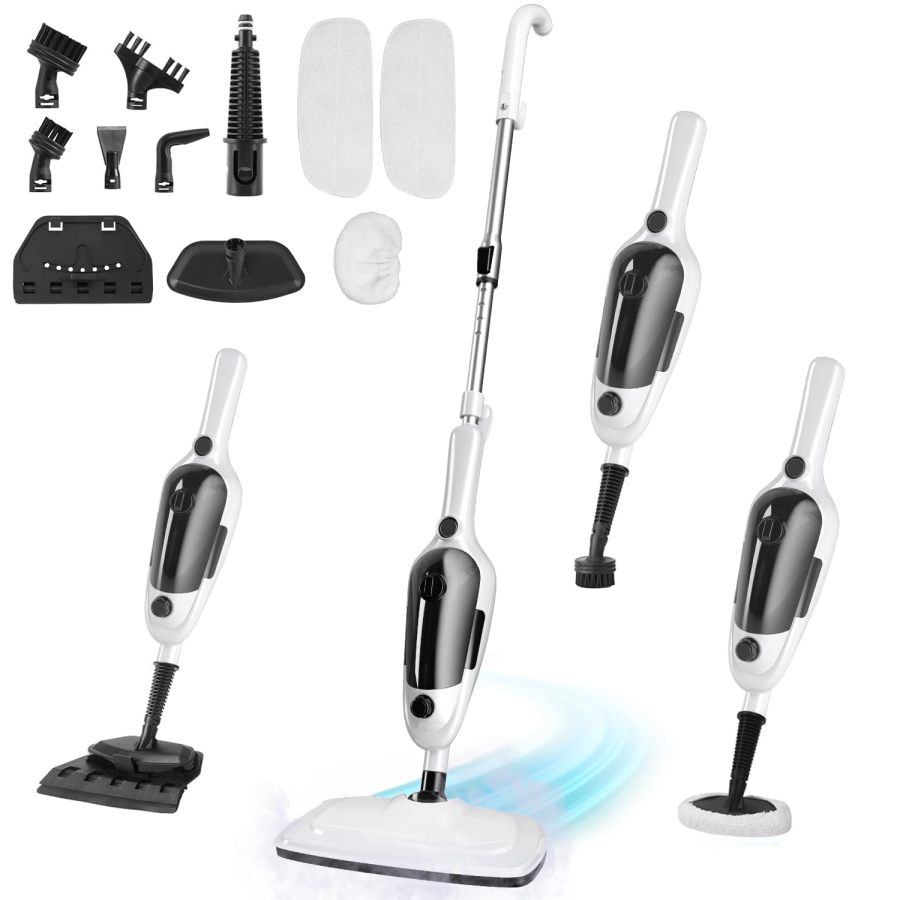
A multi-function steam mop is a home cleaning appliance that uses high-temperature steam for cleaning and sanitizing. It typically features a detachable handheld cleaner with various attachments, enabling a single device to perform deep, chemical-free cleaning on multiple surfaces such as floors (hardwood, tile, laminate, etc.), windows, kitchenware, and upholstery. It is an ideal choice for modern households seeking efficient and healthy cleaning solutions. The following table illustrates the key characteristics of consumer behavior in this category.
| Dimension | Segment | Description |
|---|---|---|
| Need Driver Type | Planned Purchase / Emergency-driven Purchase | Purchases are typically driven by a long-term need for healthier, more efficient cleaning solutions, but can also be triggered by stubborn stains or hygiene concerns leading to immediate purchases. |
| Purchase Frequency | Low Frequency | The main unit is a durable good with low purchase frequency, though there is repeat purchase demand for accessories (e.g., mop pads). No significant seasonal or holiday peaks are observed. |
| Decision Complexity | Relatively Complex | Users conduct detailed comparisons of product multifunctionality, heating speed, water tank capacity, durability, and brand reputation before purchasing, indicating a higher level of decision-making effort. |
| Price Sensitivity | Medium | Price is an important consideration, but users are more inclined to pay a reasonable premium for efficient, multi-functional, and reliable cleaning experiences. |
| Emotional Dependency | Medium | Primarily based on functionality and practicality, but the ability to provide a clean, healthy environment for the family (especially for households with children and pets) adds a sense of security and well-being. |
II. User Personas & Usage Scenarios
2.1 Clean Home Guardian
🎯 Parents or pet owners who prioritize home environment health and hygiene, seeking efficient, chemical-free cleaning solutions to ensure the safety of their family and pets.
| Typical Usage Scenarios | Core Pain Points | Primary Purchase Drivers |
|---|---|---|
|
|
|
2.2 All-in-One Cleaning Pro
🎯 Adults who pursue efficiency and exceptional results in home cleaning, have multiple floor types and diverse cleaning needs, and hope to solve whole-house cleaning challenges with one device.
| Typical Usage Scenarios | Core Pain Points | Primary Purchase Drivers |
|---|---|---|
|
|
|
III. User Needs Hierarchy (KANO Model)
3.1 Basic Needs (Must-Haves)
- High-Temperature Steam: Ability to generate steam hot enough (typically over 100°C) to effectively clean and sanitize, which is the core function of a steam mop.
- Fast Heating: Steam production within a short time (15-30 seconds) after powering on, reducing user wait time before cleaning.
- Simple Operation: The product must be easy to assemble, fill with water, and use daily, with intuitive controls and no complex settings.
- Safety: Features like dry burn protection, child lock, or auto-shutoff to ensure safety during use.
3.2 Performance Needs (Linear Satisfiers)
- Multifunctionality: Detachable handheld design with various attachments (e.g., brushes, scrapers) to handle multiple cleaning scenarios like floors, windows, grout, kitchenware, and fabrics.
- Powerful Cleaning: Effectively removing stubborn stains, grease, and grout dirt to achieve deep cleaning results.
- Compatibility with Multiple Floors: Safe and efficient application on various hard surfaces like hardwood, tile, laminate, vinyl, and sealed stone.
- Lightweight & Flexible: Light main unit with a swiveling cleaning head for easy maneuvering around furniture and in tight spaces, reducing physical strain.
- Long Power Cord: Providing a sufficiently long power cord (e.g., 18-25 feet) to reduce the hassle of frequent outlet changes and expand cleaning range.
3.3 Excitement Needs (Delighters)
- Smart Steam Control: Adjustable steam levels for different surfaces and stain types, preventing floor damage and optimizing cleaning.
- Chemical-Free Cleaning: Using only water for deep cleaning and sanitizing, requiring no chemical cleaners, making it healthier for family and pets and more environmentally friendly.
- Quick Drying: Minimal water residue left on floors after cleaning, allowing for fast drying to avoid slip hazards and moisture damage.
- Fragrance Feature: Built-in fragrance box or the ability to add fragrance discs to release pleasant scents during cleaning, enhancing the experience.
3.4 Unmet Needs & Opportunities
-
Larger Water Tank Capacity: Users commonly report that the water tank is too small, requiring frequent refills, especially during large-area cleaning, which interrupts the workflow.
User Reviews (VOC) Customers are dissatisfied with the water capacity of the steam cleaner, reporting that it runs out quickly and needs frequent refilling. // I wish the water tank was a little larger (when you use the scrubber, you use a lot more water than just using the mop head w/a pad - so it runs out quickly)
-
Insufficient Durability: Some users report that the product (especially the handle, steam generator, or connecting hose) is prone to damage, leading to a short lifespan and increased ownership costs.
User Reviews (VOC) Customers report significant durability issues with the steam mop's handle, with multiple reviews mentioning it breaking at the connecting pins or completely snapping in half. // Customers report significant issues with the steam cleaner's functionality, with multiple customers noting that the steamer stopped working within a year, the heating element failed, and it stopped producing steam entirely after limited use.
-
Inconvenient Attachment Storage: Multi-function steam mops often come with numerous attachments but lack a convenient, integrated storage solution, leading to lost parts or a cluttered home.
User Reviews (VOC) The only other negative is all the attachments are supposed to be carried in a burlap bag which doesn't actually fit all the attachments. // There is no carrying bag included. It would have been nice to have a mesh bag included.
-
Power Cord Management & Standability: Power cords easily tangle, and some products struggle to stand stably on their own, causing inconvenience during use and storage.
User Reviews (VOC) The cord is always getting in the way but I have the same issue with any vacuum. // It doesn't stand up well even when you lean it against something.
-
Handheld Mode Ergonomics: The detached handheld unit can be heavy for prolonged use, or require continuous trigger pressing, easily causing hand fatigue.
User Reviews (VOC) it does get very heavy holding it and the hose isn't long enough to sit the unit on the floor and use it, so you always have to hold it up. Also, my finger hurts from having to press the button nonstop while using the detached unit.
IV. User Decision Drivers
4.1 Key Decision Factors
- Cleaning Effectiveness: The ability to effectively remove stubborn dirt, grease, and achieve deep cleaning and sanitization is the most critical consideration for users, directly impacting cleaning satisfaction.
- Ease of Use: How easy the product is to assemble, fill, operate, and maneuver, as well as its overall lightness and flexibility, directly affect the user experience and the burden of housework.
- Multi-Surface Applicability: Whether the product can safely and efficiently handle various floor types and cleaning scenarios (e.g., floors, grout, windows, fabrics) determines its value-for-money and tool consolidation benefits.
- Fast Heating: Rapid steam production significantly saves pre-cleaning wait time and boosts cleaning efficiency, a key metric for users measuring product responsiveness.
- Chemical-Free Cleaning: For families with children, pets, or health concerns, pure steam cleaning without chemical residue is an important selection criterion and a source of peace of mind.
4.2 Secondary Decision Factors
- Water Tank Capacity / Runtime: Tank size and continuous operation time per refill affect the smoothness of large-area cleaning by reducing frequent interruptions.
- Durability / Quality: Users care about material sturdiness and whether key components are prone to failure, expecting a longer product lifespan to avoid short-term repurchases.
- Power Cord Length: Whether the power cord is long enough to cover most cleaning areas, reducing plug changes and enhancing operational convenience.
- Storage Convenience: How easily the product (including attachments) can be stored without taking up too much space, helping maintain a tidy home.
- Price: Price remains an important factor for comparison and selection, especially when products have similar features, as long as core needs and budget are met.
V. Selling Points & Competitive Landscape
5.1 Selling Point Analysis
5.1.1 Standard Features (Points of Parity)
- Multifunctionality: Commonly emphasizes 'X-in-1' design, detachable handheld unit, usable for various cleaning scenarios like floors, windows, furniture.
- Fast Heating: Widely advertised as producing steam within 10-30 seconds, reducing user wait time and improving cleaning efficiency.
- Chemical-Free: Highlights cleaning and sanitizing with just water, emphasizing health, eco-friendliness, and safety for children and pets.
- Compatibility with Multiple Floors: Claims the product is safe for various sealed hard surfaces like hardwood, tile, laminate, and stone.
- Powerful Cleaning: Emphasizes that high-temperature steam effectively removes stubborn stains, grease, and grout dirt.
5.1.2 Key Differentiators
- Adjustable Steam Modes: Offering 2-3 steam settings to adapt to different cleaning needs and surfaces, preventing damage.
- Detachable Water Tank: Designing a tank that is easy to fill and clean, enhancing user convenience.
- Long Power Cord: Providing a 16-25 foot power cord to expand cleaning range and reduce outlet switching.
- Lightweight Design: Emphasizing the product's light weight and portability for easier operation and less fatigue during extended use.
- Variety of Specialized Attachments: Providing a wider range of dedicated attachments for windows, sofas, carpets, ovens, sinks, grout, etc.
5.1.3 Unique Selling Propositions (USPs)
- Smart Digital Display: Real-time display of steam mode, water tank status, etc., providing a more intuitive control experience.
- Fragrance Function: Built-in fragrance disc slot to release pleasant scents during cleaning, improving indoor air quality.
- Auto Steam Function: Continuous steam output without needing to hold down the trigger, further enhancing operational convenience.
- Integrated Storage or Wall-Mount Design: Providing innovative attachment storage solutions or wall-mount brackets to optimize storage space and tidiness.
5.2 Competitive Landscape
5.2.1 Market Maturity
The steam mop market has a medium-high level of maturity. Core cleaning and sanitizing functions have become standardized, with most brands competing around similar selling points. Product innovation focuses on enhancing user experience details and functional expansion, but product homogenization is common with limited differentiation.
5.2.2 Innovation Trends
Innovation trends are primarily reflected in enhanced multifunctionality (evolving towards 'whole-house cleaning' solutions with more customized attachments), refined user experience optimization (e.g., faster heating, longer runtime, lighter body, smarter steam control, improved ergonomics), and deepening health & safety value propositions (emphasis on high-temperature sterilization, chemical-free cleaning, and solutions for specific allergens). Some brands are beginning to explore additional features like fragrance and LED displays to offer a more comprehensive home cleaning solution.
VI. Marketing Claims vs. Reality Check
The table below analyzes the gap between common marketing claims and actual user experiences in this category:
| Dimension | Marketing Claim | User Reality | Verdict |
|---|---|---|---|
| Steam Runtime & Stability | Long-lasting runtime; a single water fill allows for 30-45 minutes of continuous cleaning with strong, consistent steam. | Users commonly report that actual runtime under high steam mode is far lower than advertised (often 10-20 minutes), and some products experience unstable or completely stopped steam output after some use. | Sellers substitute ideal lab data or low-power mode runtime for the actual user experience, failing to deliver on the expectation of long, intensive cleaning sessions. This is a core cause of negative reviews and returns. |
| Multifunctionality & Attachment Practicality | 12-in-1, 19-in-1, even 29-in-1 all-in-one cleaning; all attachments are powerful and efficient. | Users report that some attachments are gimmicky, poorly made, or fragile, with low actual utilization and subpar cleaning results. Additionally, chaotic attachment storage degrades the overall experience. | Typical feature-stacking marketing that fails to deeply understand real user scenario needs. Multifunctionality becomes superficial, adding BOM cost without delivering real value. |
| Product Durability | Heavy-duty design, sturdy and durable, built to last. | Numerous user reviews report that handles, connectors, internal hoses, or heating elements are prone to damage, leading to short product lifespans and frequent malfunctions. | While claiming 'heavy-duty,' sellers compromise on the materials and craftsmanship of critical structural components, causing a severe disconnect between product reliability and user expectations, directly damaging brand reputation and repurchase rates. |
Key Takeaway: The market exhibits widespread parameter inflation and exaggeration of scenario-based performance, particularly regarding runtime, multifunctionality, and actual effectiveness.
VII. Supply-Demand Misalignment Analysis
The table below highlights mismatches between seller focus and buyer priorities:
| Dimension | Seller Behavior | User Focus | Verdict |
|---|---|---|---|
| Product Durability & Reliability | Sellers generally emphasize 'powerful steam' and 'deep cleaning' but rarely mention the material, build quality, lifespan of core components, or strong long-term warranty commitments, avoiding the durability issue. | User reviews frequently complain about 'handle breaking,' 'machine stopped working,' 'unstable steam,' expressing frustration over short product lifespans and poor purchase experiences. | This is a fundamental issue for the category: after functional needs are met, users care most about long-term reliability. Sellers fail to build trust here, creating a trust deficit. |
| Water Tank Capacity & Continuous Cleaning Experience | Sellers tend to promote 'fast heating' and 'multifunctionality' but are vague about actual tank capacity and real runtime data under high steam mode, sometimes using ideal values to mislead. | Users commonly report that the water tank is too small, requiring frequent interruptions to refill during large-area cleaning, disrupting the workflow and degrading the experience. They desire larger tanks for improved efficiency. | Sellers lack sufficient understanding of the core user experience, failing to translate the key user demand for 'continuous cleaning' into a product advantage, resulting in hindered cleaning efficiency. |
| Attachment Design & Storage Management | Sellers heavily promote 'X-in-1' multifunctionality, showcasing extensive attachment lists, but rarely provide details on practical application scenarios, quality assurance, or convenient storage solutions for these attachments. | Users find that some attachments are of poor quality, wear out easily, and that the numerous accessories have no proper place for storage, leading to clutter and loss, affecting home tidiness. | Sellers treat quantity as a selling point but overlook quality and user experience, turning 'multifunctionality' into 'superfluous functionality' and increasing user management costs. |
Key Takeaway: Sellers excessively focus on the number of features and gimmicks, while collectively remaining silent or downplaying the user's top concerns: product durability, sustained cleaning efficiency, and detailed user experience.
VIII. Strategic Opportunities & Recommendations
8.1 Core Component Durability Upgrade & Warranty System Establishment
8.1.1 Target Audience & Pain Points
⚡️ Pain Points Addressed: Insufficient durability, key components are prone to failure.
8.1.2 Action Plan
Redesign the structure and materials of the steam generator, water pump, and handle connection points, using high-temperature and corrosion-resistant engineering plastics or metal components. Strengthen moisture-proofing for internal circuit boards and connection points. Introduce stricter factory testing standards.
| Tech Complexity | Medium |
| Cost Impact | High Impact |
| Trade-off Warning | Increasing core component strength may slightly increase product weight or manufacturing cost, but users are willing to pay for longer lifespan. A balance between dimensions and weight is needed. |
| Price Band | Only viable above $99.99 |
8.1.3 Marketing Strategy
Emphasize '5-Year Worry-Free Warranty, Core Components Built to Last'; use authoritative certifications or long-term user test data to demonstrate product reliability, communicating the value proposition of 'one investment, lasting peace of mind.'
8.2 Large Capacity Water Tank & Integrated Power Cord Management
8.2.1 Target Audience & Pain Points
⚡️ Pain Points Addressed: Small water tank capacity requiring frequent refills; tangled power cord, inconvenient storage.
8.2.2 Action Plan
Design a detachable water tank with a capacity of 600ml or more, featuring a large top opening for easy filling. Integrate an automatic cord rewind function, or design a multi-functional cord clip and self-standing slot to solve cord tangling and storage issues.
| Tech Complexity | Low |
| Cost Impact | Medium Impact |
| Trade-off Warning | A larger tank will increase product volume and wet weight, requiring careful design to not compromise overall portability. An automatic cord reel mechanism will increase base size, needing clever design to avoid bulkiness. |
| Price Band | Only viable above $79.99 |
8.2.3 Marketing Strategy
Highlight 'One Fill, Whole House Clean'; 'Say Goodbye to Frequent Plug Changes, Enjoy Smoother Cleaning'; use demo videos to showcase the runtime advantage of the large tank and the convenience of smart cord management.
8.3 Refined Handheld Mode Ergonomics & Integrated Attachment Storage
8.3.1 Target Audience & Pain Points
⚡️ Pain Points Addressed: Handheld mode operation fatigue; numerous attachments with inconvenient storage.
8.3.2 Action Plan
Optimize the weight distribution and grip design of the handheld unit. Add a trigger lock function to avoid continuous pressing. Design an integrated (host-based) or wall-mounted attachment storage solution ensuring all attachments (including replacement mop pads) have a designated place.
| Tech Complexity | Low |
| Cost Impact | Low Impact |
| Trade-off Warning | Optimizing the handheld unit's weight distribution may require internal structural adjustments but has minimal impact on overall performance. Integrated storage may slightly increase product size but offers significant value enhancement. |
| Price Band | Only viable above $69.99 |
8.3.3 Marketing Strategy
Emphasize 'Effortless Control, Clean Without Boundaries'; 'Say Goodbye to Clutter, Attachments Within Reach'; showcase clean product storage visuals, highlighting the convenient experience brought by human-centric design.
8.4 Customized Efficient Cleaning Solution for Pet Families
8.4.1 Target Audience & Pain Points
⚡️ Pain Points Addressed: Challenges with cleaning pet hair, odors, allergens, and concerns about chemical residue.
8.4.2 Action Plan
Develop mop pad materials with superior pet hair adhesion that are also easy to clean, or provide mop heads with specialized brush bristles. Launch veterinarian-certified, non-toxic, eco-friendly pet deodorizing fragrance discs. Provide third-party test reports for mite/allergen removal.
| Tech Complexity | Medium |
| Cost Impact | Medium Impact |
| Trade-off Warning | Custom mop pad materials may slightly increase cost. Dedicated fragrances must strictly meet non-toxic standards, potentially extending R&D cycles. |
| Price Band | Only viable above $89.99 |
8.4.3 Marketing Strategy
Position as 'Customized for Love, Deep Clean Protection for Pet Families'; emphasize 'Effectively Removes Pet Hair & Odors, Chemical-Free for Greater Peace of Mind'; use pet-themed visuals and user stories to evoke emotional resonance.