Amazon US Market Analysis: Multi-functional Mandoline Slicers Category
📊 Executive Summary
📈 Market Trends
Convenience and safety are mainstream in the kitchen, with multi-functional mandolines evolving towards integration. The US Amazon market for multi-functional mandolines is highly competitive, with consumers generally seeking efficient, time-saving meal prep solutions. Product innovation focuses on enhancing operational safety (e.g., no-contact designs) and integration (e.g., one-touch multi-function adjustment) to meet modern households' dual needs for kitchen efficiency and convenience.
⚡ Major Pain Points
Safety concerns remain unresolved; ingredient compatibility and durability are major weaknesses. Despite widespread safety claims, user anxiety about cuts persists, as existing measures fail to deliver a 'zero-risk' experience. Simultaneously, product limitations in handling large or soft ingredients, blade lifespan and replacement issues, and accessory storage clutter significantly impact user satisfaction and long-term experience.
💡 Selection Opportunities
Deepen safety focus, broaden compatibility, provide long-term solutions. Market opportunities lie in developing a revolutionary 'No-Contact Smart Mandoline System' to eliminate safety hazards entirely; launching a 'Wide-Chute, All-Purpose Mandoline' to address ingredient handling limits. Additionally, through 'Modular Blade Replacement' and 'Integrated Storage Solutions,' along with 'Easy-Clean, No-Dead-Spot' designs, product added value and user trust can be effectively enhanced, building differentiated competitive advantages in the details.
I. Analysis Overview
1.1 Introduction & Report Scope
This report analyzes the 'Multi-functional Mandoline Slicers' category in the US Amazon market, focusing on target user personas, core needs, decision drivers, market communication, and potential opportunities.
1.2 Category Snapshot
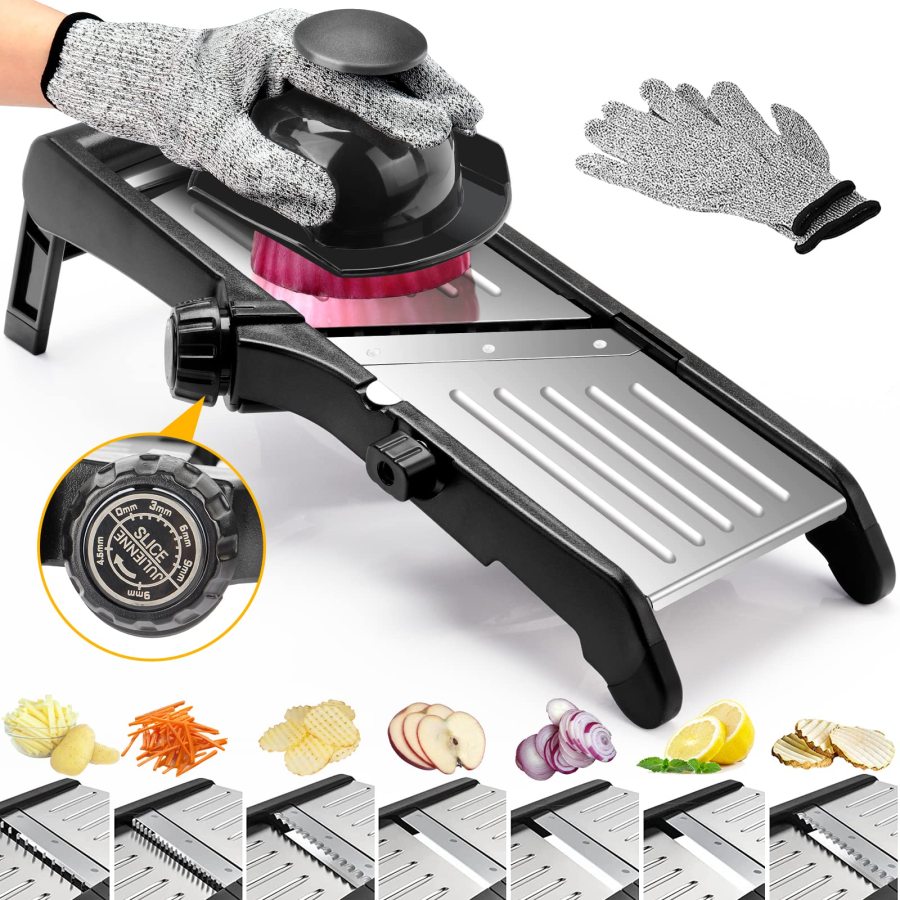
Multi-functional mandoline slicers are designed to help users efficiently and uniformly complete food prep tasks like slicing, shredding, dicing, and grating through integrated blades and cutting modes. Product forms vary, including handheld, countertop models with collection containers, and innovative safety-press designs. They primarily use stainless steel blades and food-grade plastic bodies to enhance kitchen efficiency and ensure operational safety. The following table illustrates the key characteristics of consumer behavior in this category.
| Dimension | Segment | Description |
|---|---|---|
| Need Driver Type | Planned Purchase / Problem-Solving | Purchases are typically driven by the need for efficiency in daily meal prep or to solve pain points like time-consuming, inconsistent hand-cutting and safety hazards. |
| Purchase Frequency | Low Frequency | As durable kitchenware, repurchase is typically considered only when a product breaks, lacks functionality, or significant innovation emerges; it is not a high-frequency purchase. |
| Decision Complexity | Medium | Consumers compare functional diversity, safety design, cleaning convenience, materials, and price, but usually do not conduct deep research, focusing more on practical assessment. |
| Price Sensitivity | Medium | Price is an important consideration, but users are willing to pay a reasonable premium for enhanced safety, reliable durability, and core functionality (e.g., blade sharpness). |
| Emotional Dependency | Low to Medium | Primarily based on practical functions and efficiency gains, but positive emotional value and self-satisfaction can also be derived from 'easier meal prep' and 'more professional cooking'. |
II. User Personas & Usage Scenarios
2.1 Efficiency-Focused Home Chef
🎯 Cooks frequently, values meal prep efficiency and professional ingredient handling, and pursues a more effortless kitchen experience.
| Typical Usage Scenarios | Core Pain Points | Primary Purchase Drivers |
|---|---|---|
|
|
|
2.2 Small-Kitchen Minimalist / Novice Cook
🎯 Has limited kitchen space, pursues tool compactness, multi-functionality, and easy storage, while valuing ease of use and safety.
| Typical Usage Scenarios | Core Pain Points | Primary Purchase Drivers |
|---|---|---|
|
|
|
III. User Needs Hierarchy (KANO Model)
3.1 Basic Needs (Must-Haves)
- Sharp & Durable Blades: Blades must be sharp enough to cut various ingredients easily, with sturdy, durable materials resistant to dulling or rusting, ensuring long-term performance.
- Operational Stability: Product base should have non-slip design or stable support, ensuring no wobbling or sliding during use, enhancing safety and efficiency.
- Easy to Clean: Product structure should be easy to disassemble for rinsing, with no significant cleaning dead spots, reducing food residue; ideally dishwasher-safe.
- Basic Slicing Function: Capable of performing basic uniform slicing, meeting daily thin-slicing needs for vegetables and fruits, the core function of a multi-functional mandoline.
3.2 Performance Needs (Linear Satisfiers)
- Multi-Level Thickness Adjustment: Features multiple adjustable cutting thickness levels, from paper-thin to thicker slices, to suit different cooking needs and personal preferences.
- Multiple Cutting Modes: Beyond slicing, can achieve shredding (coarse, fine), dicing, waffle cuts, etc., enhancing product applicability.
- Hand Safety Protection: Equipped with hand guards, food pushers, or cut-resistant gloves to maximize user finger safety and reduce operational risk.
- Ingredient Collection Container: Includes a built-in collection container to prevent ingredients from scattering on the countertop, keeping the kitchen tidy and facilitating ingredient collection/transfer.
- Compact Storage Design: Product is foldable or all accessories can be stored integratedly, saving kitchen space and facilitating storage.
3.3 Excitement Needs (Delighters)
- Built-in Blade Adjustment: Adjusts blade type and thickness directly via a knob or lever, eliminating the need to disassemble and change blades, offering ultimate convenience and enhanced safety, reducing operational friction.
- Large Ingredient Handling Capability: Features a larger feed chute or wider cutting platform to directly handle large vegetables, reducing pre-cutting steps and significantly boosting efficiency.
- Excellent Performance with Soft Ingredients: Achieves clean slices on soft ingredients like ripe tomatoes and mushrooms without squeezing or tearing, broadening product applicability.
- Reduced Hand Strain: Ergonomic design for more effortless operation, especially suitable for elderly users or those with hand/joint discomfort, enhancing comfort.
3.4 Unmet Needs & Opportunities
- Larger Feed Chute: Existing products generally have small feed chutes; large vegetables (e.g., whole onions, large potatoes) need pre-cutting, reducing efficiency and creating a gap with the advertised 'high efficiency'.
- Soft Ingredient Cutting Optimization: Most mandolines perform well on hard vegetables but poorly on soft ingredients like ripe tomatoes and soft fruits, often causing them to squeeze, deform, or tear.
- Long-Term Blade Lifespan & Replacement: Some users complain blades dull over long-term use, and the market lacks convenient official blade replacement services or spare parts, shortening product lifespan.
- Integrated Accessory Storage Solution: Many multi-functional products have numerous accessories but lack a unified, sturdy storage box; small parts are easily lost, causing kitchen clutter and degrading user experience.
- Consistent Product Durability: Some products receive user feedback that plastic bodies or certain structures easily break or crack during use, with inconsistent durability performance, diverging from the 'sturdy and durable' claim.
IV. User Decision Drivers
4.1 Key Decision Factors
- Safety: Users' top concern, directly impacting purchase intent and usage frequency; avoiding cuts is the primary consideration, determining if the product can be used with peace of mind.
- Blade Sharpness & Cutting Performance: The foundation for ensuring cutting results and efficiency, determining if the product is 'effective' and can easily, uniformly complete ingredient processing.
- Ease of Use: Including whether operation is simple/intuitive, assembly/disassembly is convenient, directly impacting user onboarding difficulty and daily experience, reducing operational friction.
- Cleaning Convenience: The difficulty of daily maintenance; cleaning dead spots and dishwasher compatibility are important considerations, directly impacting post-use burden.
4.2 Secondary Decision Factors
- Multi-Functionality: Provides multiple functions like slicing, shredding, dicing, meeting diverse cooking needs, enhancing the product's value as an all-in-one tool.
- Material & Durability: Impacts product lifespan and long-term performance; stainless steel or high-strength food-grade plastic is generally preferred, providing reassurance.
- Storage Space & Compactness: Whether the product is compact and easy to store, especially important for small-kitchen users, affecting kitchen tidiness and space utilization.
- Ingredient Compatibility: Ability to handle ingredients of different sizes, hardness, and softness, broadening usage scope and enhancing product versatility.
V. Selling Points & Competitive Landscape
5.1 Selling Point Analysis
5.1.1 Standard Features (Points of Parity)
- Sharp Blades: Commonly emphasizes stainless steel blade material and sharpness, claiming to achieve easy, efficient cutting, saving prep time.
- Multi-Functionality: Promotes multiple cutting modes or included blades for slicing, shredding, dicing, grating, etc., to achieve an all-in-one machine.
- Easy to Clean: Highlights detachable, easy-rinse design, some claiming dishwasher-safe, reducing cleaning burden.
- Saves Prep Time: Emphasizes high efficiency, speed, replacing traditional hand-cutting, significantly shortening ingredient prep time, boosting kitchen efficiency.
- Thickness Adjustment: Offers multi-level slicing thickness adjustment to meet users' refined needs for ingredient size.
5.1.2 Key Differentiators
- Safety Design: Highlights hand guards, food pushers, cut-resistant gloves, or built-in hidden blade design as a core safety selling point.
- Material Upgrade: Emphasizes all-stainless steel body, high-quality BPA-free plastic, promising durability, corrosion resistance, and resistance to deformation.
- Integrated One-Touch Adjustment: Adjusts blade type and thickness directly via a knob or lever, eliminating frequent blade changes, enhancing operational convenience.
- Built-in Collection Container: Includes a built-in collection box, reducing ingredient spillage on the countertop, facilitating collection/transfer, and keeping the kitchen tidy.
- Compact Foldable Storage: Highlights product's small size, portability, foldable design, saving kitchen storage space, easy to store.
5.1.3 Unique Selling Propositions (USPs)
- Press-Down / Vertical Cutting Mechanism: A few products use a fully enclosed press-down or vertical cutting system, claiming to completely avoid hand contact with blades, providing ultimate safety.
- Commercial / Restaurant-Grade Material Claims: Claims use of higher-standard materials like surgical-grade 304 stainless steel, highlighting the product's professional positioning in durability and quality.
- Larger Feed Chute / Capacity: A few brands begin emphasizing upgraded large-diameter feed chutes to handle large ingredients, reducing pre-cutting steps, improving efficiency.
- Specific User Group Optimization: Promotes user-friendly design for specific groups like the elderly or arthritis sufferers, emphasizing effortless operation and comfort.
5.2 Competitive Landscape
5.2.1 Market Maturity
The multi-functional mandoline slicer market is relatively mature, with core functions and selling points becoming homogenized. Most products compete intensely on basic points like 'sharp, multi-functional, easy to clean.' Market differentiation is mainly reflected in innovations around 'safety' and 'convenience' (especially built-in blade adjustment). Products are evolving from traditional handheld towards more integrated, safer, and smarter designs, with a wide price range coverage.
5.2.2 Innovation Trends
Current innovation trends primarily revolve around two cores: 'ultimate safety' and 'operational simplification.' Hidden or press-down blade designs are becoming breakthrough solutions, aiming to completely eliminate user concerns about cuts. Simultaneously, designs featuring integrated knob adjustment for multi-function cutting without blade changes greatly enhance operational convenience. Additionally, large feed chutes, optimization for soft ingredient cutting, and more comprehensive integrated storage solutions are becoming new differentiation directions, aiming to provide a more holistic user experience.
VI. Marketing Claims vs. Reality Check
The table below analyzes the gap between common marketing claims and actual user experiences in this category:
| Dimension | Marketing Claim | User Reality | Verdict |
|---|---|---|---|
| Safety Protection Effectiveness | Ultimate safety, includes cut-resistant gloves/hand guards, hands never touch the blade, use with confidence. | Users commonly report that even with protection, cut risks remain; hand guards are unstable with small ingredients; integrated press designs still require careful user technique, failing to completely eliminate operational fear. | Sellers market 'risk reduction' as 'no risk,' failing to truly solve all scenario safety risks through design, shifting partial responsibility to user operation, leading to a trust gap and potential safety hazards. |
| Ingredient Compatibility & Cutting Performance | Easily cuts all vegetables and fruits, achieving perfect slices, shreds, dices. | Users report products generally perform well on hard vegetables but poorly on soft ingredients like ripe tomatoes, mushrooms-often squeezing or tearing them rather than producing clean slices; large ingredients require pre-cutting. | Marketing claims over-simplify the complexity of ingredient processing; blade design and cutting mechanisms struggle to perfectly handle all textures and sizes simultaneously, failing to deliver on the 'all-in-one cutting' promise. |
| Material & Long-Term Durability | All-stainless steel construction / sturdy and durable, lasts for years, 10-year warranty. | Many product bodies are still plastic; users report some plastic parts easily crack or deform under pressure; blades dull over time with no convenient replacement options, affecting long-term use, diverging from the 'long-lasting' promise. | Sellers create ambiguity in material claims, generalizing the benefits of some components to the whole, overlooking long-term durability issues at the product's weakest points, leading to inflated user expectations of product lifespan. |
Key Takeaway: The market is rife with functional exaggeration and scenario oversimplification, especially regarding safety, ingredient compatibility, and blade performance. There is a significant gap between marketing promises and actual user experience, damaging trust.
VII. Supply-Demand Misalignment Analysis
The table below highlights mismatches between seller focus and buyer priorities:
| Dimension | Seller Behavior | User Focus | Verdict |
|---|---|---|---|
| Deep Safety Assurance | Commonly emphasizes 'includes cut-resistant gloves,' 'hand guards,' 'hidden blades' as protective measures, and communicates safety as a core selling point. | Users report these measures help but don't completely eliminate cut risks; operational concerns remain, expecting more fundamental no-contact solutions. | Sellers remain at the surface level of 'risk reduction' communication, failing to understand and address users' deep psychological desire for 'absolute safety,' leading to insufficient perceived safety value. |
| Large Ingredient Processing Efficiency | Commonly emphasizes product 'efficiency,' 'fast prep,' but listing descriptions are vague about feed chute size or limitations for large ingredients. | Users frequently complain that large ingredients (e.g., whole onions, large potatoes) need pre-cutting to fit, contradicting the expectation of 'efficient prep' and adding steps. | Sellers, when promoting efficiency, overlook the critical impact of feed chute size on actual operational efficiency, leading to a user experience gap on core convenience. |
| Multi-Function Integration & Accessory Storage | Most products emphasize 'multi-functional,' 'multiple blades,' using feature quantity as a core selling point, highlighting diversity. | Users welcome multi-functionality but simultaneously complain about numerous, scattered blade accessories lacking an effective integrated storage solution, leading to easy loss, space consumption, and more troublesome cleaning. | Sellers over-compete on feature quantity but fail to provide matching convenient storage and cleaning solutions, turning a 'functional advantage' into a 'management burden,' degrading user experience. |
Key Takeaway: Sellers tend to pile on features or emphasize superficial 'risk reduction' safety, while generally overlooking users' deep-seated need for 'zero risk' and pursuit of 'seamless efficiency,' leading to insufficient supply or poor communication on core pain points.
VIII. Strategic Opportunities & Recommendations
8.1 Revolutionary No-Contact Smart Mandoline System
8.1.1 Target Audience & Pain Points
⚡️ Pain Points Addressed: Operational safety concerns, risk of hand cuts.
8.1.2 Action Plan
Develop a fully enclosed press-down or vertical cutting system, integrating infrared or pressure sensors for automatic stop when hands approach blades; optimize ergonomics to ensure effortless operation, even for users with less strength.
| Tech Complexity | High |
| Cost Impact | High Impact |
| Trade-off Warning | May slightly increase product volume/weight to accommodate safety mechanisms and motor, or sacrifice some portability; requires trade-off. |
| Price Band | Only viable above $79.99 |
8.1.3 Marketing Strategy
Emphasize 'Future Kitchen, Zero Cut Risk'; showcase revolutionary safety performance via test videos; target messaging like 'Invest in Family Health,' 'Kitchen Novice to Master Chef.'
8.2 Wide-Chute, All-Purpose Mandoline
8.2.1 Target Audience & Pain Points
⚡️ Pain Points Addressed: Large ingredients require pre-cutting, poor cutting performance on soft ingredients.
8.2.2 Action Plan
Design an adjustable or larger feed chute to accommodate items like whole onions or large potatoes; optimize blade angle and edge treatment to achieve clean cuts on soft ingredients like ripe tomatoes and mushrooms without squeezing.
| Tech Complexity | Medium |
| Cost Impact | Medium Impact |
| Trade-off Warning | Wide chute may slightly increase overall product size; optimizing for soft ingredients may involve minor trade-offs with ultimate sharpness for hard ingredients, requiring fine balance. |
| Price Band | Only viable above $34.99 |
8.2.3 Marketing Strategy
Highlight 'No More Pre-Cutting, Handle It Whole'; showcase smooth videos processing different hard/soft ingredients; emphasize 'True All-Purpose Mandoline for All Cooking Scenes.'
8.3 Modular Blade Replacement & Integrated Storage Mandoline
8.3.1 Target Audience & Pain Points
⚡️ Pain Points Addressed: Limited blade lifespan with no replacement, accessories easily lost, storage clutter.
8.3.2 Action Plan
Design an easy, safe-to-handle modular blade system and simultaneously launch replacement blade sets; design an integrated storage base with magnetic or snap-fit for all accessories, ensuring neat storage of all components.
| Tech Complexity | Low |
| Cost Impact | Low Impact |
| Trade-off Warning | May make product structure slightly more complex or slightly increase packaging volume, but offers significant user experience improvement. |
| Price Band | Only viable above $24.99 |
8.3.3 Marketing Strategy
Emphasize 'Lasting Sharpness, Replaceable Blades, A Lasting Solution'; highlight 'Say Goodbye to Clutter, Easy Storage'; offer blade subscription service to build user loyalty.
8.4 Easy-Clean, No-Dead-Spot Healthy Mandoline
8.4.1 Target Audience & Pain Points
⚡️ Pain Points Addressed: Many cleaning dead spots, handwashing hassle, potential for bacterial residue.
8.4.2 Action Plan
Optimize product structure to reduce small crevices and grooves, enabling complete, no-dead-spot disassembly and rinsing of key parts; use antibacterial materials or easy-clean surface coatings; include an efficient fine-bristle cleaning brush.
| Tech Complexity | Low |
| Cost Impact | Low Impact |
| Trade-off Warning | No significant physical side effects; may increase number of detachable parts, but offers clear user experience improvement. |
| Price Band | Only viable above $19.99 |
8.4.3 Marketing Strategy
Emphasize 'Rinses Clean, Germ-Free Kitchen'; showcase advantages via cleaning comparison videos; highlight 'Healthy Meal Prep Starts with Cleanliness.'