Amazon US Market Analysis: Multifunctional Rotary Cheese Grater Category
📊 Executive Summary
📈 Market Trends
Efficiency and Safety Driven, Severe Functional Homogenization. The multifunctional rotary cheese grater market has matured, with products generally focusing on core selling points like hand-crank efficiency, multiple blades, and easy cleaning. Consumers increasingly favor kitchen tools that significantly boost prep efficiency, ensure operational safety, and facilitate daily maintenance.
⚡ Major Pain Points
Unstable Suction & Questionable Durability are Major Flaws. Despite widespread seller claims of powerful suction cups, user feedback reveals poor stability in actual use, coupled with fragile key plastic parts that drastically shorten product lifespan. Additionally, subpar performance with soft ingredients and incomplete cleanup of residue are high-frequency complaints.
💡 Selection Opportunities
Deep Dive into User Experience Details, Build Trust Barriers. Market opportunities lie in resolving consumer trust crises regarding suction cup stability, product durability, and ingredient compatibility. Specifically, these include: developing an Innovative Multi-Surface Compatible Stable Base, optimizing Dedicated Blades & Chamber Design for Soft Ingredients, Enhancing Core Structural Durability with a long-term warranty, and simultaneously boosting product added value and user peace of mind through an Integrated Efficient Cleaning Solution. These improvements can significantly elevate user experience and form a differentiated competitive advantage.
I. Analysis Overview
1.1 Introduction & Report Scope
This report analyzes the 'Graters' category (multifunctional rotary cheese graters) in the US Amazon market, focusing on target user personas, core needs, decision drivers, market communication, and potential opportunities.
1.2 Category Snapshot
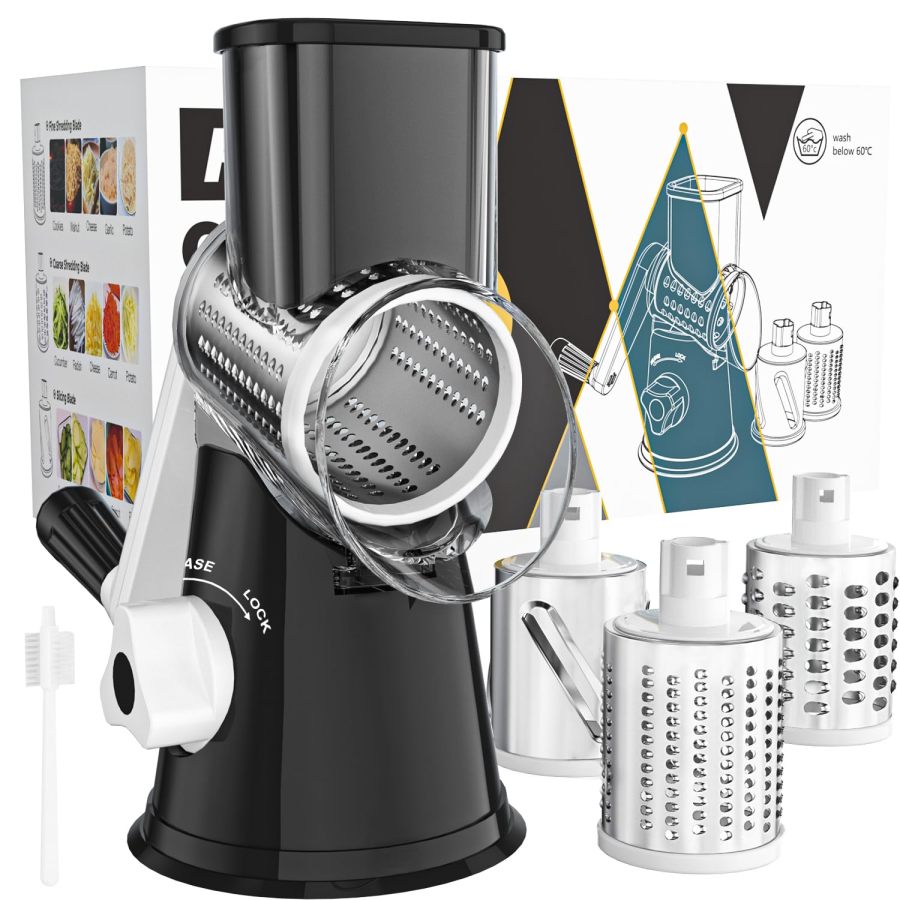
A multifunctional rotary cheese grater is a manual kitchen tool primarily using a hand-crank to drive a cylindrical blade for rapid and efficient grating, slicing, or grinding of hard cheeses, vegetables, nuts, and chocolate. This type of product aims to replace the inefficiency and high risk of traditional manual graters, enhancing food prep safety and convenience. Most products feature a suction cup base for increased operational stability and offer multiple interchangeable blades to accommodate different food processing needs. The following table illustrates the key characteristics of consumer behavior in this category.
| Dimension | Segment | Description |
|---|---|---|
| Need Driver Type | Planned Purchase / Emergency-driven Purchase | User purchases typically stem from daily food prep needs or to address pain points like inefficiency and safety hazards of traditional grating tools, with clear expectations for efficiency and convenience. |
| Purchase Frequency | Low Frequency | As durable kitchenware, these tools have a long replacement cycle. Repurchase usually occurs only after years of use leading to damage, insufficient functionality, or a desire for an efficiency upgrade. |
| Decision Complexity | Medium | Consumers compare different products based on functional diversity, operational safety, material durability, cleaning convenience, and price, requiring some information comparison and evaluation. |
| Price Sensitivity | Medium | Price is an important consideration in the decision, but users are willing to pay a reasonable premium for reliable performance, enhanced safety, and long-term durability. |
| Emotional Dependency | Low to Medium | Purchases are primarily driven by functional utility, but 'enjoying a more relaxed and pleasant cooking experience,' 'avoiding injury,' and 'improving cooking efficiency' also provide positive emotional value. |
II. User Personas & Usage Scenarios
2.1 Efficiency-Seeking Home Cook
🎯 Cooks at home regularly, seeking smart tools to significantly reduce food prep time and enjoy a relaxed, efficient cooking process.
| Typical Usage Scenarios | Core Pain Points | Primary Purchase Drivers |
|---|---|---|
|
|
|
2.2 Health-Conscious Food Guardian
🎯 Focuses on dietary health and ingredient freshness, prefers freshly grated cheese and vegetables, and has high requirements for food safety and kitchen tool materials.
| Typical Usage Scenarios | Core Pain Points | Primary Purchase Drivers |
|---|---|---|
|
|
|
III. User Needs Hierarchy (KANO Model)
3.1 Basic Needs (Must-Haves)
- Sharp & Durable Blades: Blades must be made of stainless steel, sharp enough to grate or slice easily and quickly, and resistant to rust or dulling.
- Easy to Operate: Product assembly should be simple, handle rotation smooth and effortless, allowing users to start using it quickly with minimal learning curve.
- Easy to Clean: All food-contact parts should be detachable for thorough rinsing, with no obvious hard-to-clean spots.
- Basic Grating Function: Must meet basic grating or slicing needs for hard cheeses and common vegetables; this is the foundational reason for the product's existence.
3.2 Performance Needs (Linear Satisfiers)
- Multifunctional Blades: Provides at least 3 or more interchangeable blades (e.g., coarse shred, fine shred, slice) to handle different ingredients and cooking needs.
- Efficient & Time-Saving: Significantly speeds up food prep compared to traditional manual graters, saving valuable time and boosting kitchen efficiency.
- Stable, Non-Slip Base: Features a suction cup or non-slip design on the bottom to ensure the device stays firmly fixed on the countertop during use, without sliding or wobbling.
- Hand Safety Protection: Designed with a food pusher or enclosed feed chute to ensure user's hands do not contact the blades during operation, reducing cut risk.
- Food-Grade Materials: All plastic parts in contact with food should be BPA-Free food-grade material, ensuring food safety and health.
3.3 Excitement Needs (Delighters)
- Integrated Blade Storage Case: Comes with a dedicated storage case to keep all blades neatly and safely stored, preventing loss and cuts, and maintaining kitchen organization.
- Large Capacity Feed Chute: The feed chute is large enough to directly handle larger blocks of cheese or vegetables, reducing pre-cutting steps and further saving time.
- Ambidextrous Design: Handle can be easily switched to install for left-handed or right-handed users, enhancing user experience.
3.4 Unmet Needs & Opportunities
-
Suction Cup Stability Needs Improvement: Most products advertise strong suction cups, but user feedback indicates poor performance on certain countertops (e.g., textured surfaces), or easy detachment after prolonged use, affecting operational stability.
User Reviews (VOC) Suction will lift // Does not stick to surface real well. // The base grips well until the something builds up in the device, then it pops loose from the counter.
-
Performance with Soft Ingredients: Products perform well with hard cheeses and crisp vegetables, but when processing soft cheeses (e.g., fresh mozzarella) or certain soft vegetables, they easily clog, jam, or turn into mush, affecting cutting quality.
User Reviews (VOC) It does NOT work well with softer cheeses, but I use it for others without a problem. // The first three slices were perfect until the grater began to turn the slices into a messy mushy substance.
-
Structural Durability Concerns: Some users report key plastic parts (e.g., handle connection point, main body) are prone to breaking or wearing out, impacting long-term lifespan, creating a gap with durability claims.
User Reviews (VOC) the handle broke within 60 days // the plastic center piece holding the blades cracked after a month of use // broke after 1 month of use
-
Thoroughness of Residual Ingredient Cleanup: Small gaps between blades and the body can trap small amounts of uncut ingredients, difficult to clean thoroughly, potentially affecting hygiene and causing waste.
User Reviews (VOC) the very last of the cheese was sucked down around the barrel and didn't get shredded. // cheese gets stuck on the inside of the grate barrel, under a piece of plastic. I have to use a knife to get it clean.
IV. User Decision Drivers
4.1 Key Decision Factors
- Ease of Use: Includes the convenience of product assembly, operation, and disassembly, directly impacting user experience and frequency of use; a key driver for purchase and daily use.
- Cleaning Convenience: The detachability of all parts, ease of rinsing, and dishwasher-safety are crucial considerations for daily maintenance, determining how hassle-free the product is.
- Cutting Efficiency & Results: The ability to quickly and easily produce uniform, ideal shreds or slices (especially for cheese and vegetables) is the core value proposition, directly affecting cooking quality.
- Safety: Keeping hands away from sharp blades during operation, effectively reducing cut risk, is a primary purchase consideration, especially for kitchen novices or those with hand discomfort.
4.2 Secondary Decision Factors
- Suction Cup Stability: The suction power and stability of the product on the countertop directly affect the smoothness and safety of the operation, a high-frequency concern in user reviews.
- Material & Durability: Expectations regarding product lifespan; stainless steel blades and sturdy body materials are preferred, influencing long-term value and purchase intent.
- Number & Variety of Multifunctional Blades: Enables various cutting needs, increasing product value-for-money and practicality, satisfying diverse requirements across different cooking scenarios.
- Price & Value-for-Money: Weighing the product price against the provided features and quality, given that core needs are met, influencing the final decision.
V. Selling Points & Competitive Landscape
5.1 Selling Point Analysis
5.1.1 Standard Features (Points of Parity)
- Ease of Use: Most products emphasize simple, effortless hand-crank operation, quick setup, reducing kitchen prep complexity, commonly claiming to improve efficiency.
- Multifunctional Blades: Commonly advertised as including 3-5 interchangeable stainless steel blades for slicing, coarse shredding, fine shredding, grinding, etc., to meet diverse needs.
- Easy to Clean: Highlight detachable, easy-to-rinse features; most claim main components are dishwasher-safe, reducing cleaning burden.
- Efficient & Time-Saving: Emphasize being several times faster (e.g., 12-18x) than traditional manual graters, significantly shortening ingredient prep time and boosting cooking efficiency.
5.1.2 Key Differentiators
- Powerful Suction Cup Base: Some products highlight the super-strong stability of their base suction cup, ensuring the device stays firmly fixed on the countertop during use, without sliding or tipping, enhancing operational safety.
- BPA-Free Food-Grade Materials: Emphasize that all plastic parts in contact with food are made of BPA-free food-grade materials to safeguard user health and food safety.
- Hand Safety Protection: Promote designs featuring food pushers or special enclosed feed chutes to ensure hands stay away from sharp blades during operation, reducing cut risk.
- Large Capacity Feed Chute: Some products emphasize a larger feed chute design, allowing direct processing of larger cheese blocks or vegetables, reducing pre-cutting steps, further boosting efficiency.
5.1.3 Unique Selling Propositions (USPs)
- Dedicated Blade Storage Case: Provides an independent blade storage case, helping users store all blades neatly and safely, avoiding kitchen clutter and blade loss.
- Restaurant-Grade / Professional Performance: Few products claim their grating results and efficiency rival professional restaurant-grade equipment, attracting users seeking high quality and professional experience.
- Extended Warranty Service: Some brands offer warranties or hassle-free replacement services exceeding industry standards (1 year or longer, even lifetime) to build user trust and brand loyalty.
5.2 Competitive Landscape
5.2.1 Market Maturity
The multifunctional rotary cheese grater category has reached a high level of market maturity, with widespread homogenization in core functions and basic selling points. Competition among brands mainly manifests in optimizing product details, material safety promises, and value-added features (e.g., storage, after-sales service). Consumers' continuous pursuit of efficiency, safety, and cleaning convenience remains the primary driver for incremental innovation in this category.
5.2.2 Innovation Trends
Current innovation trends primarily revolve around 'hassle-free' designs that enhance user experience. This includes: improving suction cup base adaptability and stability for effective adhesion on more countertop types; optimizing multifunctional blade compatibility for both hard and soft ingredients to reduce clogging; strengthening the structural durability of key plastic parts to extend product lifespan; and providing more integrated, convenient cleaning and blade storage solutions. Additionally, some products are beginning to emphasize retro designs or specific colors for visual appeal, and some brands are building trust through extended warranties.
VI. Marketing Claims vs. Reality Check
The table below analyzes the gap between common marketing claims and actual user experiences in this category:
| Dimension | Marketing Claim | User Reality | Verdict |
|---|---|---|---|
| Suction Cup Stability | Powerful suction cup, stable and non-slip on countertops, firmly stays in place. | Users commonly report insufficient suction on different countertop materials (e.g., textured surfaces) or easy detachment after prolonged use, affecting operational stability. | Sellers over-promote suction performance under ideal conditions, neglecting the complexity of real kitchen environments, causing this core selling point to underperform in users' hands, directly impacting operational safety and user confidence. |
| Ingredient Processing Compatibility | Multifunctional blades, suitable for various cheeses, vegetables, and nuts. | User feedback indicates products easily clog, jam, or turn soft cheeses (e.g., fresh mozzarella) or certain soft vegetables into mush, rather than achieving ideal slicing or grating results. | Sellers' promotion of product 'multifunctionality' is overly broad, failing to clarify inherent limitations when handling soft ingredients, leading to an experience gap between user expectations and actual performance. |
| Product Structural Durability | Sturdy and durable, made with high-quality food-grade materials, lasts long. | User reviews frequently mention handle breakage, plastic body cracking, or damage to internal connection parts, especially under higher stress, with actual product lifespan far below expectations. | Under cost control pressures, the strength of some key plastic components is insufficient to withstand long-term high-intensity rotational pressure, resulting in product durability severely lagging behind marketing claims, becoming a high-frequency return risk area. |
Key Takeaway: The market generally exhibits tendencies towards parameter exaggeration and ambiguous usage scenarios, particularly regarding suction cup stability and ingredient compatibility, where a significant gap exists between marketing promises and actual user experience.
VII. Supply-Demand Misalignment Analysis
The table below highlights mismatches between seller focus and buyer priorities:
| Dimension | Seller Behavior | User Focus | Verdict |
|---|---|---|---|
| Real Suction Cup Stability & Applicability | Generally emphasize 'powerful suction cup' but rarely mention specific performance guarantees or solutions for different countertop types (e.g., textured surfaces). | Users commonly complain about suction cups not holding or easily detaching, affecting operational safety and convenience, desiring reliable fixation on various countertops. | Sellers generalize selling points based on ideal conditions, failing to deeply address users' core pain point for stable operation in complex kitchen environments, resulting in insufficient reliability in a core function. |
| Professional Solutions for Soft Ingredients | Generally advertise 'multifunctional blades, suitable for multiple ingredients' but do not clarify potential limitations when processing soft cheeses or vegetables, nor provide targeted solutions. | Users find soft cheeses easily clog or get squeezed into paste, inconsistent with 'multifunctional' claims, limiting product practicality in certain scenarios. | Sellers pursue breadth over depth in functional promotion, failing to provide effective solutions for soft ingredients, leading to functional disappointment upon user trial. |
| Long-Term Durability of Key Plastic Components | Generally emphasize 'sturdy and durable' and 'food-grade materials' but rarely provide details on material strength of key stress-bearing parts or third-party durability test data in listings. | Users frequently report handles, bases, or internal transmission parts breaking or cracking within a short period, seriously questioning product quality and lifespan. | Sellers rely on verbal promises for durability without supporting them with actual product design and material guarantees, causing product quality to run counter to user expectations for high-frequency repurchase. |
Key Takeaway: Sellers exhibit collective silence or downplay core user pain points like suction cup stability and soft ingredient processing effectiveness, while overemphasizing basic cleanability, leading to a misalignment between supply focus and user demand.
VIII. Strategic Opportunities & Recommendations
8.1 Innovative Multi-Surface Compatible Stable Base
8.1.1 Target Audience & Pain Points
⚡️ Pain Points Addressed: Insufficient suction cup stability, prone to detachment on specific surfaces.
8.1.2 Action Plan
Develop a new dual-layer/composite material suction cup, combined with a mechanical lock or twist vacuum pump, to achieve strong adhesion on various kitchen surfaces (smooth, textured, wood); provide suction cup cleaning/maintenance guide and include a small test patch.
| Tech Complexity | Medium |
| Cost Impact | Medium Impact |
| Trade-off Warning | More complex suction mechanisms may slightly increase base volume or require minor weight compromises to accommodate stronger suction. |
| Price Band | Only viable above $24.99 |
8.1.3 Marketing Strategy
Emphasize 'Universal Adhesion, Rock-Solid Stability, Say Goodbye to Slipping Worries'; showcase product's excellent stability on various surfaces via real test videos; highlight 'Patented Suction Cup Technology' and 'Safe Cooking Experience'.
8.2 Dedicated Blades & Optimized Chamber Design for Soft Ingredients
8.2.1 Target Audience & Pain Points
⚡️ Pain Points Addressed: Soft ingredients easily clog, poor cutting results (mushy).
8.2.2 Action Plan
Design one or more dedicated blades for soft ingredients (e.g., mozzarella, tomatoes, boiled eggs), optimizing tooth spacing and angle to reduce squeezing; simultaneously increase the gap between the drum and housing, and apply anti-stick coating.
| Tech Complexity | Low |
| Cost Impact | Low Impact |
| Trade-off Warning | Blades optimized for soft ingredients may sacrifice cutting efficiency for extremely hard ingredients, requiring balance or offering additional blades. |
| Price Band | Only viable above $19.99 |
8.2.3 Marketing Strategy
Highlight 'Truly Versatile! Perfect for Both Soft & Hard Ingredients'; showcase clear results of soft ingredients perfectly shredded/sliced via comparison images or videos; emphasize 'Clog-Free Design' and 'Effortless Handling of Various Ingredients'.
8.3 Enhanced Core Structural Durability & Long-Term Warranty
8.3.1 Target Audience & Pain Points
⚡️ Pain Points Addressed: Handle prone to breakage, short lifespan of plastic parts.
8.3.2 Action Plan
Upgrade key stress-bearing components like the handle-to-drum connection shaft, internal transmission gears, base-to-upper body connection latches to high-strength materials like glass fiber reinforced nylon or zinc alloy, and conduct fatigue testing. Offer a warranty of 2+ years for non-manufacturing defects.
| Tech Complexity | Medium |
| Cost Impact | Medium Impact |
| Trade-off Warning | Upgrading to higher-strength materials may slightly increase product weight and manufacturing cost. |
| Price Band | Only viable above $26.99 |
8.3.3 Marketing Strategy
Emphasize 'Sturdy & Durable, Built to Last! Stop Frequent Replacements, One Investment, Long-Term Benefits.'; highlight 'High-Strength Engineering Materials' and 'Industry-Leading Warranty Commitment'.
8.4 Integrated Efficient Cleaning & Zero-Residue Design
8.4.1 Target Audience & Pain Points
⚡️ Pain Points Addressed: Incomplete cleanup of residual ingredients, many cleaning blind spots.
8.4.2 Action Plan
Optimize the gap and structure between the drum and housing to prevent ingredient trapping, and design a base that facilitates drainage and ventilation; include a set of multi-functional cleaning brushes to effectively remove residue from blade gaps and deep grooves.
| Tech Complexity | Low |
| Cost Impact | Low Impact |
| Trade-off Warning | A more open structure design may slightly impact aesthetics but significantly improves cleaning convenience. |
| Price Band | Only viable above $17.99 |
8.4.3 Marketing Strategy
Highlight 'Easy Rinse, Clean as New! Say Goodbye to Hard-to-Clean Spots, Enjoy a Hassle-Free Kitchen.'; showcase the actual usage scenario of the cleaning tools; emphasize 'Zero-Residue Design'.