Amazon US Market Analysis: Silicone Baking Mats Category
📊 Executive Summary
📈 Market Trends
Portability and eco-friendliness are mainstream; silicone baking mats have become a kitchen staple. The silicone baking mat market is highly competitive, with products generally emphasizing lightweight, non-stick, easy-to-clean, reusable features. Consumer demand for flexible sizing and multifunctional all-in-one products continues to grow, driving product forms towards greater integration and intelligence.
⚡ Major Pain Points
Overstated non-stick claims and limited cleaning/storage are core pain points. Users commonly report that despite 'non-stick' claims, flour dusting is still needed for wet doughs. Simultaneously, large mats are cumbersome to clean in standard sinks and inconvenient to store. Some products also have issues like initial chemical odor and unclear markings, affecting trust and experience.
💡 Selection Opportunities
Deeply address user pain points, deliver on the ultimate experience. Market opportunities lie in solving consumers' deep needs for ultimate non-stick performance (especially for wet doughs), flexible sizing, pure odor-free products, and convenient cleaning/storage for large mats. For example, developing an 'Ultimate Non-Stick Baking Mat for Wet Dough', 'Customizable/Modular Workstation Mat', and 'Pure Zero Odor Healthy Baking Set' can establish brand differentiation based on core functions and usage details.
I. Analysis Overview
1.1 Introduction & Report Scope
This report analyzes the 'Baking Mats' category (silicone baking mats) in the US Amazon market, focusing on target user personas, core needs, decision factors, market communication, and potential opportunities.
1.2 Category Snapshot
Silicone baking mats are reusable baking tools made from food-grade silicone, primarily used as an alternative to traditional parchment paper, providing a non-stick, heat-resistant baking surface. These products are versatile, serving as oven liners for baking cookies, bread, macarons, or as countertop mats for kneading dough and pastry making. The market offers various forms, including pre-cut size sets and customizable roll-style mats, to meet diverse baking needs. The following table illustrates the key characteristics of consumer behavior in this category.
| Dimension | Segment | Description |
|---|---|---|
| Need Driver Type | Planned Purchase/Habitual Purchase | Purchases are typically driven by anticipated baking or cooking plans, aiming to improve efficiency and reduce cleaning. For frequent bakers, it has become a habitual tool. |
| Purchase Frequency | Low Frequency / Medium-Low Frequency | Silicone baking mats are highly durable, usually a one-time investment, but medium-low frequency purchases occur for replacement, acquiring different sizes, or as gifts. |
| Decision Complexity | Medium | Consumers compare material, size, brand, price, and reviews, paying particular attention to non-stick effectiveness, ease of cleaning, and product durability. |
| Price Sensitivity | Medium | Price is an important consideration, but users are willing to pay a reasonable premium for significant quality, durability, and brand reputation. |
| Emotional Dependency | Medium-Low | Purchases are mainly based on practical function and convenience, but high quality, specific designs (e.g., macaron templates), or eco-friendly concepts can provide a sense of pleasure and security. |
II. User Personas & Usage Scenarios
2.1 Everyday Home Baker
🎯 Focuses on practicality, ease of use, and value for money. Aims to simplify the baking process and reduce kitchen cleaning effort.
| Typical Usage Scenarios | Core Pain Points | Primary Purchase Drivers |
|---|---|---|
|
|
|
2.2 Advanced Baking Enthusiast/Content Creator
🎯 Has high standards for baking quality, enjoys trying complex pastry recipes, and pursues professional-grade results and tool performance.
| Typical Usage Scenarios | Core Pain Points | Primary Purchase Drivers |
|---|---|---|
|
|
|
III. User Needs Hierarchy (KANO Model)
3.1 Basic Needs (Must-Haves)
- Non-Stick Surface: Food does not stick to the mat, facilitating easy removal without extra grease or parchment paper, ensuring smooth cooking.
- Food-Grade Material: Non-toxic, free of BPA and other harmful substances, ensuring food safety during high-temperature heating, safeguarding family health.
- Heat Resistance: Safe to use at common oven temperatures, resistant to melting or deformation, and does not produce odors.
- Baking Sheet Size Compatibility: Size matches commonly used baking sheets (e.g., half-sheet, quarter-sheet) for easy placement and use.
3.2 Performance Needs (Linear Satisfiers)
- Easy to Clean: Simple and convenient cleaning, can be hand-washed or machine-washed, leaves no grease or odor, saving user time.
- Good Non-Slip Properties: Remains stable on countertops or baking sheets, does not slip easily, facilitates operation, and improves safety.
- Even Heat Distribution: Ensures even cooking, avoiding localized burning or undercooking, improving baking success rate and taste.
- Durable and Wear-Resistant: Long-lasting, not easily damaged or losing non-stick properties, reusable for many years, offering good value.
- Multiple Size Sets: A set includes multiple mats of different sizes to meet various oven and countertop needs.
3.3 Excitement Needs (Delighters)
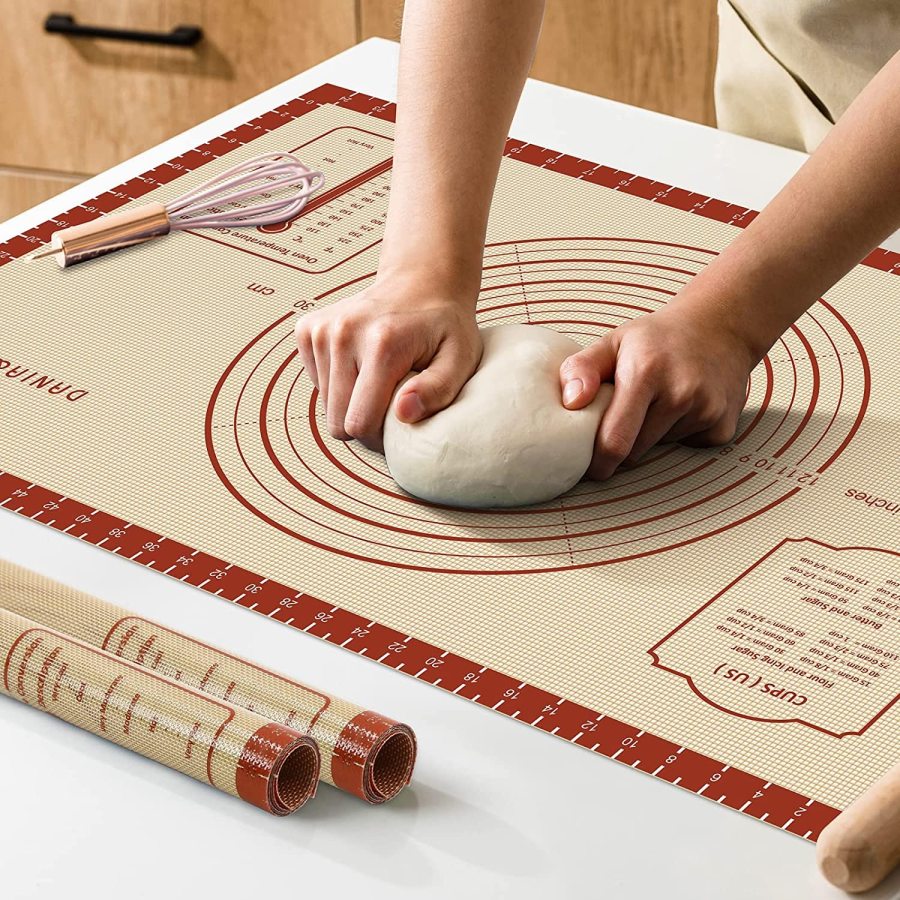
- Integrated Measurement Markings: Mats printed with size markings, circle guides, or macaron templates to assist precise rolling and piping, enhancing a professional feel.
- Thicker Design: Thicker than standard silicone mats, improving durability and non-slip feel, preventing edge curling or movement.
- Premium Silicone Material: Uses high-quality raw materials like German WACKER silicone, providing superior performance and safety, building trust.
- Customizable/Cut-to-Size Design: Roll-style design allows users to cut the mat to any desired size and shape, offering high personalization.
- Elegant Gift Box Packaging: Suitable for gifting, enhancing product added value and purchase experience, conveying thoughtfulness.
3.4 Unmet Needs & Opportunities
-
Truly Non-Stick for Wet Dough: Current products sometimes still require flour dusting for wet doughs; users expect a truly non-stick solution requiring no assistance.
User Reviews (VOC) I did encounter some sticking issues when working with particularly wet doughs. A light flour dusting solved this problem, but it's worth noting that the mat isn't completely non-stick as advertised.
-
Cleaning Convenience for Large Mats: Oversized baking mats are inconvenient to clean in standard kitchen sinks, requiring more user-friendly cleaning solutions or materials.
User Reviews (VOC) My only small complaint is that it takes up a lot of storage space due to its size, but overall it's a great addition to my kitchen! // it's hard to clean because it is so big.
-
No Initial Chemical Odor: Some users report a chemical smell from new products, expecting completely odor-free products even upon first use, without needing high-temperature deodorizing.
User Reviews (VOC) Customers report an unpleasant chemical smell from these baking mats, describing it as a bad plastic odor. // It does have a little bit of a smell to it the first time you use it, but it's not horrible.
-
Long-Lasting, Clear Markings: Measurement markings printed on the mat may wear off or fade after multiple washes; users desire permanently clear markings.
User Reviews (VOC) The measurement markings, while useful, can be difficult to read on darker countertops or when covered in flour. // my only complaint was measurements for volume and weights was very blurry and difficult to read.
IV. User Decision Drivers
4.1 Key Decision Factors
- Non-Stick Effectiveness: The core function users value most, directly impacting baking success rate and cleaning experience, determining purchase intent.
- Ease of Cleaning: Whether cleaning is quick and easy, and if dishwasher-safe, is a key consideration for practicality and time-saving.
- Material Safety: Food-grade, BPA-free, odorless are basic health requirements, especially for products contacting food.
- Durability/Lifespan: As a reusable product, users expect it to last long-term, not be a short-term consumable, reflecting product value.
4.2 Secondary Decision Factors
- Size Compatibility: Whether the baking mat fits existing baking sheets or countertops perfectly, avoiding inconvenience or the need for cutting.
- Non-Slip Performance: Whether it stays firmly in place during countertop operations (like kneading), preventing slipping that affects experience and efficiency.
- Price: An important factor influencing choice, especially for non-branded products, provided core functions are met.
- Auxiliary Features: Features like measurement markings, macaron templates, included recipes add appeal for users with specific baking needs.
- Brand Reputation: Well-known brands (e.g., Silpat) gain user trust due to professionalism and reliability, commanding higher prices.
V. Selling Points & Competitive Landscape
5.1 Selling Point Analysis
5.1.1 Standard Features (Points of Parity)
- Food-Grade Silicone: Emphasizes material safety, BPA-free, ensuring health; a basic market claim.
- Non-Stick Surface: Promises food won't stick, replacing parchment paper and grease, simplifying baking and cleaning.
- Reusable: Highlights environmental and economic benefits, reducing disposable waste, aligning with sustainable consumption.
- Easy to Clean: Emphasizes easy cleaning, hand-wash or dishwasher-safe, saving user time and effort.
- Heat Resistant: Specifies a wide temperature range, suitable for various oven cooking scenarios, increasing applicability.
5.1.2 Key Differentiators
- Multi-Size Sets: Offering combinations of sizes like half-sheet, quarter-sheet to meet different pan and cooking needs.
- With Measurement Markings/Templates: Mats printed with size marks, circle guides, or macaron templates to assist precise baking and rolling.
- Thicker Design: Emphasizing product thickness (e.g., 0.7mm) to improve durability and stability on countertops, preventing edge curling.
- Fiberglass Reinforcement: Explaining the internal material structure enhances strength, tear resistance, and even heat distribution.
5.1.3 Unique Selling Propositions (USPs)
- "The Original" Brand Endorsement: e.g., Silpat emphasizes its status as the original brand, recognized by professional chefs globally, building a premium image.
- Customizable Roll-Style: Offering silicone mats in rolls, allowing users to cut to desired size, enabling high personalization.
- Included Recipes/Gift Box: Packaging the product as a gift or including a recipe booklet increases added value and purchase appeal.
- Specific Silicone Origin: e.g., marketing "German WACKER silicone" implies higher quality and safety, boosting product trust.
5.2 Competitive Landscape
5.2.1 Market Maturity
The silicone baking mat market is highly mature and competitive. Basic selling points like non-stick, easy cleaning, and heat resistance have become industry standards, with significant product homogenization. Price is a key factor influencing purchases, but some premium brands can still command higher prices by emphasizing professional background, material source, and specific features.
5.2.2 Innovation Trends
Innovation trends manifest in several areas: First, extreme performance, pursuing stronger non-slip properties, longer-lasting non-stick (especially for wet doughs). Second, customization and multifunctionality, such as cut-to-size designs, integrating more practical measurement information, or serving as multifunctional kitchen workstations. Third, health and trust transparency, further emphasizing silicone source, certification standards, and odor-free promises to address deep-seated safety concerns. Fourth, user experience detail optimization, such as solving cleaning difficulties for large mats and marking wear issues.
VI. Marketing Claims vs. Reality Check
The table below analyzes the gap between common marketing claims and actual user experiences in this category:
| Dimension | Marketing Claim | User Reality | Verdict |
|---|---|---|---|
| Non-Stick Performance | Extreme non-stick, no sticking every time, goodbye to grease and parchment paper. | Users commonly report that flour dusting is still needed for wet doughs (e.g., high-hydration dough), or release is not as smooth as advertised, failing to meet 'completely non-stick' expectations. | Sellers generally promote the 'non-stick' effect under ideal conditions to all scenarios, failing to address the pain point of high-moisture or sticky doughs, leading to a mismatch between user expectations and actual experience. |
| Product Odor | Food-grade silicone, non-toxic, harmless, no chemical odor. | Some users report noticeable chemical or plastic odors in new products, requiring special treatment (e.g., high-temperature baking or prolonged airing) to eliminate, affecting the initial use experience. | Products claim 'odorless,' but some users report initial chemical/plastic smells, directly challenging consumer trust in food safety and product quality. |
| Cutting Capability and Durability | Can be freely cut to fit different size baking sheets, or marketed as multifunctional workstation mats. | Premium brands like Silpat explicitly warn against cutting to prevent fiberglass migration; ordinary silicone mats are also generally not resistant to sharp blades. User feedback indicates cutting easily damages them, contradicting multifunctional claims. | Some products advertise free cutting, but silicone baking mats (especially fiberglass-reinforced ones) are generally not cut-resistant. This is not only a functional misrepresentation but also a safety hazard (fiberglass migration), a typical paradox between marketing and physical reality. |
Key Takeaway: The market exhibits widespread parameter inflation and scenario-based experience exaggeration, especially regarding the comprehensiveness of 'non-stick' claims and the reality of 'easy cleaning.' Some brands also have ambiguous descriptions regarding material sources.
VII. Supply-Demand Misalignment Analysis
The table below highlights mismatches between seller focus and buyer priorities:
| Dimension | Seller Behavior | User Focus | Verdict |
|---|---|---|---|
| Non-Stick Performance for Wet Dough | Most advertise 'non-stick,' but few products dare to promise or provide a 'zero flour dusting' solution for wet doughs, remaining silent on the non-stick pain point in complex scenarios. | Users strongly desire baking mats that are truly non-stick for wet doughs, avoiding flour dusting, but current product experiences fall short. | The market's understanding of 'non-stick' remains at a basic level, failing to provide effective and credible solutions for the pain point users face when handling high-stickiness wet doughs. |
| Cleaning Convenience for Large Baking Mats | Sellers often emphasize 'easy to clean,' 'dishwasher safe,' but rarely mention the practical inconvenience of hand-washing oversized mats in standard kitchen sinks, ignoring specific operational friction. | Users report that while large mats are functional, cleaning them in small kitchen sinks is cumbersome and inconvenient, reducing daily usage willingness. | Sellers fail to fully consider the cleaning friction points of oversized products in actual home scenarios, oversimplifying the 'easy to clean' claim, leading to compromised user experience. |
| Material Source and Authenticity | Some products attempt to build trust through vague 'premium material' concepts (e.g., 'best German silicone') but immediately note 'not made in Germany,' indicating insufficient or contradictory information disclosure. | Users generally care about food safety and material quality, but such contradictory claims raise doubts about the product's true value and brand integrity. | Sellers attempt to build trust through vague 'premium material' concepts, but insufficient or contradictory information disclosure ultimately damages brand integrity, representing typical ineffective marketing competition. |
Key Takeaway: Sellers generally compete intensely on basic functions like non-stick and easy cleaning, but there is a severe lack of supply addressing users' actual complex sticking problems, large mat cleaning pain points, and initial product odor issues related to deep experience.
VIII. Strategic Opportunities & Recommendations
8.1 Ultimate Non-Stick Baking Mat for Wet Dough
8.1.1 Target Audience & Pain Points
⚡️ Pain Points Addressed: Completely non-stick for wet dough.
8.1.2 Action Plan
Invest in R&D for silicone surfaces with nano-level microporous structures or special coatings (e.g., oleophobic/hydrophobic) to ensure true zero-flour non-stick even for high-hydration doughs; incorporate enhanced suction design on the bottom for firm placement on any surface.
| Tech Complexity | Medium |
| Cost Impact | Medium Impact |
| Trade-off Warning | Might slightly sacrifice some surface friction, minimally affecting dry dough's non-slip properties, but compensable via bottom texture or enhanced suction design. |
| Price Band | Only viable above $24.99 |
8.1.3 Marketing Strategy
Emphasize 'Say goodbye to the flour dusting era, non-stick even for wet doughs'; provide comparison videos showing easy release of high-viscosity doughs; highlight its 'kitchen tech' attributes targeting users pursuing professional results.
8.2 Multifunctional 'Customizable'/'Modular' Workstation Mat
8.2.1 Target Audience & Pain Points
⚡️ Pain Points Addressed: Size mismatch, inconvenient storage, partial cutting needs.
8.2.2 Action Plan
Launch high-toughness silicone rolls that resist fraying after cutting, include a safe cutting tool and guide. Or develop modular baking mats with innovative interlocking or magnetic connections for free size combination.
| Tech Complexity | Medium |
| Cost Impact | Medium Impact |
| Trade-off Warning | Customizable design might slightly lag in ultimate durability compared to one-piece molded mats, but impact can be reduced via material optimization. Must clearly indicate not to use sharp metal knives;可以考虑提供专用安全切割工具. |
| Price Band | Only viable above $19.99 |
8.2.3 Marketing Strategy
Emphasize 'Your kitchen, your rules!', showcase perfect fit on various size pans and countertops; highlight 'one mat, multiple uses, efficient and tidy' benefits, solving space and size worries.
8.3 "Pure Zero Odor" Healthy Baking Set
8.3.1 Target Audience & Pain Points
⚡️ Pain Points Addressed: Initial chemical odor, food safety concerns.
8.3.2 Action Plan
Use higher-grade raw materials (e.g., platinum silicone) with dual LFGB/FDA certifications, optimize production to ensure complete absence of residual odor, provide authoritative third-party test reports.
| Tech Complexity | Low |
| Cost Impact | Low Impact |
| Trade-off Warning | No significant physical side effects, primarily involves optimizing raw materials and production process. |
| Price Band | Only viable above $14.99 |
8.3.3 Marketing Strategy
Emphasize 'Pure baking from the source', build an 'assured kitchen' image through transparent material sourcing and production; promote the user value of 'ready to use out of the box, no deodorizing needed'.
8.4 Smart Cleaning and Storage Solution for Large Baking Mats
8.4.1 Target Audience & Pain Points
⚡️ Pain Points Addressed: Inconvenient cleaning for large mats, storage space consumption.
8.4.2 Action Plan
Optimize mat surface with hydrophobic/oleophobic treatment for easier rinsing; design a foldable storage case with drainage grooves or compartments; include a small scraper or cleaning brush to enhance cleaning efficiency.
| Tech Complexity | Low |
| Cost Impact | Low Impact |
| Trade-off Warning | No significant physical side effects, primarily solved through design improvements and accompanying accessories. |
| Price Band | Only viable above $12.99 |
8.4.3 Marketing Strategy
Emphasize 'Large size, easy handling', demonstrate quick cleaning of large mats in a sink via video; highlight the lifestyle message 'A tidy kitchen starts with the mat'.