Amazon US Market Analysis: Silicone Dish Drying Mats Category
📊 Executive Summary
📈 Market Trends
Portability and integration are mainstream, but core functions have pain points. The silicone dish drying mat market has matured. Products generally emphasize lightness, multi-functionality, and easy cleaning. Consumer demand for seamless integration and efficient drainage continues to grow, driving product forms towards more practical and aesthetic directions. However, existing products still have shortcomings in delivering core functions.
⚡ Major Pain Points
'Self-drainage' promise broken, mold and water stains frequent. Users are generally disappointed with the 'self-drainage' function claimed by products. Water droplet residue, pooling, and even mold growth are high-frequency complaints in actual experience. Additionally, product size mismatch and unstable mat structure also affect the user experience, requiring extra manual cleaning, severely damaging product trust.
💡 Selection Opportunities
Return to basics, solve core pain points, enhance user experience. Market opportunities lie in developing silicone mats with truly efficient self-drainage structures that achieve 'zero water pooling,' and introducing long-lasting anti-bacterial, anti-mold, and anti-water stain technologies to fundamentally solve hygiene issues. Simultaneously, by offering modular size and aesthetic customization solutions to meet users' deep-seated needs for personalization and kitchen aesthetics, establishing differentiated advantages.
I. Analysis Overview
1.1 Introduction & Report Scope
This report analyzes the 'Dish Drying Mats' category (silicone dish drying mats) in the Amazon US market, focusing on target user personas, core needs, decision factors, market communication, and potential opportunities.
1.2 Category Snapshot
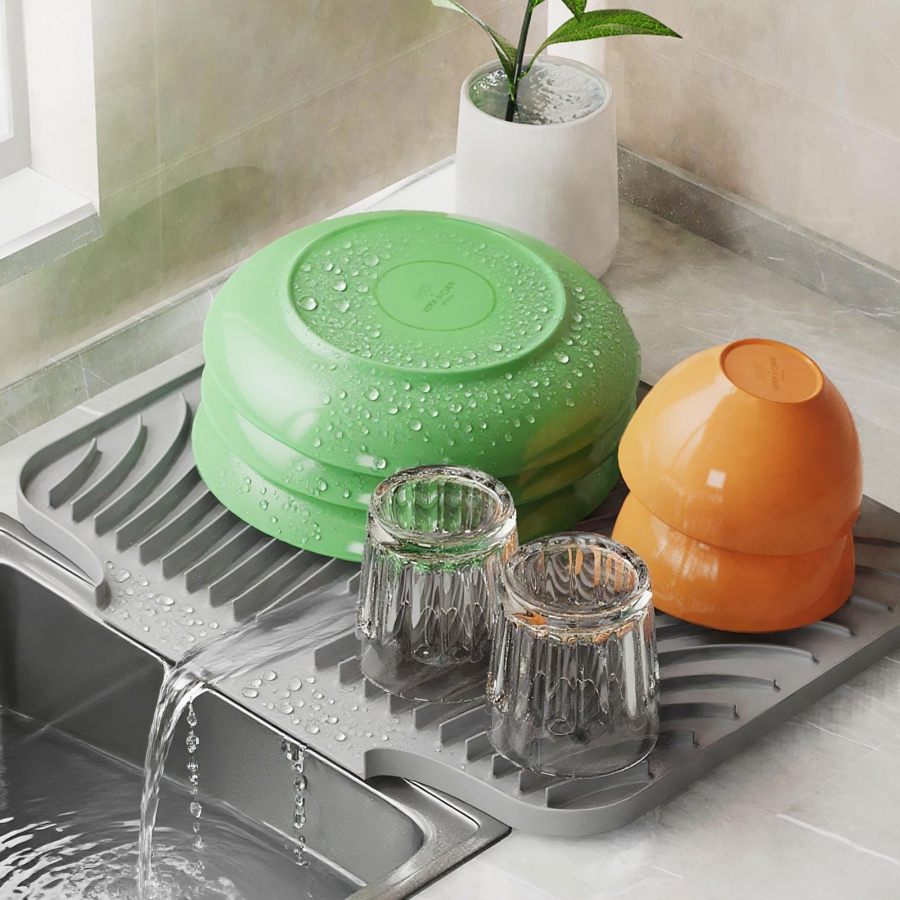
A silicone dish drying mat is an auxiliary tool placed on a kitchen countertop or next to a sink, used for air-drying hand-washed dishes, utensils, or produce. Its core function is effective water drainage to keep the countertop dry, commonly featuring heat resistance, non-slip properties, and easy cleaning. These products often use a one-piece design, with some featuring an inclined slope or a drainage lip for self-draining, aiming to enhance kitchen hygiene and convenience. The following table illustrates the key characteristics of consumer behavior in this category.
| Dimension | Segment | Description |
|---|---|---|
| Need Driver Type | Planned Purchase / Emergency-driven Purchase | User purchases may stem from planned kitchen renovations or replacing old items, or from immediate needs to solve problems like damp, unsanitary countertops. |
| Purchase Frequency | Low Frequency | As a durable good, it is typically purchased once and used for a long time. Repurchase occurs only if damaged or for functional upgrades. |
| Decision Complexity | Medium | Users compare materials, size, drainage design, ease of cleaning, etc., but usually do not require extensive research. |
| Price Sensitivity | Medium | Price is an important consideration, but users value actual drainage performance, quality, and convenience more, willing to pay a premium for superior functionality. |
| Emotional Dependency | Medium | Purchase is primarily driven by function and practicality, but aesthetic design and kitchen coordination are a plus for some users. |
II. User Personas & Usage Scenarios
2.1 Practical Homemaker
🎯 Focuses on kitchen tidiness and efficiency, seeking simple, practical tools to solve daily post-washing drainage problems, especially concerned with countertop protection and cleaning convenience.
| Typical Usage Scenarios | Core Pain Points | Primary Purchase Drivers |
|---|---|---|
|
|
|
2.2 Sophisticated Kitchen Aesthetic
🎯 Focuses on the overall design sense and coordination of the kitchen. Not only requires the drying mat to be functional but also values its appearance, color matching with kitchen style, and whether it enhances visual tidiness.
| Typical Usage Scenarios | Core Pain Points | Primary Purchase Drivers |
|---|---|---|
|
|
|
III. User Needs Hierarchy (KANO Model)
3.1 Basic Needs (Must-Haves)
- Effective Drainage: Allows water from dishes to flow away, not pool on the mat, preventing the countertop from getting damp.
- Countertop Protection: Prevents water from wetting the surface, and protects against heat or scratches damaging the countertop.
- Durability: Silicone material is resistant to deformation and aging, suitable for long-term use.
- Easy to Clean: Surface is easy to wipe, supports hand-washing or machine-washing, dishwasher safe, convenient for daily maintenance.
3.2 Performance Needs (Linear Satisfiers)
- Fast Drying: The mat itself and items placed on it dry relatively quickly, reducing the risk of bacterial growth.
- Non-slip & Stable: Ensures dishes are placed stably, not prone to slipping or tipping, ensuring safety during use.
- Built-in Drainage Function: Through slope, drainage grooves, or lip design, water is automatically directed into the sink, reducing manual pouring.
- Food-Grade Safety: Material is BPA-free, safe and non-toxic, can safely contact food and dishes.
- Size Compatibility: Offers multiple size options to fit different kitchen countertop sizes and drying needs.
3.3 Excitement Needs (Delighters)
- Zero Water Stain Residue: After draining, the mat surface has no water droplets or stains, remaining perfectly dry, especially in hard water areas.
- Long-lasting Anti-bacterial & Anti-mold: Silicone material has special anti-bacterial treatment, effectively inhibiting bacteria and mold growth, providing higher hygiene assurance.
- Aesthetically Integrated Design: Product design is highly aesthetic, can serve as part of kitchen decor, perfectly blending with the overall decoration style.
- Ultimate Storage Experience: Can be compressed extremely or has innovative storage methods, e.g., magnetic attachment, saving kitchen space.
3.4 Unmet Needs & Opportunities
-
Reliable Self-Drainage Performance: Many products claim self-drainage, but user feedback commonly reports water droplet residue or even pooling issues. Drainage is particularly poor when the sink edge is higher than the mat. Many users need to manually pour out water.
User Reviews (VOC) The design could/should be improved to slightly elevate the opposite side of the drain lip. Water sits on the mat all day and eventually air dries. // This drying mat looks amazing on my white granite countertops and feels super durable. It's thick, easy to clean, and keeps dishes from sliding. I do wish I had ordered a larger size, and the flat design sometimes prevents water from draining properly.
-
Thorough Anti-mold & Anti-bacterial: Despite being silicone, reviews mention water stains leading to mold growth. Users expect stronger anti-bacterial effects and easy-to-clean designs to avoid such problems.
User Reviews (VOC) black mold settling in the grooves and along the ridges areas. // The mat just becomes a cesspool for mold and debris that needs to be cleaned often.
-
No Water Stain Marks: Especially on dark-colored mats, hard water stains are noticeable. Users want an easy-to-maintain surface that leaves no marks, reducing wiping frequency.
User Reviews (VOC) My only complaint with the black version is that it tends to show white water stains unless it's dried thoroughly after each use. // One problem is hard water stains and the lightest color mats show stains so they need frequent washing.
-
Better Flat Surface Stability: Some mats may warp due to being tightly rolled during shipping, preventing them from lying completely flat during use, affecting drainage efficiency and aesthetics, or the mat body is too soft to support heavy items.
User Reviews (VOC) Because the mat was tightly rolled up during delivery, it sat uneven and created pools of water that won't go away. // the flat design sometimes prevents water from draining properly. // Very flimsy, can't put any weight on it.
IV. User Decision Drivers
4.1 Key Decision Factors
- Drainage Efficiency: Users care most about whether the mat can truly effectively drain water into the sink, avoiding water pooling and the hassle of secondary cleaning.
- Size Compatibility: Whether the product size perfectly fits the available space on their kitchen countertop or next to the sink.
- Ease of Cleaning & Hygiene: Whether the material is easy to clean, resistant to mold and water stains, maintaining kitchen hygiene.
- Non-slip & Stability: Whether dishes, cups, etc., are placed securely, not prone to sliding or tipping, ensuring daily use safety.
4.2 Secondary Decision Factors
- Material Quality & Durability: The thickness and flexibility of the silicone determine product lifespan and feel, also affecting its stability.
- Heat Resistance Function: Whether it can be safely used as a trivet, increasing product utility and kitchen convenience.
- Appearance Design & Color: Product aesthetics, color coordination with overall kitchen decor, affecting overall kitchen visual effect.
- Storage Convenience: Whether it can be easily rolled, folded, or hung when not in use, saving countertop space and maintaining tidiness.
- Price & Value for Money: While meeting core needs, users compare prices, seeking cost-effective products.
V. Selling Points & Competitive Landscape
5.1 Selling Point Analysis
5.1.1 Standard Features (Points of Parity)
- Silicone Material: Emphasizes the product is made of silicone, often combined with food-grade, BPA-free safety attributes for peace of mind.
- Easy to Clean: Highlights that the product can be rinsed directly or is machine-washable/dishwasher safe, convenient for daily maintenance, saving time.
- Heat Resistance: Promotes the product as usable as a trivet, protecting countertops from heat damage, adding multi-functionality.
- Non-slip: Emphasizes surface or bottom design has anti-slip effect, ensuring stable placement of dishes, preventing accidents.
- Multi-functional Use: Besides draining water, can also be used as fridge liner, coffee pad, baking mat, pet bowl mat, etc., enhancing product value.
- Easy Storage: Promotes product as soft and rollable/foldable, with hanging hole design, easy to store and save space, keeping kitchen tidy.
- Keeps Countertop Dry & Clean: As the core value proposition, emphasizes solving kitchen dampness and mess, improving user experience.
5.1.2 Key Differentiators
- Self-Drainage Design: Highlights drainage structures like inclined slope, raised ridges, built-in drainage spout, or drainage lip, promising water automatically flows into the sink.
- Size Selection: Offers different sizes (e.g., small, medium, extra-large) to fit various kitchen countertop needs, meeting personalized space requirements.
- Appearance & Color: Provides multiple colors (e.g., black, gray, white, off-white, pink) to match different kitchen styles, enhancing aesthetics.
- Thickened/Sturdy: Emphasizes product thickness or material sturdiness to increase durability and stability, extending lifespan.
5.1.3 Unique Selling Propositions (USPs)
- Nano Silver Ion Anti-bacterial: Very few products mention adding anti-bacterial components, elevating hygiene level, meeting higher cleanliness needs.
- Specific Sink Compatibility: Some products imply their design is better suited for drainage with under-mount sinks or farmhouse sinks, solving specific user pain points.
- Unique Texture Design: Such as water droplet-shaped bumps, claimed to be both aesthetic and provide extra support and drainage effect, balancing function and beauty.
5.2 Competitive Landscape
5.2.1 Market Maturity
The silicone dish drying mat market is already in a highly mature stage, with severe homogenization in product function and form. Current competition mainly focuses on price, size, color, and subtle drainage structure design. Consumer choice is diverse, but genuine innovation points are relatively few. Market competition is fierce, and profit margins are becoming transparent.
5.2.2 Innovation Trends
Current market innovation trends mainly revolve around core pain points, including: R&D of more efficient, residue-free drainage systems to solve water pooling issues; introduction of anti-bacterial, anti-mold, or anti-water stain materials and surface treatments to enhance hygiene performance; and provision of more personalized designs that better match home styles (e.g., more colors, modular combinations). Multi-functionality is already a basic configuration for this category. Future breakthroughs will focus on deeper user experience optimization and pain point resolution.
VI. Marketing Claims vs. Reality Check
The table below analyzes the gap between common marketing claims and actual user experiences in this category:
| Dimension | Marketing Claim | User Reality | Verdict |
|---|---|---|---|
| Drainage Function Stability | High-efficiency self-drainage inclined design, water flows directly into the sink, keeping countertop dry. | Users commonly report actual poor drainage, water pools on the mat, especially when the sink edge is higher than the mat or the mat deforms under weight, preventing complete automatic drainage. Many users need to manually pour out water. | Typical misleading of users with ideal lab or static scenario effects, ignoring the complexity of real kitchen environments and the structural limitations of silicone material itself. |
| Anti-mold & Anti-water Stain Capability | Hygienic drying mat, not prone to odors, easy to clean, prevents water accumulation. | User feedback indicates silicone grooves easily trap water stains and breed black mold. Dark-colored versions easily show white hard water stains, requiring frequent, thorough cleaning to maintain hygiene and appearance. | Fails to effectively address the natural weakness of silicone breeding mold and water stains in long-term damp environments, leading to reduced user trust in the product's hygiene promises. |
| Mat Body Structural Stability | Sturdy and compact, thick silicone, reliable support, lies flat. | Some products cannot lie completely flat due to shipping roll-up, or the mat body is too thin/soft. Placing heavy items (e.g., pots, dish racks) easily causes deformation, affecting drainage paths or even causing water overflow. | Sacrifices necessary structural support in pursuit of thinness or low cost, leading to poor performance in key usage scenarios of load-bearing and stability, directly impacting core function. |
Key Takeaway: The market exhibits a widespread tendency to exaggerate scenario-based experience, especially regarding self-drainage and anti-bacterial/anti-mold performance. Marketing promises are not fully delivered.
VII. Supply-Demand Misalignment Analysis
The table below highlights mismatches between seller focus and buyer priorities:
| Dimension | Seller Behavior | User Focus | Verdict |
|---|---|---|---|
| Transparency & Reliability of Drainage Effect | Listings commonly emphasize 'self-drainage,' 'inclined design,' 'drainage lip,' but avoid limitations of actual drainage performance, or data expression is unclear. | 'Water pools on the mat and doesn't drain,' 'need to manually pour,' 'sink edge blocks drainage.' Users care most about 'Does it really drain water?' | Sellers adopt a vague strategy on the core drainage function, failing to provide the unconditional drainage solution users truly need, leading to a cognitive gap regarding product efficacy. |
| Actual Effect of Anti-bacterial & Anti-mold | Commonly promote 'hygienic,' 'not prone to odors,' but rarely provide specific anti-bacterial/anti-mold technical details, third-party certifications, or solutions for mold/water stain problems. | 'Has black mold,' 'water stains are hard to clean,' 'need to dry it often,' user expectations for silicone hygiene do not match actual maintenance costs. | Sellers overlook the hygiene challenges of silicone material in long-term damp environments, failing to provide effective anti-mold and anti-water stain solutions, leading to cleaning burden and health concerns during use. |
| Priority of Multi-functionality | Commonly promote 'multi-functional use' (e.g., trivet, coffee pad, pet pad) as an important selling point, occupying significant space in listings. | 'Mainly used for draining water,' 'If drainage is poor, other functions are useless.' Users first need to solve the core pain point of drainage; other functions are secondary bonuses. | Sellers overly emphasize the product's secondary extended functions, while the core drying experience is not adequately met, causing resource misallocation and failing to hit the user's core pain point. |
Key Takeaway: Sellers generally over-promise and under-deliver on the core function of 'self-drainage,' while over-investing in auxiliary selling points like 'multi-functional use,' neglecting users' deep-seated pain points regarding real drainage effectiveness and thorough mold prevention.
VIII. Strategic Opportunities & Recommendations
8.1 True Self-Drainage Structure Silicone Mat
8.1.1 Target Audience & Pain Points
⚡️ Pain Points Addressed: Unreliable self-drainage performance, water pooling issues, poor adaptability.
8.1.2 Action Plan
Design integrated adjustable-height feet or a multi-support bottom structure to ensure an effective slope is formed in various countertop environments, thoroughly directing water into the sink. Optimize drainage spout design to ensure unobstructed water flow. Strengthen mat body hardness to prevent deformation under heavy items.
| Tech Complexity | Medium |
| Cost Impact | Medium Impact |
| Trade-off Warning | May slightly increase product thickness or bottom structure complexity, but significantly improves drainage effect. Needs to balance portability. |
| Price Band | Only viable above $18.99 |
8.1.3 Marketing Strategy
Emphasize 'Physics-based drainage principle, truly zero water pooling'; provide comparative video tests of drainage in different sink environments; highlight the core promise of 'No manual pouring needed, say goodbye to wet countertops.'
8.2 Long-lasting Anti-bacterial, Anti-mold, Anti-water Stain Silicone Mat
8.2.1 Target Audience & Pain Points
⚡️ Pain Points Addressed: Mold growth, water stain residue, troublesome cleaning and maintenance.
8.2.2 Action Plan
Adopt nano-silver/copper ion anti-bacterial technology or food-grade anti-water stain coating, verified by independent lab certification. Optimize groove design to reduce dead spots, facilitating thorough cleaning. Can be promoted alongside a dedicated cleaning brush or cleaning solution.
| Tech Complexity | Medium |
| Cost Impact | Medium Impact |
| Trade-off Warning | No obvious physical side effects, may slightly increase silicone hardness, but significantly improves hygiene experience. |
| Price Band | Only viable above $16.99 |
8.2.3 Marketing Strategy
Highlight 'Long-lasting anti-bacterial technology, say goodbye to mold and odors'; display anti-bacterial certification reports; provide comparison photos showing no water stains or mold spots after long-term use, emphasizing 'Worry-free maintenance, healthy kitchen.'
8.3 Modular Size & Aesthetic Customization Series
8.3.1 Target Audience & Pain Points
⚡️ Pain Points Addressed: Size incompatibility, mediocre appearance design, water stains affect aesthetics.
8.3.2 Action Plan
Launch 2-3 standard modular sizes with seamless edge connection design, allowing users to freely assemble according to actual countertop size. Offer more premium gray, Morandi color palettes, or special textures (e.g., stone-like, matte), and design replaceable left/right drainage spouts.
| Tech Complexity | Low |
| Cost Impact | Low Impact |
| Trade-off Warning | No obvious physical side effects, mainly increases SKU management complexity. |
| Price Band | Only viable above $22.99 |
8.3.3 Marketing Strategy
Emphasize 'Free assembly, define your kitchen aesthetics'; provide scenario-based pairing images showing how the product integrates into different kitchen styles; utilize KOL marketing to create an atmosphere of sophisticated living.
8.4 Robust Mat Body & Non-slip Base
8.4.1 Target Audience & Pain Points
⚡️ Pain Points Addressed: Lack of mat body support, prone to deformation under heavy items, insufficient bottom non-slip.
8.4.2 Action Plan
Increase silicone thickness (e.g., from 0.1 inch to 0.2 inch), or add reinforcement support structure to the bottom, ensuring the mat body does not deform under pressure. Optimize bottom non-slip texture or locally add suction points to improve stability on wet, slippery countertops.
| Tech Complexity | Low |
| Cost Impact | Low Impact |
| Trade-off Warning | May slightly increase product weight, but significantly improves usage stability. |
| Price Band | Only viable above $14.99 |
8.4.3 Marketing Strategy
Highlight 'Solid as a rock, stable as a mountain' support; showcase load-bearing test videos, emphasizing 'Placing heavy items without deformation, water flow always unobstructed'; promote 'Safe and non-slip, preventing dishware accidents.'