Amazon US Market Analysis: Under-Door Draft Stoppers Category
📊 Executive Summary
📈 Market Trends
Energy savings and multi-functionality are market fundamentals, but user pursuit of 'real performance' is intensifying. The under-door draft stopper market has entered a mature competition stage. Basic functions like energy saving, dustproofing, and soundproofing are standard. Consumers not only care if the product solves immediate problems but also increasingly focus on long-term effectiveness, durability, and integration with home aesthetics. Tolerance for false advertising is decreasing.
⚡ Major Pain Points
Adhesive failure, poor floor compatibility, and exaggerated soundproofing are the three major flaws. Users' core pain points center on self-adhesive product strips not lasting, fabric fillings deforming easily, and products sticking or failing to seal effectively on carpets or uneven floors. Additionally, the exaggerated soundproofing effects of many products fail to meet user expectations, leading to widespread disappointment and dissatisfaction.
💡 Selection Opportunities
Deeply address core pain points to create 'real value.' Market opportunities lie in developing 'Long-Lasting, No-Residue Adhesive' products to completely solve detachment issues; launching 'All-Floor Smooth-Sliding' draft stoppers for complex floor environments to enhance user experience; and considering offering 'Professional-Grade, Decibel-Certified Soundproof' draft stoppers or more aesthetically pleasing, easy-clean fabric designs to meet segmented market demands for high quality and personalization, establishing differentiated competitive advantages.
I. Analysis Overview
1.1 Introduction & Report Scope
This report analyzes the 'Door Draft Stoppers' category (under-door draft stoppers) in the US Amazon market, focusing on target user personas, core needs, decision factors, market communication, and potential opportunities.
1.2 Category Snapshot
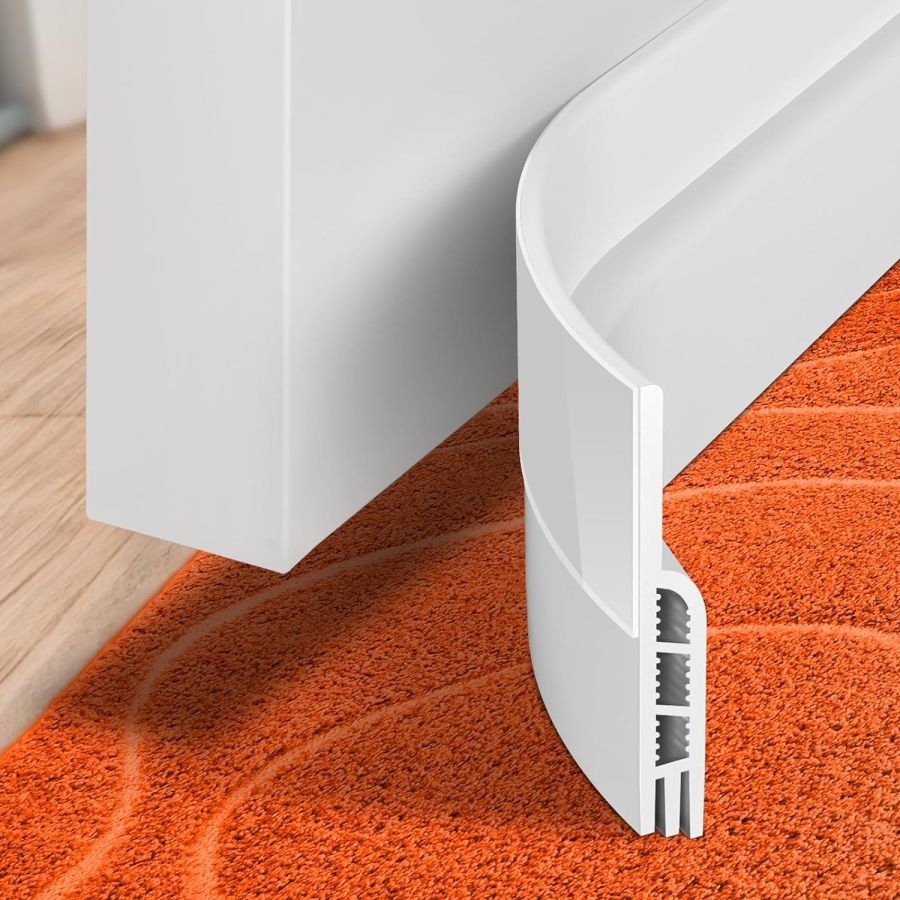
An under-door draft stopper is a home accessory installed at the bottom of a door. Its primary function is to seal the door gap, blocking airflow, noise, dust, light, and insects from entering. Market products are mainly divided into two categories: 1) Fabric-heavy draft stoppers with internal fillings (like glass beads, sandbags, foam), fixed by their own weight and moving with the door's opening/closing; 2) Self-adhesive or U-shaped slide-in types, often made of silicone, PVC, or vinyl, offering a more permanent fixing effect. These products aim to enhance indoor comfort and achieve energy savings. The following table illustrates the key characteristics of consumer behavior in this category.
| Dimension | Segment | Description |
|---|---|---|
| Need Driver Type | Emergency-driven / Planned Purchase | Often purchased upon noticing indoor temperature differences, noise, or pest issues. Some users also plan ahead during seasonal changes to improve their living quality. |
| Purchase Frequency | Low Frequency / Seasonal | The product replacement cycle is long. Purchase peaks typically occur before winter heating or summer AC usage, making it a cyclical home maintenance item. |
| Decision Complexity | Medium | Users compare different product types based on installation method, material, actual effectiveness, and price, but the decision process is usually relatively straightforward. |
| Price Sensitivity | Medium to High | As a common household accessory, users are price-sensitive and focus on value for money, expecting significant usage improvement within a reasonable budget. |
| Emotional Dependency | Low | The primary driver is practical functionality, but there is also some attention to the emotional value of enhancing home comfort, peace of mind, and environmental aesthetics. |
II. User Personas & Usage Scenarios
2.1 Cost-Conscious Homeowner
🎯 This user is sensitive to household energy costs and seeks simple, effective home improvements to reduce utility bills and enhance the economic benefits of their living environment.
| Typical Usage Scenarios | Core Pain Points | Primary Purchase Drivers |
|---|---|---|
|
|
|
2.2 Quality-of-Life-Focused Individual
🎯 This user highly values personal space and privacy, has zero tolerance for external noise, light, or odor disturbances, and seeks to create a quiet, private living or working environment.
| Typical Usage Scenarios | Core Pain Points | Primary Purchase Drivers |
|---|---|---|
|
|
|
2.3 Household with Pets/Children
🎯 This user primarily hopes to use a physical barrier to prevent pets or children from passing through door gaps into specific areas, or to keep small animals/pests out, thereby maintaining home hygiene and order.
| Typical Usage Scenarios | Core Pain Points | Primary Purchase Drivers |
|---|---|---|
|
|
|
III. User Needs Hierarchy (KANO Model)
3.1 Basic Needs (Must-Haves)
- Effectively Seal Door Gap: The product must completely block airflow under the door. This is the core function; its absence will lead to immediate returns.
- Size Adaptability: The product length should cover most standard door widths, and ideally allow users to easily cut or adjust it to ensure a perfect fit.
- Easy Installation & Use: No complex tools required; users can install it themselves within minutes. The product should not catch or detach during normal door operation.
- No Damage to Floor/Door: The material and design must ensure no scratching of sensitive surfaces like wood floors or tiles, and no damage to the door itself during long-term use and friction.
3.2 Performance Needs (Linear Satisfiers)
- Significant Noise Reduction: While blocking airflow, it should effectively reduce noise from outside or adjacent rooms, enhancing the tranquility of the living environment.
- Long-Lasting Durability: Materials should withstand frequent door wear, fillings should not shift or clump, adhesive strips (if applicable) should stay sticky and not detach, and the product should resist deformation or tearing, extending its lifespan.
- All-Season Use: Effectively insulates in winter and blocks heat in summer, maintaining comfortable indoor temperatures year-round, delivering clear energy savings.
- Smooth Door Operation: Should not increase resistance or cause sticking when opening/closing the door, ensuring daily convenience.
- Comprehensive Protection: Beyond blocking drafts, it also effectively acts as a physical barrier against dust, small insects, and odors, providing more complete home protection.
3.3 Excitement Needs (Delighters)
- Aesthetic & Home Integration: The design is stylish and aesthetically pleasing, with colors and styles that harmonize with existing home decor, potentially serving as an accent piece rather than a突兀的功能性配件.
- Easy to Clean & Maintain: For fabric products, users hope they can be conveniently removed and washed to maintain cleanliness and reduce maintenance hassle.
- Innovative, Convenient Installation: Examples include weighted designs that are movable yet don't easily detach, or adsorption/magnetic designs that require no permanent fixing but stay firmly attached and are removable at will, further enhancing convenience.
3.4 Unmet Needs & Opportunities
- Insufficient Adhesive Longevity: Many users of self-adhesive products report the adhesive strips lose stickiness quickly, detaching or peeling within a short period, requiring extra fixing or frequent replacement, causing inconvenience.
- Poor Carpet/Uneven Floor Compatibility: When used on carpets or uneven floors, products often get stuck, don't slide smoothly, or fail to seal effectively, impacting door operation and user experience.
- Soundproofing Falls Short of Expectations: Some products emphasize soundproofing in marketing, but the actual experience falls short of user expectations, especially in blocking human voices or higher-frequency noise, leading to disappointment.
IV. User Decision Drivers
4.1 Key Decision Factors
- Actual Draft/Insulation Effectiveness: The core motivation for purchasing. Users focus on whether the product genuinely blocks airflow, impacting indoor temperature and energy savings. Poor effectiveness directly affects purchase intent.
- Installation & Ease of Use: Key considerations include whether it's easy to self-install, can be easily cut to fit door width, and operates smoothly without catching or frequently shifting during daily use. The simpler and more worry-free, the better.
- Price & Value for Money: As a household accessory, users are price-sensitive. They compare the function, material, and effectiveness of different products against their price, seeking the best value.
4.2 Secondary Decision Factors
- Product Durability & Lifespan: Includes adhesive longevity for self-adhesive types, wear resistance for fabric types, and filler stability. Users don't want to replace or repair frequently and seek long-term use.
- Noise Reduction Effectiveness: For noise-sensitive users, the product's ability to reduce external sound transmission is an important bonus feature.
- Dust/Insect/Light Blocking: Beyond the core draft-blocking function, these additional protective features are extra attractive to users with specific needs (e.g., allergies, fear of insects, need for total darkness).
- Appearance & Material Aesthetics: Whether the product is visually appealing, blends naturally with home decor, and the feel/safety of the material (e.g., harmless to pets/children) also influences purchase decisions, serving as a differentiator among similar products.
V. Selling Points & Competitive Landscape
5.1 Selling Point Analysis
5.1.1 Standard Features (Points of Parity)
- Energy & Cost Savings: Sellers commonly emphasize the product's effectiveness in blocking cold/hot airflow, reducing AC/heating energy consumption, and helping users save on electricity bills. This is a core marketing point.
- Multi-Functional Protection: In addition to blocking drafts, it also provides dustproofing, noise reduction, light blocking, insect prevention, and odor blocking, offering a comprehensive solution.
- Easy Installation: Highlights the simple installation process, often claiming no professional tools are needed, allowing users to set it up quickly, emphasizing convenience.
- Durable Material: Marketing claims the product uses high-quality materials like high-density foam, wear-resistant fabric, or flexible silicone, stating it is abrasion-resistant and long-lasting.
5.1.2 Key Differentiators
- Specific Fillings/Weighting: Some products mention filling with glass beads or sandbags to increase weight, ensuring the product doesn't slide or shift easily; or using memory foam to enhance soundproofing, emphasizing performance upgrades from material improvements.
- Unique Shape Design: Examples include triangular, U-shaped, double-sided baffle, or fan-shaped bottom designs, emphasizing tighter door gap sealing or more comprehensive coverage to address different gap scenarios.
- Optimized Fixing Method: Some products use hook-and-loop fasteners, velcro, or patented anti-slip dot designs to strengthen the connection to the door, ensuring it moves with the door without displacement, requiring less frequent adjustment.
- Washable/Easy to Clean: Some fabric products emphasize being machine-washable or easy to wipe clean, convenient for users to maintain hygiene and extend product life.
5.1.3 Unique Selling Propositions (USPs)
- Decorative Appearance: Very few products adopt animal shapes (e.g., puppy), adding fun and decorative value to a functional product, making it part of the home environment and enhancing aesthetic value.
- Extra-Wide Gap Coverage: A few products claim to cover exceptionally large gaps up to 3-4.5 inches, solving more extreme or specific draft problems.
- Specific Door Compatibility Notes: Some products explicitly state they are not suitable for doors with thresholds or rough surfaces, helping users avoid purchase risks, or address compatibility issues through specific designs.
5.2 Competitive Landscape
5.2.1 Market Maturity
The under-door draft stopper market is at a moderately mature stage. Basic draft/insulation blocking and installation convenience are now common selling points, and products show significant homogenization in core functions. However, there is still substantial room for innovation and segmentation in enhancing material performance (e.g., adhesive longevity, wear resistance), optimizing design for complex floor environments, and offering products with greater aesthetic value or more professional soundproofing effects.
5.2.2 Innovation Trends
Current innovation trends are mainly reflected in the following areas: evolving from single-function to multi-function integration (e.g., enhanced soundproofing, insect prevention); shifting from purely practical to also considering home aesthetics, with more design-conscious styles emerging; demanding higher requirements for installation convenience and durability (e.g., glue-free, surface-safe, non-detaching); some products are starting to focus on user experience details, such as machine-washability, offering customized solutions for different gap types, and considering material safety (e.g., child and pet-friendly).
VI. Marketing Claims vs. Reality Check
The table below analyzes the gap between common marketing claims and actual user experiences in this category:
| Dimension | Marketing Claim | User Reality | Verdict |
|---|---|---|---|
| Adhesive Longevity | Strong adhesion, long-lasting and won't detach. | Users of multiple self-adhesive products report adhesive strips detaching or peeling within weeks, requiring additional reinforcement or frequent replacement. | Sellers overstate adhesive performance, failing to deliver on promises of long-term stability. This damages user trust and is a core reason for returns and negative reviews. |
| Soundproofing Effectiveness | Many users report the product's noise-blocking effect is not noticeable, especially for human voices or mid-to-high-frequency noise, falling far short of the 'acoustic barrier' expectation. | Thin door seals are physically limited in achieving 'significant soundproofing.' Sellers engage in over-marketing in this aspect, misleading users about reasonable product function expectations. | |
| Carpet/Uneven Floor Compatibility | Universal for all floor types, smooth movement without sticking. | Multiple products receive user feedback that they get stuck, drag poorly, or make noise on carpets or uneven floors, affecting normal door operation. | Product design in material or structure does not adequately consider friction and deformation in complex floor environments, causing the core function (smooth door operation) to fail in specific scenarios, not meeting the universality claim. |
Key Takeaway: The market exhibits a widespread tendency towards parameter inflation and scenario-based experience exaggeration, especially regarding adhesive longevity, soundproofing effectiveness, and carpet compatibility. There is a gap between marketing promises and actual user experience.
VII. Supply-Demand Misalignment Analysis
The table below highlights mismatches between seller focus and buyer priorities:
| Dimension | Seller Behavior | User Focus | Verdict |
|---|---|---|---|
| Adhesive Reliability & Longevity | Sellers commonly emphasize 'strong adhesion' but rarely provide specific test data or long-term guarantees on adhesive strip durability, and do not proactively mention potential detachment issues. | Users commonly complain about poor adhesive quality, detachment after a short time, needing to find their own ways to reinforce it, which is very annoying and disappointing. | Sellers fail to acknowledge and address the core reliability pain point of self-adhesive products, instead choosing to gloss over it, leading to continued user frustration in the most critical experience aspect. |
| Complex Floor Compatibility | Some products claim 'suitable for all floors' but do not prominently or clearly indicate limitations on carpets or uneven floors in the listing, or fail to provide corresponding solutions. | My door is on a carpet; after installing the product, the door gets stuck or is very hard to drag, making every door operation troublesome, completely different from the advertised 'smooth' experience. | Sellers fail to deeply understand the diversity of users' actual home environments. Communication about product applicability has ambiguous areas, leading users to discover after purchase that it doesn't meet their specific needs. |
| Authenticity of Soundproofing Effect | Many products list 'noise reduction' as a selling point but provide no quantifiable soundproofing data or certification, relying only on vague descriptions, implying poor effectiveness or lack of professional validation. | The product helps a bit with wind noise, but is almost useless for voices or TV sounds. It's far from the soundproofing effect I imagined; it feels exaggerated. | Sellers provide a 'pseudo-need' or 'ineffective solution' regarding soundproofing function, causing user expectations for solving core pain points to be unmet, resulting in a huge gap between experience and marketing. |
Key Takeaway: Sellers generally compete homogeneously on basic selling points like 'energy & cost savings' and 'easy installation,' collectively overlooking users' deeper pain points regarding long-term product reliability (adhesion, durability) and complex scenario compatibility (carpets), leading to a supply-demand mismatch.
VIII. Strategic Opportunities & Recommendations
8.1 Long-Lasting, No-Residue Adhesive Door Seal
8.1.1 Target Audience & Pain Points
⚡️ Pain Points Addressed: Insufficient adhesive longevity, repeated detachment; installation or removal may damage door surface.
8.1.2 Action Plan
Develop and adopt new polymer adhesive strips that maintain strong adhesion for at least one year even under extreme temperatures and allow truly residue-free, non-damaging removal. Validate performance through third-party lab aging tests.
| Tech Complexity | Medium |
| Cost Impact | Medium Impact |
| Trade-off Warning | High-performance adhesive strips may slightly increase material cost, requiring R&D and testing investment to ensure residue-free removal while maintaining strong adhesion. |
| Price Band | Only viable above $14.99 |
8.1.3 Marketing Strategy
Emphasize 'Install once, peace of mind for years, like new for a decade'; highlight 'Patented residue-free adhesive, goodbye to sticky residue and damage'; provide comparison videos of strong adhesion vs. easy removal.
8.2 All-Floor Smooth-Sliding Draft Stopper
8.2.1 Target Audience & Pain Points
⚡️ Pain Points Addressed: Poor carpet/uneven floor compatibility, door operation sticks or slides poorly.
8.2.2 Action Plan
For carpet scenarios, design a bottom with low-friction Teflon coating or high-density short pile that resists tangling. For uneven floors, consider segmented flexible bottoms or micro-roller designs to ensure smooth sliding, no door sticking, and no noise generation on any floor surface.
| Tech Complexity | Medium |
| Cost Impact | Medium Impact |
| Trade-off Warning | Optimizing bottom material or structure may slightly increase thickness or design complexity, but the improvement in sliding experience is significant and acceptable. |
| Price Band | Only viable above $16.99 |
8.2.3 Marketing Strategy
Emphasize 'Carpet-friendly, smooth operation, upgraded experience'; show real-test videos of easy sliding on different floors; highlight 'Quiet, anti-stick, goodbye to door-bottom friction noise'.
8.3 Professional-Grade, Decibel-Certified Soundproof Draft Stopper
8.3.1 Target Audience & Pain Points
⚡️ Pain Points Addressed: Soundproofing effect is exaggerated, actual noise reduction is minimal, failing to meet high noise-blocking needs.
8.3.2 Action Plan
Use multi-layer composite sound-absorbing materials, such as high-density foam combined with damping layers, increasing overall product mass and thickness. Seek third-party professional acoustic lab testing for soundproofing performance, providing clear decibel reduction data or STC (Sound Transmission Class) certification reports.
| Tech Complexity | High |
| Cost Impact | High Impact |
| Trade-off Warning | Achieving significant soundproofing requires increased product density and thickness, potentially leading to more weight and bulk, conflicting with 'lightweight' or 'unobtrusive to door operation'. |
| Price Band | Only viable above $24.99 |
8.3.3 Marketing Strategy
Highlight 'Professional-grade soundproofing, significant decibel drop, reclaim your quiet space'; provide measured data charts and comparison videos quantifying the effect; emphasize scenario value like 'Protecting baby's sleep, focusing on work/study'.
8.4 Multi-Functional, Easy-Clean Fabric Draft Stopper
8.4.1 Target Audience & Pain Points
⚡️ Pain Points Addressed: Fabric fillings shift/deform, difficult to clean and maintain.
8.4.2 Action Plan
Adopt a removable inner liner design with fillings (like fine sand or glass beads) in segmented compartments to prevent shifting/clumping. Use high-quality, wear-resistant, stain-resistant, and machine-washable (even dryer-safe) fabric for the outer cover, offering replacement cover options. Design with hidden zippers for easy removal.
| Tech Complexity | Low |
| Cost Impact | Low Impact |
| Trade-off Warning | No significant physical side effects; mainly involves optimizing structure and material selection, may slightly increase material cost. |
| Price Band | Only viable above $12.99 |
8.4.3 Marketing Strategy
Emphasize 'Detachable and machine-washable, fresh as new'; highlight 'Pet hair doesn't stick, stays clean longer'; demonstrate easy removal and washing, reinforcing the 'Easy, worry-free maintenance' user experience.