Amazon US Market Analysis: Fitness Pedometers Category
📊 Executive Summary
📈 Market Trends
Strong demand for minimalist, pure functionality; senior market potential stands out. The Amazon US pedometer market shows a trend towards de-complexification, with consumers preferring a pure step-counting experience without apps or Bluetooth. Simultaneously, there's a strong demand for user-friendly products targeting seniors unfamiliar with smart tech, becoming a significant niche growth point. The market is highly competitive but filled with homogeneous products, urgently needing innovation.
⚡ Major Pain Points
Step-counting accuracy and product durability are core weaknesses. Users commonly complain about inaccurate step counting, especially with specific gaits or wearing positions, severely impacting product credibility. Additionally, high-frequency issues like clips breaking easily, fragile shells, and difficult battery replacement lead to short product lifespans and damaged user trust.
💡 Selection Opportunities
Deepen quality details, precisely target user pain points. Selection opportunities lie in: 1. Creating a 'Precise & Durable' trustworthy brand through advanced sensors and robust materials. 2. Developing a 'Large-Font, Easy-to-Use, No-Charge' exclusive pedometer for the senior citizen segment. 3. Introducing USB charging and practical multi-functions (e.g., clock, backlight) to provide an 'Eco-Friendly & Convenient' upgraded experience. These directions effectively address existing market pain points and possess good commercial feasibility.
I. Analysis Overview
1.1 Introduction & Report Scope
This report analyzes the 'Pedometers' category in the Amazon US market, focusing on target User Personas, core needs, decision drivers, market communication, and potential opportunities.
1.2 Category Snapshot
Fitness pedometers (or simple step counters) are designed with simplicity and intuitive operation in mind, primarily functioning to accurately record users' daily steps, walking distance, and calorie burn. Unlike multifunctional smart wearables, these products typically do not rely on complex smartphone apps or Bluetooth connections. They cater to the pure need for basic activity monitoring with their plug-and-play, clear-display characteristics, appealing particularly to users pursuing a simple lifestyle or those uncomfortable with smart technology. The following table illustrates the key characteristics of consumer behavior in this category.
| Dimension | Segment | Description |
|---|---|---|
| Need Driver Type | Planned Purchase / Emergency-driven Purchase | User purchases are typically driven by anticipated content creation, video conferencing needs, or emergency scenarios like sudden low-light shooting, with clear expectations for instant fill lighting. |
| Purchase Frequency | Low Frequency / Replacement | Purchases usually occur after device damage or loss, with no clear repurchase cycle, but bulk purchasing (e.g., for family/teams) exists. |
| Decision Complexity | Relatively Simple | User investment in the decision is low, focusing mainly on whether core needs are met, with relatively high price sensitivity. |
| Price Sensitivity | Medium to High | Price is a significant consideration factor, especially for multi-packs or basic function products. |
| Emotional Dependency | Low | Purchases are primarily based on functionality and practicality, but an emotional connection exists through data-driven self-motivation and management. |
II. User Personas & Usage Scenarios
2.1 Simplicity-Seeking Daily Mover
🎯 Prefers to avoid complex smart tech products, simply wanting to efficiently record daily steps to maintain health and vitality.
| Typical Usage Scenarios | Core Pain Points | Primary Purchase Drivers |
|---|---|---|
|
|
|
2.2 Health-Conscious Senior Citizen
🎯 Values physical health but finds smartphones and complex operations challenging. Needs a pedometer with a large screen, intuitive operation, and easy readability.
| Typical Usage Scenarios | Core Pain Points | Primary Purchase Drivers |
|---|---|---|
|
|
|
III. User Needs Hierarchy (KANO Model)
3.1 Basic Needs (Must-Haves)
- Step-Counting Accuracy: As the core function, the most basic user requirement is accurate step counting, consistent even across different wearing positions and gaits.
- Ease of Operation: The product should be plug-and-play, requiring no complex setup, Bluetooth connection, or app. Ideally, all operations can be completed with one or two buttons to avoid technical barriers.
- Display Clarity: The screen must use large digits and a high-contrast LCD display for users to quickly read data, which is crucial especially for seniors with poor eyesight.
- Long Battery Life: Users expect the device to have a battery life lasting several months to a year or even longer, minimizing the hassle of frequent charging or battery replacement.
3.2 Performance Needs (Linear Satisfiers)
- 3D Multi-Axis Sensor: Utilizes 3D tri-axis sensor technology to ensure stable and accurate step counting whether placed on the waist, in a pocket, or in a bag.
- Multiple Wearing Options: Provides flexible wearing choices such as clip-on, lanyard, pocket placement, or wristband to suit different user clothing habits and usage scenarios.
- Anti-Interference & Anti-Misoperation: Features mechanisms like '10-step error prevention' to avoid false steps from hand movements, vehicle vibrations, etc., while the reset button should be designed to prevent accidental presses.
- Auto Sleep & Wake-up: The device automatically enters power-saving mode when inactive and quickly wakes up to continue recording upon detecting motion, ensuring data continuity.
- Core Data Metrics: In addition to steps, can display other basic fitness metrics like calorie burn, walking distance (km/miles), and active time.
3.3 Excitement Needs (Delighters)
- USB Rechargeable: Provides direct USB plug-in charging, eliminating the hassle of frequent coin battery replacement, making it more eco-friendly and convenient.
- Integrated Clock & Backlight: Adds time display function and includes a screen backlight for easy reading at night or in low-light environments, enhancing practicality.
- Historical Data Memory: The device can automatically store several days or even months of activity data, allowing users to review and compare progress, thus maintaining motivation.
- Multi-Pack Options: Offers cost-effective bulk purchase choices for family members, friends, or team fitness challenges.
3.4 Unmet Needs & Opportunities
-
Clip and Shell Durability: Many users report that the plastic clip on pedometers is prone to breaking or the shell is not impact-resistant, leading to shortened product lifespan.
User Reviews (VOC) My pedometer clip broke after a few weeks, it won't stay clipped anymore. // The case is too fragile, cracked after a small drop, and the accuracy was affected.
-
Accuracy Under Specific Gaits: Some users complain that the pedometer's data is not accurate enough during activities like short shuffling steps, walking backwards, non-linear walking, or using a walker.
User Reviews (VOC) My grandma walks slowly with small steps, this pedometer can't count her steps accurately at all. // When walking backwards or pushing a shopping cart, the numbers jump around, it's not accurate.
-
Data Reset Stability: Some products have issues with automatic resetting or easily triggered reset buttons, causing users to lose hard-earned data unexpectedly.
User Reviews (VOC) Found my step count suddenly reset to zero several times, don't know why, very frustrating. // The reset button is too easy to press, it gets cleared in my pocket accidentally.
-
Easy Battery Replacement Design: For products using coin batteries, some designs make the battery replacement process complex, even requiring special tools.
User Reviews (VOC) Changing the battery is a nightmare, the screwdriver is way too small, can't get a grip. // Every time I change the battery I'm afraid I'll break the cover, the design is so unfriendly.
-
Improved Water Resistance: Although most products claim daily water resistance, users hope for higher waterproof ratings to accommodate more activity scenarios, such as swimming.
User Reviews (VOC) Says it's sweat and rain resistant, but it got water inside just from washing my hands, doesn't work at all. // It would be great if I could wear it swimming, now I have to take it off.
IV. User Decision Drivers
4.1 Key Decision Factors
- Step-Counting Accuracy: This is the primary purpose for purchasing a pedometer, directly impacting user trust and satisfaction. Inaccurate step counting immediately leads to returns or negative reviews.
- Ease of Operation: Especially for non-tech-savvy users, features like plug-and-play, no learning curve, and one-button reset are key to the purchase decision.
- Display Clarity: Designs with large screens, large digits, and backlighting ensure users can read data easily and quickly anytime, anywhere.
4.2 Secondary Decision Factors
- Wearing Comfort & Security: Whether the clip is secure, if it causes discomfort when worn, and if it's prone to falling off and getting lost are important considerations for long-term use.
- Battery Life: How long the battery lasts and the convenience of charging/replacing the battery affect the user's daily maintenance experience.
- Product Durability: Users expect the pedometer to withstand daily wear and occasional drops; the sturdiness of the clip and shell are key indicators of durability.
- Price: Given that basic needs and quality standards are met, product value for money is an important filtering factor, especially for budget-conscious buyers.
- Additional Features: Features like a clock, calorie/distance display, etc., serve as auxiliary decision factors that enhance product appeal after core step-counting needs are satisfied.
V. Selling Points & Competitive Landscape
5.1 Selling Point Analysis
5.1.1 Standard Features (Points of Parity)
- Simple & Easy to Use: Most products emphasize no app, no Bluetooth, plug-and-play, one-button operation, targeting users seeking a minimalist experience.
- 3D Multi-Axis Sensor: Widely promoted to achieve high-precision step counting in any wearing position, enhancing data reliability.
- Large Screen Display: Highlights the feature of clear, easy-to-read digits, especially considering the needs of the elderly user group.
- Multiple Wearing Options: Offers various choices like clip-on, lanyard, pocket placement, increasing product applicability and convenience.
- Long Battery Life: Commonly claims battery life lasting months to a year or longer, reducing user maintenance hassles.
5.1.2 Key Differentiators
- USB Charging: Some products feature direct USB plug-in charging, differentiating from traditional coin batteries and offering a more convenient, eco-friendly charging method.
- Clock & Backlight Included: Integrates time display and a night-readable backlight, adding daily practicality and meeting more scenario needs.
- Targeted for Specific Groups: Clearly labels like 'Senior Friendly', 'Kid Suitable', etc., precisely targeting niche markets and highlighting customized design.
- IPX Waterproof Rating: Emphasizes daily sweat/rain resistance or even higher waterproof ratings, broadening usage scenarios.
- Multi-Function Metrics: In addition to steps, can display more health data like calories, distance, and active time.
5.1.3 Unique Selling Propositions (USPs)
- Multi-Pack Sales: Some sellers offer bulk packs of 2, 8, or 9 units, targeting consumers buying for family, teams, or as gifts.
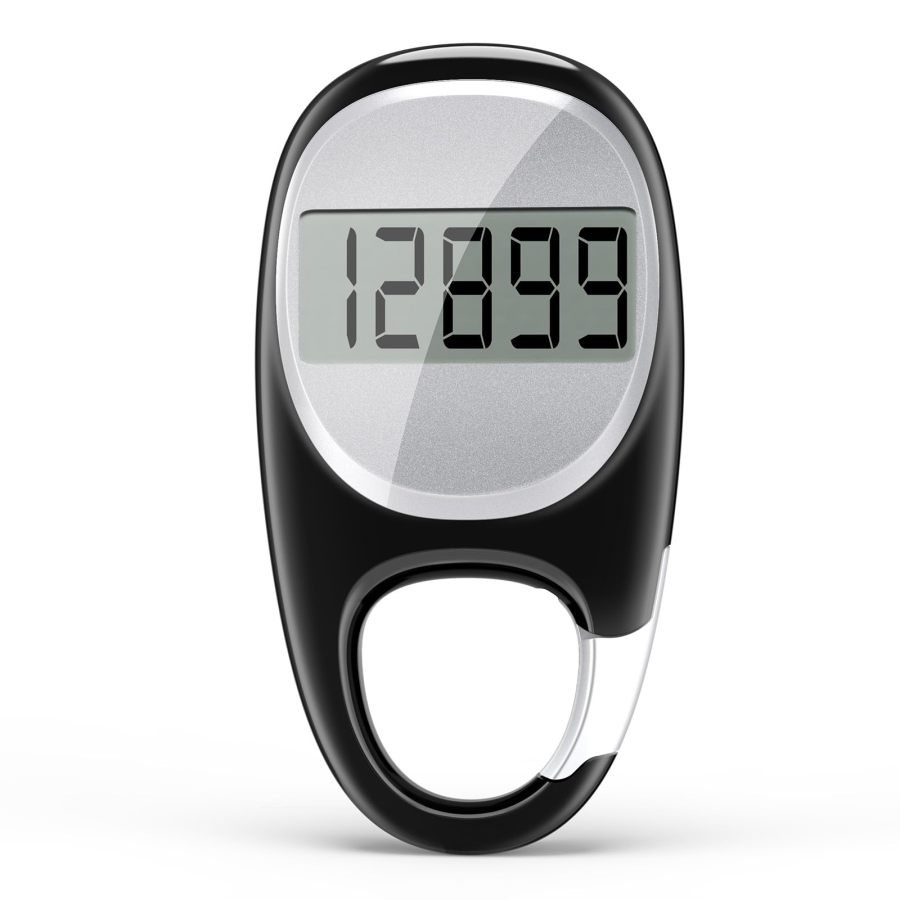
- Innovative Clip Design: For example, an integrated carabiner design emphasizing anti-loss and wearing convenience, representing a micro-innovation on traditional clips.
- Watch-Style Pedometer: Integrates step-counting function into a traditional watch appearance, suitable for users uncomfortable with clips or pocket placement, while maintaining the 'no app' minimalist characteristic.
5.2 Competitive Landscape
5.2.1 Market Maturity
The pedometer market is in a mature and highly competitive stage. Core step-counting functionality is widespread, and product homogenization is evident. Manufacturers primarily differentiate through micro-innovations and features emphasizing 'simpler', 'more accurate', and added convenience (like backlight, USB charging). Consumer expectations for basic functions are high, yet price sensitivity remains relatively high, requiring products to balance performance and cost.
5.2.2 Innovation Trends
The market shows a trend towards 'de-complexification' and 'experience optimization'. Consumers increasingly prefer devices with pure functionality and no complex connections (app/Bluetooth). Innovation is mainly reflected in improving stability and accuracy of step counting (e.g., 3D multi-axis sensors) and enhancing user convenience (e.g., USB charging, large screens, anti-misoperation design, diverse wearing options). Ease-of-use design for the senior citizen group is an emerging differentiation direction, while the 'multi-pack' sales model caters to team or family fitness challenge needs.
VI. Marketing Claims vs. Reality Check
The table below analyzes the gap between common marketing claims and actual user experiences in this category:
| Dimension | Marketing Claim | User Reality | Verdict |
|---|---|---|---|
| Step-Counting Accuracy vs. Claims | Claims to use 3D tri-axis sensors for high-precision step counting, accurate tracking in any position. | Multiple products receive user feedback about inaccurate step counting, or listings themselves note potential inaccuracies in irregular motion, short steps, car rides, etc., creating a clear contradiction with 'high-precision' claims. | Sellers emphasize 'high precision' to attract users on one hand, while downplaying accuracy limitations or disclosing them in fine print, leading to failed expectation management for the core user experience. |
| Product Durability (Clip/Shell) | Most products imply a lightweight yet sturdy structure suitable for daily wear and exercise. | Users commonly complain about clips breaking easily and fragile shells, even affecting core functionality, resulting in a product lifespan far below user expectations. | To achieve the selling point of 'lightweight and portable', the durability of product structural components was sacrificed, failing to balance design with the friction of practical use scenarios, leaving a core user pain point unaddressed. |
| Battery Life & Maintainability | Claims ultra-long battery life (6-12 months), no need for frequent charging. | Although some products have long battery life, their battery replacement design is complex, requiring special tools, or the battery is non-replaceable, contradicting the promise of 'hassle-free use'. | Sellers emphasize long battery life to reduce charging hassles but create new obstacles in battery replacement or product lifecycle management, reducing long-term user convenience. |
Key Takeaway: The market exhibits widespread tendencies of parameter inflation and scenario-based experience exaggeration, especially regarding step-counting accuracy and product durability.
VII. Supply-Demand Misalignment Analysis
The table below highlights mismatches between seller focus and buyer priorities:
| Dimension | Seller Behavior | User Focus | Verdict |
|---|---|---|---|
| True Step-Counting Accuracy & Contextual Limitations | Commonly emphasizes '3D tri-axis sensor' and 'high precision', but rarely proactively mentions product accuracy limitations in scenarios like slow walking, pushing carts, or irregular motion on the front end of listings. | Users complain about inaccurate step counting in specific daily scenarios, affecting trust in the product's core function. | Sellers overgeneralize the concept of 'high precision' in marketing, failing to adequately preset and inform users about usage in non-ideal conditions, leading to a mismatch between actual user experience and expectations. |
| Durability of Product Structural Components (Clip/Shell) | Sellers commonly promote 'lightweight and portable' but rarely highlight sturdiness and durability under daily use (drops, pressure). | User feedback indicates clips break very easily, shells are fragile, causing products to fail to wear properly or break quickly, a frequent quality complaint. | Sellers sacrificed 'durability', a core quality attribute, in their promotion to highlight 'lightweight', overlooking the fundamental user demand for long-term product reliability, creating high return risk. |
| Data Tracking & Long-Term Management | Most products emphasize the minimalist philosophy of 'no app, no Bluetooth', but remain silent on data storage, review, or export. Some products even have defects like easily triggered resets. | While users accept no app, they also wish to review multi-day data, compare progress, and avoid accidental data loss for better health management. | Sellers oversimplified 'no app' to mean 'no data management', failing to recognize users' latent need for basic historical data recording and loss prevention, missing an opportunity to provide added-value experience. |
Key Takeaway: Sellers overemphasize the superficial aspects of 'simplicity' and 'precision' while collectively remaining silent on the actual reliability of core functions, durability, and data transparency, creating a supply-demand mismatch.
VIII. Strategic Opportunities & Recommendations
8.1 Enhance Core Accuracy & Durability, Build a 'Trustworthy' Brand
8.1.1 Target Audience & Pain Points
⚡️ Pain Points Addressed: Insufficient step-counting accuracy, poor clip and shell durability, data reset stability issues.
8.1.2 Action Plan
Adopt higher-grade MEMS 3D tri-axis sensors, optimize algorithms to improve accuracy in slow walking and short steps. Use impact-resistant ABS or PC alloy materials, reinforce clip structure, and provide a detachable spare clip. Design a recessed, anti-misoperation reset button.
| Tech Complexity | Medium |
| Cost Impact | Medium Impact |
| Trade-off Warning | Using more robust materials may slightly increase product weight or thickness, requiring the best balance between portability and durability. |
| Price Band | Only viable above $18.99 |
8.1.3 Marketing Strategy
Emphasize 'Military-Grade Accuracy, Every Step Counts' and 'Drop-Proof & Durable, Fearless of Daily Challenges'; strengthen trust through third-party accuracy test reports and durability test videos. Highlight the user-friendly, anti-misoperation design to enhance user peace of mind.
8.2 'Senior-Exclusive' Ultimate Ease-of-Use Pedometer
8.2.1 Target Audience & Pain Points
⚡️ Pain Points Addressed: Complex smart device operation, screen too small to read, difficult battery replacement.
8.2.2 Action Plan
Design an extra-large font, high-contrast LCD screen displaying only steps and time, removing complex features. All operations (power on/off, reset) via a single, large, anti-misoperation physical button. Use high-capacity coin batteries (e.g., CR2450) or low-power solutions for 2+ years of battery life, with a tool-free, quick-access battery compartment design.
| Tech Complexity | Low |
| Cost Impact | Low Impact |
| Trade-off Warning | A larger screen may slightly increase size but is a plus for the target users; ultra-long-life batteries may increase single-unit BOM cost but eliminate frequent replacement, enhancing user value. |
| Price Band | Only viable above $16.99 |
8.2.3 Marketing Strategy
Highlight 'Designed for Parents, Large Digits Clear at a Glance'; emphasize 'One-Button Operation, Zero Learning Curve, No App Needed' and 'Ultra-Long Standby, Goodbye to Charging Hassles'. Marketing should revolve around filial piety and convenient healthy living.
8.3 USB-Rechargeable & Basic Multi-Function Integrated Pedometer
8.3.1 Target Audience & Pain Points
⚡️ Pain Points Addressed: Frequent coin battery replacement, lack of clock and backlight, single functionality.
8.3.2 Action Plan
Integrate a USB-A direct plug or USB-C charging port with a built-in rechargeable lithium battery, providing at least 3 months of battery life. Add clock display, night backlight function, and the ability to display steps, distance, calories, etc. Simplify operational logic to ensure added functions don't increase complexity.
| Tech Complexity | Low |
| Cost Impact | Low Impact |
| Trade-off Warning | A built-in lithium battery may add minimal weight, and product lifespan is limited by battery cycle life, but charging convenience is significantly improved. |
| Price Band | Only viable above $15.99 |
8.3.3 Marketing Strategy
Emphasize 'Goodbye Batteries, USB Charging On-the-Go & Eco-Friendly'; highlight 'All-in-One Device, Time & Steps in Your Palm, Clear Even at Night'. Stress daily convenience and environmental values.