Amazon US Market Analysis: Hand-Crank Emergency Weather Radios Category
📊 Executive Summary
📈 Market Trends
Steady disaster preparedness demand with parallel trends of feature integration and capacity competition. The hand-crank emergency weather radio market is driven by frequent natural disasters and growing outdoor activities, sustaining demand. Products are generally moving towards multifunction integration while simultaneously engaging in a 'digital arms race' over battery capacity, yet lack disruptive innovation.
⚡ Major Pain Points
False battery life claims and inefficient power replenishment are critical flaws. Users widely report that solar and hand-crank charging are inefficient, far from achieving advertised results, leading to power anxiety at critical emergency moments. Additionally, products generally lack true 'rugged' capabilities, batteries are prone to failure after long-term storage, and complex interfaces reduce the product's reliability and usability in real emergency scenarios.
💡 Selection Opportunities
Return to efficacy fundamentals, enhance extreme environment reliability, and optimize user experience. Market opportunities lie in developing 'true efficacy' high-efficiency emergency charging solutions, such as adopting more efficient power generation components and fast-charging protocols. Simultaneously, create 'military-grade rugged' products to meet the needs of advanced outdoor and heavy-duty disaster preparedness. Furthermore, offer 'extremely simple smart operation' products targeting special groups like the 'silver generation,' and achieve bundle sales through 'multifunction emergency survival kits' to meet one-stop disaster preparedness needs.
I. Analysis Overview
1.1 Introduction & Report Scope
This report analyzes the 'Weather Radios' category (specifically hand-crank emergency weather radios) within the Amazon US market, focusing on target user personas, core needs, decision drivers, market communication, and potential opportunities.
1.2 Category Snapshot
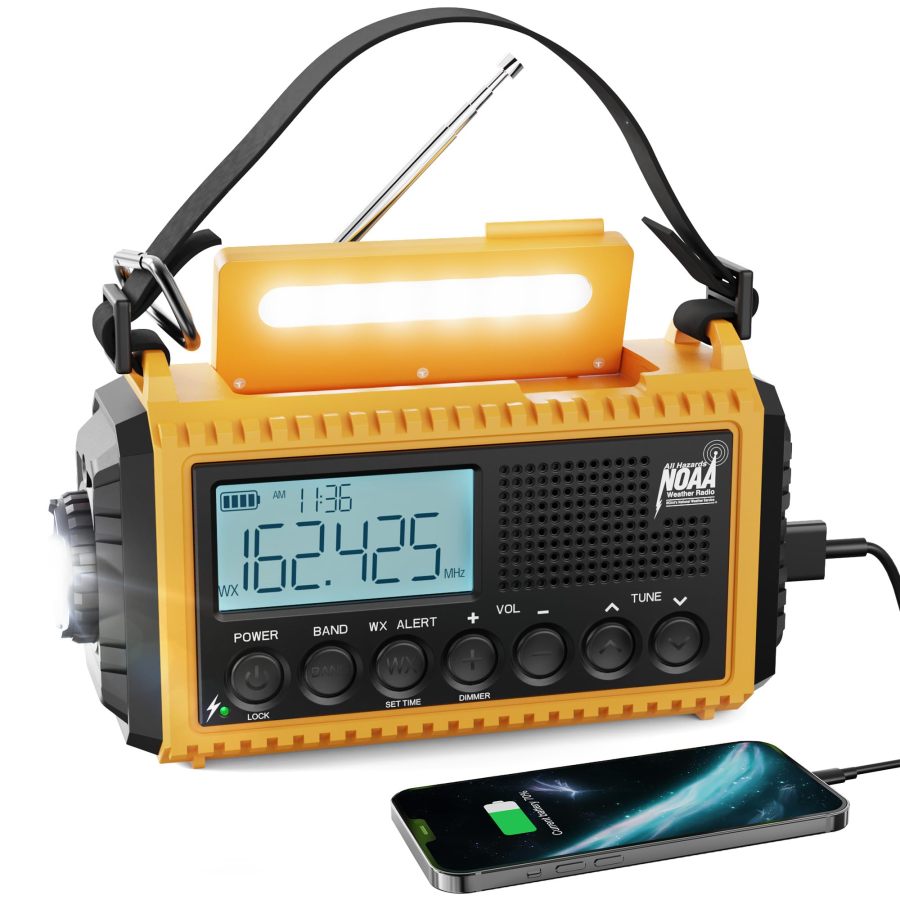
A hand-crank emergency weather radio is a multifunctional portable electronic device that integrates AM/FM/NOAA weather broadcast reception, multiple power modes (hand-crank, solar, built-in battery, USB charging, and AAA batteries), emergency lighting (flashlight, reading lamp), and emergency phone charging capabilities. It serves not only as a critical tool for natural disaster preparedness (e.g., hurricanes, tornadoes, power outages) but also as essential survival gear for outdoor activities (e.g., camping, hiking). Its core value lies in providing 'self-sufficient' information access and power assurance independent of the electrical grid. The following table illustrates the key characteristics of consumer behavior in this category.
| Dimension | Segment | Description |
|---|---|---|
| Need Driver Type | Planned Purchase / Emergency-driven Purchase | User purchases typically stem from anticipated content creation, video conferencing needs, or emergency scenarios like sudden low-light shooting, with clear expectations for immediate fill lighting. |
| Purchase Frequency | Low Frequency | As a phone accessory, its replacement cycle is tied to the phone's lifecycle or wear and tear, resulting in typically low purchase frequency; it is not a fast-moving consumer good. |
| Decision Complexity | Medium | Consumers will compare different products based on brightness, battery life, magnetic stability, additional features, and price, but will not conduct in-depth research. |
| Price Sensitivity | Medium | Price is an important consideration in the decision-making process, but users are willing to pay a reasonable premium for significant experience upgrades or solutions to core pain points. |
| Emotional Dependency | Medium to High | It satisfies both the functional need for fill lighting and provides emotional value and self-satisfaction related to 'looking better on camera' and 'more professional creation'. |
II. User Personas & Usage Scenarios
2.1 Family Preparedness Guardian
🎯 An adult residing in a high-risk natural disaster area (e.g., hurricane belt, tornado alley) who places extreme importance on family emergency preparedness and the safety of loved ones.
| Typical Usage Scenarios | Core Pain Points | Primary Purchase Drivers |
|---|---|---|
|
|
|
2.2 Hardcore Outdoor Adventurer
🎯 Enthusiastic about off-grid camping, long-distance hiking, or wilderness survival, seeking lightweight, multifunctional gear that does not rely on the electrical grid.
| Typical Usage Scenarios | Core Pain Points | Primary Purchase Drivers |
|---|---|---|
|
|
|
III. User Needs Hierarchy (KANO Model)
3.1 Basic Needs (Must-Haves)
- Multiple Charging Paths: At least three methods: USB charging, hand-crank generation, and solar charging, ensuring continuous power supply during outages.
- NOAA Weather Reception: The ability to stably receive emergency weather warning broadcasts from the National Oceanic and Atmospheric Administration (NOAA).
- Basic Lighting Function: A built-in flashlight with adequate brightness to meet basic lighting needs in dark environments.
- AM/FM Radio: Capable of receiving standard AM and FM broadcasts for daily news or entertainment information.
3.2 Performance Needs (Linear Satisfiers)
- Battery Life & Capacity: Possessing a mainstream or larger built-in battery capacity (e.g., 4000mAh or above) for extended operation and providing emergency phone charging.
- Automatic Alert Function: Automatically monitors NOAA alerts in standby mode and issues a loud alert without requiring manual user operation.
- Radio Clarity & Sensitivity: Ability to receive broadcast signals clearly and stably even in remote areas or environments with weak signals.
- Volume & Sound Quality: Ensuring broadcast content can be heard clearly in noisy emergency environments without sound distortion.
3.3 Excitement Needs (Delighters)
- Motion-Sensing Reading Lamp: Equipped with an intelligent sensor function or an adjustable-brightness reading lamp for a more user-friendly nighttime lighting experience.
- Bluetooth/TF Card Playback: Extending the emergency radio function to daily entertainment, such as playing music as a Bluetooth speaker, increasing usage frequency.
- Built-in Multi-in-One Charging Cable: A device-integrated charging cable compatible with multiple interfaces, avoiding the hassle of not finding the right cable during an emergency.
- LCD Digital Display: Providing precise frequency, battery level, and time display, replacing traditional analog tuning dials to improve ease of use.
3.4 Unmet Needs & Opportunities
-
Truly Efficient Emergency Power Replenishment: Users commonly report that solar and hand-crank charging are inefficient, making it difficult to effectively recharge large-capacity batteries, with expectations for more efficient and reliable self-generation solutions.
User Reviews (VOC) I tried for 4 days with constant sunlight to recharge the battery with the solar panel and couldn't even get 1/4 charge. // The solar panel is USELESS. // The charging crank turns fine, but it takes work to do so. One minute of cranking makes my hands tired and a bit sore.
-
Extreme Environmental Endurance: Most existing products are IPX3 waterproof, but the market lacks truly high-grade (e.g., IPX7/8) waterproof, dustproof, and shockproof products capable of withstanding extreme natural disasters.
User Reviews (VOC) The only feature not included was making it waterproof and that's easily solved with a ziplock gallon bag. // Not rugged so be gentle, but not flimsy either. Will work great as an emergency radio in the house. For outdoor camping I would say take care of it
-
Battery Long-Term Storage Reliability: Some users complain that emergency radios' batteries fail or become unchargeable after long-term storage, necessitating more stable battery management and user-replaceable battery designs.
User Reviews (VOC) after fully charged, if left as is, the product does not hold the current charge forever and will run down over time. // I'm slightly worried that the battery may DIE die (like, for good) sometime before I need this in an emergency.
-
More Intuitive & Friendly User Interface: Most products still use complex knobs and buttons, which are not intuitive enough for non-technical users or for operation under stress, especially for tuning and mode switching.
User Reviews (VOC) No channel memory/favorites and no power on memory of last tuned station. // tuning in a FM station at 98.1, but it's showing like it's around 101 on the dial.
IV. User Decision Drivers
4.1 Key Decision Factors
- NOAA Alert Reliability: Users are most concerned about whether they can receive official weather warnings timely and accurately during emergencies, with the automatic alert function being particularly important.
- Emergency Phone Charging Capability: In a power outage, whether the product can truly and effectively provide at least one emergency charge for a smartphone is a key criterion for measuring its practicality.
- Overall Battery Life: How long the device can operate on a full charge for all functions (especially radio and lighting) determines the adequacy of emergency preparedness.
- Signal Reception Stability: The ability to receive desired broadcast signals clearly and stably in remote areas or indoor environments.
4.2 Secondary Decision Factors
- Product Portability & Durability: Whether the size is moderate for easy carrying, and if it is shockproof and waterproof, to adapt to different emergency scenarios and outdoor use.
- Ease of Operation: Whether core functions can be activated and used quickly and intuitively in emergency or dark environments to avoid panic.
- Additional Lighting Features: Beyond a flashlight, whether there are reading lamps, multi-mode brightness adjustments, etc., to enhance nighttime utility.
- Design Aesthetics: Whether the product's appearance, color, etc., align with personal preferences, especially when purchased as a gift.
V. Selling Points & Competitive Landscape
5.1 Selling Point Analysis
5.1.1 Standard Features (Points of Parity)
- Multiple Power Modes: Commonly emphasizes hand-crank, solar, USB charging, and AAA batteries among various power supply methods to ensure 'never run out of power'.
- AM/FM/NOAA Radio: Provides basic news, entertainment, and authoritative weather warning functions, forming the core feature set.
- Emergency Lighting: Built-in flashlight and/or reading lamp for basic lighting in dark environments.
- SOS Alarm Function: High-decibel alarm sound and flashing light for emergency distress signaling, a standard safety feature.
5.1.2 Key Differentiators
- High-Capacity Power Bank: Claims of high-capacity batteries (4000mAh up to even 20000mAh or more) to provide longer emergency phone charging.
- Digital Tuning/LCD Display: Compared to traditional analog dials, emphasizes tuning precision and information readability, displaying battery level, frequency, etc.
- Bluetooth Speaker Function: Extends the emergency tool into a daily entertainment device, increasing product added value and usage frequency.
- Built-in Charging Cables: Provides integrated charging cables with multiple interfaces like Lightning/USB-C/Micro USB for added convenience.
5.1.3 Unique Selling Propositions (USPs)
- Ultrasonic Dog Whistle: (e.g., Midland ER310) Used to assist search and rescue dogs in locating distressed individuals, very niche but unique.
- Dual Solar Panel Design: (Some new brands) Attempts to increase charging efficiency by adding solar panel area, but real-world effectiveness remains to be verified.
- Integrated Survival Kit: Bundling the radio with other survival tools like a headlamp, emergency blanket, survival bracelet, etc., to meet one-stop disaster preparedness needs.
- White Noise Function: (e.g., R11) Provides sleep-aiding white noise, expanding the product's daily use scenarios.
5.2 Competitive Landscape
5.2.1 Market Maturity
The hand-crank emergency weather radio market is in the late-mid stage of maturity. Product features are highly homogenized, with competition primarily focused on an arms race in battery capacity (from 2000mAh to claimed 74000mWh or even higher) and integrating more small additional features (e.g., compass, multi-in-one charging cable, extra survival tools). This competitive model indicates an innovation bottleneck, lacking disruptive technological breakthroughs, and is prone to leading to inflated specifications and homogeneous market saturation.
5.2.2 Innovation Trends
The category is evolving from a pure 'emergency tool' towards a 'multifunctional integrated outdoor hub' and 'daily companion'. Visible trends include: increasing battery capacity and phone charging speed (introducing USB-C fast charging), enhancing environmental adaptability (higher IPX waterproof and dustproof ratings), and integrating entertainment functions (e.g., Bluetooth audio, white noise). Simultaneously, automation and digital functions (e.g., automatic alert scanning, precise LCD display) are gradually becoming new selling points, with some brands attempting to provide more comprehensive solutions through bundled survival gear sales.
VI. Marketing Claims vs. Reality Check
The table below analyzes the gap between common marketing claims and actual user experiences in this category:
| Dimension | Marketing Claim | User Reality | Verdict |
|---|---|---|---|
| Battery Life & Charging Efficiency | Long-lasting battery life, all-day use, 10000mAh or even higher capacity batteries providing ample power for phones, with efficient hand-crank/solar recharging. | Users commonly report that hand-crank and solar charging are inefficient, making it difficult to effectively charge large batteries, let alone provide a full charge for modern smartphones; battery life at high brightness falls far short of claims. | Typically uses large battery numbers to create a 'sense of security' but fails to address the physical energy conversion efficiency bottleneck of micro-generation devices, resulting in a failure to deliver the core emergency experience. |
| Emergency Durability & Protection | Rugged and durable, drop-resistant, IPX6 waterproof (splash-proof), suitable for extreme outdoor environments. | Most products have a protection rating of only IPX3 (splash-resistant), insufficient for actual disaster scenarios like heavy rain or falls. Users perceive them as 'not sturdy, need careful handling' and even require additional protective measures. | Sellers ambiguously promote 'durability' and 'waterproof' without clarifying actual protection ratings and impact resistance, leading to device damage risks in harsh environments, which contradicts the positioning of an emergency device. |
| Ease of Operation & Information Display | Easy to use, large tuning knob, clear labels, convenient for operation in the dark. | Most products have issues like inaccurate tuning, lack of channel memory, counterintuitive button layouts, and short LCD backlight time, leading to inefficient operation and poor experience, especially in emergency or dark environments. | Sellers have failed to fully consider the special requirements of emergency use scenarios (e.g., darkness, stress) in product interaction design, resulting in complex operational logic and non-intuitive information display, reducing the product's usability at critical moments. |
Key Takeaway: The market suffers from widespread parameter inflation and exaggerated energy conversion efficiency claims, leading consumers to develop unrealistic expectations about the product's core emergency capabilities.
VII. Supply-Demand Misalignment Analysis
The table below highlights mismatches between seller focus and buyer priorities:
| Dimension | Seller Behavior | User Focus | Verdict |
|---|---|---|---|
| 'Real Efficiency' of Emergency Power Replenishment | Commonly emphasizes hand-crank/solar as a 'never run out of power' selling point but downplays or lacks transparency regarding actual charging efficiency and required time. | Most users complain that solar charging is 'useless' and hand-cranking makes 'hands sore,' failing to effectively charge large batteries or phones, with experience falling far short of marketing claims. | Sellers have failed to deliver on the most core promise of 'emergency power replenishment,' using marketing rhetoric to mask physical limitations, leading to decreased user trust. |
| Battery Reliability for Long-Term Storage | Sellers generally do not emphasize or provide information about the built-in battery's long-term storage performance and self-discharge rate, nor do they offer user-friendly battery replacement solutions. | Users complain that emergency radios' batteries fail or become unchargeable after long-term storage, causing the emergency product to 'fail at the critical moment,' triggering preparedness anxiety. | As an emergency product, its core 'standby' value is eroded by battery long-term reliability issues. Sellers have failed to design and communicate from the user's 'prepare for the worst, hope for the best' scenario. |
| Protection Rating Under Extreme Environments | Most products only mention 'weather-resistant' or low-level waterproofing, lacking authoritative certifications like military-grade drop and dust resistance, leaving consumers skeptical about the product's actual protective capabilities. | Users need truly sturdy products that can withstand heavy rain, mud, and even drops. Existing products are perceived as 'not sturdy, need careful handling' and require additional protection. | Sellers have failed to recognize users' higher expectations for a device's 'survivability' in real disasters or outdoor adventures, leading to a disconnect between product functionality and environmental reliability. |
Key Takeaway: Sellers are overly focused on battery capacity numbers and feature stacking, neglecting users' core demands for real emergency efficacy and long-term reliability, leading to a severe misalignment between supply and demand focus.
VIII. Strategic Opportunities & Recommendations
8.1 High-Efficiency Emergency Fast-Charge & Smart Battery Management Radio
8.1.1 Target Audience & Pain Points
⚡️ Pain Points Addressed: Truly efficient emergency power replenishment, battery long-term storage reliability.
8.1.2 Action Plan
Adopt a more efficient rare-earth magnet hand-crank generator mechanism. Integrate larger area/higher conversion rate flexible solar panels (or a foldable design). Incorporate a user-replaceable standard 18650/21700 battery compartment. Support USB-C PD fast charging input/output. Provide accurate real-time battery level and charging efficiency display.
| Tech Complexity | Medium |
| Cost Impact | High Impact |
| Trade-off Warning | Increasing battery capacity might slightly increase volume and weight, but high-efficiency charging is a core need, and users may accept minor compromises. |
| Price Band | Only viable above $49.99 |
8.1.3 Marketing Strategy
Emphasize 'Say Goodbye to Inflated Specs, Real Tested Battery Life'; '72 Hours Post-Disaster, Power Uninterrupted.' Provide authoritative third-party certified charging efficiency data, e.g., '1 minute of cranking enables X minutes of talk time.' Highlight the user-replaceable battery design to address long-term storage anxiety.
8.2 Military-Grade Ruggedized Smart Weather Radio
8.2.1 Target Audience & Pain Points
⚡️ Pain Points Addressed: Extreme environmental endurance.
8.2.2 Action Plan
Use dual injection molding or high-strength composite materials for the housing, meeting MIL-STD-810G drop test standards. Achieve IPX7/8 waterproof and dustproof ratings. Integrate a GPS module supporting offline maps and track recording. Include a high-precision digital compass.
| Tech Complexity | Medium |
| Cost Impact | Medium Impact |
| Trade-off Warning | Achieving higher protection ratings typically increases product volume and weight and may sacrifice some heat dissipation space. |
| Price Band | Only viable above $59.99 |
8.2.3 Marketing Strategy
Emphasize 'Fearless in Rain, Mud, and Extreme Conditions'; 'Military-Grade Quality, Safeguarding Lives.' Showcase performance test videos of the product in mud, water, drops, and extreme temperatures. Highlight 'Essential for Outdoor Survival, First Choice for Professionals'.
8.3 Large-Screen, Easy-to-Use Smart Emergency Radio
8.3.1 Target Audience & Pain Points
⚡️ Pain Points Addressed: More intuitive & friendly user interface.
8.3.2 Action Plan
Equip with a 3-inch or larger high-definition screen displaying time, frequency, and battery level in large fonts. Use oversized physical buttons for core functions, with backlighting and tactile feedback, enabling one-touch operation (e.g., one-touch power on/off, one-touch NOAA switch). Provide simple channel preset functionality.
| Tech Complexity | Low |
| Cost Impact | Low Impact |
| Trade-off Warning | Large screens and buttons will slightly increase product volume, but for the target users, ease of use has higher priority. |
| Price Band | Only viable above $29.99 |
8.3.3 Marketing Strategy
Emphasize 'Even Parents Can Use It Easily'; 'Large Screen, Large Fonts, Clear at a Glance'; 'In an Emergency, No More Fumbling.' Demonstrate barrier-free operation by seniors through videos. Highlight clear voice announcement features to increase a sense of security.
8.4 Multifunction Emergency Survival Kit (Bundle Sales)
8.4.1 Target Audience & Pain Points
⚡️ Pain Points Addressed: The complexity and potential omissions in consumers' disaster preparedness supply procurement.
8.4.2 Action Plan
Use an existing mid-to-high-end emergency radio as the core, bundled with high-quality items like an emergency blanket, water purification tablets/straw, multifunction survival bracelet, and a first aid guide. Package in a sturdy, waterproof storage case.
| Tech Complexity | Low |
| Cost Impact | Low Impact |
| Trade-off Warning | Increases the overall volume and weight of the kit but offers an attractive one-stop solution for users. |
| Price Band | Only viable above $39.99 |
8.4.3 Marketing Strategy
Emphasize '72-Hour Survival Essentials'; 'One Box, Fully Prepared, Disaster Ready and Worry-Free'; 'The Most Practical Gift of Care for Your Family.' Highlight the professionalism and completeness of the kit.