Amazon US Market Analysis: Household Folding Step Stools Category
📊 Executive Summary
📈 Market Trends
Portability and Safety are the Foundation; Functional Integration and Aesthetic Fusion are the Direction. The household folding step stool market is maturing. Consumer demand for lightness, easy storage, and high safety persists. Simultaneously, the market is gradually moving towards multi-functional integration and home aesthetic integration to meet users' higher demands in diverse scenarios like daily household use, DIY, and interior decoration.
⚡ Major Pain Points
Inflated Weight Claims and Structural Instability are Core Hard Issues. The current market suffers from widespread inflation of product weight capacity and discrepancies between claims and actual experience, causing users to lose trust in product safety. Additionally, insufficient step width, stiff folding/locking mechanisms, and some products failing to achieve a good balance between lightweight and stability severely impact daily user experience and satisfaction.
💡 Selection Opportunities
Return to the Essence of Safety, Innovate User Experience, and Transparentize Product Performance. Future product selection should focus on developing the 'Ultra-Lightweight Yet Structurally Stable Household Aluminum Ladder' and the 'Elderly-Friendly Wide Comfort & Safety Step Stool' to address core pain points. Simultaneously, build brand trust through 'Data-Transparent & Real-Performance Verification' and explore the 'Multi-functional Smart Integrated Storage Step Stool' for differentiation in the premium market, enhancing product value and competitiveness.
I. Analysis Overview
1.1 Introduction & Report Scope
This report analyzes the 'Step Ladders' category (Folding Step Stools) in the Amazon US market, focusing on target user personas, core needs, decision drivers, market communication, and potential opportunities.
1.2 Category Snapshot
A household folding step stool is a lightweight, foldable, multi-purpose auxiliary tool primarily used in homes, kitchens, offices, and garages to help users safely and conveniently reach high objects. These products are typically designed with 2-5 steps, emphasizing stability, slip resistance, and easy storage. They are indispensable height-assistance tools in daily household life. The following table illustrates the key characteristics of consumer behavior in this category.
| Dimension | Segment | Description |
|---|---|---|
| Need Driver Type | Planned Purchase / Emergency-driven Purchase | Users often have purchase needs when encountering difficulties reaching high places in daily life (e.g., changing light bulbs, cleaning high areas). This could be part of long-term home planning or an immediate solution to a problem. |
| Purchase Frequency | Low Frequency | As a durable good, purchase frequency is extremely low, typically once every few years, unless repurchased due to damage, moving, or changes in family member needs. |
| Decision Complexity | Medium | Users will carefully compare product performance in safety, stability, portability, and storage, but usually without complex technical parameter analysis. |
| Price Sensitivity | Medium | Price is an important consideration, but consumers are more inclined to pay a reasonable premium for better safety assurance and quality experience, rather than just pursuing low prices. |
| Emotional Dependency | Low to Medium | The product is primarily functional, but the 'peace of mind', 'worry-free operation', and 'convenience in home life' can provide a certain level of emotional value and mental premium. |
II. User Personas & Usage Scenarios
2.1 Daily Home Convenience Seeker
🎯 Household members with limited height or elderly individuals who frequently need to retrieve or place items around the house (e.g., kitchen top cabinets, living room shelves, bedroom wardrobes). They prioritize daily-use convenience and absolute safety.
| Typical Usage Scenarios | Core Pain Points | Primary Purchase Drivers |
|---|---|---|
|
|
|
2.2 Multi-functional Home Maintainer / Small Project DIYer
🎯 Homeowners actively engaged in small-scale home improvement, repair, or gardening projects. They need a multi-functional, durable ladder that can assist with tool usage.
| Typical Usage Scenarios | Core Pain Points | Primary Purchase Drivers |
|---|---|---|
|
|
|
III. User Needs Hierarchy (KANO Model)
3.1 Basic Needs (Must-Haves)
- Sufficient Height: The step stool must provide the basic height-increasing function needed to safely reach high places, meeting most household usage scenarios.
- Basic Stability: No excessive wobbling or tipping during use, ensuring the user's basic standing safety.
- Folding Storage Function: Easy to store, not occupying too much home space when folded.
- Anti-slip Foot Pads: Ensuring the ladder doesn't slip on various floor surfaces and protects floors from scratches.
3.2 Performance Needs (Linear Satisfiers)
- Wide Anti-slip Steps: Providing a more comfortable and safe standing space, reducing foot fatigue during prolonged standing, and improving center of gravity stability.
- Lightweight and Portability: The product itself is lightweight, convenient for one-handed carrying and moving, especially suitable for frequent use in different rooms.
- Handrail Support: Providing additional balance support and a sense of security when climbing and standing, particularly important for elderly users.
- Secure Locking Mechanism: Reliable automatic or manual locking when the ladder is unfolded to prevent accidental folding during use, enhancing safety.
- Excellent Weight Capacity: Meeting the weight-bearing needs of users of different sizes and those carrying tools, providing stronger psychological safety and applicability.
3.3 Excitement Needs (Delighters)
- Integrated Tool Tray/Bag: Convenient for placing tools like screwdrivers, paintbrushes, small parts, significantly improving work efficiency and reducing the hassle of frequent climbing.
- Ready-to-Use Out of the Box: Eliminating complicated assembly steps, ready for immediate use out of the box, greatly enhancing the first-use experience.
- Stylish Appearance and Color Options: Aesthetic design and diverse color choices (e.g., pink, blue, white) allow it to better integrate into modern home decor, moving beyond being just a tool.
- Unique Safety Design Details: Features like retractable handrails, multiple locks, ergonomic curved designs, etc., providing unexpected safety and comfort.
3.4 Unmet Needs & Opportunities
-
True Balance Between Lightweight and Stability: Consumers generally want a ladder that is both light and stable, but many products on the market involve trade-offs. User feedback indicates it sometimes feels unbalanced-too light and unstable, or too stable and heavy.
User Reviews (VOC) Customers have mixed opinions about the ladder's weight, with some finding it good while others describe it as very heavy. // Although ss an older adult, I wished I would have ordered the 2 step. Third step is very high.
-
Optimization of Step Width and Comfort: Some products advertise wide steps, but user feedback indicates the top step is still narrow in actual use, or the width is insufficient for larger shoe sizes, leading to instability or discomfort.
User Reviews (VOC) I'm a big guy and I find the treads a little narrow for my balance. They're very solid it's just my feet end up having to be pretty much touching each other giving me a very narrow stance on top of the step. // Customers find the ladder too narrow, with steps measuring only 11.5 inches wide, making it unsuitable for average adults.
-
Ease of Use of Reliable Folding/Locking Mechanism: Some users report locking mechanisms being stiff, requiring significant force to open or close, or feeling insufficiently secure, even making unsettling noises during use.
User Reviews (VOC) You have to use a bit of force to open it up from a folded up position. I actually felt stumped on my first try. I also was surprised at how stiff it was to even lock it in place with the yellow plastic bit. // Upon opening fully, it "latches"... but apparently *something* does not engage fully at that time because it always produces a loud - and startling - "snap" the first time I step on it after opening it.
-
Authenticity and Consistency of Weight Capacity Claims: Some products claim extremely high weight capacities (e.g., 600-900 lbs) that contradict the perceived materials or product manuals, raising consumer doubts and trust issues.
User Reviews (VOC) The webpage says, "Designed with user safety in mind, ...". I'm not so sure. ... it answered another reviewer's question concerning actual weight capacity, 150kg which is about 330 pounds. But the critical statement on the finely-printed list was the seventh, near the bottom. // This is not sturdy at all I have to have someone hold it just to get on it. Almost like its made out of tin foil I have not used it that often and the first step is bending very unsafe. DEFINATELY not worth your money.
IV. User Decision Drivers
4.1 Key Decision Factors
- Safety and Stability: Whether the ladder wobbles during use, if steps are anti-slip, and if the structure is sturdy are the user's primary concerns. Especially for high-altitude work, users have extremely high demands for ladder stability and slip resistance, directly impacting purchase decisions.
- Ease of Use and Convenience: Whether it can be easily unfolded/folded and if it's lightweight and portable directly affects daily user experience. Users don't want a tool that adds operational burden, especially with frequent use.
- Storage Space Occupancy: Whether it's compact enough when folded to fit into limited home spaces (e.g., kitchen corners, behind wardrobes, under beds) is a key purchase consideration.
- Weight Capacity: Users need assurance the ladder can safely support their own weight and any tools carried, especially for heavier individuals or those doing strenuous work. This is a fundamental safety guarantee.
4.2 Secondary Decision Factors
- Step Width and Comfort: Wide, anti-slip, and comfortable steps enhance user safety and comfort, especially for prolonged standing or users with larger feet. Step design impacts perceived fatigue and stability while standing.
- Additional Features: Features like integrated tool trays, adjustable handrail height, unique handle designs, etc., can enhance practicality and convenience in specific scenarios, serving as differentiating factors among similar products.
- Product Appearance and Color: Although a tool, harmony with the home environment is increasingly a factor for some consumers, especially when placed in visible areas like living rooms or kitchens.
- Brand and Reviews: Well-known brands typically bring higher trust, while genuine user reviews, especially regarding safety and durability, significantly influence new users' decisions.
V. Selling Points & Competitive Landscape
5.1 Selling Point Analysis
5.1.1 Standard Features (Points of Parity)
- Foldable and Space-saving: Almost all products emphasize their easy folding and compact storage features to address the pain point of limited home space.
- Anti-slip Steps and Foot Pads: Widely claimed to provide anti-slip textured steps and anti-slip rubber foot pads to ensure safe use and protect floors.
- Heavy Duty / Durable: Emphasizing robust structure, often using steel or alloy steel, capable of withstanding daily use and a certain weight.
- Multi-purpose Use: Extensively advertised as suitable for various indoor/outdoor scenarios like home, kitchen, office, garage, emphasizing versatility.
- Weight Capacity: Commonly claiming weight limits of 330-500 lbs, with a few claiming higher (e.g., 600-900 lbs).
- Design with Handrail: Many products include a handrail or top handle to add support and a sense of security when climbing.
5.1.2 Key Differentiators
- Wide Steps: Some products emphasize providing more spacious standing area than competitors to enhance comfort and stability.
- Lightweight Design: Highlighting lightness achieved through aluminum or optimized structure, making the product easy to carry and move.
- No Assembly or Easy Assembly: Positioned as an advantage for immediate or quick use out of the box, saving user time and effort.
- Secure Locking Mechanism: Highlighting automatic locking or unique latch design to enhance perceived safety and prevent accidental folding.
- Compliance with Safety Standards: Some products mention certification under industry safety standards like ANSI to reinforce safety claims.
5.1.3 Unique Selling Propositions (USPs)
- Integrated Tool Tray/Bag: A few products integrate a removable or fixed tool tray/bag at the top, convenient for placing small tools and accessories, improving work efficiency.
- Retractable Handrail: Very few products feature a retractable handrail design, balancing safety with ultimate storage compactness.
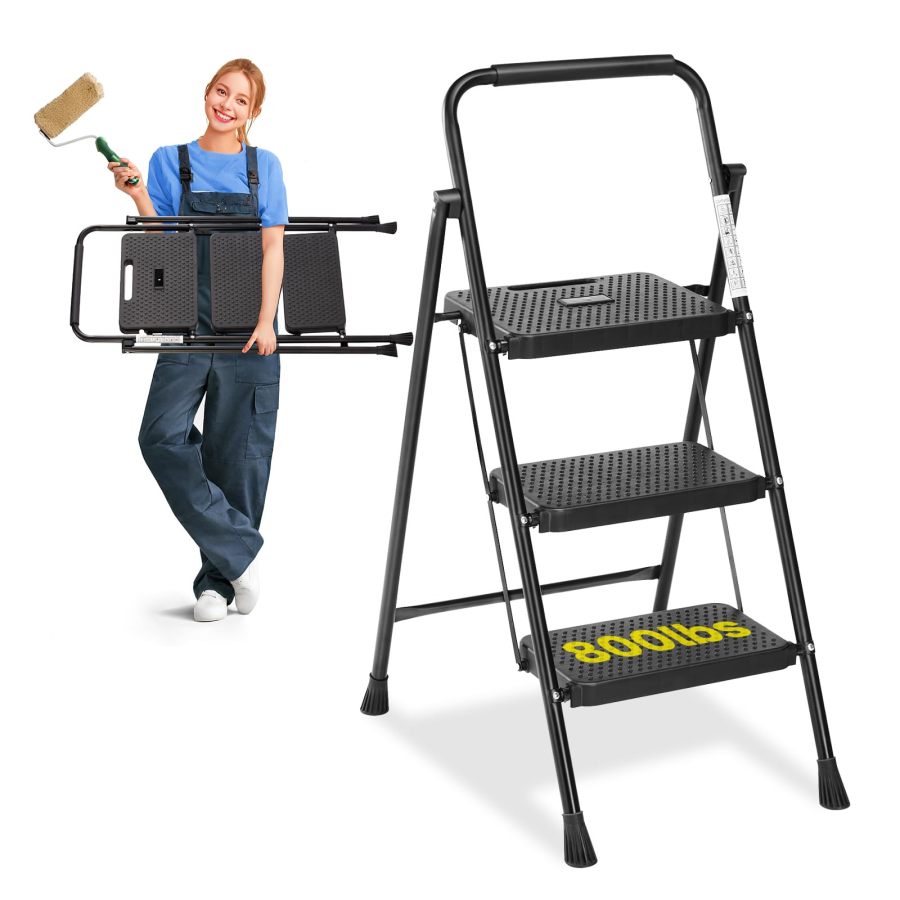
- Extremely High Weight Capacity: Individual products claim ultimate weight capacities of 800-900 lbs, aiming to attract users with extremely high weight requirements or create a psychological advantage.
- Special Appearance and Color Options: Offering non-traditional colors (e.g., pink, blue, white) to integrate the tool into home aesthetics, breaking away from the traditional tool stereotype.
- No-Latch Design: Individual products experiment with latch-free designs, achieving locking through gravity or structural connection, simplifying operation.
5.2 Competitive Landscape
5.2.1 Market Maturity
The household folding step stool market has matured, with products showing high homogeneity in function and design. Competition mainly focuses on price, brand awareness, product materials, weight capacity, and refinement of safety details. New entrants need to find more niche market demands or achieve breakthroughs in user experience.
5.2.2 Innovation Trends
Innovation trends are mainly reflected in several areas: First, Balancing Lightweight with High Strength, using new materials and structural optimization to ensure safe weight capacity while reducing product weight. Second, User-friendly Design, such as smoother folding mechanisms, wider steps to enhance comfort, and convenience of no assembly. Third, Multi-functional Integration, such as tool trays or magnetic areas to meet DIY user needs. Fourth, Integration with Home Aesthetics, offering more fashionable colors and design sense so the tool is no longer obtrusive and better fits modern home environments. Fifth, Optimization for Specific Demographics, such as designing easier-to-use, safer handrail systems for the elderly.
VI. Marketing Claims vs. Reality Check
The table below analyzes the gap between common marketing claims and actual user experiences in this category:
| Dimension | Marketing Claim | User Reality | Verdict |
|---|---|---|---|
| Weight Capacity | Claiming extremely high weight capacities like 600 lbs or even 800-900 lbs. For example, HBtower (B0F2HRR4H5) claims 500lb, Simple Deluxe (B0DM5CZ28X) claims 800lb. | Riverlin (B0FK4M77DP) claims 600 lbs, but a user at 250 lbs reported bending; Simple Deluxe (B0DM5CZ28X) listing mixes 'adult toy' information, with user feedback on insufficient weight capacity or cheap steps. | This weight capacity inflation is typical marketing fraud, raising household ladder claims to professional industrial levels without matching materials and structure, posing serious safety hazards and a trust crisis for users. |
| Structural Stability | Widespread emphasis on 'stable, sturdy, no wobble', e.g., LUISLADDERS (B08NPQ38HP) claims 'Security and Stability', KINGRACK (B0DJQ31KZS) claims 'SAFETY & STABILITY'. | LUISLADDERS (B08NPQ38HP) has numerous user reports of 'feels wobbly', 'too weak', 'broke on third use'; Jack Boss (B0CXD345Z5) user feedback: 'each step wobbles a bit'; HBTower (B0FGNWJ2C4) user feedback: 'narrow, feels unsafe'. | Sellers over-promise on stability, neglecting the decisive impact of actual material strength and connection craftsmanship on structural rigidity, leading to serious defects in the core safety function. |
| Ease of Use of Folding/Locking Mechanism | Claiming 'easy to open/close and fold', 'secure latch design', e.g., KINGRACK (B0DJQ31KZS) claims 'lock-and-open system makes it easy to open and fold'. | Riverlin (B0FK4M77DP)'s plastic latch mechanism is unintuitive and prone to misuse, potentially causing the ladder to fold unexpectedly during use; HBTower (B0F2HRR4H5) user feedback: opening/closing and safety latch require significant force, even producing a 'loud snap'. | Packaging a complex or flawed locking mechanism as a 'safety design', failing to optimize from a user experience perspective, instead increasing operational difficulty and safety risks. |
Key Takeaway: The market suffers from widespread parameter inflation, marketing exaggeration, and chaotic product information, especially regarding weight capacity and actual safety, severely damaging user trust.
VII. Supply-Demand Misalignment Analysis
The table below highlights mismatches between seller focus and buyer priorities:
| Dimension | Seller Behavior | User Focus | Verdict |
|---|---|---|---|
| Authenticity and Applicability of Weight Capacity | Widespread emphasis on extremely high weight capacities (e.g., 600-900 lbs) as a core selling point, but lacking transparent explanation of data sources and stability in real-world scenarios. | Users doubt the authenticity of high weight numbers, caring more about reliability and stability under daily household intensity, not an extreme numbers game. | Sellers excessively amplify a non-core pain point, neglecting users' deep-seated need for 'authentic reliability', leading to decreased trust-an ineffective numbers arms race. |
| Step Width and Comfort | Widespread claims of 'wide anti-slip steps', but lacking clear dimension data and specific optimization explanations for the top step. | User feedback indicates the top step is still narrow, causing instability or discomfort for users with larger feet or those standing for long periods. | Sellers fail to meet expectations on key user experience details, with a superficial understanding of 'wide', missing effective opportunities to enhance user comfort and safety. |
| Balance Between Lightweight and Stability | Some products simultaneously emphasize 'lightweight' and 'heavy-duty structure', but fail to clearly explain how this balance is achieved in listings, causing consumer cognitive conflict. | Users have doubts about the stability of lightweight products, fearing lightness sacrifices safety; conversely, stable products are criticized as heavy and hard to move. | Sellers fail to effectively communicate core technical advantages in marketing, leading to vague product positioning and inability to effectively address users' deep-seated need for both lightness and stability. |
Key Takeaway: Sellers exhibit inflation and blind spots in core safety features, while over-investing in marketing extreme weight numbers and some additional functions. This significantly misaligns with users' true pain points and their desire for reliability.
VIII. Strategic Opportunities & Recommendations
8.1 Ultra-Lightweight Yet Structurally Stable Household Aluminum Ladder
8.1.1 Target Audience & Pain Points
⚡️ Pain Points Addressed: Traditional ladders are heavy and inconvenient, occupying large storage space; lightweight ladders often lack sufficient stability.
8.1.2 Action Plan
Use aerospace-grade 6061/7075 aluminum alloy, optimize structural design (e.g., increase tube diameter and wall thickness at key stress points) to achieve overall lightweight (target under 10 lbs) while ensuring zero wobble stability under 330 lbs capacity. Strengthen riveting and welding processes, integrate smooth folding mechanism.
| Tech Complexity | Medium |
| Cost Impact | High Impact |
| Trade-off Warning | Achieving ultra-lightweight may sacrifice part of the extremely high weight capacity in non-core scenarios, but it is sufficient for daily household use. |
| Price Band | Only viable above $49.99 |
8.1.3 Marketing Strategy
Highlight the core value of 'Light as a Feather, Solid as a Rock'. Demonstrate through videos of one-handed carrying and easy use by the elderly, emphasizing unparalleled portability and safety. Emphasize design for the home, not industrial use.
8.2 Elderly-Friendly 'Wide Comfort & Safety' Step Stool
8.2.1 Target Audience & Pain Points
⚡️ Pain Points Addressed: Elderly individuals have poor balance when climbing; narrow steps cause discomfort; stiff locking mechanisms are hard to operate.
8.2.2 Action Plan
All steps (including top) width no less than 12 inches, depth no less than 8 inches, surface with high-friction rubber. Design U-shaped handrail, height adjustable, covered with soft anti-slip material. Use gravity auto-lock mechanism ensuring extremely smooth opening/closing with clear visual/auditory lock feedback. No-assembly design, include large-print safety guide.
| Tech Complexity | Low |
| Cost Impact | Medium Impact |
| Trade-off Warning | Wide steps and extended handrails slightly increase product volume and weight, but the benefits far outweigh the sacrifice. |
| Price Band | Only viable above $39.99 |
8.2.3 Marketing Strategy
Emphasize 'The Assured Choice Made for Parents'. Use scenario videos of elderly users operating safely and smoothly, highlighting 'Every step is steady happiness'. Emphasize barrier-free design and family care philosophy.
8.3 Data-Transparent & Real-Performance Verified Product
8.3.1 Target Audience & Pain Points
⚡️ Pain Points Addressed: Inflated weight claims, chaotic information, low user trust.
8.3.2 Action Plan
Clearly label the product's true weight capacity and display third-party authoritative agency (e.g., SGS, UL) test reports in the listing, not just text claims. Provide static and dynamic stability test videos under rated capacity. Fully transparent product specifications and material information, e.g., steel thickness, aluminum alloy type.
| Tech Complexity | Low |
| Cost Impact | Low Impact |
| Trade-off Warning | Primarily investment in marketing and compliance costs, no negative impact on the physical product. |
| Price Band | Only viable above $29.99 |
8.3.3 Marketing Strategy
Build an 'Integrity Brand' image, emphasize 'Data is Certified, Safety is Visible'. Highlight the product's authentic reliability by contrasting market inflation, winning long-term user trust. Actively address user questions about weight capacity and materials in Q&A.
8.4 Multi-functional Smart Integrated Storage Step Stool
8.4.1 Target Audience & Pain Points
⚡️ Pain Points Addressed: Nowhere to place tools during high-altitude work, requiring frequent climbing; product is functionally single after storage.
8.4.2 Action Plan
Integrate a removable, multi-compartment tool tray at the top, add magnetic zones (for screws/nails). Consider designing a phone mount or small LED light on the handrail for work in low light. Optimize folding mechanism to ensure all add-ons store perfectly when folded, not affecting ultra-thin profile. Explore NFC tags for easy scanning to access tutorials or maintenance guides.
| Tech Complexity | Medium |
| Cost Impact | Medium Impact |
| Trade-off Warning | Adding integrated functions slightly increases product complexity and manufacturing cost, but must ensure it doesn't affect core portability and storage. |
| Price Band | Only viable above $69.99 |
8.4.3 Marketing Strategy
Highlight 'One Ladder, Multiple Functions, Efficiency On-the-Go'. Use scenario videos showing time-saving and efficiency gains in home repair/DIY projects, emphasizing its 'Professional Assistant' positioning. Leverage designer collaborations to emphasize 'Functional Aesthetics' fusion.