Amazon US Market Analysis: Digital Cooking Thermometers Category
📊 Executive Summary
📈 Market Trends
The digital cooking thermometer market is highly mature, with convenience and intelligence as core drivers. Consumer demand for fast, accurate temperature measurement, multi-scenario applicability, and easy cleaning continues to grow, alongside expectations for remote monitoring and smart connectivity. The market generally sees incremental innovation on basic functions, but a trend towards premiumization and smart features is emerging.
⚡ Major Pain Points
Insufficient long-term reliability and poor battery management are key user pain points. Most products exhibit a gap between advertised water resistance/durability and actual experience, leading to early failures like probe malfunction and hinge breakage. Additionally, opaque battery life data and lack of low-battery warnings severely disrupt the continuity of the cooking experience. Unstable connections and feature-poor smart connectivity Apps are also widely criticized.
💡 Selection Opportunities
Deepen product durability, enhance smart experience, and optimize core functional details. The opportunity lies in addressing user concerns about product lifespan through reinforced materials and structures, coupled with extended warranties. Simultaneously, developing stable, feature-rich smart connectivity Apps can enable precise remote monitoring and cooking guidance, meeting advanced user needs. Furthermore, optimizing details like battery indicators, anti-accidental activation design, and auto-rotating screens can significantly enhance user experience and create differentiated competitive advantages.
I. Analysis Overview
1.1 Introduction & Report Scope
This report analyzes the 'Instant-Read' category (digital cooking thermometers) in the Amazon US market, focusing on target user personas, core needs, decision drivers, market communication, and potential opportunities.
1.2 Category Snapshot
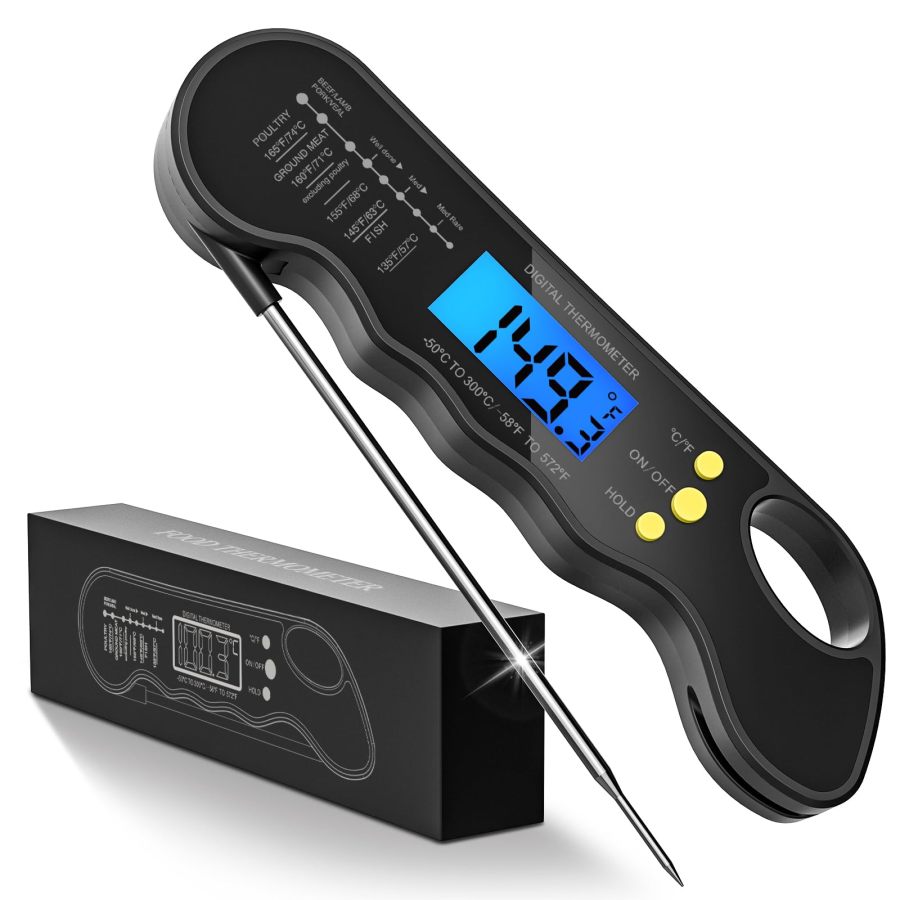
Digital cooking thermometers are essential kitchen gadgets, primarily used for quickly and accurately measuring the internal temperature of ingredients like meat, liquids, and fried foods to ensure proper doneness, safety, and flavor. Typical features include foldable probes, digital displays, backlights, and water resistance. Some high-end models offer multi-probe functionality, wired/wireless remote monitoring, and smart app connectivity to cater to diverse cooking scenarios. The following table illustrates the key characteristics of consumer behavior in this category.
| Dimension | Segment | Description |
|---|---|---|
| Need Driver Type | Planned Purchase / Emergency-driven Purchase | Purchases are typically driven by anticipated cooking needs (e.g., holiday meals, daily baking) or the immediate requirement for temperature measurement in sudden low-light/high-heat scenarios, ensuring food safety and texture. |
| Purchase Frequency | Low Frequency / Seasonal | As durable kitchen goods, purchase frequency is low, usually occurring when an existing product breaks or for functional upgrades. Demand increases during holidays as gifts. |
| Decision Complexity | Medium | Consumers compare factors like reading speed, accuracy, water resistance, backlight, probe type, and price, requiring some information gathering and trade-offs. |
| Price Sensitivity | Medium to High | Price-sensitive for basic functional products, but willing to pay a reasonable premium for higher accuracy, speed, multifunctionality, or reliability. |
| Emotional Dependency | Medium | The product not only fulfills the functional need for precise temperature measurement but also delivers emotional value and self-satisfaction from successful cooking, food safety, and worry-free grilling. |
II. User Personas & Usage Scenarios
2.1 Home Cooking Enthusiast
🎯 Daily home cooks who pursue perfect cooking results, emphasizing food safety and texture.
| Typical Usage Scenarios | Core Pain Points | Primary Purchase Drivers |
|---|---|---|
|
|
|
2.2 Outdoor BBQ/Smoking Master
🎯 Professional or semi-professional grillers focused on outdoor BBQ and smoking, pursuing precise temperature control for ultimate flavor and texture.
| Typical Usage Scenarios | Core Pain Points | Primary Purchase Drivers |
|---|---|---|
|
|
|
III. User Needs Hierarchy (KANO Model)
3.1 Basic Needs (Must-Haves)
- Fast & Accurate Reading: Users expect the thermometer to provide stable, reliable temperature readings within 2-3 seconds. This is the core expectation, ensuring timely and effective cooking decisions.
- Easy to Use: The product should feature intuitive on/off mechanisms (e.g., automatic switch with foldable probe), clear buttons, and simple function switching to lower the learning curve.
- Digital Display: Compared to traditional analog dials, digital displays provide more precise, intuitive temperature information, reducing visual judgment errors.
3.2 Performance Needs (Linear Satisfiers)
- Water Resistant & Easy to Clean: Ability to withstand splashes during cooking, allowing rinsing under a faucet, enhancing hygiene convenience and extending product life.
- Backlit Display: Ensures the screen is clearly visible in low-light kitchens or outdoor BBQ settings, facilitating temperature reading.
- Magnetic/Hang Hole Storage: Allows users to attach it to metal surfaces (e.g., fridge, oven) or hang it up, keeping it within easy reach and saving drawer/counter space.
- Long Probe Design: Protects user's hands when measuring large cuts of meat or in high-heat areas, while ensuring the core temperature is reached.
- Auto Sleep/Wake: Intelligently senses usage state, automatically turning on/off or entering sleep mode, effectively extending battery life and reducing manual operation.
3.3 Excitement Needs (Delighters)
- Multi-Probe/Remote Wireless Monitoring: Allows users to monitor multiple ingredients simultaneously or check BBQ temperature from a distance (e.g., living room), significantly enhancing convenience and freedom.
- Auto-Rotating Screen: The display automatically adjusts orientation regardless of the angle it's picked up or inserted from, providing the best viewing angle and improving usage fluidity.
- Integrated Additional Functions: Features like a built-in bottle opener or preset USDA cooking temperature guides add extra small surprises and practical value, increasing appeal.
- Ultra-Thin Probe: Small probe diameter (e.g., 1.7mm) minimizes damage to food (especially delicate meats), preserving appearance and juices.
- NIST-Certified High Accuracy: Achieves ±0.5℉ ultimate accuracy certified by the U.S. National Institute of Standards and Technology (NIST), targeting professional users with extremely high precision requirements.
3.4 Unmet Needs & Opportunities
-
Improve Long-Term Durability: Many users complain about product failure within months to a year (e.g., probe malfunction, water resistance failure, hinge breakage), expecting longer lifespan and more reliable quality control.
User Reviews (VOC) 用了没多久探针就坏了,防水根本没用 // 铰链处断了,再也无法折叠
-
More Intuitive Battery Indicator: Current products often shut down suddenly; users want clear low-battery warnings or percentage displays to avoid mid-cooking disruptions.
User Reviews (VOC) 烤肉到一半没电了,没有任何预兆 // 希望有个电量显示,而不是突然黑屏
-
Advanced Connectivity (App) Popularization & Optimization: While some wireless products offer RF connection, smart home users expect more stable Bluetooth/Wi-Fi connectivity and feature-rich mobile apps (e.g., cooking curve recording, estimated finish time).
User Reviews (VOC) 蓝牙经常断线,App功能也太简陋了 // 如果能记录烹饪过程,或者预估时间就太棒了
-
Avoid Accidental Activation in Power Design: Some products easily turn on accidentally when stored due to pressure, leading to battery drain and impacting user experience and battery life.
User Reviews (VOC) 放在抽屉里经常自己开机,电很快就没了
IV. User Decision Drivers
4.1 Key Decision Factors
- Measurement Speed & Accuracy: The user's core demand, determining whether the temperature measurement task can be completed efficiently and reliably, directly impacting cooking results and food safety.
- Ease of Use: Intuitive operation, clear display, and convenient on/off methods are key factors influencing the initial experience and long-term usage.
- Price: A major consideration for basic products with severe functional homogeneity; for high-end products, value-for-money remains important, influencing purchase decisions.
- Long-Term Reliability & Durability: Users expect products to be long-lasting, avoiding frequent replacements. Water resistance, and the sturdiness of the probe and hinge are key considerations.
4.2 Secondary Decision Factors
- Water Resistance: An important value-add for easy cleaning and extended lifespan, especially in splash-prone kitchen environments.
- Display Quality: Backlight brightness, digit size, viewing angles, and auto-rotate functionality impact reading experience and multi-scenario applicability.
- Probe Design: Probe length, thinness, material, and support for multi-probe functionality affect measurement range and applicable scenarios.
- Brand Reputation & After-Sales Service: Especially when encountering quality issues, the warranty period and customer service quality provided by the brand significantly influence user trust and purchase decisions.
- Additional Functions: Features like a bottle opener, preset temperature guides, timer, etc., can add extra value but are not core decision factors.
- Battery Type & Life: Use of rechargeable or easily replaceable AAA batteries, along with clear battery indicators, affect usage convenience and long-term maintenance costs.
V. Selling Points & Competitive Landscape
5.1 Selling Point Analysis
5.1.1 Standard Features (Points of Parity)
- Fast & Accurate: Almost all products emphasize 2-4 second reading speed and high accuracy (typically ±1-2°F) as core selling points.
- Easy to Use: Commonly feature automatic on/off with foldable probe, large screen, backlit display, and simple button operation, emphasizing convenience.
- Water Resistant Design: Most products claim IP65 or IP67 water resistance ratings for easy cleaning and improved durability.
- Magnetic/Hang Hole Storage: Allows users to attach the thermometer to metal surfaces (e.g., fridge, oven) or hang it up, saving kitchen space.
5.1.2 Key Differentiators
- Dual-Probe/Multi-Probe: Some products offer combinations of foldable and wired probes, even up to four probes, meeting the need to monitor multiple ingredients simultaneously.
- Remote Wireless Connection: A few products provide RF wireless transmission for long-distance monitoring (e.g., 1000 feet), freeing users from cable constraints.
- Professional Certifications: Some brands emphasize certifications from professional bodies like NSF, NIST, CE, FCC to enhance product professionalism and credibility.
- Ultra-Thin Probe: Some products highlight a small probe diameter (e.g., 1.7mm) to minimize food damage, preserving appearance and juices.
- Auto-Rotating Screen/Motion Sensing: A few products feature a display that automatically rotates 180° or smart sensing that turns on when picked up and sleeps when set down, improving usage fluidity.
5.1.3 Unique Selling Propositions (USPs)
- Integrated Bottle Opener: Individual products incorporate a bottle opener into the design, adding fun and practicality for multi-purpose use.
- NIST-Certified 0.5℉ Accuracy: Very few products emphasize achieving the ultimate ±0.5℉ accuracy certified by NIST, targeting users with extremely high precision requirements.
- Eco-Sustainable Design: Some products are beginning to mention the use of sustainable materials and energy-efficient designs, appealing to environmentally conscious consumers.
5.2 Competitive Landscape
5.2.1 Market Maturity
The digital cooking thermometer market is highly mature, with core temperature measurement functions becoming homogenized. Brands primarily seek differentiation through minor improvements in reading speed and accuracy, convenience features (e.g., auto-rotating screen, smart sensing), and multi-function integration. However, overall innovation pace is relatively slow, with intense price competition.
5.2.2 Innovation Trends
Category innovation trends are shifting from single-purpose handheld tools towards smarter, more convenient scenario-based solutions. Examples include multi-probe remote wireless monitoring, more stable Bluetooth/Wi-Fi connectivity, and exploration of integration with smart device apps. Simultaneously, attention to long-term product durability and more eco-friendly materials is driving upgrades in materials and processes. Future developments may include more AI-assisted cooking guidance features, such as intelligent recommendations for cooking parameters based on ingredients and target doneness.
VI. Marketing Claims vs. Reality Check
The table below analyzes the gap between common marketing claims and actual user experiences in this category:
| Dimension | Marketing Claim | User Reality | Verdict |
|---|---|---|---|
| Durability & Water Resistance | Claims of '100% waterproof,' 'directly washable,' 'rugged and drop-proof,' 'long-lasting durability,' providing IP65/IP67 level protection. | Users widely report product failures within months to a year (e.g., probe malfunction, internal water damage, display failure, or folding hinge breakage). Water resistance often underperforms expectations, and products are not durable. | Sellers are overconfident in their water resistance claims, failing to adequately address structural vulnerabilities in humid kitchen environments and from daily drops, resulting in a severe disconnect between user expectations and actual durability. |
| Reading Speed & Accuracy | Claims of '1-2 second lightning-fast reading,' even 'NIST-certified ±0.5℉ ultra-high accuracy,' ensuring perfection every time. | Some users report actual reading speeds still have delays (3-5 seconds or longer), or accuracy fluctuates during repeated measurements. Some products lack third-party verification or long-term stability guarantees. | In the pursuit of extreme 'fast' and 'accurate' marketing, some products fail to deliver long-term stable performance or generalize ideal lab data as everyday usability, damaging user trust in core functionality. |
| Practicality of Smart Features | Claims of 'multi-probe remote monitoring,' 'smart app connectivity,' 'monitor cooking progress anytime, anywhere.' | Bluetooth connection is unstable, signals drop easily; App functionality is rudimentary, lacking advanced features like cooking curve recording or estimated finish time, merely adding to user operational burden. | Smart connectivity features are superficially designed, failing to deeply address users' underlying needs for refined cooking process management and worry-free remote monitoring. They add cost without providing real value. |
Key Takeaway: The market is generally characterized by inflated claims about core performance (speed, accuracy) and over-marketing of convenience features (water resistance, durability), leading to a significant gap between user expectations and actual experience.
VII. Supply-Demand Misalignment Analysis
The table below highlights mismatches between seller focus and buyer priorities:
| Dimension | Seller Behavior | User Focus | Verdict |
|---|---|---|---|
| Product Durability & Long-Term Reliability | Generally emphasize 'waterproof,' 'rugged and drop-proof,' but rarely mention 'long-term warranty,' 'reinforced internal structure,' or 'tested for XX drops' as hard guarantees. | Users complain about products failing prematurely, with probe, hinge, and water resistance failures being frequent pain points. They crave longer product lifespans. | Sellers overly rely on surface-level claims without fundamentally addressing users' core concerns about long-term reliability, leading to trust crises and high return rates. |
| Battery Life & Power Management | Most products only mention battery type and included batteries, rarely providing clear runtime estimates (in different modes) or lacking low-battery warning features. | Users report sudden battery depletion disrupting cooking, desiring battery level indicators or low-battery warnings to prepare in advance. | Sellers have not elevated battery management design to a user experience level, overlooking the inconvenience and anxiety caused by sudden battery failure mid-cooking. |
| User Experience of Smart Connectivity Apps | Some wireless products emphasize App connectivity, but the Apps are often feature-limited and connection-unstable, failing to provide advanced features like cooking curves or estimated time. | Users expect more advanced features and stable connections from Apps, not just remote temperature display. They find existing Apps low in practicality. | Sellers have invested in connectivity hardware but have not matched user expectations in software experience and feature depth, causing high-end features to become mere gimmicks. |
Key Takeaway: Sellers' offerings and messaging on basic features are becoming homogenized, while there is a collective supply gap in optimizing product long-term durability, battery usage experience, and the depth of smart connectivity features.
VIII. Strategic Opportunities & Recommendations
8.1 Rugged & Durable Professional-Grade Thermometer with Extended Warranty
8.1.1 Target Audience & Pain Points
⚡️ Pain Points Addressed: Poor long-term durability, water resistance failure, structural damage.
8.1.2 Action Plan
Use reinforced ABS engineering plastic shells or metal hinges at critical joints; improve sealing and cable strength at the probe-host connection; adopt screw-on or double-sealed battery compartment covers to ensure long-term effectiveness of IP67 water resistance. Offer a longer warranty period (e.g., 2-3 years).
| Tech Complexity | Medium |
| Cost Impact | Medium Impact |
| Trade-off Warning | May slightly increase product weight or volume, but has no negative impact on core functionality, while significantly improving user experience. |
| Price Band | Only viable above $24.99 |
8.1.3 Marketing Strategy
Emphasize 'Say goodbye to frequent replacements, reliability that lasts for years'; showcase videos of products undergoing rigorous drop, water immersion, and high-temperature tests; highlight 'Industry-leading warranty, worry-free after-sales'; emphasize food safety certifications like NSF to build buyer trust.
8.2 Ultra-Precise Smart Connected 'Cooking Brain'
8.2.1 Target Audience & Pain Points
⚡️ Pain Points Addressed: Remote monitoring needs, cumbersome multi-tasking switching, rudimentary App functionality, lack of cooking curve recording.
8.2.2 Action Plan
Integrate NIST-certified ±0.5℉ accuracy thermocouple sensors; incorporate Bluetooth 5.0/Wi-Fi modules for stable connection; develop a feature-rich App supporting real-time multi-probe monitoring, temperature curve recording, estimated cooking completion time, custom alarms, and smart recipe suggestions. The main unit can be equipped with a small color screen to display more information.
| Tech Complexity | High |
| Cost Impact | High Impact |
| Trade-off Warning | May slightly increase main unit size, raise power consumption, and demand higher battery life, but these are inherent characteristics of high-end smart products. |
| Price Band | Only viable above $49.99 |
8.2.3 Marketing Strategy
Emphasize 'Control temperature like a pro chef, smart cooking has never been easier'; showcase the App's intuitive interface and powerful features, highlighting the convenience of remote monitoring; provide cooking curve data analysis to meet professional user needs; highlight the authority and professionalism of NIST certification.
8.3 Ultra-Convenient 'Frictionless' Thermometer
8.3.1 Target Audience & Pain Points
⚡️ Pain Points Addressed: Inconvenient operation, accidental activation, battery anxiety, reading angle limitations.
8.3.2 Action Plan
Optimize motion-sensing wake/sleep sensitivity; design anti-accidental-activation power buttons (e.g., long-press activation or recessed); add clear battery level indicators or low-battery warnings; upgrade the response speed and stability of the auto-rotating display; print clearer, more comprehensive USDA cooking temperature guides inside the probe sheath.
| Tech Complexity | Low to Medium |
| Cost Impact | Low Impact |
| Trade-off Warning | No significant physical side effects; primarily improves user experience through design optimization. |
| Price Band | Only viable above $19.99 |
8.3.3 Marketing Strategy
Emphasize 'Pick up and use, set down and it sleeps, battery life at a glance'; highlight 'Whether left-handed or right-handed, any angle offers easy reading'; promote 'Anti-accidental activation, saves worry and battery'; use scenario-based demonstrations to show how the product makes cooking smoother and more enjoyable.