Amazon US Market Analysis: Under-Desk Walking Pads Category
📊 Executive Summary
📈 Market Trends
Compact & portable, quiet, with incline have become mainstream, but smart connectivity experiences are inconsistent. The under-desk walking pad market is highly competitive, with products generally emphasizing lightweight, low noise, and basic workout data tracking. Consumer demand for seamless connectivity and multi-functional all-in-one solutions continues to grow, driving product evolution towards greater integration and intelligence, though actual app experience feedback is poor.
⚡ Major Pain Points
Uncontrolled noise details and belt size limitations are core weaknesses. Despite widespread claims of 'ultra-quiet,' overly loud operational beeps during startup/stop are a frequent complaint. Additionally, belt width and length are insufficient for taller users or those with longer strides, posing safety risks. Inconvenient manual incline adjustment, easily lost remotes, and gimmicky app features also significantly degrade the user experience.
💡 Selection Opportunities
Deeply understand real user experience, execute on details, achieve differentiation and premium pricing. Market opportunities lie in addressing consumer trust crises regarding product quietness (including operational sounds), belt size adaptation, incline adjustment convenience, and app utility. Examples include developing a 'truly unobtrusive quiet' product, offering a 'wide, comfortable belt & height-adapted solution,' and a 'one-touch electric incline' premium line. Simultaneously, enhancing user stickiness through 'modular smart app & third-party ecosystem integration' can build long-term competitive advantage in a homogenized market.
I. Analysis Overview
1.1 Introduction & Report Scope
This report analyzes the 'Treadmills' category (under-desk walking pads) in the Amazon US market, focusing on target user personas, core needs, decision drivers, market communication, and potential opportunities.
1.2 Category Snapshot
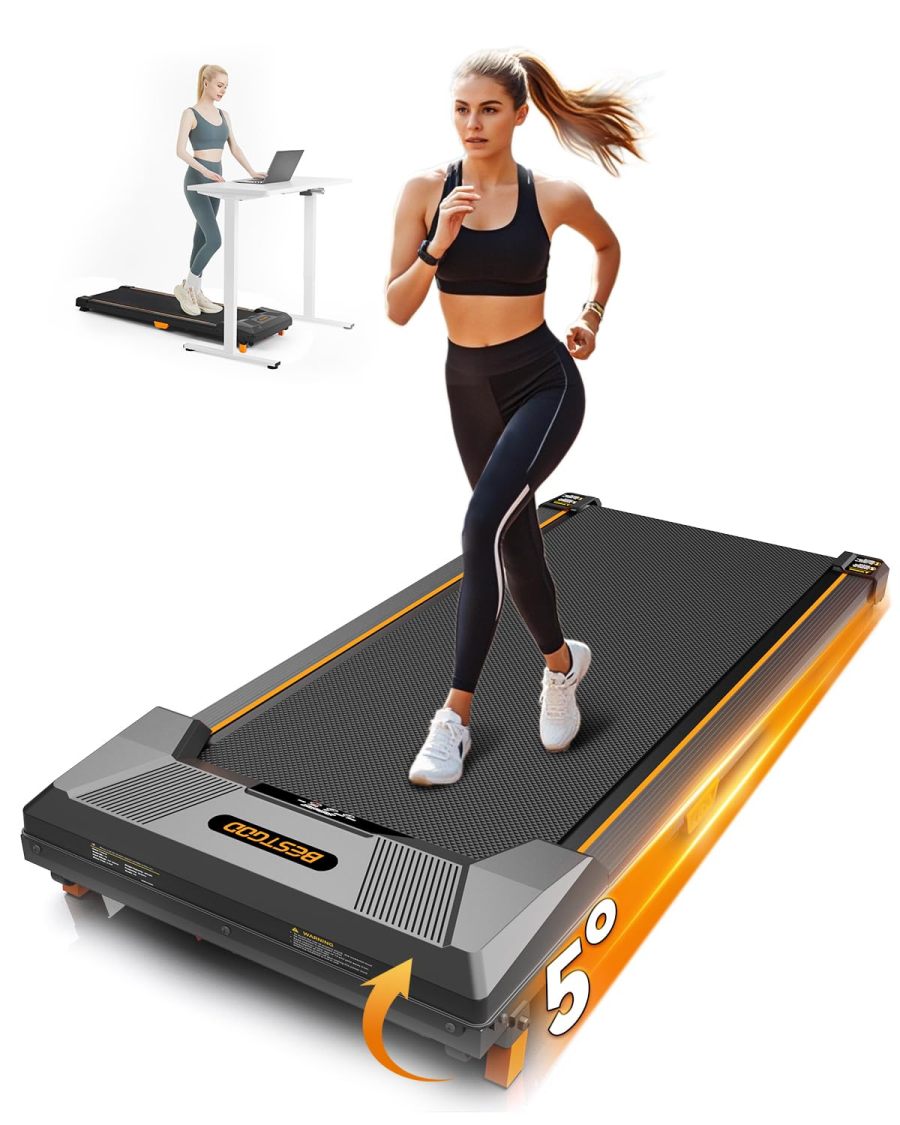
An under-desk walking pad is a lightweight fitness device designed for home or office environments. Its compact, portable, and easy-to-store features help users increase daily physical activity during routine work and life. Its core function is to provide a low-intensity walking or light jogging experience, alleviating discomfort from prolonged sitting and improving overall health. The following table illustrates the key characteristics of consumer behavior in this category.
| Dimension | Segment | Description |
|---|---|---|
| Need Driver Type | Planned Purchase / Habitual Purchase | User purchases typically stem from a conscious desire to improve sedentary habits and enhance health, with the expectation of integrating the device into daily routines. Some users develop regular usage habits post-purchase. |
| Purchase Frequency | Low Frequency | As a durable consumer good, its replacement cycle is long. It is usually a one-time purchase, with repurchase considered only if the product fails or significant technological upgrades are available. |
| Decision Complexity | Medium | Consumers weigh multiple factors such as space, noise, stability, core features (e.g., incline, belt size), and price, conducting extensive comparisons and research. |
| Price Sensitivity | Medium-High | Price is an important consideration, but users prioritize whether the product meets core needs (e.g., quiet operation, stability, durability) and provides a good experience over simply seeking the lowest price. They are willing to pay a premium for quality and functionality. |
| Emotional Dependency | Medium | The primary driver is functional value (health, convenience). However, a pleasant user experience, the sense of achievement from reaching fitness goals, and the feeling of control over a healthy lifestyle also contribute positive emotional value. |
II. User Personas & Usage Scenarios
2.1 Efficiency-Seeking Remote Worker
🎯 Works from home for extended periods and seeks to increase daily activity without interrupting workflow, aiming to improve both physical health and work efficiency.
| Typical Usage Scenarios | Core Pain Points | Primary Purchase Drivers |
|---|---|---|
|
|
|
2.2 Urban Small-Space Fitness Enthusiast
🎯 Lives in a space-constrained urban apartment, desires indoor fitness equipment but has strict requirements on size, noise, and storage. Seeks multi-functional, high-value solutions.
| Typical Usage Scenarios | Core Pain Points | Primary Purchase Drivers |
|---|---|---|
|
|
|
III. User Needs Hierarchy (KANO Model)
3.1 Basic Needs (Must-Haves)
- Stable & Steady: The treadmill should remain stable without wobbling at different speeds, ensuring user safety and preventing fall risks.
- Controlled Noise: Motor noise during operation should be below 45dB, not interfering with normal life and work, especially in shared home office or living spaces.
- Easy to Store: The product should be compact, featuring wheels or a foldable design for easy movement and storage when not in use, saving home space.
- Basic Speed Range: Provides a speed range suitable for daily walking and light jogging (approx. 0.6-4.0 MPH), meeting basic exercise needs.
- Weight Capacity: Safely supports the weight range of the target user group, ensuring product safety and durability.
3.2 Performance Needs (Linear Satisfiers)
- Incline Adjustment: Features manual or automatic incline adjustment to increase workout intensity, effectively boosting calorie burn and cardiovascular fitness.
- Shock Absorption: Multi-layer belt and shock absorption systems effectively reduce impact on joints (knees, ankles), enhancing exercise comfort.
- Belt Width & Length: Provides sufficiently spacious belt area to accommodate users of different heights and strides, reducing step-off risk and ensuring free movement.
- Smart Connectivity: Connects via an app for real-time workout data tracking, customized programs, and social interaction, increasing exercise enjoyment and management efficiency.
- Remote Control Operation: Equipped with a convenient remote to adjust speed, start/stop without bending over, improving workout fluidity.
3.3 Excitement Needs (Delighters)
- Automatic Incline Adjustment: Enables seamless, real-time incline changes during exercise, offering a more challenging and immersive training experience.
- Built-in Entertainment Features: Features like Bluetooth speakers, tablet/phone holders, or video playback capabilities make workouts less monotonous and more enjoyable.
- Maintenance-Free Design: Reduces or eliminates regular maintenance steps (e.g., lubrication, belt calibration), significantly improving daily convenience and reducing user burden.
- High-Aesthetic Design: Features a minimalist, stylish design that seamlessly integrates into modern home decor as an accent piece, not an intrusive piece of equipment.
3.4 Unmet Needs & Opportunities
-
APP Connection Stability & Feature Utility: Users have high expectations for app connection stability, feature completeness, and data sync accuracy. However, current product experiences vary widely, with some apps being unusable or offering gimmicky features.
User Reviews (VOC) App sucks. When I searched for it in the App Store, it has a 1.9 star rating. Don't get this treadmill if you wanted a native step tracking option. // The avatar on the app is a little creepy but I like that you can change scenery and see other walkers on the app. The app even has competitions where you can win $$. // I used it with their app, without warning, expedited the pace of walking to more than expected, almost a running effect, that I could not do, and almost threw me off! Be careful and attentive!
-
Actual Noise Control (Especially Operational Sounds): While often marketed as 'quiet,' users complain about excessively loud beeps during startup/stop or actual operational noise exceeding expectations, affecting the experience in quiet environments, with a lack of volume adjustment options.
User Reviews (VOC) I wish there was a way to turn the loud beep off because I don't want to wake up the house in the morning if I want to take a walk inside. // The sound of the motor sort of annoys me. I think it sounds like all walking pad/treadmill. When buying it I thought it was going to be unnoticeably silent but it isn't. // The belt even after an adjustment will immediately move back over the side and made a loud noise and damage the side.
-
Belt Size & Adaptation for Taller Users with Larger Strides: Some users report the belt is too short or narrow, especially for taller individuals or those with longer strides, leading to issues like stepping off, requiring high concentration, or restricted gait.
User Reviews (VOC) So it's so narrow that I've slipped off of the side twice and that's not fun. I also try to keep my strides short so I don't slip off the back. // The pad is short in length. I'm 5'5" with small legs and feet. If I'm distracted watching TV while walking, I've ran out of walking space a few times and almost lost my footing.
-
Convenience of Incline Adjustment: Manual incline adjustment requires stopping exercise and getting off the machine, which is less convenient than electric adjustment, disrupting workout continuity and flow.
User Reviews (VOC) The incline is nice (you do have to flip the little feet for the incline yourself) // The incline is rather minor. It is either flat, or a slight incline. No other options. // manual incline adjustment however it's basically flip down legs or wedges and cannot be adjusted while in use.
-
Remote Control Reliability & Anti-Loss Design: The remote is often the sole control method for many products, but it is easily lost, batteries may not be included, or it may be unresponsive. Some machines lack backup controls on the unit itself, rendering them unusable if the remote is lost.
User Reviews (VOC) My only reason not to give it a five star ratings is I cannot control it without a remote control // If you misplace or lose that remote, you will have zero access of using the treadmill. // The remote control is a big help and easy to use. It only works with the remote so don't lose that!
IV. User Decision Drivers
4.1 Key Decision Factors
- Size & Storage Convenience: Whether the product is compact, can be easily stored under beds, sofas, or desks, and has wheels for easy movement is a primary purchase consideration.
- Quiet Operation: Whether it runs quietly enough not to disturb work, rest, or others is a core need for use in home and office environments.
- Stability & Safety: Whether the belt is stable, the unit wobbles during use, and if it has sufficient weight capacity directly impacts user safety and trust.
- Price & Value for Money: Given that functional needs are met, whether the product price is reasonable and offers good value for the experience is a key factor influencing the final purchase decision.
4.2 Secondary Decision Factors
- Incline Function & Adjustment Method: Whether incline adjustment is offered, and if it's manual or automatic, affects workout intensity and variety, serving as a value-add.
- Belt Size & Shock Absorption: The actual belt width and length for comfort, and whether the shock absorption system effectively protects knees, impacts the experience of prolonged use.
- APP / Smart Features: Whether there is a companion app for data tracking, programs, or social interaction, and the app's usability and stability, enhance user experience.
- Remote Control Design: Whether the remote is intuitive, responsive, prone to being lost, or has anti-loss features (e.g., magnetic attachment) affects daily convenience.
- Brand & After-Sales Service: The brand's market reputation, warranty policy, and customer service response speed address concerns about potential failures, influencing purchase confidence and loyalty.
V. Selling Points & Competitive Landscape
5.1 Selling Point Analysis
5.1.1 Standard Features (Points of Parity)
- Compact, Portable, Storable: Most products emphasize compact design, wheels, and easy storage under beds or desks, addressing the space pain point.
- Quiet Operation: Widely claimed to be equipped with 2.5HP or higher motors, operating below 45dB, not disturbing others, suitable for home offices.
- Easy Setup / No Assembly: Often marketed as ready to use out of the box, requiring no complex assembly, lowering the user barrier to entry.
- Multi-Layer Shock Absorption Belt: Emphasizes the belt's anti-slip properties, multi-layer structure, and shock absorption to protect knees and enhance workout comfort.
- LED Display & Remote Control: Provides basic workout data display (time, speed, distance, calories) and remote operation for basic function control.
5.1.2 Key Differentiators
- Incline Adjustment Method: Divided into manual multi-level (typically via foot pads) and automatic electric incline (less common, higher-priced), offering different intensity options.
- Handrail Design: Some products feature foldable or detachable handrails for balance support, or doubling as phone/tablet holders, adding safety and convenience.
- APP Smart Connectivity: Some brands offer proprietary apps supporting data sync, virtual routes, programs, or community interaction, enriching the fitness experience.
- Motor Power & Max Speed: Beyond the common 2.5HP, some products claim 3.0HP or even 3.5HP, with max speeds reaching 6-7.6 MPH, emphasizing running capability.
- Higher Weight Capacity: Mainstream capacity is 265-330 lbs; some products claim up to 350-450 lbs to attract a broader user base.
5.1.3 Unique Selling Propositions (USPs)
- Vibration Massage Function: Very few products integrate full-body vibration, claimed to relax muscles post-workout or aid fat burning, offering a differentiated experience.
- RGB LED Screen: Individual products offer multi-color LED displays, adding a tech-savvy and visually appealing element, enhancing product personalization.
- Special APP Features: Examples include Yesoul's scenic routes and live classes, or Superun's exercise competition features, providing unique interactive experiences.
5.2 Competitive Landscape
5.2.1 Market Maturity
The under-desk walking pad category has entered a mature stage, with severe product homogenization. Core features (quiet, portable, basic workout data) have become standard. Most products are similar in parameters like motor power, belt structure, and weight capacity. Competition primarily manifests in price, minor feature points (e.g., incline type, handrail design), and brand service, with no disruptive innovation yet emerging.
5.2.2 Innovation Trends
Current innovation trends focus on 'user experience optimization' and 'deepening smart connectivity': 1. Improving the convenience and automation of incline adjustment; 2. Enhancing app functionality, shifting from simple data tracking to providing interactive programs, virtual scenarios, and social experiences; 3. Optimizing storage experience, reducing physical barriers during movement and storage (e.g., handrails); 4. Some products attempt multi-function integration, like vibration massage, to offer differentiated value, though effectiveness awaits market validation. Simultaneously, consumer focus on product durability and true quiet performance is increasing.
VI. Marketing Claims vs. Reality Check
The table below analyzes the gap between common marketing claims and actual user experiences in this category:
| Dimension | Marketing Claim | User Reality | Verdict |
|---|---|---|---|
| Quiet Performance | Ultra-quiet operation below 45 decibels, does not disturb neighbors, does not affect work calls. | Users commonly report loud beeps during startup/stop, or actual operational noise far exceeding 45dB (e.g., 59-77dB, B0D3GGPKCB), causing disturbance in quiet environments. | Sellers substitute the concept of a 'quiet' motor for 'overall quiet use environment,' ignoring users' real need for quiet operation sounds. This causes the core selling point to fall short in actual experience, leading to negative reviews. |
| Folding & Storage Convenience | One-step folding, no assembly required, easily stores under bed/sofa. | For some products, folding the handrails requires manually unscrewing bolts (B0FCXSMWNN, B0FKSX2KD3), or the unit is heavy (B0FD9Y1NV4), making movement and storage far less convenient and effortless than advertised. | Marketing copy oversimplifies the actual operational complexity, failing to truly meet users' expectation of 'hassle-free storage.' Product design conflicts with the user's pursuit of 'convenience and efficiency.' |
| Running Performance & Belt Size | Multi-functional walk-run capability, max speed up to 6-7.6 MPH, spacious belt. | Most products' max speed is only 3.8-5 MPH, and users report the belt width (15-16 inches) and length as too narrow/short for truly safe and comfortable 'running,' easily leading to stepping off (B0FCXSMWNN, B0F52J3D81, B0FPMNB2D3). | Physical size constraints dictate that this category is better suited for walking or light jogging. Marketing claims of 'running' are misleading, sacrificing safety and comfort for attention-grabbing, resulting in user expectation gaps and potential safety hazards. |
Key Takeaway: The market exhibits widespread parameter inflation and exaggeration of scenario-based experiences, particularly regarding quiet performance, folding convenience, and running capability.
VII. Supply-Demand Misalignment Analysis
The table below highlights mismatches between seller focus and buyer priorities:
| Dimension | Seller Behavior | User Focus | Verdict |
|---|---|---|---|
| APP Smart Features vs. Actual Experience | Commonly emphasizes APP connectivity, data tracking, virtual routes, etc., as key selling points, dedicating significant listing space to them. | Numerous users report unstable app connections, poor UI experience, gimmicky features, or even extremely low ratings (B0D3GGPKCB). The apps fail to deliver real value and instead create usage barriers. | Typical technology-driven marketing that fails to understand users' real needs and experience thresholds for apps, resulting in features being practically useless. Development costs are incurred without winning user approval. |
| Actual Quietness & Operational Sounds | Widely advertises 'quiet motor below 45dB,' but collectively remains silent or does not mention adjustability regarding operational noises like startup/stop beeps or speed change sounds. | Users strongly complain about excessively loud beeps causing serious disturbance in quiet environments (e.g., home office, morning/night workouts), making it a high-frequency complaint (B0D3GGPKCB, B0DFQ1HSFL, B0DMT1FZ3N). | Sellers focus only on the single metric of motor noise, ignoring users' systemic need for an overall 'quiet and unobtrusive' product experience, resulting in a critical shortcoming in core user experience. |
| Incline Adjustment Convenience & Marketing | Commonly emphasizes the calorie-burning benefits of 'incline function' but downplays the inconvenience of 'manual adjustment' or exaggerates its ease. | Users report that manual adjustment requires stopping exercise and bending down to operate, or that the incline range is small, making it less convenient than electric adjustment and disrupting workout flow (B0FCXSMWNN, B0FKSX2KD3). | Sellers fail to consider the incline function in conjunction with the 'seamless workout experience.' The functional design contradicts the user's pursuit of 'efficiency and convenience,' leading to users recognizing the value but experiencing poor execution. |
Key Takeaway: Sellers overly focus on feature stacking and numerical parameters but fail to effectively address users' core pain points regarding quiet operation details, belt size, and incline adjustment convenience in actual use, leading to a supply-demand mismatch.
VIII. Strategic Opportunities & Recommendations
8.1 Truly 'Unobtrusive' Quiet Walking Pad
8.1.1 Target Audience & Pain Points
⚡️ Pain Points Addressed: Noise disturbance, especially overly loud operational beeps; actual running noise not matching marketing claims.
8.1.2 Action Plan
Optimize mainboard firmware to allow adjustable operational beep volume or a silent mode option, using softer, lower-decibel sound effects. Ensure motor noise remains stable and below 45dB across all speed ranges, and obtain third-party certification.
| Tech Complexity | Medium |
| Cost Impact | Low Impact |
| Trade-off Warning | No significant physical side effects; primarily involves software optimization and minor hardware tweaks (e.g., speakers, button tactile feedback). |
| Price Band | Only viable above $159.99 |
8.1.3 Marketing Strategy
Emphasize 'Upgraded Ultra-Quiet, Adjustable Operation Sounds'; provide third-party authoritative noise test reports. Showcase actual operation videos with no beeps or adjustable beeps in the listing, highlighting the core benefit: 'Focus on Work, Enjoy Peaceful Fitness.'
8.2 Wide, Comfortable Belt & Height-Adapted Solution
8.2.1 Target Audience & Pain Points
⚡️ Pain Points Addressed: Belt is too narrow, prone to stepping off, unfriendly to taller users, affecting exercise comfort and safety.
8.2.2 Action Plan
Offer models with belts at least 18-20 inches wide and 40-42 inches long. Optimize belt material and shock absorption structure to ensure stability and comfort during high-speed or long-stride movement.
| Tech Complexity | Medium |
| Cost Impact | High Impact |
| Trade-off Warning | Increasing belt width and length inevitably increases product dimensions and weight, impacting extreme portability and potentially increasing logistics costs. |
| Price Band | Only viable above $249.99 |
8.2.3 Marketing Strategy
Highlight 'Wide Comfort Belt, Unrestricted Strides.' Provide real usage scenario images/videos of users of different heights on the belt. Emphasize 'The Assured Choice for Taller Users.' Clearly label actual belt dimensions and recommended height range in the listing.
8.3 One-Touch Electric Incline Walking Pad
8.3.1 Target Audience & Pain Points
⚡️ Pain Points Addressed: Inconvenient manual incline adjustment interrupts workout flow, limiting the enhancement of calorie-burning effects.
8.3.2 Action Plan
Integrate a micro electric linear actuator for 0-10% stepless or multi-level automatic incline adjustment, enabling instant switching during exercise. Optimize control algorithms for smooth incline transitions to reduce impact.
| Tech Complexity | High |
| Cost Impact | High Impact |
| Trade-off Warning | Adding an electric incline module significantly increases product weight and thickness, requires more complex motors and control systems, potentially compromising the original slim/portable advantage and increasing failure rates. |
| Price Band | Only viable above $299.99 |
8.3.3 Marketing Strategy
Emphasize 'One-Touch Incline Switch, Seamlessly Challenge Limits.' Use comparative data to showcase the calorie-burn efficiency improvement from electric incline (e.g., 'Calorie Burn Increased by XX%'). Create dynamic incline adjustment demo videos, highlighting 'Smart Hill Simulation, Double the Fun.'
8.4 Modular Smart App & Third-Party Ecosystem Integration
8.4.1 Target Audience & Pain Points
⚡️ Pain Points Addressed: Poor app connection stability, gimmicky features, subpar user experience, failing to provide real value.
8.4.2 Action Plan
Redesign or optimize the app, focusing on core needs (e.g., accurate data tracking, personalized workout plans), improving connection stability and UI friendliness. Prioritize deep integration with mainstream health apps (e.g., Apple Health, Google Fit), offer open APIs to reduce the burden of building a proprietary ecosystem, ensuring data truly serves the user.
| Tech Complexity | Medium |
| Cost Impact | Low Impact |
| Trade-off Warning | No significant physical side effects; primarily involves software development and API integration, with minimal impact on hardware BOM. |
| Price Band | Only viable above $129.99 |
8.4.3 Marketing Strategy
Promote 'Seamless Health Data Sync, Connect Your Fitness World.' In the listing, showcase clear app data charts, user-friendly operation screenshots, and third-party health app integration examples. Avoid exaggerating proprietary app features, emphasize openness and compatibility.