Amazon US Market Analysis: Smart Water Leak Detectors Category
📊 Executive Summary
📈 Market Trends
Home security is a rigid need, smart connectivity becomes mainstream. The smart water leak detector market continues to grow, driven by strong consumer demand for property protection and remote monitoring. Products are generally evolving towards remote app notifications, loud local alarms, multi-probe detection, and long battery life. However, most still rely on brand-specific hubs, and Wi-Fi connectivity remains a core pain point.
⚡ Major Pain Points
Unstable connections and overstated features are fatal flaws. Users commonly report frequent Wi-Fi dropouts and poor 5GHz network compatibility, severely impacting alert timeliness and reliability. Concurrently, battery life and alarm volume are often overstated, apps lack precise battery status display, and specific products (e.g., Satisure) exhibit pricing logic paradoxes. These issues severely undermine user trust and perceived product value.
💡 Selection Opportunities
Deepen reliability focus, upgrade to automated loss prevention. Future product selection should focus on achieving ultimate wireless connection stability and transparent app status management to address user core anxieties. More importantly, a significant market opportunity exists to evolve towards 'detection triggers prevention' automated solutions (e.g., integrated automatic water shut-off valves). Additionally, developing multi-scenario cable-style sensors and actively embracing universal standards like Matter can effectively broaden market coverage and user trust.
I. Analysis Overview
1.1 Introduction & Report Scope
This report analyzes the 'Water Detectors & Alarms' category (specifically Smart Water Leak Detectors) in the Amazon US market, focusing on target user personas, core needs, decision factors, market communication, and potential opportunities.
1.2 Category Snapshot
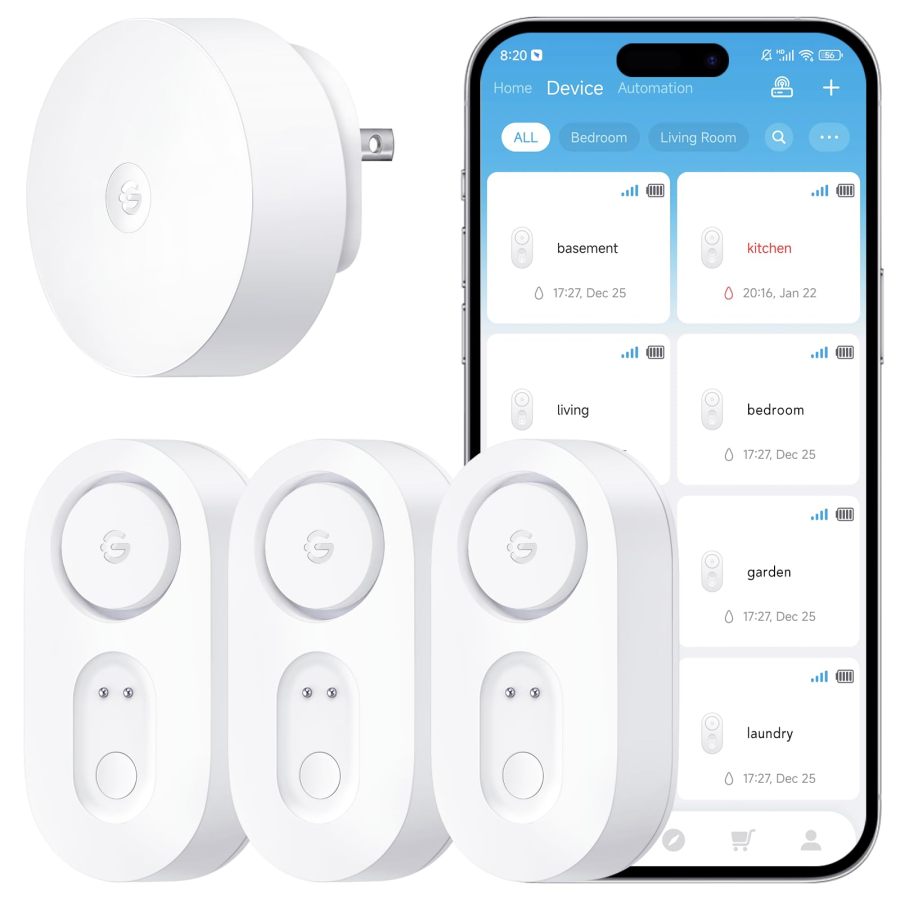
A smart water leak detector is a device designed to detect the presence of water droplets, leaks, or flooding in a home and alert the user promptly. These products aim to help users take action before water damage causes significant loss, typically through local audible/visual alarms and remote smartphone notifications. The market offers diverse product types, including standalone Wi-Fi-connected devices, sensor systems requiring a dedicated hub, and a few advanced systems with integrated automatic water shut-off valve functionality. The following table illustrates the key characteristics of consumer behavior in this category.
| Dimension | Segment | Description |
|---|---|---|
| Need Driver Type | Planned Purchase / Emergency-driven Purchase | Users typically make preventative purchases due to concern over potential water damage losses, or seek emergency solutions after experiencing a water-related incident. |
| Purchase Frequency | Low Frequency | The product is a durable good, usually purchased once for long-term use. Repurchases mainly occur when expanding coverage or replacing/upgrading devices. |
| Decision Complexity | Medium | Consumers evaluate different technologies (Wi-Fi, LoRa, Zigbee), compatibility, system scalability, and reliability, indicating a relatively high level of decision-making effort. |
| Price Sensitivity | Medium-High | Users are willing to pay a reasonable premium for reliability and 'peace of mind,' but remain value-conscious and are deterred by excessively high prices. |
| Emotional Dependency | High | The purchase motivation is strongly linked to family property safety and living comfort, delivering significant psychological 'peace of mind.' |
II. User Personas & Usage Scenarios
2.1 Property-Conscious Homeowner
🎯 Focuses on preserving home value, has experienced or worries about water damage, and seeks to prevent issues proactively through smart devices to avoid costly repairs and inconvenience.
| Typical Usage Scenarios | Core Pain Points | Primary Purchase Drivers |
|---|---|---|
|
|
|
2.2 Smart Home Enthusiast
🎯 Passionate about building and optimizing smart home ecosystems, pursues device interconnectivity and automation, and enjoys the convenience and fun brought by technology.
| Typical Usage Scenarios | Core Pain Points | Primary Purchase Drivers |
|---|---|---|
|
|
|
III. User Needs Hierarchy (KANO Model)
3.1 Basic Needs (Must-Haves)
- Accurate & Sensitive Detection: Capable of promptly detecting minor drips (e.g., 0.4mm) and large-scale flooding, ensuring no missed alerts.
- Loud Local Alarm: Provides a clear, loud local alarm sound (typically 100dB+), ensuring immediate awareness when at home.
- Long Battery Life: Battery life of at least 1-2 years to reduce the hassle of frequent replacements.
- IP Waterproof Rating: Possesses IP66 or IP67 rating, ensuring the device remains undamaged in damp environments or during brief submersion.
3.2 Performance Needs (Linear Satisfiers)
- Real-time App Notifications: Receive instant leak alert push notifications via smartphone app, regardless of location.
- Dual Probe Detection: Features both top-mounted drip sensors and bottom-mounted flood sensors for comprehensive leak type coverage.
- Easy Installation & Setup: Supports DIY installation with a simple, guided app setup process, requiring no professional tools.
- Smart Home Compatibility: Seamlessly connects with mainstream smart home platforms (e.g., Alexa, Google Home) for basic automations.
- Low Battery Alert: Alerts users via app or local indicator light about battery status for timely replacement.
3.3 Excitement Needs (Delighters)
- Automatic Water Shut-off Valve Integration: Automatically shuts off the home's main water valve upon leak detection, preventing disaster escalation.
- Extended Wireless Range: Utilizes technologies like LoRa for reliable signal transmission over long distances (hundreds of meters) and through floors.
- Offline Operation Guarantee: Local alarms or direct device-to-device (D2D) communication continue to function during Wi-Fi or internet outages.
- Integrated Environmental Monitoring: Includes additional temperature or humidity monitoring for comprehensive environmental data and freeze warnings.
- Granular Alert Management: Allows customization of alarm volume, multiple ringtones, alarm duration, and sensor naming by location within the app.
3.4 Unmet Needs & Opportunities
-
More Stable Wireless Connection: Users commonly complain about unstable Wi-Fi connections, frequent dropouts, or poor compatibility with 5GHz networks, affecting system reliability.
User Reviews (VOC) If this Support Engineer's description and troubleshooting steps are right, no one should buy this kit at this time. First off, if you use an Eero, as I said before, it won't work out of the box and it requires a support call to them to disable 5GHz (shame on you Eero for not making that a user toggle, BTW). // Customers report significant connectivity issues with the water leak detector, noting that it fails to connect to Wi-Fi, disconnects daily, and is extremely difficult to set up.
-
Transparent Battery Status in App: Most apps lack real-time battery percentage display, preventing users from accurately estimating replacement time.
User Reviews (VOC) The app is ok-again think like a programmer/engineer for navigation as it's not intuitive. I tested the leak detectors-worked great. // The only thing I really dislike is that it doesn't tell any information about your sensors (battery, connectivity).
-
Reduce Dependency on Specific Hubs: Some products mandate the use of a brand-specific hub, increasing costs and contributing to smart ecosystem fragmentation.
User Reviews (VOC) An Aqara Hub is required and sold separately. Not compatible with hubs from other brands. // The sensor requires an Aqara hub, which excludes it from compatibility with other Zigbee hubs, even though Aqara produces some of the best in the market.
-
More User-Friendly Battery Compartment: Some products have battery compartments that are difficult to open, providing a poor experience during battery replacement.
User Reviews (VOC) The only downside is the battery compartment. Opening it was surprisingly difficult, and I ended up bending and breaking the small pick that came with the device. // The monitor is designed to be water proof so the back is very tight. Even my teenager had to grasp lthe screws with a mosquito clamp to get it off.
-
Broad Smart Ecosystem Support: Support for emerging universal protocols like Matter is not yet widespread, limiting cross-brand integration.
User Reviews (VOC) The only downside is that it uses a proprietary app rather than integrating with something like Kasa or Tapo, which means managing one more app on my phone. // Not being Matter or otherwise independent of their dumb app (no offense, I dont want the app).
-
Higher-Precision Cable Sensors: Further demand exists for cable-style sensors that can cover larger areas or be flexibly arranged in complex or elongated spaces.
User Reviews (VOC) I want to monitor a much larger area than is possible with pucks. I want to be alerted if there's a spray of water. // The extensible sensor cable seems like a good touch.
IV. User Decision Drivers
4.1 Key Decision Factors
- Leak Detection Reliability: Users' top concern is whether the device can accurately and promptly detect various types of leaks, avoiding false negatives or false positives.
- Alert Timeliness & Effectiveness: The immediacy of remote app notifications and whether the local alarm volume is sufficiently loud and adjustable are critical for timely user response.
- System Stability: Stability of the wireless connection (especially Wi-Fi) and whether devices remain consistently online, preventing missed alerts due to disconnections.
- Installation & Setup Ease: Users expect devices to be 'plug-and-play,' with an intuitive app setup process minimizing learning curve and time investment.
- Product Quality & Durability: Device build quality, waterproofing, and long-term operational stability ensure reliable performance even in harsh environments.
4.2 Secondary Decision Factors
- Smart Home Ecosystem Compatibility: Whether the device can integrate with the user's existing smart home system (e.g., Alexa, Google Home) for unified management and more complex automations.
- Battery Life & Maintenance: Long battery life and convenient battery replacement methods reduce long-term usage and maintenance burdens.
- Wireless Coverage Range: For large homes or multi-story residences, the connection range between detectors and the hub/router is crucial.
- Value for Money: Obtaining a comprehensive leak protection solution at a reasonable price, provided core needs are met.
- App User Experience: Intuitiveness of the app interface, flexibility of feature settings, and helpfulness of troubleshooting aids.
V. Selling Points & Competitive Landscape
5.1 Selling Point Analysis
5.1.1 Standard Features (Points of Parity)
- Real-time App Notifications: Sends instant smartphone app notifications upon leak detection, ensuring user awareness even when away from home.
- Loud Local Alarm: Features a built-in loud alarm sound, typically 100dB+, to attract immediate attention.
- Easy Installation & Setup: Emphasizes wireless design, no complex wiring or professional tools required, enabling quick DIY deployment.
- Dual Probe Detection: Top sensor detects drips, bottom probes detect flooding, providing dual-layer protection.
- Long Battery Life: Claims battery life lasting several years, reducing user maintenance frequency.
- IP Waterproof Rating: Features IP66/IP67 rating, suitable for damp environments, resistant to splashes and short immersion.
- 2.4GHz Wi-Fi Compatible: Most products explicitly state support only for 2.4GHz Wi-Fi networks, requiring user attention to router settings.
- Smart Home Ecosystem Compatible: Supports integration with mainstream smart voice assistants or platforms like Alexa and Google Home.
5.1.2 Key Differentiators
- Extended Wireless Range: Utilizes technologies like LoRa or Sub-1G for wireless coverage over hundreds of meters or more, penetrating walls.
- Multi-Sensor Kits & Scalability: Offers kits with 2-6 sensors and supports connecting more sensors to a single hub.
- Hub-Free Design: Some Wi-Fi direct models emphasize no need for an additional hub, simplifying system architecture.
- Adjustable Alarm Volume & Ringtones: Offers multi-level volume adjustment and multiple ringtone choices to meet personalized needs.
- Additional Environmental Monitoring: Integrates temperature monitoring for freeze warnings.
- Cable-Style Sensor: Uses an extendable sensing cable to expand detection range and adapt to special installation scenarios.
5.1.3 Unique Selling Propositions (USPs)
- Automatic Water Shut-off Valve Integration: Integrates an electric valve controller to automatically shut off the home's main water valve upon leak detection.
- Offline D2D Control: Sensors can directly trigger related YoLink devices (e.g., sirens or shut-off valves) even without Wi-Fi/internet.
- No Subscription Fee for Notifications: Explicitly promises no additional charges for app push, email, or SMS notifications.
5.2 Competitive Landscape
5.2.1 Market Maturity
The smart water leak detector market is at a medium-high maturity level. Product functionality shows significant homogenization, with most brands competing around 'remote notifications' and 'local alarms.' However, brands are still seeking differentiation through wireless connection technologies (Wi-Fi, LoRa, Zigbee, Thread) and smart ecosystem compatibility.
5.2.2 Innovation Trends
Market innovation trends include: evolving from pure 'detection & notification' towards 'detection & automated prevention' (e.g., integrated valve shut-off); adopting long-range, low-power wireless technologies like LoRa to solve coverage challenges; and improving smart home ecosystem compatibility, especially potential support for unified standards like Matter. Additionally, more refined, multi-scenario sensor designs (e.g., cable-style, multi-point probes) are gaining increasing attention.
VI. Marketing Claims vs. Reality Check
The table below analyzes the gap between common marketing claims and actual user experiences in this category:
| Dimension | Marketing Claim | User Reality | Verdict |
|---|---|---|---|
| Wi-Fi Connection Stability & Compatibility | Easy connection to 2.4GHz Wi-Fi, 24/7 reliable protection, plug-and-play. | Users commonly report unstable Wi-Fi connections, frequent dropouts, poor compatibility with certain routers, and setup difficulties due to 2.4GHz-only support. | Sellers oversimplify the connection complexity of smart devices, overlooking the diversity of users' home network environments, leading to insufficient reliability of the core remote notification feature in practical application. |
| Alarm Volume Overstatement | Super loud alarm up to 110-120dB, ensuring it can be heard anywhere in the home. | Some users measure actual volume significantly lower than claimed (below 105dB), making it difficult to provide effective warnings through obstacles or across floors, with some users finding it 'not loud enough.' | Overstating alarm volume misleads consumers about the product's actual coverage capability in emergencies, potentially causing missed alerts at critical moments. |
| Product Pricing & Feature Logic (Future Product) | Smart water leak protection system, includes Hub, sensors, and automatic water shut-off valve, priced at only $9.99. | ASIN B0DYNY3K7Y has a release date of April 9, 2025 (future), and offers a complete system including a valve controller at an extremely low price of $9.99, severely contradicting BOM cost common sense, indicating false information or potential fraud risk. | This pricing and feature configuration is highly irrational within the smart home category, representing typical false advertising that violates business logic and severely damages market integrity. |
Key Takeaway: The market exhibits widespread parameter inflation and insufficient management of user experience expectations, particularly regarding battery life, wireless connectivity, and alarm volume.
VII. Supply-Demand Misalignment Analysis
The table below highlights mismatches between seller focus and buyer priorities:
| Dimension | Seller Behavior | User Focus | Verdict |
|---|---|---|---|
| Real Connection Reliability & Complex Network Compatibility | Commonly emphasize 'easy Wi-Fi connection,' 'wireless convenience,' but collectively remain silent on connection stability issues in multi-band or complex network environments (e.g., 5GHz networks, Mesh networks) and solutions for compatibility challenges. | Users commonly complain about 'frequent disconnections,' 'difficulty connecting to 5G Wi-Fi,' 'complicated setup process,' 'worry about missing alerts.' | Sellers generalize ideal connection states, overlooking users' rigid need for seamless, stable connections in real home network environments, damaging the core promise of 'peace of mind.' |
| Automated Loss Prevention Capability (Automatic Water Shut-off) | Most products remain at the 'detection & notification' level. A few brands (e.g., Satisure) offer automatic shut-off valves, but their price/market performance (e.g., the abnormal low price of the future listing) casts doubt on their functionality. The market supply side lacks reliable and widespread loss prevention solutions. | Users' deep-seated need is to 'automatically shut off water upon a leak to prevent greater loss,' 'desire automated handling, not just receiving alerts.' | The market has not universally upgraded to the 'problem-solving' (loss prevention) level, missing the opportunity to create significant value and premium by offering advanced automated prevention features. |
| Battery Level & Device Status Transparency in App | Commonly promote 'low battery alerts,' but apps typically only show vague 'low battery' warnings rather than precise percentage, and lack clear display of real-time sensor online/offline status. | Users want to 'know the exact battery level to replace it in advance,' 'worry the device is offline without knowing,' 'need to actively check to feel at ease.' | Sellers fail to provide the precise device management tools users truly need, undermining user confidence in the product's 'continuous protection' and creating maintenance blind spots. |
Key Takeaway: Sellers under-supply user core pain points like battery life and app status transparency, while over-promoting feature stacking in other areas, leading to supply-demand misalignment.
VIII. Strategic Opportunities & Recommendations
8.1 Develop a Smart Leak Detection System with Ultimate Stability & Transparent Status Management
8.1.1 Target Audience & Pain Points
⚡️ Pain Points Addressed: Insufficient Wi-Fi connection stability, poor compatibility with 5GHz networks, and lack of precise battery level and device online status display in the app, causing user doubt about system reliability.
8.1.2 Action Plan
Adopt dual-band Wi-Fi (2.4G/5G) compatible wireless modules and optimize connection algorithms for various routers. Provide real-time sensor battery percentage, connection status (online/offline), and signal strength display in the app, along with automatic offline notification functionality.
| Tech Complexity | Medium |
| Cost Impact | Medium Impact |
| Trade-off Warning | No significant physical side effects. Primarily achieved by optimizing wireless modules, power management ICs, and software algorithms, potentially slightly increasing chip cost and R&D investment. |
| Price Band | Only viable above $24.99 |
8.1.3 Marketing Strategy
Highlight the core value: 'Say goodbye to disconnection anxiety, control your safety in real-time.' Showcase the transparent device status management interface via app screenshots. Promote 'Worry-free connection, status at a glance,' and provide third-party authoritative connection stability test reports.
8.2 Launch an Integrated 'Leak Loss Prevention' Solution with Automatic Water Shut-off Valve
8.2.1 Target Audience & Pain Points
⚡️ Pain Points Addressed: Inability to promptly stop water flow after leak detection, leading to major property damage; lack of automated loss prevention mechanism.
8.2.2 Action Plan
Develop a complete system comprising highly sensitive leak detectors and a reliable electric main water valve, ensuring extremely reliable communication between them (e.g., via offline D2D or independent wireless protocol). Simplify valve installation process or provide professional installation service guides to reduce user difficulty.
| Tech Complexity | High |
| Cost Impact | High Impact |
| Trade-off Warning | Requires professional installation (may involve plumbing modifications), increasing setup barrier. The electric valve itself is relatively large, requiring dedicated installation space and power supply. |
| Price Band | Only viable above $99.99 |
8.2.3 Marketing Strategy
Emphasize 'More than an alert, it's prevention: Shuts off water instantly upon leak detection, maximizing protection of your property.' Demonstrate rapid response from leak to valve shut-off via video. Highlight its role as the ultimate safety guarantee as a 'home flood guard,' providing quantifiable data on potential losses saved.
8.3 Offer Multi-functional, Flexible Deployment Cable-Style Sensors & Rich Installation Accessories
8.3.1 Target Audience & Pain Points
⚡️ Pain Points Addressed: Traditional point sensors have limited coverage, making it difficult to monitor elongated, vertical, or hard-to-reach areas (e.g., pipes, behind appliances); single detection points are prone to missed alerts.
8.3.2 Action Plan
Design a leak sensor with an extendable flexible cable that can be routed along baseboards, wrapped around pipes, or inserted into narrow gaps. Provide various installation accessories like magnetic mounts, adhesive pads, and mini stands to adapt to vertical surfaces, curved surfaces, and various tight spaces.
| Tech Complexity | Low |
| Cost Impact | Low Impact |
| Trade-off Warning | Cable management may be slightly cumbersome, requiring consideration for aesthetics. Excessively long cables might increase wiring costs, but the enhanced coverage value is significant. |
| Price Band | Only viable above $29.99 |
8.3.3 Marketing Strategy
Highlight 'Fear no corner, leave no leak uncovered: Full coverage, letting no leak escape.' Showcase flexible installation and wide monitoring capabilities in scenarios like under sinks, behind fridges, and near washing machines via lifestyle imagery. Emphasize 'One device solves whole-house risks, improves coverage.'
8.4 Embrace Universal Smart Home Standards to Lower User Ecosystem Integration Barriers
8.4.1 Target Audience & Pain Points
⚡️ Pain Points Addressed: Forced reliance on brand-specific hubs, closed ecosystems, poor native compatibility with mainstream smart home platforms (e.g., Alexa/Google Home), limiting system expansion and unified management.
8.4.2 Action Plan
Actively adopt open, universal smart home standards like Matter, achieving native support through firmware updates or new product iterations. If a hub is still required, emphasize its function as a bridge for an open ecosystem, not the core of a closed system. Simplify pairing and automation setup with other mainstream platforms (e.g., Apple HomeKit, Google Home, Alexa, SmartThings).
| Tech Complexity | Medium |
| Cost Impact | Low Impact |
| Trade-off Warning | No significant physical side effects. Primarily involves software development and certification costs, but in the long term enhances product competitiveness and market acceptance. |
| Price Band | Only viable above $29.99 |
8.4.3 Marketing Strategy
Emphasize 'One investment, lifelong compatibility: Supports open standards, seamlessly integrates into your smart life, future-proof.' Highlight cross-brand automation capabilities, reducing user 'brand lock-in' concerns. Promote 'Build a truly interconnected smart security network.'