Amazon US Market Analysis: Portable Rechargeable Camping Fans Category
📊 Executive Summary
📈 Market Trends
Multi-functionality and large capacity are mainstream, but users expect more 'real' performance. The portable rechargeable camping fan market is highly competitive. Products commonly integrate fan, lighting, and power bank functions, with large battery capacity and long runtime as main selling points. Future trends will focus on improving real runtime, solving slow charging, and balancing strong airflow with quiet operation. Simultaneously, users have higher expectations for smart controls and product durability.
⚡ Major Pain Points
Exaggerated runtime claims, slow charging, and high-speed noise are the core issues. Users widely report that advertised battery runtime and charging speed severely mismatch actual experience, especially with rapid battery depletion at high speeds and excessively long charging times. Additionally, most products produce noticeable noise at high speeds, disturbing rest. Issues like unstable battery life and poor remote control experience are also frequently criticized, severely affecting user satisfaction.
💡 Selection Opportunities
Return to fundamental user needs, deliver a 'truly reliable' product experience. Opportunities lie in: First, launching high-performance fans with "True Runtime, Rapid Recharge" to solve runtime and charging pain points. Second, developing "Ultra-Quiet Strong Airflow" smart fans to improve quietness and control experience. Third, strengthening the professional-grade product line with "Extreme Durability, All-Terrain Protection." Product selection should be guided by actual user pain points, rejecting parameter inflation and ineffective feature stacking, using reliability, true performance, and detailed experience to build brand trust and premium pricing power.
I. Analysis Overview
1.1 Introduction & Report Scope
This report analyzes the 'Camping Fans' category (portable rechargeable camping fans) in the Amazon US market, focusing on target user personas, core needs, decision drivers, market communication, and potential opportunities.
1.2 Category Snapshot
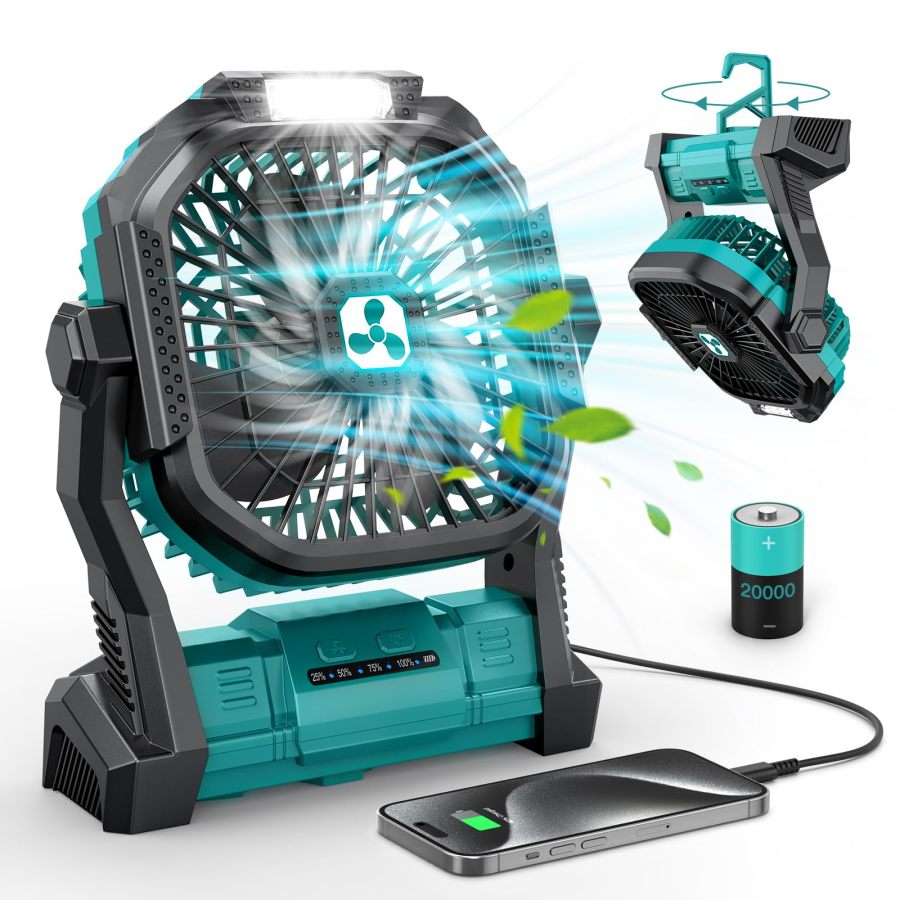
Portable rechargeable camping fans primarily refer to portable devices with built-in high-capacity rechargeable batteries, integrating fan, lighting, and sometimes power bank functions. They are typically designed with hooks or standable brackets, suitable for various scenarios such as tents, RVs, and outdoor tables, to combat outdoor heat, provide emergency power outage solutions, or offer personal cooling on the go. This product category emphasizes long battery life, strong airflow, quiet operation, and multi-functional integration. The following table illustrates the key characteristics of consumer behavior in this category.
| Dimension | Segment | Description |
|---|---|---|
| Need Driver Type | Planned Purchase / Emergency-driven Purchase | User purchases typically stem from anticipated needs for outdoor comfort and cooling, or are triggered by emergency scenarios like power outages, with a clear expectation for immediate relief. Demand peaks during summer, outdoor activity seasons, and emergency situations. |
| Purchase Frequency | Low / Seasonal | These products are mostly durable goods with low purchase frequency, often considered a one-time investment. However, purchase demand increases significantly during peak outdoor activity seasons like summer and holidays. |
| Decision Complexity | Medium | Consumers compare factors like battery life, airflow strength, noise level, additional features (e.g., lighting, charging), portability, and price, but do not engage in excessive professional research. |
| Price Sensitivity | Medium | Price is an important consideration, but consumers are willing to pay a reasonable premium for quality and enhanced experience in core value areas like long battery life, strong airflow, true quiet operation, and reliable durability. |
| Emotional Dependency | Medium | The product not only provides physical cooling but also delivers a sense of security, comfort, and control over the environment in outdoor or emergency situations, offering certain emotional value. |
II. User Personas & Usage Scenarios
2.1 Outdoor Adventurer / Camping Enthusiast
🎯 Passionate about outdoor activities like camping, hiking, and fishing. Values equipment practicality, reliability, and battery life, pursuing comfort even in the wilderness.
| Typical Usage Scenarios | Core Pain Points | Primary Purchase Drivers |
|---|---|---|
|
|
|
2.2 Home Emergency Prepper / RV Camper
🎯 Lives in disaster-prone areas, values family emergency preparedness; or frequently travels by RV, needing portable and multi-functional electrical appliances to enhance in-vehicle comfort.
| Typical Usage Scenarios | Core Pain Points | Primary Purchase Drivers |
|---|---|---|
|
|
|
III. User Needs Hierarchy (KANO Model)
3.1 Basic Needs (Must-Haves)
- Strong Airflow: The fan must provide perceptible airflow to effectively cool and circulate air, especially in hot, stuffy outdoor environments, not just a gentle breeze.
- Long Battery Life: Built-in high-capacity battery that can last at least a full night (8-12 hours) when outdoors or during power outages, ensuring basic comfort.
- Multi-Functional Integration: Beyond the fan function, it must include LED lighting, and preferably an emergency charging function, achieving multi-purpose use in one device.
- Portability: Moderate size, lightweight, easy to carry and store, e.g., fits in a backpack or is easy to hang/place on a table.
3.2 Performance Needs (Linear Satisfiers)
- Quiet Operation: While providing sufficient airflow, noise is controlled to an acceptable level, especially at medium-low speeds, not disturbing sleep or conversation.
- Multi-Speed & Brightness Adjustment: Offers multiple fan speeds (at least 3-4 levels or stepless) and lighting brightness options to adapt to different ambient light and cooling needs.
- Flexible Angle Adjustment & Multiple Hanging Points: The fan head can rotate or tilt at multiple angles; the base or top has foldable, rotatable hooks for flexible mounting and directional airflow in various scenarios.
- Rugged Durability: Uses drop-resistant, impact-resistant materials, can withstand bumps during outdoor use, extends product lifespan, and provides a reliable user experience.
3.3 Excitement Needs (Delighters)
- Auto Oscillation Function: Provides 45°/90° automatic left-right oscillation, covering a wider area without manual adjustment, significantly enhancing comfort in multi-person tents or RVs.
- Remote Control & Timer Function: Includes a remote for convenient long-distance operation; timer function allows setting automatic shutoff for convenience and energy saving, especially at night without needing to get up.
- Digital Battery Display: Real-time display of remaining battery percentage or battery bars, giving users clear visibility of battery status, alleviating battery anxiety, and allowing for better charging planning.
- Night Mode: One-touch to turn off all indicator lights or dim them to a very low level, avoiding light interference at night, providing a purer dark sleep environment.
3.4 Unmet Needs & Opportunities
-
Battery Capacity vs. Actual Runtime Discrepancy: Some products advertise high-capacity batteries and ultra-long runtime, but users find actual runtime at high speeds far below expectations, especially in sustained hot environments, easily triggering negative emotions and returns.
User Reviews (VOC) The fan does not last 36 hours on a single charge. I ran it on low for 28 hours before I went to sleep, and woke up approximately 35 hours after it had been started. It was no longer running. // Pessimo Não segura carga e a luz é fraca, esperava mt mais
-
Excessively Long Charging Time: Despite large battery capacity, charging speed is slow, taking several hours or even over 10 hours for a full charge, resulting in a very poor experience in outdoor or emergency scenarios requiring quick recharge.
User Reviews (VOC) Charge speed: probably my biggest complaint, this thing charges REALLY slow. like 12 hours to fully charge 0 to 100 slow. // Takes over 48hrs to get a full charge is ridiculous
-
Noticeable Noise at High Speeds: Most products advertise quiet operation, but noise remains significant, even with a high-pitched whine, at high fan speeds, severely affecting quiet rest environments or focused work.
User Reviews (VOC) The noise level receives mixed feedback - while some find it insanely quiet, others report a high-pitched squeal at the highest setting. // My only gripe is that every time you press any of the buttons, it makes a stupid loud 'BEEP' and I haven't found a way to shut that off.
-
Rapid Battery Degradation / Unstable Quality Control: Some users report rapid performance decline of the battery after a period of use, even failure to charge; or product malfunctions occurring in a short time, causing core functions to fail.
User Reviews (VOC) Batterys broke and wont charge after a month of very little use wont recommend this product // I've had these fans for less than a month, and all but one of the fan batteries have managed to crap out despite being on full charge.
-
Inconvenient Remote Control / Easy to Lose: The remote requires precise aiming at the fan to work and lacks a reasonable storage design, leading to frequent loss or unresponsive operation, reducing convenience.
User Reviews (VOC) The remote doesn't work great unless pointed right at the fan // I had to carefully carry it around.
IV. User Decision Drivers
4.1 Key Decision Factors
- Battery Runtime: How long the battery lasts in off-grid outdoor or emergency scenarios is a core consideration, directly related to obtaining prolonged cooling and lighting.
- Airflow Strength & Coverage: Whether the fan provides sufficiently strong airflow for effective cooling and air circulation, and whether it supports wide-angle airflow, is key to determining comfort.
- Multi-Functional Integration: Whether it integrates LED lighting, emergency charging, etc., and the practicality and reliability of these functions, impacts the value of multi-purpose use.
- Portability & Mounting Flexibility: The product's size, weight, and ease of carrying, hanging, or placing determine its adaptability in different outdoor scenarios.
4.2 Secondary Decision Factors
- Noise Level: Especially inside a tent or during sleep, whether the fan's operating noise is quiet affects the user's rest experience and environmental comfort.
- Charging Speed: The time required for a full charge affects the product's reusability efficiency, especially under limited charging conditions outdoors.
- Ease of Operation: Whether it supports remote control, timer, and whether the control buttons are intuitive and easy to use, enhancing the user experience.
- Product Sturdiness: Outdoor use demands high drop resistance and durability; whether the materials and structure are reliable impacts long-term value.
- Price & Value for Money: On the basis of meeting core needs, whether the product price is reasonable and can provide superior comprehensive use experience.
V. Selling Points & Competitive Landscape
5.1 Selling Point Analysis
5.1.1 Standard Features (Points of Parity)
- Large Capacity Battery, Long Runtime: Commonly emphasizes built-in 20,000mAh+ large capacity batteries, providing 12-100 hours or even longer runtime.
- Multi-Speed Adjustment: Offers 3-4 speed settings to meet different cooling needs, from breeze to strong wind.
- Integrated LED Lighting: Most products have built-in LED lights with multi-level brightness adjustment, serving as a camping lantern or emergency light.
- Portable & Hangable Design: Compact size, usually with hooks or handles, convenient for use in various scenarios like tents, desktops, and vehicles.
- Quiet Operation: Claims to use brushless motor technology to achieve low-noise operation, enhancing user experience.
5.1.2 Key Differentiators
- Remote Control & Timer Function: Some products provide a remote control and 1/2/4/8-hour auto shut-off timer, increasing convenience.
- Auto Oscillation Function: Provides 45°/90° automatic left-right oscillation, expanding airflow coverage for more comfortable air circulation.
- Emergency Power Bank Function: Equipped with USB output ports to charge devices like phones in emergencies, serving as a portable power bank.
- Digital Battery Display: Displays remaining battery percentage or battery bars via an LED screen or indicator lights, helping users monitor power.
- Dual-Layer Blades / Multi-Blade Design: Claims to provide stronger or more concentrated airflow by optimizing blade structure.
5.1.3 Unique Selling Propositions (USPs)
- Exclusive Brand Ecosystem Compatibility: Products from brands like DEWALT are compatible with their power tool batteries, facilitating resource reuse for existing users and enabling cross-category synergy.
- Anti-Misoperation Night Mode: Provides a one-touch sleep mode to turn off all indicator lights, avoiding nighttime light interference for pure darkness.
- Detachable Battery Design: A few products support detachable batteries, facilitating replacement with spares or use as an independent power bank, extending outdoor use time.
5.2 Competitive Landscape
5.2.1 Market Maturity
The portable rechargeable camping fan market has entered a rapid development phase, with highly integrated product features and intense price competition. Brands commonly attract consumers by increasing battery capacity and adding multi-functions (e.g., lighting, power bank, remote control), but bottlenecks remain in core technological innovation (e.g., balancing extreme quietness with strong airflow, fast charging), and product homogenization is evident.
5.2.2 Innovation Trends
Future innovation trends are mainly reflected in: First, combining ultra-long runtime with fast-charging technology to address user needs for prolonged use and quick recharge. Second, smart features and interactive experience upgrades, such as more precise battery displays, more convenient remote control (especially night mode), and even potential smart sensing for automatic speed adjustment based on the environment. Third, scenario-specific specialization, e.g., higher protection ratings (IP rating) for extreme outdoor environments, lighter designs, or ecosystem connectivity with other outdoor gear. Fourth, differentiated aesthetic design, moving beyond traditional molds to offer more personalized and visually appealing products.
VI. Marketing Claims vs. Reality Check
The table below analyzes the gap between common marketing claims and actual user experiences in this category:
| Dimension | Marketing Claim | User Reality | Verdict |
|---|---|---|---|
| Battery Runtime | Claims of 20,000mAh to 40,000mAh ultra-large capacity batteries providing up to 100-150 hours of ultra-long runtime, enabling worry-free all-day use. | Users widely report actual runtime at high brightness or medium-high speeds is far below claims (often 3-10 hours). Some products fail to meet expectations even at low speeds. Data is severely disconnected from real-world experience. | A typical case of misleading consumers with ideal lab data or lowest brightness/speed figures, failing to deliver on the core promise of long-term outdoor or emergency use, severely damaging user trust. |
| Charging Speed | Emphasizes Type-C fast charging, claiming the large battery can be fully charged in a short time for quick recharge. | User feedback indicates charging large capacity batteries takes 8-12 hours or even longer, far from the 'fast charge' experience, becoming a significant pain point under limited outdoor charging conditions. | There is a physical constraint between large battery capacity and fast charging, difficult to achieve simultaneously with current technology and cost. Sellers over-promote fast charging but neglect the impact of actual charging duration on user experience, creating a cognitive mismatch. |
| Noise Level | Advertises using brushless motors, noise below 30dB, whisper-quiet, not disturbing sleep or work. | Users generally find low-speed settings acceptably quiet, but noise increases significantly at medium-high speeds, with reports of high-pitched whines or mechanical rattles, affecting use in quiet environments. | Balancing strong airflow with extreme quietness within limited size and cost is a technical challenge. Sellers generalize the quietness of low-speed settings to all speeds, misleading user expectations about noise at high speeds. |
Key Takeaway: The market generally exhibits tendencies for parameter inflation and exaggerated scenario-based experience claims, especially regarding battery runtime, charging speed, and high-speed noise, where significant gaps exist between marketing and actual user experience.
VII. Supply-Demand Misalignment Analysis
The table below highlights mismatches between seller focus and buyer priorities:
| Dimension | Seller Behavior | User Focus | Verdict |
|---|---|---|---|
| Real Runtime & Data for Different Settings | Sellers commonly emphasize 'ultra-long runtime 100+ hours' but often lack transparency or obfuscate actual runtime data for different fan speed/light brightness settings, avoiding the shortcoming at high speeds. | Users care most about how long it lasts at high speeds or commonly used settings, not the theoretical minimum. Data contradictions and insufficient runtime are frequent complaints, leading to loss of trust. | Sellers fail to provide transparent data on the core performance metrics users truly care about, leading to a severe mismatch between user experience and advertised expectations, directly impacting product reputation and repurchase intent. |
| Charging Efficiency & Compatibility | Some sellers emphasize Type-C charging but do not specify their own charging power requirements and time, nor include a high-performance charger by default, assuming users own fast-charging devices. | Slow charging of large batteries is a common pain point. Users are dissatisfied with waiting hours or even over a full night for a full charge and complain about needing to purchase a charger separately. | When users have a strong need for quick recharge, sellers fail to provide a complete charging solution and clear charging expectations, instead adding to user cost and inconvenience. |
| Practicality of Additional Features | Some products stack features like remote control, timer, multi-color temperature LED, but suffer from poor remote sensitivity, lack of storage design, overly bright LED indicators at night, etc. | Users have expectations for additional features, but poor experience renders them gimmicky. For example, remotes requiring precise aiming or overly bright indicators affecting sleep reduce overall satisfaction. | Sellers blindly stack features but neglect the detailed experience of feature implementation, resulting in low perceived user value and even creating new pain points-a typical case of ineffective feature competition. |
Key Takeaway: Sellers commonly exhibit information ambiguity or excessive optimism regarding core pain points like battery runtime, charging speed, and high-speed noise, while over-investing in feature stacking and low-value details, leading to a supply-demand mismatch.
VIII. Strategic Opportunities & Recommendations
8.1 "True Runtime, Rapid Recharge" High-Performance Camping Fan
8.1.1 Target Audience & Pain Points
⚡️ Pain Points Addressed: Battery capacity vs. actual runtime discrepancy; Excessively long charging time.
8.1.2 Action Plan
Adopt high-energy-density lithium batteries (e.g., 20,000-30,000mAh), support PD 30W+ fast charging input for a full charge in 2-4 hours. Clearly label actual runtime for all settings (not theoretical minimum power consumption) in the listing, and support with third-party review data.
| Tech Complexity | Medium |
| Cost Impact | High Impact |
| Trade-off Warning | Increasing battery capacity or using higher energy density batteries may slightly increase product volume or weight (50-100g), but users are willing to pay a premium. Fast-charge modules require more space and heat dissipation, potentially affecting overall dimensions. |
| Price Band | Only viable above $39.99 |
8.1.3 Marketing Strategy
Highlight the promise of "True Runtime, No False Claims," emphasize the ultimate efficiency of "2-Hour Full Charge, All-Night Peace of Mind." Use comparison test videos to showcase real runtime performance at high speeds and provide authoritative certification reports.
8.2 "Ultra-Quiet Strong Airflow" Smart Camping Fan
8.2.1 Target Audience & Pain Points
⚡️ Pain Points Addressed: Noticeable noise at high speeds; Nighttime indicator lights are glaring; Inconvenient remote control / easy to lose.
8.2.2 Action Plan
Use next-generation quiet brushless motors, optimize blade aerodynamics and airflow channel structure to ensure noise is controlled below 35dB even at highest speed. Introduce a night mode to turn off all indicator lights with one touch; upgrade remote to RF and design magnetic or snap-fit storage slots to improve usability and prevent loss.
| Tech Complexity | Medium |
| Cost Impact | Medium Impact |
| Trade-off Warning | Optimizing airflow channels and motors may slightly increase mold complexity and cost. Integrating better remote modules and sensors increases BOM cost. |
| Price Band | Only viable above $29.99 |
8.2.3 Marketing Strategy
Emphasize "Library-Quiet, Hurricane-Cool." Showcase noise test data and comparison videos; highlight the remote's convenience for blind nighttime operation and demonstrate its clever storage design.
8.3 "Extreme Durability, All-Terrain Protection" Professional Outdoor Fan
8.3.1 Target Audience & Pain Points
⚡️ Pain Points Addressed: Rapid battery degradation / unstable quality control; Insufficient product sturdiness.
8.3.2 Action Plan
Use higher-strength, more weather-resistant ABS+PC composite materials, reinforce internal structural design to withstand drop impacts. Introduce IPX5/IPX6 waterproof rating (resistant to rain splashes) and clearly label it in the listing. Offer a longer warranty period (e.g., 2-3 years) to enhance user confidence.
| Tech Complexity | Low |
| Cost Impact | Medium Impact |
| Trade-off Warning | Improving shell material and structural strength will slightly increase weight and manufacturing cost but has limited impact on portability. |
| Price Band | Only viable above $49.99 |
8.3.3 Marketing Strategy
Claim "Military-Grade Quality, Fearless in Extreme Environments." Showcase drop and splash resistance test videos; emphasize the "3-Year Warranty, Replacement Only" after-sales promise to build a professional and reliable image.