Amazon US Market Analysis: Automatic Fish Feeders Category
📊 Executive Summary
📈 Market Trends
Portability and automation are the baseline, smart connectivity is the new growth driver. The automatic fish feeder market is evolving from meeting basic timed feeding needs towards pursuing more precise, intelligent, and worry-free experiences. USB charging and moisture/clog-resistant designs have become mainstream, while smart feeders integrating Wi-Fi, cameras, and environmental monitoring represent an emerging trend, though their stability still requires validation.
⚡ Major Pain Points
Insufficient feeding precision and unstable smart features are the core chronic issues. Users widely complain about difficulty in precisely controlling feeding amounts (especially for small tanks), leading to water pollution and fish health damage. Simultaneously, smart feeders commonly suffer from unstable Wi-Fi connections and poor App experiences, adding to user burden and uncertainty. Flake food's tendency to absorb moisture and clump is also a long-standing pain point.
💡 Selection Opportunities
Deepen micro-precision feeding and improve smart connectivity reliability. Market opportunities lie in developing 'micro-precision dispensing' feeders targeting small tank and betta users to solve overfeeding pain points. For smart feeders, resources should be invested to achieve industrial-grade Wi-Fi stability and superior App user experience. Additionally, a 'flake food specific moisture-resistant' solution and a 'modular aquatic ecosystem' also hold potential for differentiated competition and can be explored as high-end line extensions.
I. Analysis Overview
1.1 Introduction & Report Scope
This report analyzes the 'Automatic Feeders' category (Automatic Fish Feeders) in the US Amazon market, focusing on target user personas, core needs, decision drivers, market communication, and potential opportunities.
1.2 Category Snapshot
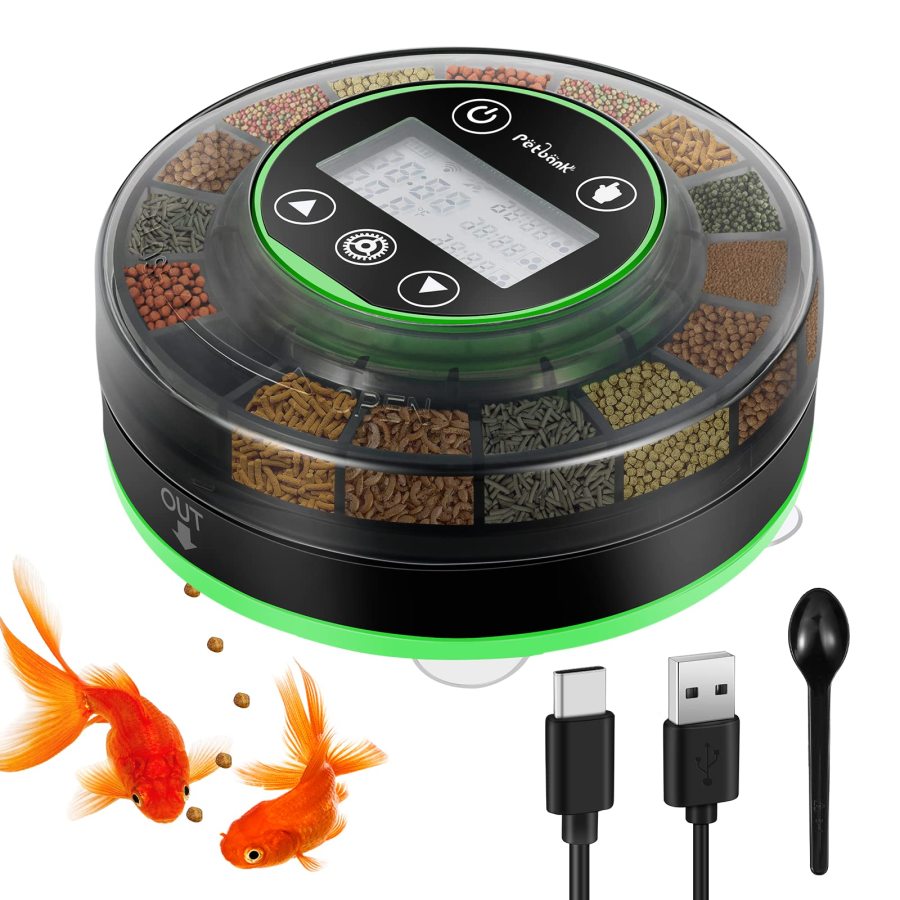
Automatic fish feeders are smart devices specifically designed for aquariums, aimed at providing timed, measured, and automated feeding for ornamental fish, aquatic turtles, and other aquatic pets. Their core functions include programmable timing, precise food dispensing, moisture-proofing for freshness, and support for various mounting methods, ensuring stable food supply for pets during daily life or when the owner is away. With technological advancements, some high-end models also integrate Wi-Fi connectivity, camera monitoring, water temperature sensing, and other smart features to meet more sophisticated fish-keeping demands. The following table illustrates the key characteristics of consumer behavior in this category.
| Dimension | Segment | Description |
|---|---|---|
| Need Driver Type | Planned Purchase / Emergency-driven Purchase | Purchases are often planned in advance (e.g., upcoming travel, establishing feeding routines) or made to address unexpected situations (e.g., busy work schedules). |
| Purchase Frequency | Low Frequency | As durable goods, they are typically purchased once every few years, mainly for upgrades or to replace a broken unit. |
| Decision Complexity | Medium | Users compare feeding reliability, capacity, features (e.g., moisture resistance, charging), and especially the stability of smart connectivity. |
| Price Sensitivity | Medium to High | Price is an important consideration, but users are willing to pay a premium for reliability and practical features to ensure pet health and personal convenience. |
| Emotional Dependency | Medium to High | Pet welfare and the owner's peace of mind while away are the primary emotional drivers, alleviating the mental burden of daily care. |
II. User Personas & Usage Scenarios
2.1 Busy Fish Hobbyist / Traveler
🎯 Works long hours or travels frequently, unable to feed fish daily on time, worried about fish hunger or irregular feeding schedules.
| Typical Usage Scenarios | Core Pain Points | Primary Purchase Drivers |
|---|---|---|
|
|
|
2.2 Budget-Conscious Aquarium Beginner / Small Tank Owner
🎯 Has a limited budget, typically owns a smaller tank with few fish (e.g., a single betta), focuses on basic product reliability and cost-effectiveness, and has high requirements for portion accuracy to avoid water quality deterioration.
| Typical Usage Scenarios | Core Pain Points | Primary Purchase Drivers |
|---|---|---|
|
|
|
2.3 Smart Home Enthusiast / Professional Fish Keeper
🎯 Pursues a high-tech, high-efficiency fish-keeping experience, hopes to manage aquariums precisely through smart features (e.g., remote monitoring, App control), and may own multiple tanks.
| Typical Usage Scenarios | Core Pain Points | Primary Purchase Drivers |
|---|---|---|
|
|
|
III. User Needs Hierarchy (KANO Model)
3.1 Basic Needs (Must-Haves)
- Timed & Measured Feeding: Core function, must automatically dispense food at preset times and in preset amounts.
- Food Moisture Protection & Freshness: The feeder interior should effectively prevent moisture ingress, avoiding food clumping or spoilage.
- Stable & Reliable Power Supply: Battery-powered or dual-power (USB + battery), ensuring operation even during power outages.
- Easy Installation & Mounting: Offers multiple mounting methods (clamp, suction cup, stand) to fit different aquariums.
- Simple & Intuitive Operation: Device setup and daily operation are intuitive and easy to understand, requiring no complex learning.
3.2 Performance Needs (Linear Satisfiers)
- Precise Portion Adjustment: Features multi-level or stepless adjustment of the dispensing opening size to suit different fish appetites and food types.
- Large Capacity Food Hopper: Meets long-term (weeks to months) unattended feeding needs, reducing refill frequency.
- Anti-Clogging Design: Optimized dispensing structure ensures smooth flow of different food types like pellets, flakes, and sticks.
- Low-Noise Operation: Feeding mechanism operates with minimal sound, not disturbing pets or the home environment.
- Easy Cleaning & Maintenance: Food-contact components are detachable for cleaning, facilitating hygiene maintenance.
3.3 Excitement Needs (Delighters)
- Wi-Fi / App Smart Control: Mobile App for remote feeding control, real-time device status viewing, and receiving anomaly notifications.
- Real-Time Video Monitoring (with Night Vision): Built-in HD camera for remote real-time observation of fish feeding and tank activity, supports night mode.
- Customizable Feeding Cycles: Supports fine-grained scheduling beyond daily feeding, like every other day or multi-day intervals.
- Smart Low Battery / Low Food Alerts: Notifies users of low battery or near-empty food hopper via App or device indicator lights.
- Water Temperature / Quality Monitoring: Built-in sensors for real-time tank temperature monitoring, or providing simple water parameter alerts (e.g., TDS), displayed via App.
3.4 Unmet Needs & Opportunities
-
Poor Portion Output Consistency: Many users report significant variations in food amount per dispensing even with the same settings, especially poor control for small portions.
User Reviews (VOC) The smallest insert was still too big // none of the food dispenser openings accommodate a singular fish // it still dumps too much on the 1st setting // even at the lowest setting I feel like it dumped too much food
-
Wi-Fi Connectivity Stability & App Experience: Advanced smart feeders frequently experience Wi-Fi disconnections, App lag, or complex setup issues, impacting user experience.
User Reviews (VOC) Didn't Work from the Start // it still wouldn't connect // WiFi does not work // After two hours of trying to get it to connect to our WiFi
-
Optimization for Flake Food: Flake food is prone to moisture absorption/clumping, clogging the dispensing outlet, or being scattered unevenly.
User Reviews (VOC) Not for flakes // I definitely do not recommend powder foods or flakes, they will get stuck // moisture building up inside and flakes balling up // the food gets damp then won't come out
-
Battery Life & Low Battery Alert Reliability: Sudden battery depletion or delayed alerts can lead to fish going without food, causing unnecessary user anxiety.
User Reviews (VOC) Battery failures // stops working when battery gets low // battery display is incorrect // battery life mixed
IV. User Decision Drivers
4.1 Key Decision Factors
- Feeding Reliability: The ability to consistently and uninterruptedly feed on time is the primary purchase consideration.
- Portion Accuracy: The ability to precisely control the amount dispensed per feeding, avoiding overfeeding or underfeeding, directly impacts water quality and fish health.
- Food Moisture & Clog Prevention: Ensures food stays fresh and dry, dispenses smoothly, preventing fish starvation or water quality deterioration.
- Ease of Use: Whether product setup and daily operation are simple, intuitive, and quick to learn.
4.2 Secondary Decision Factors
- Battery Life & Power Options: Battery longevity, availability of USB charging or dual-power options, enhancing convenience.
- Food Hopper Capacity: Determines refill frequency, especially influencing decisions for travelers.
- Mounting Compatibility: Ability to meet installation needs for different types of aquariums.
- Additional Smart Features: Wi-Fi control, camera, thermometer, etc., providing added value for users seeking high-tech solutions.
- Product Quietness: Whether operating noise is acceptable and does not disturb the home environment.
V. Selling Points & Competitive Landscape
5.1 Selling Point Analysis
5.1.1 Standard Features (Points of Parity)
- Timed & Measured Feeding: Programmable daily feeding frequency and dispensing intervals (e.g., 8H/12H/24H/48H).
- Multiple Mounting Methods: Supports clamping, suction cup, or standing, adapting to different aquarium rims or covers.
- Adjustable Capacity: 200-320ml large capacity food hopper, some offer multiple dispensing opening sizes.
- Manual Feeding Function: Allows users to feed extra food at any time, increasing interaction.
- Battery Powered: Most products emphasize using AA/AAA batteries for portability and power outage resilience.
5.1.2 Key Differentiators
- Moisture & Clog Resistant Design: Sealed food hopper, drawer-style dispensing, rubber wiper to clean outlet, preventing food clumping.
- USB Charging / Dual Power: Built-in lithium battery with USB charging, or support for USB + battery dual-mode power.
- LCD Display: Clearly shows time, feeding schedule, and battery status, facilitating setup.
- Food Compatibility: Marketed as suitable for various fish food types like pellets, flakes, and sticks.
- Noise Control: Marketed as operating as low as 5dB, quiet enough not to disturb fish or home environment.
- Includes Feeding Ring: Comes with a floating feeding ring to concentrate food, reduce dispersion, and maintain water quality.
5.1.3 Unique Selling Propositions (USPs)
- Wi-Fi Smart Control & App: Remote feeding control, real-time monitoring, notifications via mobile App, some even integrate 2.5K HD cameras.
- Thermometer Function: Built-in water temperature sensor and alarm to monitor tank temperature, ensuring fish comfort.
- Long Battery Life (Lithium): Large capacity lithium battery, one charge supports months of use.
- Adjustable Feeding Interval Days: Beyond daily feeding, can be set to feed every other day or at multi-day intervals.
5.2 Competitive Landscape
5.2.1 Market Maturity
The current automatic fish feeder market is at a medium level of maturity. Basic timed/measured feeding and moisture-proof functions are now common, but significant unmet needs remain regarding feeding accuracy and smart feature stability, indicating room for market improvement and innovation.
5.2.2 Innovation Trends
Innovation trends are mainly reflected in smart features (App remote control, camera monitoring, temperature sensing), power management (USB charging, long-life lithium batteries), and optimized designs for specific food types (e.g., flakes) and small tanks. Future focus may shift more towards system integration (e.g., linking with smart home ecosystems) and rapid response to user feedback.
VI. Marketing Claims vs. Reality Check
The table below analyzes the gap between common marketing claims and actual user experiences in this category:
| Dimension | Marketing Claim | User Reality | Verdict |
|---|---|---|---|
| Feeding Portion Accuracy | Precise portion control, multiple dispensing opening sizes, adapts to different fish appetites, prevents overfeeding. | Users widely report that even the smallest opening dispenses too much food, especially for small fish or single fish, often requiring user modifications (e.g., taping part of the outlet) to achieve reasonable portions. | Sellers' definition of 'precision' severely deviates from users' actual needs, overlooking the real pain point of micro-feeding, leading to water quality deterioration and fish health damage. This is a fatal disconnect between the product's core promise and user experience. |
| Smart Connectivity & App Stability | App smart control, Wi-Fi remote connection, real-time monitoring, lets you control your aquarium anytime, anywhere. | Multiple products marketed as smart control are complained about for Wi-Fi connection difficulties, App pairing failures, frequent disconnections, or feature malfunctions, with some users returning products due to connectivity issues. | Smart feature design fails to fully account for the complexity of home network environments and users' rigid need for stable connections, turning 'convenience' into 'trouble', severely damaging user trust in high-end features. |
| Food Moisture Protection & Compatibility | Innovative moisture & clog-resistant design, compatible with various fish foods like flakes, pellets, ensuring dry, fresh food. | Numerous users report flake food easily absorbing moisture and clumping, clogging the dispensing outlet, or scattering during rotation/dispensing, contradicting claims of 'compatible with various foods' and 'moisture & clog resistant'. | Sellers' design fails to adequately consider the physical properties of flake food (hygroscopic, adhesive), causing moisture protection and dispensing mechanisms to fail, resulting in food waste and water pollution. This is a serious design flaw. |
Key Takeaway: The market exhibits a widespread tendency towards functional exaggeration and overpromising on scenario-based experiences, particularly regarding core feeding accuracy and smart connectivity features.
VII. Supply-Demand Misalignment Analysis
The table below highlights mismatches between seller focus and buyer priorities:
| Dimension | Seller Behavior | User Focus | Verdict |
|---|---|---|---|
| Minimum Feeding Portion Accuracy | Most sellers emphasize 'large capacity' and 'adjustable portions', but few products specify their minimum dispensable amount or offer precise control solutions for small fish/bettas. | Users strongly complain that 'the smallest setting still gives too much', leading to water quality deterioration or even fish death in small tanks, urgently needing finer micro-dispensing capability. | Sellers meet the need for 'having' portion adjustment but fail to address the deeper pain point of 'precision', a classic case of functional design being disconnected from real-world scenarios. |
| Stability of Smart Connectivity | High-end product lines heavily promote 'App remote control', 'Wi-Fi connectivity' as core differentiating selling points. | Users report Wi-Fi connection difficulties, unstable Apps, failed remote control, believing these 'smart' features actually cause more trouble and undermine peace of mind. | Sellers over-pursue feature stacking and smart concepts but invest insufficiently in user experience and technical stability, turning high-end selling points into a crisis of trust. |
| Dedicated Solution for Flake Food | Some sellers claim product compatibility with 'flakes, pellets, sticks' and other foods but offer no specific optimization for flake food characteristics (hygroscopic, fragile, prone to clogging). | Users commonly encounter issues with flake food absorbing moisture and clumping, clogging the outlet, or scattering unevenly, believing product compatibility with flakes is actually poor. | Sellers speak vaguely about food compatibility, failing to identify and solve the real pain points of the specific user group using flake food, limiting product applicability. |
Key Takeaway: Sellers generally over-promote basic features like 'feeding capacity' and 'universal mounting', while collectively neglecting user core pain points like 'micro-feeding accuracy' and 'smart connectivity stability', leading to a severe supply-demand mismatch.
VIII. Strategic Opportunities & Recommendations
8.1 Precision Micro-Dispensing Fish Feeder (For Small Tanks)
8.1.1 Target Audience & Pain Points
⚡️ Pain Points Addressed: Poor portion output consistency, minimum feeding amount too large, leading to overfeeding in small tanks.
8.1.2 Action Plan
Redesign the dispensing mechanism, using micro-stepper motors with precision sliders or small gear sets to achieve pellet-count level (1-5 pellets) precision. Provide replaceable mini dispensing outlets. Integrate a small drying module or active ventilation system to keep micro-portions dry.
| Tech Complexity | Medium |
| Cost Impact | Medium Impact |
| Trade-off Warning | Achieving micro-precision may require more precise molds and motors, slightly increasing manufacturing costs, but volume need not increase significantly. |
| Price Band | Only viable above $24.99 |
8.1.3 Marketing Strategy
Emphasize 'Betta Exclusive', 'Say Goodbye to Overfeeding, Hello to Clear Water'; highlight the significant advantages of micro-feeding through comparative data (water quality, fish health) and user testimonials, paired with a compact, refined aesthetic design.
8.2 Industrial-Grade Stable Wi-Fi Smart Fish Feeder
8.2.1 Target Audience & Pain Points
⚡️ Pain Points Addressed: Poor Wi-Fi connectivity stability & App experience, unreliable low battery/low food alerts.
8.2.2 Action Plan
Adopt industrial-grade Wi-Fi modules from leading brands like Qualcomm or MediaTek, support dual-band (2.4G/5G) auto-switching, optimize network reconnection protocols. Develop a smooth, feature-rich, thoroughly tested App providing real-time device status, connection diagnostics, and smart low battery/low food push notifications (multi-channel).
| Tech Complexity | High |
| Cost Impact | High Impact |
| Trade-off Warning | Using more stable Wi-Fi chips and complex power management systems will significantly increase BOM cost, potentially increasing product size slightly and power consumption (requiring larger batteries). |
| Price Band | Only viable above $79.99 |
8.2.3 Marketing Strategy
Position as 'Never Offline, Total Control'; provide rigorous network stability test reports, emphasize 'Enterprise-Grade Reliability, Home-Grade Convenience'; highlight the peace-of-mind value of remote monitoring, data analysis, and anomaly alerts.
8.3 Flake Food Specific Moisture-Resistant Feeder
8.3.1 Target Audience & Pain Points
⚡️ Pain Points Addressed: Flake food easily absorbs moisture and clumps, clogs dispensing outlet, poor compatibility.
8.3.2 Action Plan
Design an active drying/ventilation module, e.g., built-in small fan with desiccant cartridge. Apply anti-stick coating to the dispensing outlet and incorporate an adjustable flexible wiper blade to prevent flake clumping/clogging. Optimize hopper shape to reduce dead spots for flake accumulation.
| Tech Complexity | Medium |
| Cost Impact | Medium Impact |
| Trade-off Warning | Special stirring/dispensing structures may increase mold complexity and slight energy consumption, but overall impact on size and weight is minimal. |
| Price Band | Only viable above $29.99 |
8.3.3 Marketing Strategy
Market as 'The Flake Food Terminator', 'End Clumping Worries, Every Flake Fresh into the Tank'; use transparent demonstration videos showing flake food remaining dry and flowing smoothly within the product, dispelling user doubts.
8.4 Modular Multi-Function Aquarium Smart Hub
8.4.1 Target Audience & Pain Points
⚡️ Pain Points Addressed: Lack of interaction with traditional feeding, missing data-driven management, only solves the single problem of feeding.
8.4.2 Action Plan
Design a modular feeder platform where the basic feeding unit can be expanded with plug-in modules for water temperature, TDS, pH sensors, even small dissolved oxygen probes. All data is displayed via a unified App, providing long-term trend analysis and smart alerts. Consider opening an API for compatibility with third-party smart home platforms.
| Tech Complexity | High |
| Cost Impact | High Impact |
| Trade-off Warning | Integrating multi-function sensors and modules increases product size and complexity, imposes higher demands on waterproofing, power consumption, and data transmission, potentially raising the price. |
| Price Band | Only viable above $129.99 |
8.4.3 Marketing Strategy
Position as 'Your Aquatic Ecosystem Command Center', 'All-in-One Smart Fish Keeping Solution'; attract high-end hobbyists by showcasing a professional App interface and data reports, emphasizing leading advantages and expertise in water quality management and fish health monitoring.