Amazon US Market Analysis: Under Desk Elliptical Category
📊 Executive Summary
📈 Market Trends
Demand for portability and low-impact exercise continues to grow; smart features remain a blue ocean. The under-desk elliptical market is mature, with consumers having clear expectations for core functions like seated exercise, quiet operation, and joint protection. Driven by remote work and aging trends, demand is rising for convenience, ease of use, and health solutions that integrate seamlessly into daily life. Future innovation will focus on enhancing core experiences and smart upgrades.
⚡ Major Pain Points
Reliability and practicality pain points are prominent. Current products commonly suffer from unresponsive remotes, slippery bases, poor durability of core components, and mismatches between advertised exercise intensity and actual effect. These issues directly degrade user experience, impacting product reputation and repurchase intent. Additionally, poor display readability and difficulty moving are frequent complaints from elderly users.
💡 Selection Opportunities
Deepen core experience, precisely segment products. Market opportunities lie in thoroughly solving the two major user pain points of remote control and anti-slip performance, thereby improving basic product reliability. Simultaneously, by launching two clearly differentiated product lines-'Passive Circulation Aid' and 'Light Active Exercise'-precisely match the exercise intensity needs of different users to avoid expectation gaps. For the senior demographic, offer specialized products with more customized features in durability, display clarity, and handle design to build differentiated competitive advantage and brand loyalty.
I. Analysis Overview
1.1 Introduction & Report Scope
This report analyzes the 'Leg Exercisers' category (Under Desk Ellipticals) in the Amazon US market, focusing on target user personas, core needs, decision factors, market communication, and potential opportunities.
1.2 Category Snapshot
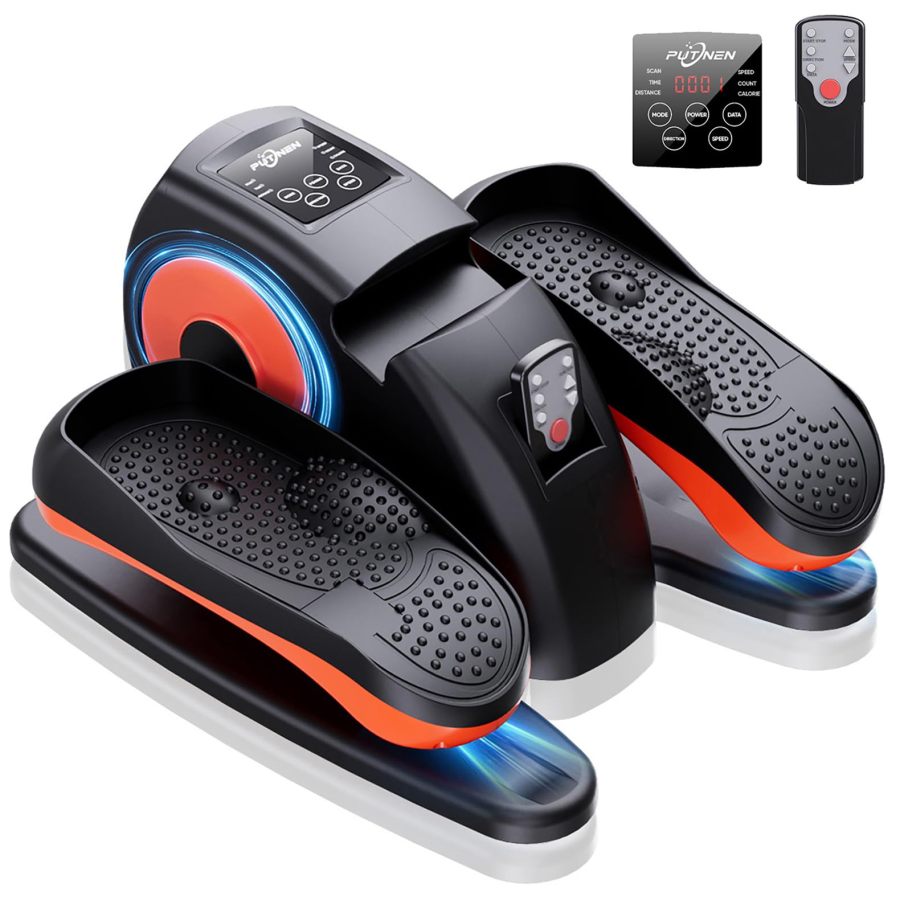
An under-desk elliptical (or seated leg exerciser) is a compact electric fitness device designed specifically for long-term sedentary individuals, the elderly, and rehabilitation populations, allowing them to perform low-impact leg exercises while seated. Its core functions are to promote blood circulation, provide mild leg muscle activity, and alleviate discomfort caused by prolonged sitting. These products are generally equipped with remote controls, digital displays, and multiple speed modes to enhance ease of use and comfort. The following table illustrates the key characteristics of consumer behavior in this category.
| Dimension | Segment | Description |
|---|---|---|
| Need Driver Type | Planned Purchase / Emergency-driven Purchase | Purchases are typically driven by long-term plans to improve health or address sedentary lifestyles, or by emergent needs arising from leg discomfort or rehabilitation requirements. |
| Purchase Frequency | Low Frequency | As durable fitness equipment, such products are typically one-time purchases with long repurchase cycles, unless the product is damaged or has significant functional upgrades. |
| Decision Complexity | Medium | Consumers compare product features (e.g., quiet operation, speed modes, remote control), performance (e.g., anti-slip, durability), and user reviews to ensure the chosen device meets their specific needs. |
| Price Sensitivity | Medium | Price is an important consideration in the decision-making process, but users are willing to pay a reasonable premium if the product effectively addresses health pain points and provides a good experience. |
| Emotional Dependency | Medium-High | The product is closely tied to the user's health, daily comfort, and quality of life. Especially for the elderly and those in rehabilitation, it carries emotional value related to improving mobility, reducing pain, and regaining a sense of security and independence. |
II. User Personas & Usage Scenarios
2.1 Remote Workers / Sedentary Individuals
🎯 Individuals who work, study, or attend online meetings at a desk for long hours, seeking to keep their legs active and alleviate physical discomfort from prolonged sitting without disrupting daily efficiency.
| Typical Usage Scenarios | Core Pain Points | Primary Purchase Drivers |
|---|---|---|
|
|
|
2.2 Health-Conscious Seniors / Rehabilitation Population
🎯 Individuals with limited mobility or fragile joints due to aging, chronic conditions, or post-operative recovery, requiring safe, low-intensity, and easy-to-operate leg exercise methods to maintain or restore mobility.
| Typical Usage Scenarios | Core Pain Points | Primary Purchase Drivers |
|---|---|---|
|
|
|
III. User Needs Hierarchy (KANO Model)
3.1 Basic Needs (Must-Haves)
- Low-Impact / Joint Protection: The device must provide a smooth, gentle motion with no pressure on knees, ankles, and other joints, suitable for users of all ages, especially the elderly and those in rehabilitation.
- Quiet Operation: The machine must operate with minimal noise to ensure it doesn't disturb others in offices, homes during rest, or sleep environments, enabling unobtrusive exercise.
- Stability: The device must remain stable during use, without slipping, shaking, or tilting, to ensure user safety and a comfortable experience.
- Easy to Operate: The product should have an intuitive control interface and simple startup process, ideally ready to use out-of-the-box or requiring minimal assembly for quick user adoption.
3.2 Performance Needs (Linear Satisfiers)
- Adjustable Speed Modes: Offering multiple speed levels and preset automatic program modes allows users to adjust exercise intensity and rhythm based on personal needs and physical condition, catering to everything from light activity to moderate exercise.
- Remote Control Operation: Inclusion of a wireless remote control allows users to easily adjust speed, mode, or power on/off without bending over, significantly enhancing convenience and comfort.
- Forward/Reverse Motion: Supporting both forward and reverse pedal rotation works different leg muscle groups, provides more comprehensive exercise effects, and helps relieve muscle fatigue.
- Real-Time Data Display: A clear LCD or LED screen that tracks and displays workout time, speed, distance, step count, and calories burned helps users monitor their progress.
- Compact & Portable: A small, lightweight design facilitates storage under a desk or beside a sofa, and allows for easy relocation to adapt to different usage scenarios at home or office.
3.3 Excitement Needs (Delighters)
- Smart Connectivity Features: Features like integrated Bluetooth speakers for background music, or syncing workout data via a mobile app for personalized training plans and community interaction, enhance exercise enjoyment and management efficiency.
- Fully Assembly-Free: Promising out-of-the-box usability by plugging in, requiring no screwdrivers or assembly steps, saves users time and effort, providing instant gratification.
- Ergonomic Carry Handle Design: Built-in or external handles designed ergonomically make carrying and moving the machine much easier, especially for elderly users and those with less strength.
- Foot Massage Pedals: Pedal surfaces designed with massage nodules or unique textures provide a gentle massage experience for the feet during exercise, further promoting blood circulation and relaxation.
3.4 Unmet Needs & Opportunities
-
Remote Control Reliability: Users frequently report unresponsive remote controls, delayed response, or the need for precise aiming at the device, severely undermining the convenience of 'no bending required'.
User Reviews (VOC) Customers report issues with the remote control of the elliptical machine, with several mentioning that it doesn't work properly. // The remote needs 2 AAA batteries, so its best to keep extra batteries handy. The trick to using the remote is to be about 1 foot away from the machine, aiming directly at the display on the machine.
-
Insufficient Anti-Slip Performance: Despite many products advertising anti-slip features, the machine still tends to slide during actual use, especially on hardwood floors or certain carpets, forcing users to add their own anti-slip mats.
User Reviews (VOC) Customers have mixed experiences with the elliptical machine's slideability - while some report it stays in place while operating, others mention that it tends to move around during use. // You will probably need a mat of some kind to keep in from moving around on the floor or carpet.
-
Exercise Intensity Perception Gap: Some users perceive electric ellipticals as primarily providing passive movement rather than active exercise, with insufficient intensity for expected calorie burning or muscle toning, creating a gap between expectations of 'exercise' and the actual experience.
User Reviews (VOC) There is no resistance. You get zero benefit other than maybe some circulation and keeping your legs from getting stuff due to sitting still. I wanted to burn calories while working and this will not do it. // The maximum of difficulty that one can set remains light.
-
Product Durability: Users report unusual noises, loose pedals, or complete failure after short periods of use, raising concerns about long-term lifespan.
User Reviews (VOC) It worked great for a little while. Then one of the pedals fell apart. // I reached out to the company and they returned my money in full. I think I got a defective one. // The screws kept falling out and it would make a griding noise.
-
Display Function Optimization: Existing displays often lack backlighting, have fonts that are too small, or lack data memory functions, hindering visibility in low light and tracking of long-term workout data.
User Reviews (VOC) I really dont understand the display though or if it even recalls my step count after the fact. // LCD readout is not backlit. // LCD screen is still somewhat hard for my grandma to see.
IV. User Decision Drivers
4.1 Key Decision Factors
- Health Benefits: Whether the product effectively improves lower limb circulation, relieves leg stiffness and swelling, reduces joint pressure, and provides practical assistance in rehabilitation is the primary consideration for purchase.
- Ease of Use / Convenience: How simple and intuitive the device is to operate, whether it requires assembly, the responsiveness of the remote control, and the machine's portability directly determine how easily it can be integrated into daily use.
- Quietness: Whether the machine truly operates 'ultra-quietly', ensuring it doesn't create disruptive noise during work, rest, or family time, is a key selection factor.
- Stability: Whether the machine remains stable and doesn't slide during use is crucial for safety, especially for elderly users and those seeking a worry-free experience.
4.2 Secondary Decision Factors
- Value for Money: Users weigh the product's features, quality, after-sales service, and price, seeking a purchase that offers good value rather than blindly pursuing the lowest price.
- Product Quality / Durability: Confidence in the machine's materials, manufacturing quality, and expected lifespan, particularly focusing on the stability of core components like pedals and motors, to avoid short-term failures.
- Feature Richness: Whether adjustable speed levels, multiple automatic program modes, forward/reverse motion, and data tracking functions meet users' personalized exercise needs and experience preferences.
- After-Sales Service / Warranty: The warranty period, return/refund policies, and the responsiveness and problem-solving ability of the customer service team are important factors influencing purchase decisions and long-term trust.
V. Selling Points & Competitive Landscape
5.1 Selling Point Analysis
5.1.1 Standard Features (Points of Parity)
- Low-Impact / Joint Protection: Almost all products emphasize protection for knees, ankles, and other joints, making them suitable for the elderly, rehabilitation users, and those who sit for long periods.
- Quiet Operation: Widely advertised as using quiet technology to ensure silent operation in offices or homes without disturbing others.
- Multiple Speeds/Modes: Offer 12-16 adjustable speed levels and preset automatic program modes like manual and P1-P3 to meet different intensity needs.
- Remote Control Operation: Equipped with a wireless remote control, promoted for easy adjustment of settings while seated, eliminating the need to bend over.
- LCD Display: Real-time display of key data like workout time, speed, distance, steps, and calories helps users track progress.
- Compact & Portable: Emphasis on small size and light weight for easy storage under desks or beside sofas, and effortless movement between locations.
- Promotes Blood Circulation: Highlighting the product's ability to improve leg circulation and relieve fatigue and swelling from prolonged sitting.
5.1.2 Key Differentiators
- Fully Assembly-Free: Some products emphasize being ready to use out-of-the-box, requiring no assembly steps, saving users the hassle.
- Forward/Reverse Motion: Allows pedals to rotate in both forward and reverse directions, aiming to work more diverse leg muscle groups.
- Bluetooth Speaker: A few products feature built-in Bluetooth speakers, aiming to enhance user enjoyment and immersion through music.
- Extended Power Cord: Some products offer longer-than-standard power cords to increase placement flexibility and applicability.
- Specific Anti-Slip Design: Such as additional bottom anti-slip pads, special texture pedals, or internal triangular claw bearing structures, aiming to enhance machine stability on various floor surfaces.
- Lifetime / Long-Term Service: Some brands offer warranty periods and customer support exceeding industry standards to build consumer trust.
5.1.3 Unique Selling Propositions (USPs)
- Brand App Connectivity (Manual Input): e.g., The Cubii brand uses a mobile app to manually record workout data, gradually building its branded health ecosystem experience.
- Patented Support Mechanism: e.g., Ancheer's claimed 'patented lateral support mechanism' aims to further reduce knee pressure during exercise, providing more professional rehabilitation assistance.
- Bottom Power Switch: One brand added a bottom power switch to prevent accidental activation from desk contact or children playing, improving safety.
5.2 Competitive Landscape
5.2.1 Market Maturity
The under-desk elliptical market has reached a mature stage. Product features are highly homogenized, with intense competition among brands on basic functions (like quiet operation, low impact, remote control), and price wars are common. Consumers have clear expectations for basic functions while demanding higher reliability and attention to detail in the user experience.
5.2.2 Innovation Trends
Current innovation trends are mainly reflected in: 1) Smart upgrades, such as exploring App connectivity for more personalized training plans and data tracking, and integrating more entertainment features like Bluetooth speakers; 2) Material and structural optimizations addressing core pain points like quietness, anti-slip, and durability; 3) More human-centric and customized functional designs to meet the segmented needs of elderly rehabilitation and varying exercise intensities, such as providing longer power cords, easier-to-carry handles, etc.
VI. Marketing Claims vs. Reality Check
The table below analyzes the gap between common marketing claims and actual user experiences in this category:
| Dimension | Marketing Claim | User Reality | Verdict |
|---|---|---|---|
| Product Durability | Sturdy and durable, excellent quality, offering lifetime after-sales service. | Multiple users report pedals falling off, loose screws, internal strange noises, or complete failure after short-term use. | There is a significant gap between sellers' promises of product quality and the actual quality control of shipped batches. Short-term failures severely damage user trust, even leading to brands issuing full refunds. |
| Exercise Intensity & Effectiveness | Efficient calorie burning, muscle strengthening, provides full-body workout, helps achieve fitness goals. | Many products explicitly state 'Resistance Mechanism: NO' or 'Maximum Stride 1-5 inches'. User feedback indicates almost no resistance, primarily passive movement, making it difficult to achieve expected calorie burning or muscle toning effects. | Sellers package 'passive movement' or 'circulation aid' as 'active exercise', excessively exaggerating the product's fitness efficacy, which contradicts exercise physiology principles and misleads consumers seeking active fitness results. |
| Remote Control Practicality | Equipped with a remote control, allowing easy adjustment of modes and speed without bending over. | Numerous users report unresponsive remotes, the need for precise aiming at the display, or complete remote failure, severely impacting the convenience of remote operation. | Sellers highlight the convenience of the remote control, but the actual product experience fails to deliver. There are clear technical shortcomings, turning a value-added feature into a user pain point. |
| Max Weight Capacity & Stride | Max weight capacity 500 lbs/ton, maximum stride 15-20 inches. | Some products' actual weight capacity is only 66 lbs or even 11 lbs (possibly a mislabeling of product weight), while the advertised '500 ton' max capacity is an absurd exaggeration. Meanwhile, some products have a maximum stride of only 1 inch, far from the concept of a normal elliptical 'stride'. | Sellers engage in severe misrepresentation and unit errors regarding key parameters, not only涉嫌虚假宣传 but also potentially creating safety hazards and serious misunderstandings about product functionality for consumers. |
Key Takeaway: The market exhibits widespread parameter inflation and exaggeration of scenario-based experiences, particularly regarding exercise intensity, weight capacity, and remote control practicality, leading to significant discrepancies between user expectations and actual experience.
VII. Supply-Demand Misalignment Analysis
The table below highlights mismatches between seller focus and buyer priorities:
| Dimension | Seller Behavior | User Focus | Verdict |
|---|---|---|---|
| Product Reliability & Long-Term Durability | Commonly advertise 'sturdy and durable', 'lifetime service', but actual product quality control is insufficient, with many users reporting failures within a short period. | Users strongly complain about pedals breaking, strange noises, or complete failure within weeks or months, feeling the nearly hundred-dollar price is not justified. | Sellers fail to meet user expectations on the most basic dimension of 'how long the product lasts'. This is the core issue leading to loss of trust and negative brand word-of-mouth. |
| True Exercise Intensity & Expectation Management | Widespread use of strong fitness-effect terms like 'exercise', 'calorie burning', 'muscle strengthening', but rarely clarify that the product falls under 'passive assistance' or 'low-intensity activity', lacking respect for exercise physiology facts. | Users seeking fitness results feel disappointed, finding the machine has 'no resistance', is 'just wiggling', and doesn't match their understanding of 'exercise', even offering less workout than manual versions. | Sellers fail to clearly define the exercise intensity the product provides, leading users to develop unrealistic expectations about 'workout effects'. This information asymmetry is the root cause of negative reviews and functional misunderstandings. |
| Remote Control User Experience | All products list 'remote control operation' as a core convenience selling point, but generally lack sufficient technical investment, resulting in poor remote reliability. | Users frequently mention unresponsive remotes, needing precise aiming, or complete failure, rendering the 'no bending required' convenience promise virtually useless. | Sellers under-invest in a feature that seemingly enhances convenience, making it a source of negative user experience-a classic case of form over substance. |
| Product Bottom Anti-Slip Design | Most products advertise anti-slip pads or designs but generally overlook actual anti-slip performance on various floor types (hardwood, carpet). | Users frequently complain about the machine sliding on different floors, forcing them to purchase their own anti-slip mats, indicating existing anti-slip solutions are ineffective in real scenarios. | Sellers fail to fully understand the importance of user demand for 'stability' as a fundamental safety and experience need, resulting in anti-slip functionality being a 'half-baked' design that increases user cost and hassle. |
Key Takeaway: Sellers collectively remain silent or downplay core experience issues like durability, remote control reliability, and true exercise intensity, while over-supplying feature stacking and low-value details, leading to a supply-demand mismatch.
VIII. Strategic Opportunities & Recommendations
8.1 Core Experience Upgrade: Smart Wireless Remote & Full-Scenario Anti-Slip Base
8.1.1 Target Audience & Pain Points
⚡️ Pain Points Addressed: Poor remote control reliability and machine sliding on various floors, impacting ease of use and safety.
8.1.2 Action Plan
Upgrade the remote to RF or Bluetooth technology for 360-degree non-directional control and instant response, with a built-in rechargeable battery. Enhance the base with multi-point high-friction suction cups or modular replaceable anti-slip pads to ensure stability on hardwood, tile, and short-pile carpet without moving.
| Tech Complexity | Medium |
| Cost Impact | Medium Impact |
| Trade-off Warning | Upgrading to RF/Bluetooth remote modules increases cost; optimizing bottom anti-slip materials and structure may slightly increase mold costs, but no significant physical side effects. |
| Price Band | Only viable above $89.99 |
8.1.3 Marketing Strategy
Emphasize the ultimate convenience of 'One-Click Control, Worry-Free Anywhere'. Showcase 'rock-solid' anti-slip performance on different floors via professional test videos. Highlight the enhanced safety and user peace of mind.
8.2 Precise Positioning: Dual Product Lines for Passive Circulation Aid & Light Active Exercise
8.2.1 Target Audience & Pain Points
⚡️ Pain Points Addressed: Exercise intensity perception gap, where user expectations for 'workout' effects do not match reality.
8.2.2 Action Plan
Launch a 'Comfort Circulation' model (maintaining low-resistance passive aid) and a 'Vitality Burn' model (adding multi-level adjustable active magnetic or hydraulic resistance). Ensure the active model provides sufficiently effective resistance in manual mode for users to feel clear muscle engagement.
| Tech Complexity | Medium |
| Cost Impact | High Impact |
| Trade-off Warning | Adding an active resistance mechanism (e.g., magnetic or hydraulic) significantly increases BOM cost, may slightly increase product size/weight, minimally impacting portability, but provides a more authentic exercise feel. |
| Price Band | Only viable above $129.99 (for the active exercise model) |
8.2.3 Marketing Strategy
Clearly differentiate the core value: 'Sit Back & Enjoy Healthy Circulation' vs. 'Burn Calories Sitting Down, Customize Your Vitality'. For the active model, emphasize 'Feel the Muscle, Activate the Heartrate', supported by exercise physiology data. For the passive model, stress 'Gentle Aid, Joint-Friendly'.
8.3 Silver-Specific Model Winning with Durability & Customized Details
8.3.1 Target Audience & Pain Points
⚡️ Pain Points Addressed: Insufficient product durability, hard-to-read displays, difficulty moving, not senior-friendly enough.
8.3.2 Action Plan
Use sturdier alloy steel to reinforce pedal connection shafts and motor mount structures; strengthen power cord port design. Upgrade the display to a large-font, high-brightness backlit OLED screen. Redesign the carry handle to be more ergonomic, positioned near the center of gravity, with added non-slip rubber for easy one-handed lifting. Include large-print, illustrated, easy-to-understand paper manuals.
| Tech Complexity | Low |
| Cost Impact | Low Impact |
| Trade-off Warning | Reinforcing key components (pedal connections, power cord ports) may slightly increase weight; large font backlit display costs slightly more. |
| Price Band | Only viable above $99.99 |
8.3.3 Marketing Strategy
Highlight 'Senior Preferred, Peace of Mind'. Emphasize the quality promise of 'Built Tough, Lasts Long' and the human-centric design of 'Every Detail, For Your Comfort'. Reinforce its value in rehabilitation through user stories or doctor recommendations.
8.4 Power Cord Length Optimization & Storage Design
8.4.1 Target Audience & Pain Points
⚡️ Pain Points Addressed: Short power cords limit device placement flexibility, affecting ease of use.
8.4.2 Action Plan
Increase standard power cord length to 2.5-3 meters (8-10 ft). Design an integrated cord wrap groove or hook-and-loop strap on the product base/side for neat organization and easy movement.
| Tech Complexity | Low |
| Cost Impact | Low Impact |
| Trade-off Warning | Extending the cord or adding storage mechanisms only marginally increases cost, with no negative impact on core functions. |
| Price Band | No significant price increase expected |
8.4.3 Marketing Strategy
Emphasize 'Flexible Placement, Tidy as You Like'. Use diagrams to show the product's flexible use in different spaces (sofa side, desk, bedside), highlighting its friendliness to home environments.