Amazon US Market Analysis: Airplane Foot Hammocks Category
📊 Executive Summary
📈 Market Trends
Portability vs. Support Dilemma, Multi-Scenario Demand Emerges. The airplane foot hammock market has entered maturity, with consumers' comfort demands for long-distance travel continuously 升级. Product innovation is shifting from single function to multi-scenario (airplane, office, car) expansion, seeking balance between portability and structural support, but 物理限制 and user expectations still have significant conflicts.
⚡ Major Pain Points
High Risk of Disturbance & Compliance Issues, Durability and Adaptability Questionable. Core pain points include product easily disturbing front passengers during use, and explicit bans by some airlines, posing actual usage risks. 同时,structural stability under long-term use (buckle breakage, sagging) and precise adaptability for different heights (especially shorter users) are generally insufficient, affecting user trust and experience.
💡 Selection Opportunities
Focus on Unobtrusive Experience and Personalized Needs. Selection opportunities lie in developing innovative structures with 'Independent Support, Non-Intrusive' features to address 航空合规 and social concerns; launching 'Height-Customized/Multi-Size Adjustment' solutions to meet the precise needs of 细分用户群体. Additionally, enhancing product 'Flagship-Level Durability' and 'Ultra-Thin Portability' will be key paths to building brand premium.
I. Analysis Overview
1.1 Introduction & Report Scope
This report analyzes the 'Footrests' category (airplane foot hammocks) in the US Amazon market, focusing on target user personas, core needs, decision factors, market communication, and potential opportunities.
1.2 Category Snapshot
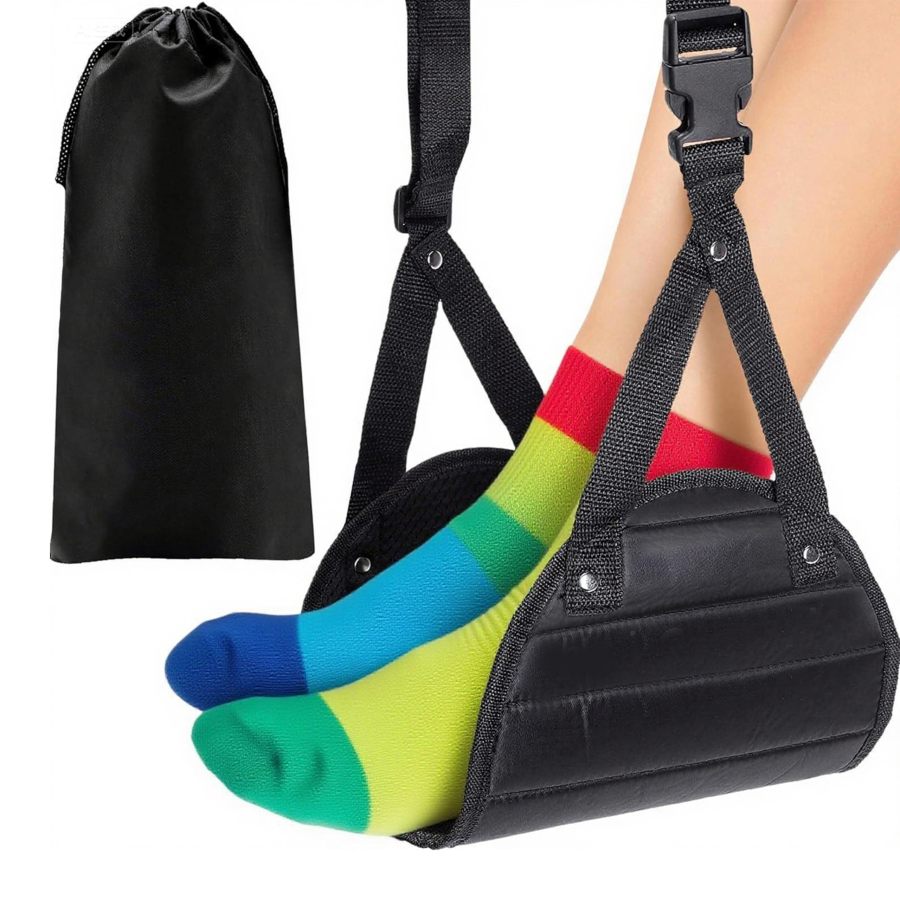
An airplane foot hammock is a portable foot support device primarily designed for long-distance travel (especially on airplanes, trains) and office settings. It elevates the user's feet by hanging or attaching to the seatback/table tray, alleviating leg fatigue, swelling, and discomfort caused by prolonged sitting, thereby providing a more comfortable posture. Product designs vary, from simple fabric slings to structured designs with hardboard supports and memory foam padding, all aimed at enhancing comfort during travel and work. The following table illustrates the key characteristics of consumer behavior in this category.
| Dimension | Segment | Description |
|---|---|---|
| Need Driver Type | Planned Purchase/Emergency-driven Purchase | Users purchase based on existing discomfort (e.g., leg discomfort from prolonged sitting) or anticipated needs (e.g., long-distance travel) to address specific pain points. |
| Purchase Frequency | Low Frequency/Seasonal | Typically a one-time purchase as essential travel or office gear, with long repurchase cycles, but demand surges during peak travel seasons or holidays. |
| Decision Complexity | Medium | Users compare different products based on design (support method, materials), portability, ease of use, and price, focusing on practical effectiveness. |
| Price Sensitivity | Medium-High | Consumers have certain price expectations for such practical small items; prices that are too high or too low may raise concerns about efficacy and quality. |
| Emotional Dependency | Medium | Primarily driven by functionality and practicality, but improved comfort can provide significant relaxation and peace of mind during travel. |
II. User Personas & Usage Scenarios
2.1 Frequent International Flyer
🎯 Frequently takes long-haul flights, especially in economy class, suffering from cramped legroom, dangling feet, swelling, and fatigue, seeking an economical and effective solution.
| Typical Usage Scenarios | Core Pain Points | Primary Purchase Drivers |
|---|---|---|
|
|
|
2.2 Office Worker/Remote Worker with Prolonged Sitting
🎯 Sits at a desk for long hours daily, especially while working from home, lacking proper foot support, leading to leg and back discomfort, pursuing a more ergonomic workspace.
| Typical Usage Scenarios | Core Pain Points | Primary Purchase Drivers |
|---|---|---|
|
|
|
2.3 Shorter Stature Adult/Child Traveler
🎯 Shorter adults or children whose feet cannot reach the floor on planes or in cars, needing extra support to avoid discomfort and unease from dangling legs.
| Typical Usage Scenarios | Core Pain Points | Primary Purchase Drivers |
|---|---|---|
|
|
|
III. User Needs Hierarchy (KANO Model)
3.1 Basic Needs (Must-Haves)
- Portability: Lightweight, foldable product, easy to store in carry-on luggage or backpack, without adding travel burden.
- Easy Installation: Quick, simple attachment under the tray table or desk, no complex tools needed, intuitive operation.
- Sufficient Load Capacity: Safely supports leg weight, not prone to damage or breakage, ensuring safety.
- Adjustability: Adjustable strap length to fit different heights and usage scenarios, finding the most comfortable height.
3.2 Performance Needs (Linear Satisfiers)
- Comfortable Materials: Uses memory foam, soft fabrics, etc., providing comfortable foot feel and cushioning, doesn't harden with prolonged use.
- Support Stability: Includes a hardboard (e.g., bamboo, cardboard) or special structure to prevent feet from sinking together or sagging, providing stable support.
- Alleviate Fatigue/Swelling: Effectively elevates feet, promotes blood circulation, reduces pressure on legs and lower back,显著提升舒适度.
- Durability: Sturdy stitching, high-density nylon straps, and wear-resistant fabric ensure the product withstands multiple long trips.
- No Disturbance to Front Passenger: Design should minimize shaking the front seat or encroaching on others' space during use, reducing awkwardness.
3.3 Excitement Needs (Delighters)
- Built-in Storage: Product itself folds and integrates a zippered storage pouch, no extra bag needed,更方便、不易丢失.
- Foot Zoning Design: Provides separate or partitioned foot placement areas to prevent feet from colliding or squeezing, enhancing experience.
- Multi-Scenario Adaptability: Can be easily used in offices, cars, trains, etc., beyond airplanes, with corresponding accessories, increasing product value.
- Included Accessories: Includes travel kits like eye masks, earplugs, enhancing the overall travel experience as a thoughtful surprise.
3.4 Unmet Needs & Opportunities
-
Effective Use in Extremely Tight Spaces: In extremely cramped economy class seats, many users find the product difficult to use comfortably or it interferes with the front passenger; a truly space-adaptive solution is still lacking.
User Reviews (VOC) Not enough room in Economy/ Coach seats to make this work. // I was constantly worried about bothering the person in the seat in front of me because every time I would put any pressure on the footrest I could see that it was moving the tray table in front of me.
-
Structural Stability After Long-Term Use: Some products with hardboards may still experience board warping, fabric sagging, or buckle loosening after multiple uses; users need more durable, non-deforming support.
User Reviews (VOC) After my third use it started bunch up under my feet. // one of plastic buckles broke the 1st time I used it.
-
Height and Adjustment Precision: For users of shorter stature, even at the shortest adjustment, the footrest may be too high, causing knees to be scrunched up, lacking a finer height adjustment mechanism.
User Reviews (VOC) Straps are too short. I extended the straps to the full length but the footrest was still too high (even for my short legs). I felt like my knees were scrunched up.
-
Universality and Compliance: Some airlines explicitly prohibit such hanging devices, causing purchase hesitation and actual usage risks for users.
User Reviews (VOC) Not allowed on Qantas flights - Check your airline options. // I have read that some airlines will not allow them.
-
Balance Between Portability and Support: Products with hardboards offer good support but sacrifice ultimate thinness/portability, remaining bulky when packed.
User Reviews (VOC) It's useful and makes a flight more comfortable but it's just too bulky.
IV. User Decision Drivers
4.1 Key Decision Factors
- Actual Comfort Improvement: Whether it effectively alleviates leg fatigue, swelling, and discomfort from long travel or sitting is the primary purchase purpose.
- Portability and Ease of Use: Whether the product is lightweight, easy to fold/store, and quick to install is key to users' willingness to carry and use it.
- Stable Support: Whether the feet get steady, non-sagging support, not a 'flimsy' feeling, directly impacts comfort.
- Applicability and Compliance: Whether it works effectively in actual airplane economy class space without disturbing passengers, and whether it's allowed by airlines.
4.2 Secondary Decision Factors
- Materials and Durability: Material feel, breathability, and overall craftsmanship affect long-term ownership意愿.
- Price and Value for Money: Whether the price is reasonable while meeting core needs, and if it offers额外价值 (e.g., multi-packs, included accessories).
- Size Adaptability: Whether it suits different heights (especially shorter individuals) or foot sizes, ensuring comfort for a wider user base.
- Multi-Scenario Functionality: Besides airplanes, whether it can be easily used in offices, cars, etc., increasing usage frequency and value.
V. Selling Points & Competitive Landscape
5.1 Selling Point Analysis
5.1.1 Standard Features (Points of Parity)
- Alleviate Fatigue/Swelling: Universally emphasizes elevating feet, improving circulation, reducing leg and lower back discomfort as the core function.
- Portable & Easy to Use: Highlights lightweight, foldable, easy installation, includes storage bag, convenient for travel.
- Adjustable Straps: Promotes adjustable strap length for different heights, customizable height and posture.
- Memory Foam Comfort: Widely uses memory foam as filling, emphasizing soft, comfortable foot feel and cushioning.
5.1.2 Key Differentiators
- Hardboard Support Design: Emphasizes built-in hardboard (bamboo, cardboard) to prevent foot sagging or bunching, providing more stable support.
- Multi-Scenario Versatility: Can be used in offices, trains, cars, etc., beyond airplanes, expanding usage value.
- 2-Pack/Multi-Pack: Offers multi-unit bundles, often including additional travel accessories like eye masks, earplugs.
- Foot Zoning Design: Product has foot separators to prevent feet from colliding, enhancing individual comfort.
5.1.3 Unique Selling Propositions (USPs)
- Built-in Zippered Storage: Product itself folds and zips closed, no extra storage bag needed,极致便携 (e.g., ASIN: B0DKXKKMLC).
- Strong Desk Clamp: Specifically provides a desk clamp for desktop use, enhancing stability in office scenarios (e.g., ASIN: B0DSKWD5XR).
- Female Founder Design: Emphasizes design by 'traveling moms' who better understand user needs and details (e.g., ASIN: B0F9XN97FJ).
- Waterproof, Easy-Clean Fabric: Uses waterproof fabric for easy cleaning, enhancing hygiene attributes (e.g., ASIN: B0DKXKKMLC).
5.2 Competitive Landscape
5.2.1 Market Maturity
The airplane foot hammock market is currently in mid-growth to maturity. Core functionalities and basic comfort selling points have become homogenized, indicating broad market awareness and acceptance of basic needs. However, there is still room for differentiation and innovation around deeper user experience pain points (e.g., space adaptability, structural longevity).
5.2.2 Innovation Trends
Current innovation trends are mainly evident in two areas: First, the continuous evolution of structural support, moving from pure fabric to built-in hardboards (bamboo, memory foam boards) to enhance foot support stability. Second, the expansion of multi-functionality; products are no longer limited to airplane use, starting to emphasize multiple scenarios like offices and cars, with specific accessories like desk clamps appearing to adapt to these new scenarios, aiming to increase daily usage frequency and value. Additionally, some brands are 也开始关注 product 收纳的便捷性 (e.g., built-in zippers) and brand stories (e.g., female founder design) to enhance emotional value and brand connection.
VI. Marketing Claims vs. Reality Check
The table below analyzes the gap between common marketing claims and actual user experiences in this category:
| Dimension | Marketing Claim | User Reality | Verdict |
|---|---|---|---|
| No Disturbance to Front Passenger / Economy Class Space Compatibility | Claims no disturbance to front passengers, suitable for all seats, provides free stretching space. | Multiple user reports indicate that in cramped economy class, the product shakes the front seat or there's insufficient legroom; some airlines explicitly ban such hanging devices. | Sellers deliberately avoid addressing the physical limitations of economy class, generalizing ideal usage scenarios, causing core promises to fail in the primary scenario, damaging user trust. |
| Balance Between Portability and Support | Claims极致轻便, easy storage, while providing hardboard stable support without sagging. | Users report that products with hardboards (e.g., bamboo, memory foam boards) remain bulky when packed, occupying significant carry-on space, contradicting '极致轻便' claims. | Sellers fail to transparently address the trade-offs in physical attributes, conflating the advantage of structural support with the expectation of ultimate portability, leading to a gap between user expectations and actual portability. |
| Durability | Claims premium materials, sturdy, durable, heavy-duty adjustable straps, safe load-bearing. | Multiple products have issues with buckle breakage, strap loosening, footpad curling or sagging, even failing on first use, far below advertised durability standards. | Sellers have defects in product quality control, causing core load-bearing components to fail in actual use, severely damaging user trust and brand image. |
Key Takeaway: The market exhibits widespread parameter inflation and exaggeration of scenario-based experiences, especially regarding portability, durability, and space adaptability.
VII. Supply-Demand Misalignment Analysis
The table below highlights mismatches between seller focus and buyer priorities:
| Dimension | Seller Behavior | User Focus | Verdict |
|---|---|---|---|
| Airline Restrictions/Usage Compliance | Sellers generally fail to proactively and clearly disclose the risk of airline bans, or provide only fine-print warnings, insufficiently highlighting compliance risks. | Users strongly worry about inability to use the product after purchase or being stopped by flight attendants, damaging travel experience, leading to returns and negative reviews. | Sellers fail to proactively fulfill the duty of disclosure, leaving users with significant uncertainty in purchase decisions, a direct risk leading to negative experiences and returns. |
| Front Passenger Disturbance | Sellers repeatedly emphasize 'no disturbance' in marketing, but product design doesn't fundamentally address the力学影响 on the front seat, lacking substantive innovation. | Users普遍抱怨 the product shakes the front seat, worry about disturbing others, have reservations during use, experiencing significant social pressure. | Sellers remain at the marketing level, failing to iterate product design to address the core social concern, causing a major gap in user experience. |
| Height Adjustment and Universality | Sellers overclaim the product 'fits all heights' (4ft to 7ft), attempting to cover all users, but actual adjustment range is limited. | Many shorter users report the footrest is still too high even at the shortest setting, causing uncomfortable knee scrunching, having the opposite effect. | Sellers make over-promises to pursue market coverage, ignoring actual ergonomic differences, leading to false promises and degraded experience for specific user groups (especially shorter individuals). |
Key Takeaway: Sellers are collectively silent on key pain points like airline policies and solutions for front passenger disturbance, while over-supplying feature stacks and low-value details, leading to supply-demand misalignment.
VIII. Strategic Opportunities & Recommendations
8.1 Independent Support, Non-Intrusive Foot Rest Solution
8.1.1 Target Audience & Pain Points
⚡️ Pain Points Addressed: Effective use in extremely tight spaces, no disturbance to front passengers, airline restrictions.
8.1.2 Action Plan
Develop inflatable or self-supporting footrests that don't rely on hanging from the front tray table, or use seat bottom/side armrest fixation systems. Optimize structure to absorb shaking, ensuring no感知 impact on the front passenger. Ensure compliance with major airline carry-on and safety regulations.
| Tech Complexity | Medium |
| Cost Impact | High Impact |
| Trade-off Warning | Might slightly increase product weight or packed volume; requires clever design balance. |
| Price Band | Only viable above $29.99 |
8.1.3 Marketing Strategy
Emphasize 'Private, Unobtrusive First-Class Experience', highlight the innovative design of 'No disturbance to front, no tray table needed'. Provide airline approval proof (or clear guidance) to eliminate user concerns, position as an 'Intelligent travel companion aligned with future flight trends'.
8.2 Height-Customized/Multi-Size Precision-Adjustable Footrest
8.2.1 Target Audience & Pain Points
⚡️ Pain Points Addressed: Insufficient height and adjustment precision, discomfort for shorter users.
8.2.2 Action Plan
Develop products in S/M/L sizes targeting different height ranges (e.g., below 1.6m and 1.6-1.8m), or introduce finer infinite adjustment systems. Optimize the minimum strap length to ensure shorter users' knees aren't overly bent. Provide detailed size selection guides and visual fit diagrams.
| Tech Complexity | Low |
| Cost Impact | Low Impact |
| Trade-off Warning | No significant physical side effects, mainly involves increased SKU management for production lines. |
| Price Band | Only viable above $14.99 |
8.2.3 Marketing Strategy
Promote 'Tailored for Your Legs, Say Goodbye to Flight Cramping'; emphasize precise adaptation to different heights, offer专属方案 for children and shorter adults, enhancing user-friendliness and细分市场吸引力.
8.3 Flagship-Level Structural Durability and Cleanable Design
8.3.1 Target Audience & Pain Points
⚡️ Pain Points Addressed: Insufficient structural stability after long-term use, buckle breakage, difficulty cleaning and maintaining materials.
8.3.2 Action Plan
Use aerospace-grade aluminum alloy or high-strength nylon for core load-bearing components (e.g., adjustment buckles, straps), ensuring durability through rigorous testing. Select waterproof, stain-resistant, and removable machine-washable fabrics, adopt modular design to significantly improve cleaning convenience. Offer long-term warranty承诺.
| Tech Complexity | Medium |
| Cost Impact | Medium Impact |
| Trade-off Warning | Using sturdier metal buckles might slightly increase weight; modular design requires optimization of assembly complexity. |
| Price Band | Only viable above $18.99 |
8.3.3 Marketing Strategy
Highlight 'One Investment, Ten Years of Comfort', emphasize 'Military-Grade Durability, Machine Wash Worry-Free'; build a high-quality,安心使用的 brand image through durability test videos and detachable cleaning demonstrations.
8.4 Ultra-Compressed/Ultra-Thin Hardboard Support Solution
8.4.1 Target Audience & Pain Points
⚡️ Pain Points Addressed: Balance between portability and support (bulkiness of hardboards), large packed volume.
8.4.2 Action Plan
R&D new lightweight, high-strength hardboard materials that can multi-directionally fold/roll (e.g., carbon fiber composites), or innovative folding structures, allowing the hardboard to provide stable support while being compressed to phone-size volume. Combine with ultra-light fabrics and components.
| Tech Complexity | High |
| Cost Impact | High Impact |
| Trade-off Warning | May require new composite materials, higher cost. Extreme thinness might require minor compromises on extreme load capacity. |
| Price Band | Only viable above $24.99 |
8.4.3 Marketing Strategy
Market as 'First Class in Your Pocket', emphasize 'Hardcore Support, Light as Nothing', showcase differentiation through high-tech materials and精巧结构. Target high-end, minimalist users,突出 the极致 balance between function and portability.