Amazon US Market Analysis: Electric Salt and Pepper Grinders Category
📊 Executive Summary
📈 Market Trends
Rechargeable electric grinders are the new favorite, with convenience driving consumption upgrades. The market is rapidly transitioning from traditional AAA battery power to USB-C fast charging and charging dock solutions, with consumer demand for cost savings, eco-friendliness, and long battery life becoming increasingly prominent. Automated operation and multi-level coarseness adjustment are now standard configurations, while appearance design and materials have become new competitive focal points.
⚡ Major Pain Points
Poor durability and battery anxiety are the core critical flaws. Users are generally dissatisfied with high short-term failure rates, salt corrosion causing grinder failure, and strongly complain about the cost and inconvenience of frequent battery replacement. Detail-level experience issues like gravity sensor accidental activation and ground residue spills also persistently affect user satisfaction.
💡 Selection Opportunities
Deep cultivation of quality and smart experience to achieve differentiated premium pricing. Market opportunities lie in developing long-lifespan, corrosion-resistant grinders to address users' most critical durability pain point. Simultaneously, enhance operational precision and convenience through smart anti-accidental activation and high-precision coarseness adjustment, combined with quiet, aesthetic design. Build high-value products in functional and experiential details to meet the needs of high-end consumers and those focused on quality of life.
I. Analysis Overview
1.1 Introduction & Report Scope
This report analyzes the 'Salt & Pepper Mill Sets' category (electric salt and pepper grinders) in the Amazon US market, focusing on target user personas, core needs, decision drivers, market communication, and potential opportunities.
1.2 Category Snapshot
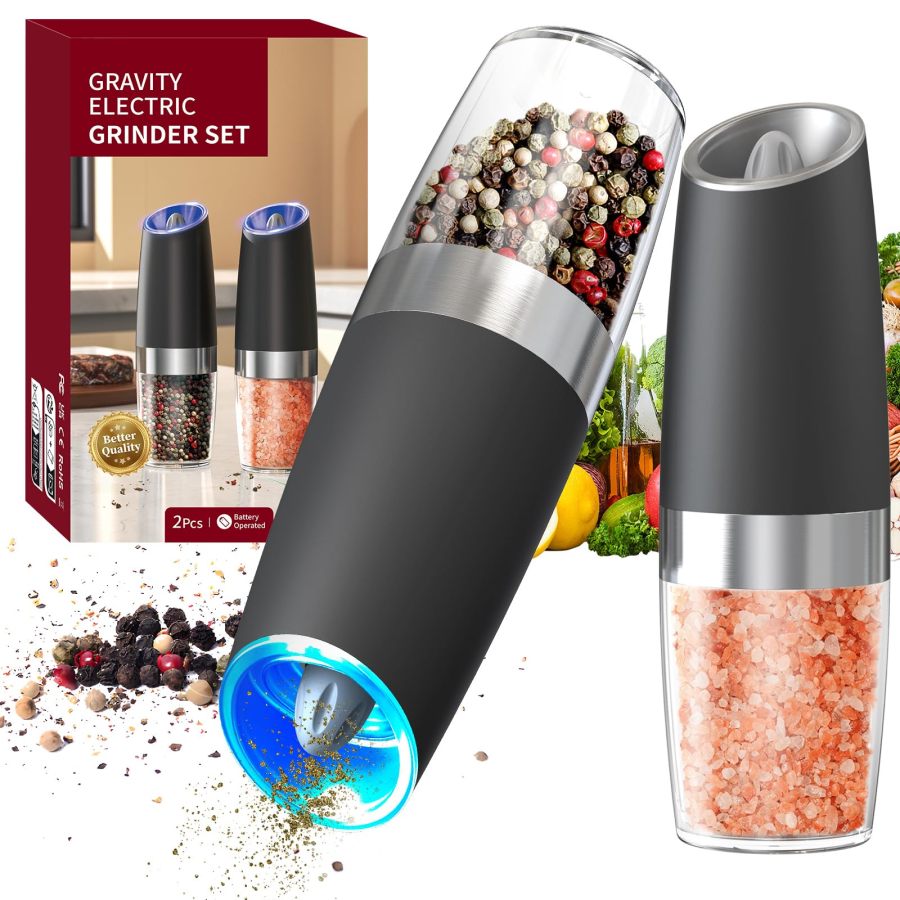
An electric salt and pepper grinder is a modern kitchen gadget designed to automatically grind spices via electric power, providing users with freshly ground salt and peppercorns. Its core advantage lies in freeing up hands, enabling one-handed operation, and allowing for adjustable grind coarseness based on cooking needs. The market primarily features two power supply methods: AAA battery-powered models and USB rechargeable models (some with independent charging docks). Operation is typically via gravity-sensing (tilt-to-start) or push-button mechanisms. The following table illustrates the key characteristics of consumer behavior in this category.
| Dimension | Segment | Description |
|---|---|---|
| Need Driver Type | Planned Purchase / Emergency-driven Purchase | User purchases are typically driven by anticipated cooking efficiency improvements, failure of a manual grinder, or an immediate need for convenient seasoning during gatherings or barbecues. |
| Purchase Frequency | Low Frequency | This type of product is a durable kitchen utensil with a low purchase frequency, typically bought for upgrades, replacements, or as a gift. |
| Decision Complexity | Medium | Consumers compare products based on brightness, battery life, grinding stability, additional features, and price, but do not conduct in-depth research. |
| Price Sensitivity | Medium to High | Price is an important consideration in the decision, but users are willing to pay a premium for significant experiential upgrades or solutions to core pain points. |
| Emotional Dependency | Medium | Primarily fulfills functional seasoning needs, but also provides emotional value such as 'enhancing cooking enjoyment' and 'demonstrating lifestyle taste', as well as social value when given as a gift. |
II. User Personas & Usage Scenarios
2.1 Efficiency-Seeking Modern Food Enthusiast
🎯 Values efficiency and experience in the cooking process, enjoys trying trendy kitchen tools, and seeks more convenient and precise seasoning.
| Typical Usage Scenarios | Core Pain Points | Primary Purchase Drivers |
|---|---|---|
|
|
|
2.2 Home User with Hand Discomfort / Elderly User
🎯 Has limited hand mobility due to arthritis, carpal tunnel syndrome, or age, requiring accessible, easy-to-operate seasoning tools.
| Typical Usage Scenarios | Core Pain Points | Primary Purchase Drivers |
|---|---|---|
|
|
|
III. User Needs Hierarchy (KANO Model)
3.1 Basic Needs (Must-Haves)
- Effective Grinding: Can grind spices into powder stably and quickly without jamming or idling, ensuring basic functionality.
- Adjustable Coarseness: Has the function to adjust grind coarseness to meet different cooking needs, providing basic seasoning flexibility.
- Easy to Refill: Spice chamber has a wide opening for easy addition of salt or peppercorns, minimizing refilling hassle.
- Easy to Clean: Product structure is designed for easy disassembly and cleaning to prevent spice residue buildup and ensure hygiene.
3.2 Performance Needs (Linear Satisfiers)
- One-Handed Operation: Gravity-sensing or one-touch operation for convenient one-handed seasoning while cooking, freeing the other hand.
- Long Battery Life / Charging: Large battery capacity, convenient USB charging, long usage per charge to reduce frequent charging or battery replacement hassle.
- LED Grinding Light: Built-in light at the base or grinding outlet to observe the output in low-light conditions and avoid overseasoning.
- Sturdy, Durable Materials: Uses materials like stainless steel housing, high-quality ceramic grinding cores to ensure long-term stable use and durability.
- Stylish Appearance: Simple, modern design that can serve as a decorative element on kitchen countertops or dining tables, enhancing home aesthetics.
3.3 Excitement Needs (Delighters)
- Integrated Charging Dock: Combines charging and storage, keeping the countertop tidy, preventing clutter or loss, and enhancing overall convenience and aesthetics.
- Dust/Spill-Proof Design: Features a bottom cover or special structure to effectively prevent ground residue from spilling onto the countertop, maintaining kitchen cleanliness.
- Quiet Operation: Low motor noise provides a quieter, more pleasant cooking experience, especially in open kitchens or during meals.
- Broader Compatibility: Can stably grind various dry granular spices (e.g., cumin, rosemary, Sichuan peppercorns) beyond salt and pepper, expanding usage scenarios.
3.4 Unmet Needs & Opportunities
-
Battery Life & Replacement Frequency: Users complain about requiring many AAA batteries that deplete quickly, increasing usage cost and replacement hassle, impacting eco-friendliness and convenience.
User Reviews (VOC) The only downfall is the each take 6 AAA batteries. // Customers report that the grinder requires six AAA batteries per unit, which they find excessive and that don't last long.
-
Insufficient Product Durability: Many users report product failure within a short period (weeks to months), such as motor failure, grinding head jamming, especially with salt grinders prone to corrosion.
User Reviews (VOC) Broke after 5 months. I messaged the seller but have not heard back. // One of them stopped working after 2 days for no apparent reason. Even after changing brand new batteries.
-
Grinding Uniformity & Fineness: Some products perform poorly at achieving very fine or very coarse grinds, or produce inconsistent results, affecting seasoning precision.
User Reviews (VOC) It also seems to become clump up or clogged in the process. // Customers have mixed experiences with the pepper grinder's performance, with some saying it works okay and others noting issues with uneven coarseness.
-
Accidental Activation & Countertop Cleanliness: Gravity-sensing models activate too easily with slight tilting; button models are prone to accidental presses when picked up; some lack bottom covers, causing ground residue spills and cleaning hassle.
User Reviews (VOC) I go to grab the grinder and invariably I hit the grind button when I grab it and get salt or pepper on the tablecloth. // It begins to grind when it's on its side, which causes a bit of a mess.
-
Charger Configuration & Universality: Some sets include only one charger or lack a charging plug, adding user inconvenience, and charging ports are prone to water damage or breakage.
User Reviews (VOC) Only comes with one charger. // a defect with the USB port making it very very difficult to insert the cable
IV. User Decision Drivers
4.1 Key Decision Factors
- Grinding Performance & Stability: The ability to provide stable, uniform, and adjustable grind coarseness without jamming or clogging over long-term use is the primary consideration for purchasing an electric grinder.
- Ease of Operation: Whether it supports one-handed operation, gravity sensing, or easy-to-press buttons to reduce burden during cooking or dining, especially crucial for users with hand mobility issues.
- Power Method & Battery Life: Choosing between models requiring frequent battery replacement versus convenient, long-lasting USB rechargeable models directly impacts usage cost and convenience.
- Product Durability: Whether the quality of the grinding core, motor, and housing ensures long-term use, avoiding short-term failures, especially the corrosion issue from salt on internal components.
4.2 Secondary Decision Factors
- Refilling & Cleaning: Whether the spice chamber is easy to open and refill, and if the product is convenient for daily cleaning and maintenance, especially if it's water-washable or easy to disassemble.
- Appearance Design & Material: Whether the product is stylish, aesthetically pleasing, and made of materials that convey quality and premium feel, coordinating with the overall kitchen or dining table style.
- Additional Features: Features like LED light brightness/color, dust cover, storage dock, etc., that enhance the user experience and add value.
- Price: After meeting core functionality and quality expectations, price is a key final factor in choosing among many options.
V. Selling Points & Competitive Landscape
5.1 Selling Point Analysis
5.1.1 Standard Features (Points of Parity)
- Automatic Operation: Most products emphasize gravity-sensing or one-touch start, freeing hands for convenient one-handed operation during cooking.
- Adjustable Coarseness: Adjust grind coarseness via a bottom dial or side knob to meet personalized seasoning needs.
- LED Lighting: Built-in LED light at the base during grinding to observe output in low light and avoid overseasoning.
- Easy to Use / Refill: Promotes simple, intuitive operation and an easy-to-open spice chamber for enhanced daily convenience.
5.1.2 Key Differentiators
- USB Charging / Charging Dock: Differentiates from traditional AAA battery power, emphasizing eco-friendliness, cost savings, and the convenience of centralized storage, especially with integrated dock designs.
- Large Capacity Design: Promotes reduced frequency of refills, suitable for families and heavy users, offering longer usage cycles.
- Premium Materials: Uses stainless steel housing, high-hardness ceramic grinding cores, emphasizing product durability and premium feel.
- Gift Packaging: Some products highlight elegant gift box packaging, positioning them as ideal gifts for holidays or housewarmings, adding product value.
5.1.3 Unique Selling Propositions (USPs)
- External Coarseness Adjustment: A few products offer an external adjustment dial, allowing changes without touching spices, improving hygiene and operational convenience.
- Dust Cover / Storage Dock: Includes a dock or dust cover to effectively prevent ground residue spills, maintaining countertop cleanliness and tidiness.
- Quiet Motor: Emphasizes low-noise operation for a quieter, more pleasant cooking experience, reducing noise disturbance.
- Visible Spice Chamber: Transparent container design allowing clear visibility of spice levels and types for timely refills and differentiation.
5.2 Competitive Landscape
5.2.1 Market Maturity
The electric salt and pepper grinder market has reached a medium-to-high maturity stage. Core functionality is widespread, and product homogenization is evident. Competition now focuses on brand, design details, power solutions, and price points. New entrants need to offer more significant value propositions to stand out, with price wars being particularly fierce in the low-end market.
5.2.2 Innovation Trends
Current innovation centers on optimizing user experience: a full transition from disposable batteries to USB-C fast charging and integrated charging docks to address battery life and convenience pain points; more refined ergonomic designs (e.g., anti-accidental activation, lighter weight); emphasis on material durability and ease of cleaning; and pursuit of simpler, more modern aesthetic designs to better integrate into home environments. Quiet operation and more precise grind settings are also emerging as new selling point directions.
VI. Marketing Claims vs. Reality Check
The table below analyzes the gap between common marketing claims and actual user experiences in this category:
| Dimension | Marketing Claim | User Reality | Verdict |
|---|---|---|---|
| Battery Life & Power Method | Long-lasting battery life, fast charging, goodbye to frequent battery changes. | Some products still require many AAA batteries (6-12 per set), with user feedback indicating quick depletion; even for rechargeable products, actual battery life often falls short of claims, with contradictory data. | Sellers excessively package battery life claims and selectively ignore the additional cost and inconvenience of disposable batteries, severely misleading consumers and diminishing long-term product value. |
| Product Durability | High-quality stainless steel/ceramic grinding core, long-lasting durability. | Numerous users report product failure within weeks to months, such as motor failure, grinding head jamming (especially salt grinders prone to corrosion), far below user expectations for 'high quality'. | A significant gap exists between material claims and actual durability. Cost-cutting or simplified design sacrifices core functional lifespan, severely damaging user experience. |
| Operational Anti-Accidental Activation & Countertop Cleanliness | Gravity-sensing automatic grinding, freeing hands, keeping the kitchen tidy. | Gravity sensors are overly sensitive, activating with minimal tilt; button models are prone to accidental presses when picked up; some products lack bottom dust covers, causing ground residue spills and cleaning hassle. | The original intent of automated design was convenience, but it overlooks the need for foolproofing and spill prevention in actual use, turning convenience into extra cleaning burden and operational frustration. |
Key Takeaway: The market exhibits widespread parameter inflation and exaggeration of scenario-based experiences, particularly regarding battery life, grinding performance, and durability. A few brands even have basic contradictions in battery information.
VII. Supply-Demand Misalignment Analysis
The table below highlights mismatches between seller focus and buyer priorities:
| Dimension | Seller Behavior | User Focus | Verdict |
|---|---|---|---|
| Product Longevity & Quality Assurance | Sellers commonly emphasize 'high-quality materials', 'ceramic grinding core', etc., but rarely provide specific commitments in listings regarding long-term durability, corrosion resistance, or extended warranties, nor do they showcase rigorous durability testing. | User reviews repeatedly contain negative feedback like 'broke', 'stopped working', 'motor died', clearly expressing serious dissatisfaction with product lifespan, feeling it's 'not worth the price'. | Sellers have failed to provide reliable solutions or effective communication on the most fundamental product quality issue, leading to continuous erosion of user trust. This is the category's biggest structural problem. |
| Charging Convenience & Actual Needs | Some sellers still insist on using many AAA batteries (6 per unit), even promoting it as a selling point, or provide only a USB cable without a charging plug, lagging behind the market's mainstream rechargeable integrated dock solutions in charging experience. | Users strongly prefer USB charging, especially solutions with charging docks, complaining about quick battery drain, frequent replacement hassle, high cost, and lack of eco-friendliness. | Traditional battery-powered models are increasingly becoming a user pain point. Sellers not actively upgrading charging solutions face market obsolescence risk. Overemphasizing 'easy to put batteries in' rather than 'eliminating batteries' is typical self-congratulatory marketing. |
| Grinding Noise & Uniformity | Most sellers rarely mention noise levels during grinding, or only vaguely mention 'quiet operation'. They also lack quantitative demonstrations or commitments regarding grind uniformity and precision across different coarseness settings. | Users provide sporadic feedback about grinders being 'too loud', 'grinding unevenly', or 'unable to achieve a very fine grind', indicating these issues, while not primary return reasons, affect user experience and perception of 'professional grade'. | Sellers under-invest in user experience details, failing to elevate the grinder from 'usable' to 'enjoyable to use', missing opportunities for differentiation and premium pricing through attention to detail. |
Key Takeaway: Sellers generally over-invest marketing resources in 'automation' and 'appearance design', while collectively under-communicating or inadequately addressing users' core concerns about 'long-term product stability' and 'hassle-free actual use'.
VIII. Strategic Opportunities & Recommendations
8.1 Long-Lifespan, Corrosion-Resistant Electric Grinder
8.1.1 Target Audience & Pain Points
⚡️ Pain Points Addressed: Insufficient product durability, salt corrosion, motor failure.
8.1.2 Action Plan
Upgrade the core grinding structure (including motor shaft and grinding core connectors) to all-ceramic or food-grade 316 stainless steel. Implement triple-protection (dustproof, waterproof, corrosion-resistant) for the battery compartment. Offer a 2-3 year warranty for non-manufacturing defects and clearly label materials and testing standards.
| Tech Complexity | Medium |
| Cost Impact | High Impact |
| Trade-off Warning | Using higher-quality anti-corrosion materials and precision motors may slightly increase product weight or cost, requiring positioning in the high-end price segment. |
| Price Band | Only viable above $39.99 (single unit) |
8.1.3 Marketing Strategy
Emphasize 'Carrier-grade corrosion resistance, crafted to last for years'; showcase internal anti-corrosion details via exploded-view diagrams; highlight the core value of 'The professional choice, built to last, one investment for lasting peace of mind', and offer an extended warranty promise.
8.2 Smart Anti-Accidental Activation & Self-Cleaning Grinder
8.2.1 Target Audience & Pain Points
⚡️ Pain Points Addressed: Gravity sensors prone to accidental activation, overly sensitive buttons, ground residue spills.
8.2.2 Action Plan
Add 'smart wake' or 'tilt angle threshold' design to gravity-sensing grinders to prevent accidental activation. Button-operated models can feature a protective cover or require a long press. Add a detachable, magnetic or snap-on sealed dust cover at the base, and consider a self-cleaning scraper.
| Tech Complexity | Medium |
| Cost Impact | Medium Impact |
| Trade-off Warning | Adding smart sensors may slightly increase power consumption or product size, but this is manageable. |
| Price Band | Only viable above $29.99 (set) |
8.2.3 Marketing Strategy
Emphasize 'Smart anti-accidental activation, goodbye to messy countertops'; demonstrate spill prevention and easy cleaning advantages via video; highlight 'Uninterrupted cooking, enjoy worry-free seasoning', offering a more secure and hassle-free experience.
8.3 High-Precision, Stepless Adjustable, Rechargeable Grinder
8.3.1 Target Audience & Pain Points
⚡️ Pain Points Addressed: Insufficient grinding uniformity and fineness, high battery consumption, inconvenient charging.
8.3.2 Action Plan
Adopt more precise ceramic grinding teeth and a stepper motor to achieve stepless or more granular (e.g., 10+) coarseness adjustments, ensuring uniformity for each grind. Fully adopt USB-C charging solutions and include dual charging docks.
| Tech Complexity | Medium |
| Cost Impact | Medium Impact |
| Trade-off Warning | A stepless adjustment mechanism may increase structural complexity but significantly enhances user experience. |
| Price Band | Only viable above $34.99 (set) |
8.3.3 Marketing Strategy
Promote 'Stepless seasoning, control flavor at the millimeter level'; showcase uniformity across different coarseness levels with high-definition macro photos; highlight 'Professional-grade grinding core, unlocking true ingredient flavor' to attract advanced users with precision, while emphasizing charging convenience.
8.4 Minimalist, Quiet, Aesthetic Grinder Set
8.4.1 Target Audience & Pain Points
⚡️ Pain Points Addressed: Loud grinding noise, insufficient material feel, homogenized appearance.
8.4.2 Action Plan
Use optimized motors and sound-dampening structures to control noise below 60dB. Choose integrated matte stainless steel or high-quality matte ABS for the body, paired with minimalist design. Offer color choices in black, white, gray, or muted pastel tones.
| Tech Complexity | Low |
| Cost Impact | Low Impact |
| Trade-off Warning | Quiet operation structures and premium materials will slightly increase cost but are manageable and do not affect core functionality. |
| Price Band | Only viable above $24.99 (set) |
8.4.3 Marketing Strategy
Emphasize 'Quiet cooking, gentle seasoning'; highlight 'Minimalist design, illuminating kitchen aesthetics'; showcase premium texture with product photos, and compare grinding noise in videos to create a quiet, comfortable kitchen atmosphere.