Amazon US Market Analysis: Handheld Electric Milk Frother Category
📊 Executive Summary
📈 Market Trends
Strong demand for electric handheld milk frothers, evolving towards higher quality, multi-functionality, and wireless operation. The trend of consumers making coffee and beverages at home continues to grow, driving demand for convenient, efficient handheld frothers. The market is gradually shifting from simple battery-powered models to USB rechargeable, multi-speed, multi-attachment options. User expectations for product experience and feature integration are rising, though price sensitivity remains.
⚡ Major Pain Points
Product durability, operational splashing, and main body waterproofing are core pain points. Most handheld frothers suffer from short-term motor failure or lack of main body waterproofing, leading to short product lifespans and high cleaning risks. Additionally, many products, being overly powerful and lacking fine speed control, easily cause liquid splashing during single-cup use, severely impacting the daily experience. Battery-powered models also commonly have inconvenient battery installation and poor-quality included batteries.
💡 Selection Opportunities
Deepen focus on quality details, pursue pragmatic innovation, and enhance the full user journey experience. Core opportunities lie in: strengthening main body waterproofing and motor durability to reduce failure rates and address the biggest user reliability pain point; optimizing speed control and anti-splash design to improve daily operational convenience. For different power sources, optimize charging system reliability or battery compartment design respectively to enhance user experience. Marketing must return to the product's true value, avoid over-promising, and build long-term trust and brand loyalty by solving user pain points, enabling differentiation in a homogenized market.
I. Analysis Overview
1.1 Introduction & Report Scope
This report analyzes the 'Milk Frothers' category (handheld electric milk frothers) in the US Amazon market, focusing on target user personas, core needs, decision drivers, market communication, and potential opportunities.
1.2 Category Snapshot
A handheld electric milk frother is a compact, portable kitchen appliance primarily designed for quickly frothing milk, creamer, or plant-based milk to create the rich foam needed for coffee drinks (latte, cappuccino), matcha, or hot chocolate. It can also be used for mixing protein powder, eggs, etc. The category addresses the need for cafe-quality beverages at home with its immediacy and ease of use, making it an ideal choice for modern home coffee enthusiasts. The following table illustrates the key characteristics of consumer behavior in this category.
| Dimension | Segment | Description |
|---|---|---|
| Need Driver Type | Planned Purchase/Habitual Purchase | Purchases are typically driven by daily coffee or beverage-making habits, a pursuit of efficiency and quality, or a planned purchase to enhance the at-home living experience. Some purchases are impulsive due to the product's portability and low price, with gift-giving also accounting for a portion of sales. |
| Purchase Frequency | Low Frequency/Habitual Use | As a small appliance, the purchase frequency is low, typically a one-time buy. However, once owned, daily use (high frequency) becomes habitual, especially for daily coffee or fitness drink preparation. |
| Decision Complexity | Medium | Consumers compare product features (e.g., power source, speed settings, attachments), brand reputation, durability, and price, but typically do not conduct deep technical research. They place greater emphasis on value for money and immediate results. |
| Price Sensitivity | Medium | The market price range is moderate ($6-$40). Users are relatively price-sensitive towards handheld models but are willing to pay a reasonable premium for features like USB charging, multi-functionality, multi-speed settings, or higher quality. |
| Emotional Dependency | Medium | The product not only meets the functional need for frothing but also delivers emotional value through the at-home cafe experience, enhancing life's rituals and personal enjoyment, commanding a certain degree of mental premium. |
II. User Personas & Usage Scenarios
2.1 Daily Coffee/Beverage Enthusiast
🎯 Makes lattes, cappuccinos, matcha, or protein shakes at home daily, seeking convenient and efficient tools to enhance lifestyle quality and save on out-of-home expenses.
| Typical Usage Scenarios | Core Pain Points | Primary Purchase Drivers |
|---|---|---|
|
|
|
2.2 Quality & Function-Focused Home User
🎯 A home coffee enthusiast who values beverage taste, device durability, and overall experience. Willing to pay a premium for rechargeable models, multi-functionality, and longer warranties. Desires simple operation and low maintenance.
| Typical Usage Scenarios | Core Pain Points | Primary Purchase Drivers |
|---|---|---|
|
|
|
III. User Needs Hierarchy (KANO Model)
3.1 Basic Needs (Must-Haves)
- Rapid and Efficient Frothing: The fundamental requirement is the ability to produce at least basic froth in a short time (within seconds).
- Easy to Clean: The product must be quick and easy to clean after use, leaving no residue. The whisk head should be washable; otherwise, usage frequency will significantly drop.
- Food-Grade Safe Materials: The whisk head must be made of food-grade stainless steel to ensure safety and be free of odors.
- Sturdy, Secure Whisk Head: The whisk head should remain stable without wobbling or detaching easily during high-speed operation, ensuring safety and performance.
3.2 Performance Needs (Linear Satisfiers)
- Powerful and Stable Motor: Sufficiently powerful motor to easily froth milk, creamer, protein powder, and other liquids without significant power degradation.
- Long Battery Life: Both battery-powered and rechargeable models should offer sufficient runtime to minimize the hassle of frequent charging or battery replacement.
- Portable Storage Solution: Includes a storage stand or protective case, with a compact design for tidy storage on countertops or in drawers, saving space.
- Wireless Portability: Lightweight product without power cord restrictions, convenient for use in the kitchen, office, or while traveling.
3.3 Excitement Needs (Delighters)
- USB-C Charging: Universal, eco-friendly, and fast charging interface, eliminating the hassle of frequent battery purchase and replacement, enhancing user experience.
- Multi-Speed/Infinitely Variable Speed Control: Offers multiple speed options or variable speed control, allowing users to precisely adjust froth texture and mixing intensity for different beverages and needs, preventing splashing.
- Multiple Whisk Attachments: Includes various interchangeable whisk heads (e.g., spring, balloon, hook) for multi-purpose use, meeting diverse kitchen needs (whisking eggs, mixing thick liquids).
- LED Battery/Speed Display: Visually displays real-time battery level and current speed, providing users with accurate device status, enhancing certainty and a professional feel.
3.4 Unmet Needs & Opportunities
-
Core Function Short-Term Failure: Multiple products experience significant motor power degradation, complete failure, or switch malfunction within months of normal use (commonly 3-8 months), severely undermining user trust in long-term reliability.
User Reviews (VOC) Unit quit after 6 months. // It stopped working after a few weeks of use, but the customer service was quick to address the issue and sent me a replacement unit. // Product DIED after 8 weeks.
-
Inadequate Main Body Waterproofing: Many handheld products have non-waterproof main bodies. Accidental wetting or rinsing can lead to damage and total loss, requiring careful cleaning and increasing usage risk and maintenance burden.
User Reviews (VOC) I did unfortunately put the handle in my sink and it got too wet (not submerged) and did not work and I had to order another one. // Do not immerse the body of the machine in the water.
-
Single-Cup Preparation Prone to Splashing: Some handheld models are overly powerful, causing contents to splash out of the cup even at low speeds or with small liquid volumes, creating a messy countertop. Users need to adjust technique or use different containers.
User Reviews (VOC) Even on the low setting, it has too much speed and throws the liquid up over the sides and all over. // If your used to the batter powered frother/mixers (like I was) then you'll be surprised by the power of this one, which can be problematic if you use a small cup or start off with more speed.
-
Difficult Battery Compartment (Battery-Powered Models): Some battery-powered models have overly tight battery compartments, making it difficult to insert or remove batteries smoothly, increasing maintenance hassle and user frustration.
User Reviews (VOC) Battery compartment is SO TIGHT I needed a spoon to Shove them in, and a butter knife for Popping them out. // I only had issues placing the batteries. For some odd reason it was as if the batteries didn't fit right.
IV. User Decision Drivers
4.1 Key Decision Factors
- Actual Frothing Performance & Speed: The ability to produce fine, dense, and long-lasting froth quickly is the core consideration and potential deal-breaker for users, directly impacting beverage taste and quality.
- Product Durability & Reliability: Motor lifespan, likelihood of failure, and warranty service directly influence long-term user trust and repurchase intent.
- Power Mode & Battery Life: The hassle-free runtime of USB charging (especially compared to batteries) and long-term cost of ownership are significant purchase influencers. Users favor more eco-friendly and convenient charging methods.
- Easy Cleaning & Maintenance: How quick and convenient the cleaning process is, and whether the handle is waterproof, directly impacts daily usage frequency and user experience. Reducing cleaning burden is a key consideration.
4.2 Secondary Decision Factors
- Multi-Functionality: Beyond frothing, whether it can mix protein powder, whisk eggs, blend other drinks, and offer multiple whisk attachments to enhance practical value.
- Portability & Storage: Product's lightweight nature, inclusion of a stand or case for tidy storage, and convenience for use in various settings (home, office, travel).
- Multi-Speed Control: Offering different speed options to meet user needs for precise control over froth texture and mixing intensity, preventing splashing.
- Noise Level: Operating noise, especially during early morning or nighttime use, affecting user experience and home tranquility.
- Price & Value for Money: Whether the price is reasonable and offers high value for money, assuming core functions and quality are met, is a key trade-off in the final decision.
V. Selling Points & Competitive Landscape
5.1 Selling Point Analysis
5.1.1 Standard Features (Points of Parity)
- Creates Rich Froth in Seconds: The core selling point emphasized by all electric handheld milk frothers, meeting the need to quickly make cafe-quality beverages, directly demonstrating product value.
- Multi-Purpose Use: Commonly claimed to be suitable for coffee, lattes, matcha, hot chocolate, protein powder, and other drink mixing, highlighting multi-scenario applicability.
- Easy to Clean: Emphasizes convenience and speed through simple rinsing of the whisk head, encouraging frequent daily use and reducing cleaning burden.
- Lightweight and Portable: Handheld models emphasize wireless, lightweight design for easy carrying and use anytime, anywhere, without space constraints.
- Stainless Steel Whisk: Emphasizes food-grade 304 stainless steel material, ensuring safety and durability, a commonly used base material.
5.1.2 Key Differentiators
- USB Charging/Built-in Battery: Differentiates from traditional battery-powered models, emphasizing eco-friendliness, convenience, and long runtime. Represents a market upgrade trend addressing the pain point of frequent battery changes.
- Multi-Speed Control: Offers 2-9 speeds or even infinitely variable speed, meeting user needs for precise control over froth texture and mixing intensity, preventing splashing, and enhancing a professional feel.
- Includes Storage Stand/Protective Case: Facilitates tidy storage on countertops or provides protection during travel. Some designs are more aesthetically pleasing, addressing the storage pain point.
- Multiple Whisk Attachments: Provides different shaped whisk heads (e.g., spring, balloon, hook), further expanding product functionality (e.g., whisking eggs, mixing thick liquids), increasing multi-purpose value.
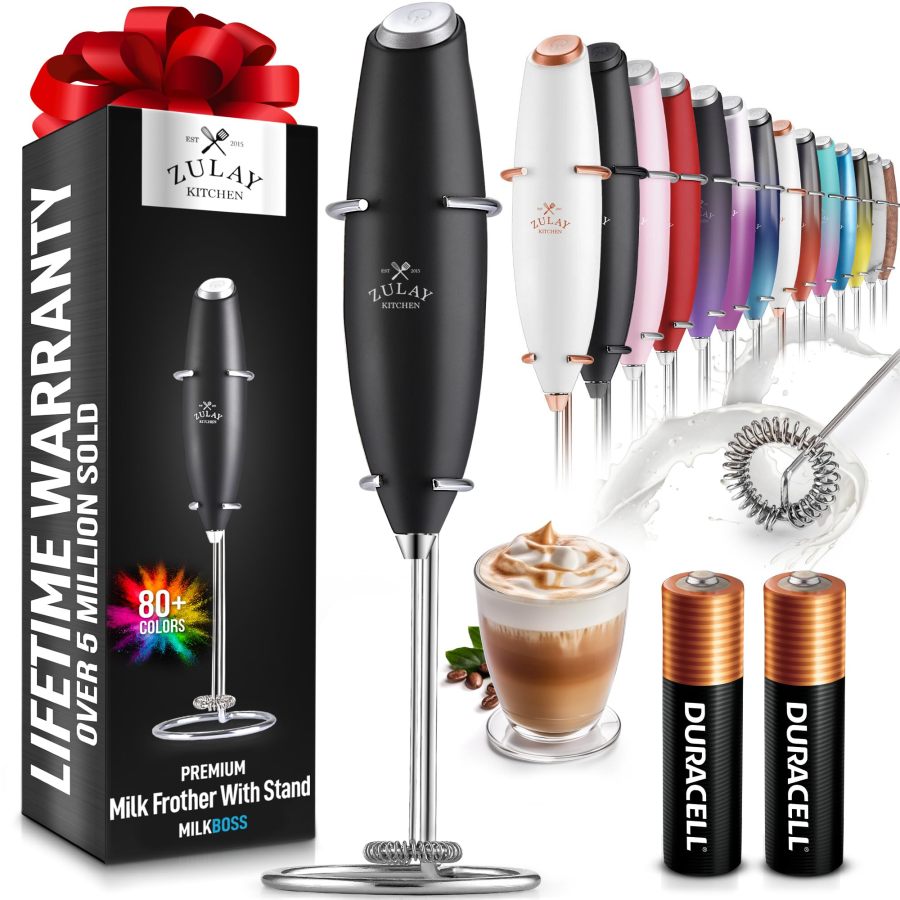
- Brand Warranty/After-Sales Service: Some brands (e.g., Zulay Kitchen, FoodVille) build trust by emphasizing lifetime warranties or long-term service, mitigating potential concerns about product lifespan.
5.1.3 Unique Selling Propositions (USPs)
- LED Battery/Speed Display: Found in very few premium products, provides an intuitive interface and real-time feedback, enhancing user experience and a sense of technology.
- Wireless Magnetic Charging Dock: A few products offer this more convenient charging method, improving charging ease and product premium feel.
- Double Spring/Triple Spiral Whisk: Some products use more efficient or innovatively designed whisk heads, claiming to produce denser, more uniform froth, enhancing the core functional experience.
- Unique Aesthetic Design/Color: Examples include Paris Hilton's pink line. Differentiates through design and color to attract users with specific aesthetic preferences, increasing gift appeal.
5.2 Competitive Landscape
5.2.1 Market Maturity
The electric handheld milk frother market has entered a mature stage. Basic consensus has been formed on core frothing and convenience, leading to severe product homogenization. Most product selling points are similar, with competition primarily based on price. Differentiation mainly lies in power source (battery vs. rechargeable), multi-functional attachments, speed control, and brand after-sales service. Overall market growth is stable but lacks disruptive innovation.
5.2.2 Innovation Trends
Current innovation trends focus on enhancing user experience and addressing existing pain points. Specific manifestations include: a full transition from battery-powered to USB rechargeable models for longer runtime and eco-friendly convenience; adding multi-speed control and interchangeable whisk heads for multi-purpose use and finer control; improving product durability and main body waterproof ratings to reduce failure rates; and incorporating smart features like LED displays to improve usability and a sense of technology.
VI. Marketing Claims vs. Reality Check
The table below analyzes the gap between common marketing claims and actual user experiences in this category:
| Dimension | Marketing Claim | User Reality | Verdict |
|---|---|---|---|
| Product Durability & Lifespan | High-quality materials, rust-proof, non-breakable, lifetime warranty. | Numerous user feedback indicates products experience significant motor power degradation or complete failure within months (3-8 months) of normal use, with some having faulty switches. Despite warranties, frequent failures cause significant user inconvenience. | Sellers use after-sales promises to mask inherent deficiencies in the lifespan of core components (motor, switch), exaggerating the 'unbreakable' physical reality. This leads to user fatigue with after-sales processes and fundamentally damages product reputation. |
| Handheld Main Body Waterproofing | Easy to clean, just rinse the whisk head with water. | Many handheld products explicitly or implicitly state the main body (handle) is not washable; accidental wetting or immersion can lead to total loss. This contradicts the intuitive understanding of 'easy to clean,' requiring careful handling during cleaning. | This is a classic 'functionality vs. usability paradox.' The claimed ease of cleaning does not extend to overall waterproof design, exposing users to a high risk of accidental damage during the frequent cleaning scenario. |
| Single-Cup Anti-Splash Capability | Powerful motor, precise frothing, no splashing. | Some handheld models easily cause liquid to splash when mixing in small cups, even at the lowest setting, due to excessive power. Users must develop their own techniques or use larger containers, contradicting the 'precise, no-splash' claim. | Sellers overemphasize 'power' while neglecting the importance of 'controllability' in daily use, failing to provide solutions adapted to small-volume scenarios, resulting in a 'negative surprise' for user experience. |
| Battery/Charging System Reliability | USB charging, long-lasting battery, no need for frequent battery changes. | Some rechargeable models develop charging failures or inability to hold a charge after weeks to months of use, rendering the product useless. Battery-powered models often come with expired or low-quality included batteries, requiring users to purchase their own. | Sellers over-package promises regarding charging convenience and battery life. The quality and stability of core battery or charging modules fail to match the宣传, negating the charging advantage and turning it into a user pain point. |
Key Takeaway: The market exhibits widespread parameter inflation and scenario-based experience exaggeration, particularly regarding product durability, noise level, battery life, and main body waterproofing. A significant gap exists between marketing promises and actual user experience, leading to user complaints and eroded trust.
VII. Supply-Demand Misalignment Analysis
The table below highlights mismatches between seller focus and buyer priorities:
| Dimension | Seller Behavior | User Focus | Verdict |
|---|---|---|---|
| Product Durability & Long-Term Reliability | Commonly emphasize broad concepts like 'high-quality materials' and 'lifetime warranty' but fail to fundamentally address short-term motor failure or component damage through product design and quality control. | Users complain about products breaking after a few months, requiring frequent warranty processes, adding unnecessary hassle and eroding brand trust. | Sellers use after-sales promises as a remedy rather than improving product quality and lifespan at the source. This subjects users to reliability challenges early on, severely impacting user retention. |
| Single-Cup Small Volume Anti-Splash | Most products emphasize 'powerful motor' and 'fast frothing' but rarely offer anti-splash solutions for small cups or finer low-speed control. | Users report that frothing in regular coffee cups easily splashes liquid, forcing them to use larger mugs or operate with extreme care, significantly diminishing the daily user experience. | In the pursuit of ultimate speed and power, sellers overlook users' practical needs for 'precise operation' and 'countertop cleanliness' in daily scenarios, resulting in a usability shortfall. |
| Handheld Main Body Waterproof Protection | Commonly advertise 'easy to clean,' but product instructions or user feedback reveal the main body is not waterproof, posing a significant risk during cleaning, without effective preventive measures in design or communication. | Users have damaged products due to accidental wetting, feeling confused and dissatisfied with the operational risk during cleaning, perceiving a lack of user-centric design consideration. | Sellers fail to fully consider the 'easy to clean' selling point, ignoring the inherent risk of electronics contacting water, leading to user loss due to information asymmetry during use. |
| Battery-Powered Model Battery Compartment Design & Included Batteries | Battery-powered models only mention 'portability' but overlook practical design details of the battery compartment, leading to user difficulty in changing batteries or poor quality included batteries. | Users complain about batteries being hard to insert or remove, requiring tools; or receiving expired included batteries, affecting the out-of-box experience. | Sellers neglect the 'micro-experience' during product maintenance. These accumulated minor pain points significantly impact overall user satisfaction and long-term usage intent. |
Key Takeaway: Sellers generally over-rely on 'powerful motor' and 'portability' for marketing, while collectively remaining silent or inadequately addressing core user pain points frequently encountered in actual use, such as 'product durability,' 'operational splashing,' and 'cleaning safety hazards.'
VIII. Strategic Opportunities & Recommendations
8.1 Enhance Handheld Main Body Waterproofing & Core Component Durability
8.1.1 Target Audience & Pain Points
⚡️ Pain Points Addressed: Inadequate main body waterproofing, core function short-term failure.
8.1.2 Action Plan
Redesign sealing structures for battery compartments, buttons, and handle-body connections to achieve at least IPX4 splash resistance. Consider conformal coating for PCBs. Select longer-lasting brushless motors and high-quality switch components, conducting stricter long-term lifespan testing.
| Tech Complexity | Medium |
| Cost Impact | Medium Impact |
| Trade-off Warning | Improving waterproof rating may slightly increase product size or cost, but impact can be minimized through optimized structural design. Using more durable motors and switches increases unit cost but significantly reduces after-sales issues and improves reputation. |
| Price Band | Only viable above $19.99 |
8.1.3 Marketing Strategy
Emphasize 'Full-body splash-proof, clean without worry, goodbye accidental loss!' and 'Upgraded core motor, durable and long-lasting, performs like new for years.' Offer extended warranty promises (e.g., 2 years). Use comparison test videos to showcase waterproof and durability advantages, building a premium, reliable image.
8.2 Achieve Handheld Single-Cup Anti-Splash & Multi-Speed Precise Control
8.2.1 Target Audience & Pain Points
⚡️ Pain Points Addressed: Single-cup preparation prone to splashing, lack of speed control.
8.2.2 Action Plan
Introduce at least 3-speed control, optimizing the lowest speed to minimize splashing in small cups or shallow containers. Add a 'soft start' feature for a buffer period to fully immerse the whisk. Consider offering two whisk head sizes for different cup sizes and liquid viscosities.
| Tech Complexity | Medium |
| Cost Impact | Medium Impact |
| Trade-off Warning | Adding motor controller and button complexity may slightly increase cost but has no significant physical side effects. |
| Price Band | Only viable above $14.99 |
8.2.3 Marketing Strategy
Highlight 'Customize for one cup, precise and splash-free' and 'Variable speed, control the perfect taste.' Use demo videos to showcase fine control at different speeds. Emphasize advantages of 'beginner-friendly' and 'countertop clean,' attracting users with higher experience demands.
8.3 Optimize Rechargeable Model Battery System Reliability & Lifespan
8.3.1 Target Audience & Pain Points
⚡️ Pain Points Addressed: Charging port failure or battery degradation.
8.3.2 Action Plan
Select higher-quality lithium battery cells and optimize the Battery Management System (BMS) to prevent overcharge/discharge, extending battery life. Reinforce the physical mounting and internal soldering of the USB-C port to reduce damage from frequent plugging/unplugging. Clearly state actual runtime testing standards in listings.
| Tech Complexity | Medium |
| Cost Impact | Medium Impact |
| Trade-off Warning | Using higher-quality battery cells and more stable charging management ICs may slightly increase product cost with minimal impact on size. Upgrading the Type-C port's mounting structure enhances durability. |
| Price Band | Only viable above $19.99 |
8.3.3 Marketing Strategy
Emphasize 'Long-lasting power, goodbye battery anxiety' and 'Stable charging, built to last.' Strengthen trust with battery cycle life test reports and real-user runtime data. Position the product as a 'one-time investment, long-term enjoyment' reliable companion.
8.4 Optimize Battery-Powered Model Battery Compartment & Provide Rechargeable Batteries
8.4.1 Target Audience & Pain Points
⚡️ Pain Points Addressed: Poor battery compartment installation experience, included battery quality issues.
8.4.2 Action Plan
Redesign battery compartment cover and internal contact structure to ensure smooth battery insertion/removal. Add an easy-grip battery removal ribbon. If cost allows, upgrade included batteries to reputable brand (e.g., Energizer) high-quality long-life AA batteries, or offer an option to purchase rechargeable AAs separately.
| Tech Complexity | Low |
| Cost Impact | Low Impact |
| Trade-off Warning | Minor mold adjustments and including higher-quality batteries add minimal cost with no negative performance impact. Adding a battery removal ribbon has negligible design/cost impact. |
| Price Band | No Price Band Jump |
8.4.3 Marketing Strategy
Emphasize 'Smooth replacement, ready to use' and 'Includes high-quality long-life batteries, ready out of the box,' highlighting user-friendliness and convenience. Target the budget entry-level market while optimizing user experience.