Amazon US Market Analysis: Laundry Backpacks Category
📊 Executive Summary
📈 Market Trends
Portability and durability are core, with a clear trend towards multi-function integration. The laundry backpack market is maturing, with strong consumer demand for large capacity and hands-free carrying. Product design is generally evolving towards multi-function integration (e.g., extra pockets, hanging features) to adapt to diverse scenarios like student dorms, apartment living, and travel. However, there is a widespread unmet latent demand for heavy-load carrying comfort and product durability.
⚡ Major Pain Points
Material misrepresentation, shoulder strap digging/breaking are major flaws. Users commonly report product materials not matching marketing claims, poor durability, straps easily loosening/lacking padding causing discomfort or even breaking, and inner linings peeling and contaminating clothes. Additionally, most soft-shell bags cannot stand upright when empty, causing inconvenience in daily use.
💡 Selection Opportunities
Deepen focus on experiential details, defining new standards with high quality. Market opportunities lie in upgrading strap design (thickened padding, anti-slip chest strap) to improve heavy-load comfort; introducing removable water-resistant liners to address hygiene and cleanability; and exploring innovative structures for self-standing when empty and easy storage. These improvements can significantly enhance user experience, create differentiated competitive advantages, and open up mid-to-high-end market space.
I. Analysis Overview
1.1 Introduction & Report Scope
This report analyzes the 'Laundry Bag' category (specifically laundry backpacks) within the Amazon US market, focusing on target user personas, core needs, decision drivers, market communication, and potential opportunities.
1.2 Category Snapshot
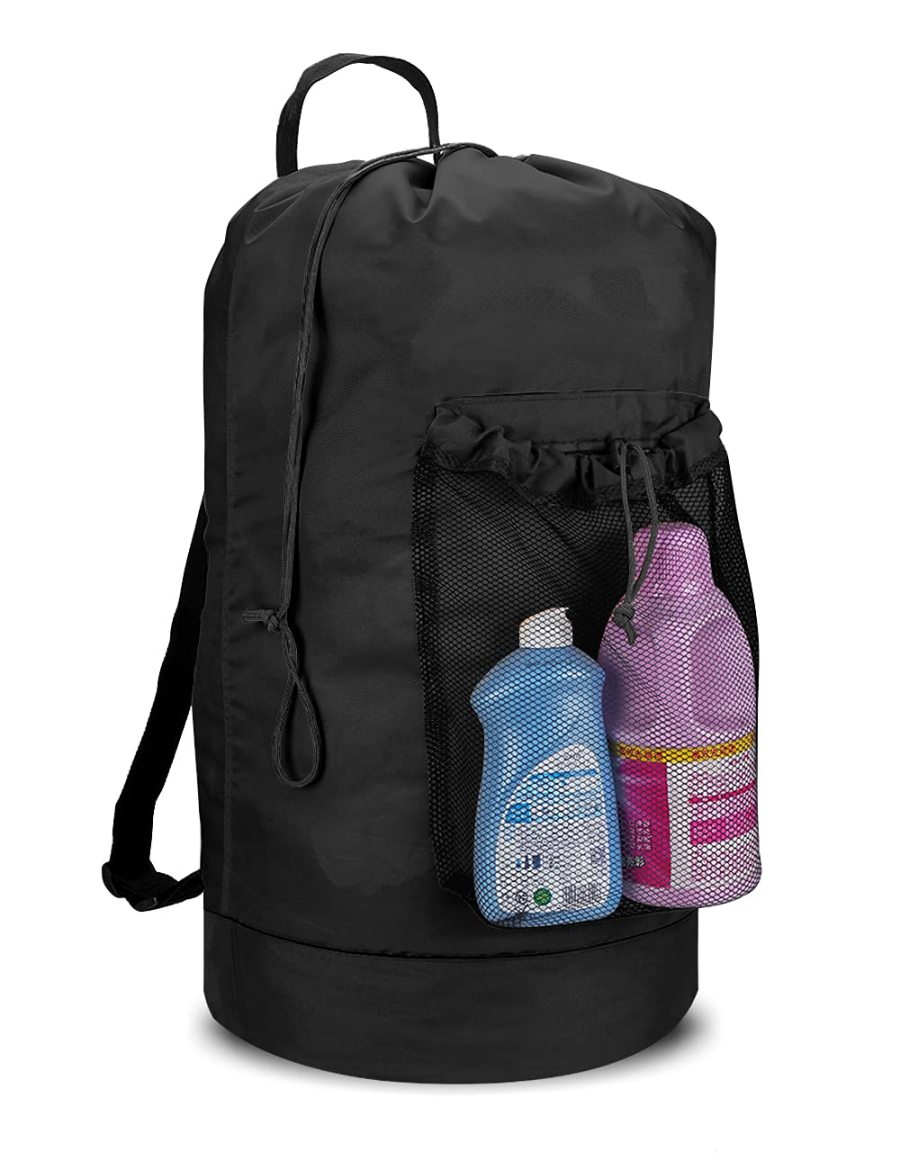
A laundry backpack is a product that combines the functions of a traditional laundry bag and a backpack. It is primarily used to conveniently transport dirty laundry hands-free, especially for users such as college students living in dorms, apartment renters, and those who frequently visit public laundromats. Its core functions are providing high-capacity storage and convenient shoulder-carrying, while also emphasizing material durability and auxiliary storage space. The following table illustrates the key characteristics of consumer behavior in this category.
| Dimension | Segment | Description |
|---|---|---|
| Need Driver Type | Planned Purchase / Habitual Purchase | Primarily driven by periodic laundry needs, such as weekly trips to the laundromat, preparing for a new semester, or as part of a daily clothing storage habit. |
| Purchase Frequency | Low Frequency | Typically purchased during specific life stages (e.g., starting college, moving) or when an existing product is damaged; not a high-frequency repeat purchase. |
| Decision Complexity | Medium | Users compare capacity, material durability, carrying comfort, and additional features to weigh value for money. |
| Price Sensitivity | Medium-High | Price-sensitive, but willing to pay a reasonable premium for better quality, durability, and carrying experience. |
| Emotional Dependency | Medium-Low | Primarily functional, but features like 'hands-free,' 'hassle-free,' and 'reducing trouble' can provide significant peace of mind and satisfaction. |
II. User Personas & Usage Scenarios
2.1 College Student (Dorm Resident)
🎯 Lives in a university dorm, needs to frequently travel to on-campus or off-campus laundromats, typically carrying a week's worth of laundry.
| Typical Usage Scenarios | Core Pain Points | Primary Purchase Drivers |
|---|---|---|
|
|
|
2.2 Apartment Renter / Urban Commuter
🎯 Lives in an apartment or multi-story residence without in-unit laundry facilities, needs to go to public laundromats, or transports laundry during commutes.
| Typical Usage Scenarios | Core Pain Points | Primary Purchase Drivers |
|---|---|---|
|
|
|
III. User Needs Hierarchy (KANO Model)
3.1 Basic Needs (Must-Haves)
- Sufficient Capacity: Easily holds 2-3 loads of laundry, meeting a week's worth of clothing needs.
- Durable Material: The bag body and straps must be made of durable, tear-resistant fabric capable of carrying heavy loads without damage.
- Convenient Carrying: Equipped with shoulder straps or handles, allowing the user to transport laundry hands-free, especially suitable for stairs.
3.2 Performance Needs (Linear Satisfiers)
- Comfortable Carrying: Shoulder straps should be widened, thickened, and padded to reduce pressure on the shoulders from heavy loads, improving comfort during extended carrying.
- Auxiliary Storage: Provides external mesh pockets, zippered inner pockets, etc., for convenient storage of detergent, coins, phones, and other small items.
- Splash-Resistant / Water-Resistant: Fabric has a degree of water resistance to protect clothes from accidental spills and is easy to clean.
- Secure Closure to Prevent Spills: Top features a drawstring or buckle design to ensure clothes do not spill out during transport.
3.3 Excitement Needs (Delighters)
- Foldable & Self-Standing: Can stand upright when empty for easy loading of clothes and folds compactly for storage when not in use.
- Compartmentalized Management: Provides removable internal dividers or separate pockets for effective separation of dirty/clean clothes, shoes, etc.
- Safety Details: Features like reflective strips for nighttime safety or the use of eco-friendly, non-toxic materials.
3.4 Unmet Needs & Opportunities
-
Strap Loosening / Lack of Support: Many laundry backpack straps easily loosen under heavy loads, requiring frequent user adjustment, which impacts the carrying experience. Also, some straps lack sufficient padding, causing discomfort during prolonged carrying.
User Reviews (VOC) The straps loosen easily. I would have to sit the back up on a table or the dryer to prevent the straps from loosening // My only criticism is that padded straps when holding like 50 lbs of laundry would be a very desirable improvement
-
Inner Lining Easily Breaks/Peels: Some products may appear sturdy externally, but the inner lining tends to tear or peel after short-term use, causing small particles to contaminate clean clothes, reducing product lifespan and perceived hygiene.
User Reviews (VOC) After only a few uses, the inner lining of the laundry backpack is falling apart, so I can no longer put clean linens in it without having tons of little brown particles all over the sheets and towels. // The only reason I gave it a 4 and not a 5 is due to the lining tearing.
-
Empty Bag Cannot Stand Upright: Most laundry backpacks cannot maintain an upright shape when empty, requiring users to hold them open when loading dirty clothes, adding operational inconvenience.
User Reviews (VOC) Please note: non-self-standing design when empty // Does not stand up if empty.
IV. User Decision Drivers
4.1 Key Decision Factors
- Capacity Size: Whether it can hold 1-3 weeks' worth of dirty laundry at once is the primary practical consideration before purchase.
- Durability & Strength: Whether the bag fabric, stitching, and straps are sturdy enough to withstand heavy loads and repeated use without damage.
- Carrying Method: Whether it offers a backpack-style carrying function to free up hands, which is more convenient and less strenuous than hand-carrying or dragging.
- Price Range: The product's value for money is a key decision factor, provided basic needs and quality expectations are met.
4.2 Secondary Decision Factors
- Carrying Comfort: Whether the shoulder straps are thickened, breathable, and adjustable to fit different body types and reduce pressure during prolonged carrying.
- Additional Storage: Whether it has external pockets (e.g., mesh, zippered) for storing detergent, coins, or personal items.
- Material Properties: Whether it is water-resistant, stain-resistant, machine-washable, and easy to clean and maintain.
- Aesthetic Design: Whether the color and style match personal taste and coordinate as a household item or for use outside the home.
V. Selling Points & Competitive Landscape
5.1 Selling Point Analysis
5.1.1 Standard Features (Points of Parity)
- Extra Large Capacity: Most products emphasize the ability to hold 2-4 loads of laundry, meeting a week's clothing needs.
- Backpack Carrying: Widely advertised as hands-free, more convenient for transport than traditional laundry baskets.
- Durable Material: Widespread use of 600D or 900D Oxford fabric, claimed to be tear-resistant and wear-resistant.
- Multi-Purpose Use: Emphasized as suitable for multiple scenarios: college dorms, apartments, laundromats, travel, camping, etc.
- Extra Pockets: Features front mesh pockets, zippered inner pockets, etc., for convenient storage of laundry supplies and personal items.
5.1.2 Key Differentiators
- Thickened/Widened Shoulder Straps: Some products highlight strap comfort, offering a better carrying experience and reducing shoulder discomfort.
- Reinforced Top Closure: In addition to a drawstring, includes buckles or security clasps to further ensure clothes don't spill out.
- Foldable/Self-Standing Design: A few products have a bottom support frame, allowing them to stand upright when empty for easy loading/unloading, and fold when not in use.
- Water-Resistant Coating/Lining: Emphasizes an internal PU coating or special treatment to enhance water and moisture resistance.
5.1.3 Unique Selling Propositions (USPs)
- Eco-Friendly Material Certification: Some products claim compliance with California Prop 65 standards or use recycled materials, emphasizing environmental friendliness.
- Nighttime Reflective Strips: Integrated reflective strips on the bag body to enhance safety during nighttime use or in dimly lit environments.
- Multi-Compartment Design: Provides removable internal laundry bags or dedicated shoe compartments for more refined item separation.
- Innovative Opening Design: Such as a front-opening zipper design for easy access to folded clean clothes.
5.2 Competitive Landscape
5.2.1 Market Maturity
The laundry backpack category market has matured, with many products highly homogeneous in basic functions (large capacity, backpack carrying, durable fabric). Competition is now focused on detail optimization, material upgrades, and value for money. Consumer awareness of this new category is high, but brand loyalty is generally low, with a tendency to choose based on specific needs and price.
5.2.2 Innovation Trends
Current innovation trends focus on enhancing user experience in comfort and convenience, such as more ergonomic carrying systems with chest straps; more refined internal storage compartments, like dry/wet separation or shoe compartments; and exploring added product value, like emphasizing eco-friendly materials, personalized aesthetics, or even integrating smart storage prompts. In the future, product differentiation will increasingly depend on the depth and breadth of solving user pain points, not just stacking basic features.
VI. Marketing Claims vs. Reality Check
The table below analyzes the gap between common marketing claims and actual user experiences in this category:
| Dimension | Marketing Claim | User Reality | Verdict |
|---|---|---|---|
| Material Durability | Claims of using high-quality 600D/900D Oxford fabric, tear-resistant, load-bearing up to 44-55 lbs, with reinforced stitching ensuring long-term durability. | Users commonly report products tearing easily, inner linings peeling, and straps breaking after short-term use, creating a significant gap with the 'heavy-duty,' 'durable' marketing claims. | Sellers commonly use terms like 'heavy-duty' and 'tear-resistant' to promise durability far exceeding actual cost and quality control levels, leading to frequent product failures during user experience. This is typical parameter inflation and false advertising. |
| Carrying Comfort | Claims of adjustable wide straps, padded straps, providing maximum support, reducing heavy load burden, and delivering a comfortable carrying experience. | User feedback indicates straps are thin, lack sufficient padding, causing pinching and discomfort during prolonged or heavy-load carrying. Straps also easily loosen, failing to deliver on the 'reduce burden' promise. | Sellers over-promise on strap comfort. Even when mentioning 'padded,' the actual experience falls short due to insufficient thickness and ergonomic design, failing to fulfill the core promise of 'reducing burden.' |
| Self-Standing Function When Empty | Marketing presents the product as usable like a laundry hamper or implies it maintains an upright shape for easy daily storage and clothes loading. | Most soft-shell laundry backpacks cannot stand upright when empty; they collapse, requiring users to hold them open when loading dirty clothes. Some framed products are difficult to reshape after folding. | Many soft-shell backpack-style laundry bags physically cannot stand upright without contents. Some sellers avoid or are vague about this in their marketing, creating a contradiction with the user's practical need to use it as a daily hamper, reducing product utility. |
Key Takeaway: The market exhibits widespread parameter inflation and exaggeration of scenario-based experiences, particularly regarding material durability and carrying comfort.
VII. Supply-Demand Misalignment Analysis
The table below highlights mismatches between seller focus and buyer priorities:
| Dimension | Seller Behavior | User Focus | Verdict |
|---|---|---|---|
| Strap Loosening & Comfort | Generally emphasizes 'adjustable wide straps,' but few products genuinely offer a stable, non-loosening, sufficiently padded carrying experience, especially in lower price tiers. | Users strongly desire more comfortable, more secure straps. Complaints about straps digging into shoulders and easily loosening are frequent pain points. | Sellers have not sufficiently invested in the structure and ergonomics of straps, causing users to repeatedly experience frustration with the core carrying experience. This is a critical pain point requiring immediate attention. |
| Inner Lining Quality & Ease of Cleaning | Most sellers only emphasize the durability and machine-washability of the outer fabric, while ignoring or not mentioning the material and durability of the inner lining (if present), and how to address lining damage issues. | Users complain that inner linings easily tear or peel, with debris contaminating clean clothes, reducing product lifespan and perceived hygiene. | Users have clear requirements for product interior hygiene and long-term durability. Sellers' insufficient attention to this leads to fatal flaws in detailed user experience. |
| Self-Standing When Empty & Multi-Mode Switching | Most soft-shell products are implicitly marketed as functioning like a 'hamper,' but generally lack support structures; a few framed ones can stand but may sacrifice folding convenience. There is a widespread lack of clear communication about the trade-offs between these two modes. | Users find it inconvenient to load clothes when the empty bag cannot stand upright. They want the product to maintain its shape when used as a hamper at home, while also folding conveniently for storage and transport. | While catering to the 'multi-functional' concept, sellers have not deeply addressed the inherent physical limitations of the product structure, resulting in a poor seamless switching experience between the two core scenarios: home daily storage (standing) and outdoor transport (folded). |
Key Takeaway: Sellers collectively under-communicate or downplay user core pain points like material durability and carrying comfort, while over-emphasizing basic features, leading to a misalignment between supply and demand focus.
VIII. Strategic Opportunities & Recommendations
8.1 Optimize Strap Design for 'Weightless' Heavy-Load Carrying Experience
8.1.1 Target Audience & Pain Points
⚡️ Pain Points Addressed: Strap loosening/lack of support; heavy-load comfort limitations.
8.1.2 Action Plan
Adopt a layered strap structure: inner layer using high-density EVA or memory foam for cushioning, outer layer using breathable mesh. Add an adjustable chest strap and waist belt (optional for ultra-heavy loads) to ensure weight is evenly distributed. Reinforce the strap-to-bag connection points with high-density multi-'Z' stitching combined with metal or engineering plastic buckles.
| Tech Complexity | Medium |
| Cost Impact | Medium Impact |
| Trade-off Warning | No significant physical side effects. |
| Price Band | Only viable above $24.99 |
8.1.3 Marketing Strategy
Emphasize 'revolutionary comfortable carrying system,' 'carry 50 lbs like it's nothing,' 'spine-friendly design.' Use GIFs/videos to showcase strap thickness, breathability, and heavy-load testing.
8.2 Introduce Removable/Washable Inner Liner for Enhanced Hygiene & Practicality
8.2.1 Target Audience & Pain Points
⚡️ Pain Points Addressed: Inner lining easily breaks/peels; mixing dirty/clean clothes; cleaning method limitations.
8.2.2 Action Plan
Design a fully removable, independently washable, thin inner liner with a water-resistant coating, secured inside the main bag via clips or Velcro. Consider offering an antibacterial material liner.
| Tech Complexity | Low |
| Cost Impact | Low Impact |
| Trade-off Warning | The liner may slightly reduce main compartment capacity, but this is negligible. |
| Price Band | Only viable above $16.99 |
8.2.3 Marketing Strategy
Highlight 'Say goodbye to dirt, keep only cleanliness,' 'Dry/wet separation, hygiene worry-free,' 'Machine-washable liner, easy maintenance.' Use diagrams to show the liner's removal and washing process.
8.3 Innovative Structural Design for Self-Standing When Empty & Easy Folding
8.3.1 Target Audience & Pain Points
⚡️ Pain Points Addressed: Empty bag cannot stand upright; insufficient folding convenience.
8.3.2 Action Plan
Develop a lightweight, quickly foldable and deployable internal frame (e.g., fiberglass rods or memory alloy wires) to ensure the bag stands stably when empty and folds easily for storage when not in use.
| Tech Complexity | Medium |
| Cost Impact | High Impact |
| Trade-off Warning | May slightly increase the product's empty weight and thickness when folded. |
| Price Band | Only viable above $34.99 |
8.3.3 Marketing Strategy
Emphasize 'Smart transformation, space master,' 'Goodbye to sagging, stylish at home,' 'Patented structure, stands up in a second.' Use video to demonstrate its quick transformation process.