Amazon US Market Analysis: Children's Crystal Growing Kits Category
📊 Executive Summary
📈 Market Trends
Portability & Integration are Mainstream, STEM Education is the Core Driver. The Children's Crystal Growing Kit market is maturing, with products generally emphasizing lightweight portability, multi-color temperature adjustment, and built-in mirrors. Consumer demand for seamless connectivity and multi-functional, all-in-one products continues to grow, driving product forms towards greater integration and intelligence. Simultaneously, the popularization of STEM education philosophy makes parents more focused on the educational value and hands-on practice attributes of products.
⚡ Major Pain Points
Unstable Growth Results, Fragile Products, Poor Container Quality are Major Flaws. Users are generally skeptical of sellers' claims regarding crystal growth success rates and final results, with a large gap between actual experience and advertising. Additionally, finished crystals are extremely fragile and difficult to preserve long-term. Containers prone to breakage and leaks, and messy experimental processes are also frequent complaints, severely impacting user experience and parental peace of mind.
💡 Selection Opportunities
Deepen Core Experience, Deliver Tangible User Value. Market opportunities lie in solving the trust crisis around crystal growth success rates, for example, by developing products with a 'High-Success-Rate & Durable Crystal Formula.' Simultaneously, optimize user operational experience through 'Leak-Proof, Stain-Resistant Experiment Containers,' and deepen educational content via 'Multimedia/Multilingual Instruction.' Furthermore, combine 'Glow-in-the-Dark Crystals & Customized Themes' to enhance differentiation and fun, building brand advantages in the details.
I. Analysis Overview
1.1 Introduction & Report Scope
This report analyzes the 'Science Kits & Toys' category (Children's Crystal Growing Kits) within the Amazon US market, focusing on target user personas, core needs, decision factors, market communication, and potential opportunities.
1.2 Category Snapshot
Children's Crystal Growing Kits are educational toys designed for children, allowing them to cultivate colorful crystals through simple chemical reactions. These products aim to spark interest in science, develop hands-on skills and observational abilities, and are often positioned as part of STEM (Science, Technology, Engineering, Mathematics) education. These kits typically include crystal powder, growth containers, display bases, and often incorporate specific themes (e.g., dinosaurs, unicorns, glow-in-the-dark) or multi-functional integration (e.g., light-up bases, multi-experiment combos) to enhance fun and educational value. The following table illustrates the key characteristics of consumer behavior in this category.
| Dimension | Segment | Description |
|---|---|---|
| Need Driver Type | Planned Purchase / Gift-giving | Purchases are typically driven by parents seeking planned gifts for holidays, birthdays, or school projects, though impulsive purchases for family entertainment activities can also occur. |
| Purchase Frequency | Low Frequency / Seasonal | As educational toys and gifts, purchase frequency is low, primarily concentrated around holidays like birthdays and Christmas, not being daily high-consumption items. |
| Decision Complexity | Medium | Consumers make decisions after comparing factors such as educational value, experiment success rate, ease of operation, material safety, additional features, and price. |
| Price Sensitivity | Medium | Price is an important consideration, but parents place greater value on the product's educational significance and the child's engagement experience, willing to pay a reasonable premium for higher quality, greater educational value, or unique features. |
| Emotional Dependency | Medium-High | The product can deliver the joy of discovery, the sense of accomplishment from a successful experiment, and the creation of shared positive memories through parent-child interaction, with emotional value carrying significant weight in the purchase decision. |
II. User Personas & Usage Scenarios
2.1 The Science Explorer & Their Parent
🎯 School-aged children (typically 6-12 years old) filled with curiosity about the world and eager to explore scientific mysteries through practice, along with parents who actively support and guide their child's scientific interests.
| Typical Usage Scenarios | Core Pain Points | Primary Purchase Drivers |
|---|---|---|
|
|
|
2.2 The Gift Giver
🎯 Grandparents, relatives, friends, or parents seeking a meaningful and popular gift to celebrate a child's birthday, holiday, or special occasion.
| Typical Usage Scenarios | Core Pain Points | Primary Purchase Drivers |
|---|---|---|
|
|
|
III. User Needs Hierarchy (KANO Model)
3.1 Basic Needs (Must-Haves)
- Non-Toxic & Safe: All experimental materials must meet strict children's toy safety standards, ensuring they are harmless to children's skin and the environment, providing parents peace of mind.
- Complete Core Functionality: The kit must contain all basic materials and tools needed for crystal growth, requiring no additional purchases, ensuring it's ready to play right out of the box.
- Successful Crystal Growth: This is the core value proposition of the product. Regardless of final appearance, crystals must be able to start growing and form visible structures as per instructions; otherwise, the product's value is zero.
3.2 Performance Needs (Linear Satisfiers)
- Clear, Easy-to-Understand Instructions: Provide detailed, intuitive, step-by-step, illustrated manuals, ideally with QR codes linking to video tutorials, allowing children and parents to easily understand and operate.
- Crystal Growth Speed: Crystals should grow noticeably within a relatively short time (e.g., 24-72 hours) to meet children's expectations for immediate feedback and maintain their interest and patience.
- Diverse & Vibrant Crystal Colors: Offer multiple color choices or mixable crystal powders, ensuring finished products are saturated, bright, and visually appealing.
- Additional Display Features: Features like light-up bases, display domes, or cute shaped models (dinosaurs, unicorns, etc.) increase the观赏性,趣味性, and long-term display value of the finished crystal.
- Rich Educational Content: Beyond experimental steps, provide科普知识 about crystal formation principles, chemical reactions, geological background, or related scientists to deepen the learning experience.
3.3 Excitement Needs (Delighters)
- Glow-in-the-Dark Effect: The finished crystal emits a soft glow in the dark, providing children with extra surprise and a 'magical' experience, enhancing the fun of play.
- Multi-Function Combo Experience: The kit integrates other innovative experiments or craft elements (like volcano eruptions, fossil digs, scene building) alongside crystal growth, offering a richer scientific exploration journey.
- Reusability: Crystal solution or certain materials in the kit can be reused for multiple experiments (e.g., refillable crystal powder), significantly extending product life and the child's play乐趣.
3.4 Unmet Needs & Opportunities
-
Crystal Durability & Stability: Users commonly report that finished crystals are extremely fragile, easily breaking or crumbling, making long-term preservation and handling difficult, diminishing the sense of achievement.
User Reviews (VOC) It was so fragile, it broke just by touching it. // The crystals were pretty but shattered when we tried to move them to the display.
-
Actual Growth Results vs. Advertised Images: Many users complain about significant discrepancies between the actual grown crystal's size, shape, density, etc., and the product's promotional images, leading to psychological落差 and disappointment.
User Reviews (VOC) The crystals looked nothing like the picture on the box, much smaller and paler. // Disappointed with the size, the photo was misleading.
-
Container Quality & Leak Resistance: Some users encounter issues with growth containers cracking or solution leaking, causing mess and potential contamination, impacting safety and user experience.
User Reviews (VOC) The plastic container cracked, and the solution leaked all over my table. // The cup was flimsy and almost tipped over, making a big mess.
-
Ease of Cleanup: Crystal solution or dyes easily stain skin or clothing and are difficult to clean, adding burden for parents.
User Reviews (VOC) The dye stained my child's hands and the tablecloth. // It was hard to clean up the residue from the solution.
-
Instruction Clarity & Accuracy: Some users report issues with instructions lacking detail, inaccurate measurements, temperature unit mismatches, or not matching actual items, increasing operational difficulty and experiment failure rates.
User Reviews (VOC) Instructions were only in English, wish there was a Spanish version for my kids. // The instructions were vague and didn't explain the science behind it very well.
IV. User Decision Drivers
4.1 Key Decision Factors
- Experiment Success Rate: Whether crystals can grow successfully as per instructions is the fundamental criterion for users evaluating product quality, deciding to recommend it, and for children gaining a sense of achievement.
- Safety: Whether materials are non-toxic and eco-friendly, and containers are sturdy and leak-proof, ensuring children can experiment in a safe environment, is the primary concern for parents.
- Ease of Operation: Whether instructions are clear and easy to follow, steps are simple and intuitive, and children can complete the process with minimal or no heavy adult assistance, directly impacts user experience and willingness to replay.
- Fun & Engagement: Whether the product can continuously attract children's interest, provide enjoyable interactive experiences, and keep them curious and explorative during play, is key to determining the product's long-term value.
4.2 Secondary Decision Factors
- Crystal Aesthetics: Crystal color vibrancy, unique and full shape, size meeting expectations, and consistency with advertised images affect the final visual enjoyment and display willingness.
- Added Value: Features like light-up displays, inclusion of other science experiments, real mineral specimens, or cute models can enhance product性价比 and long-term appeal.
- Brand Reputation: Well-known brands (e.g., National Geographic, 4M) enjoy higher consumer trust, often perceived as offering better product quality and educational content.
- Value for Money: Whether the price is reasonable relative to the provided features, materials, and experience, given that core and performance needs are met.
V. Selling Points & Competitive Landscape
5.1 Selling Point Analysis
5.1.1 Standard Features (Points of Parity)
- Science Education/STEM: Most products emphasize cultivating children's scientific interest, enhancing STEM skills, and their value as learning tools to attract education-focused parents.
- Easy to Use: Commonly claim simple experiment steps, easy for children to start and complete quickly, alleviating parental concerns about complexity.
- Perfect Gift: Position the product as an ideal choice for birthdays, Christmas, or other holidays, highlighting its value as a gift combining entertainment and education.
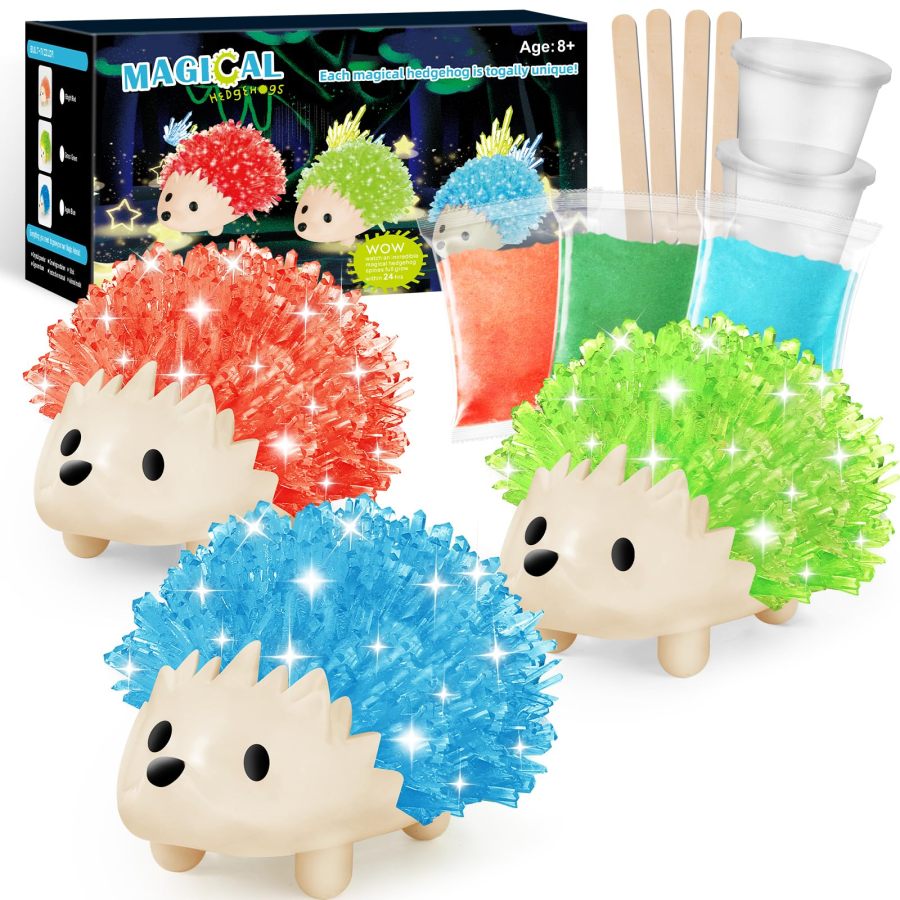
- Multiple Colors/Themes: Offer multiple crystal color choices or attract children with specific themes (e.g., dinosaurs, unicorns, hedgehogs, trees), increasing product personalization and appeal.
5.1.2 Key Differentiators
- Fast Growth: Some products highlight crystals showing visible growth in very short times (e.g., 24 hours or 6 hours) to meet children's need for immediate feedback.
- Light-Up Display Base: Products include LED light-up bases or display domes, increasing观赏性 of finished crystals and enhancing nighttime effects and display value.
- Includes Multiple Experiments: Some kits include other scientific activities like volcano eruptions, fossil digs, or chemical reactions alongside crystal growth, offering a richer learning experience.
- Real Mineral Specimens: A few brands bundle real gemstones or mineral samples, adding collection value and a geological learning dimension.
5.1.3 Unique Selling Propositions (USPs)
- Reusable Design: Very few products mention that their crystal solution can be reheated and dissolved, or containers can be reused for multiple growth experiments, extending product life and乐趣.
- Custom Coloring: Provide marker pens or dyes allowing children to color crystals or models themselves, combining science and art to enhance personalization and creativity.
5.2 Competitive Landscape
5.2.1 Market Maturity
The Children's Crystal Growing Kit market has entered a mature stage. Product functionality is highly homogeneous, with most brands emphasizing educational value, ease of use, and gift attributes. However, brands compete on differentiation through added features and theming (e.g., glow-in-the-dark, fast growth, cartoon shapes, multi-experiment combos), indicating there is still room for innovation and optimizing existing pain points.
5.2.2 Innovation Trends
Current innovation trends are mainly in two areas: First, enhancing sensory and interactive experiences, such as faster growth speeds, introducing glow-in-the-dark effects, and developing more diverse crystal forms (animals, plants, 3D models) to attract children. Second, moving towards comprehensive science kits, positioning crystal growth as one of multiple experiments, providing a more holistic, multidisciplinary STEM learning experience. Additionally, some products are beginning to experiment with more creative art-science integration, like custom coloring features.
VI. Marketing Claims vs. Reality Check
The table below analyzes the gap between common marketing claims and actual user experiences in this category:
| Dimension | Marketing Claim | User Reality | Verdict |
|---|---|---|---|
| Crystal Growth Results & Success Rate | Easily grow 'giant,' 'colorful' crystals, with 24-hour fast growth, guaranteed success. | Users commonly report failed growth, undersized crystals, mismatched colors, poor shapes, or complete failure. Actual growth speeds often far exceed the claimed 24 hours. | Sellers engage in excessive beautification and false promises regarding the core functionality, failing to deliver the product's most basic value, severely disappointing user expectations and forming the root cause of negative reviews and returns. |
| Container & Experimental Process Safety/Cleanliness | Safe and non-toxic, providing a mess-free experience. | Multiple users report included plastic containers easily cracking, solutions leaking, and dyes easily staining hands, clothes, and tables, making cleanup difficult. | Sellers fail to adequately consider the actual operating environment for children and material limitations, falsely claiming 'mess-free,' leading to safety hazards and extra cleanup burdens, severely impacting user experience and parental peace of mind. |
| Crystal Durability & Display Value | Cultivate a long-term displayable 'scientific artwork.' | Finished crystals are extremely fragile, breaking upon touch, difficult to move and preserve long-term, far from the 'decorative item' attribute users expect. | Sellers fail to accurately set user expectations regarding crystal durability, overpromoting its decorative and long-term preservation value, overlooking the inherent physical properties of crystals, causing the product to fall short on 'long-term value.' |
Key Takeaway: This category's market is generally characterized by exaggerated functional claims and unstable quality control, particularly regarding the core crystal growth success rate and final results, which often differ greatly from advertised images.
VII. Supply-Demand Misalignment Analysis
The table below highlights mismatches between seller focus and buyer priorities:
| Dimension | Seller Behavior | User Focus | Verdict |
|---|---|---|---|
| Crystal Growth Success Rate & Final Results | Listings generally emphasize 'easy growth,' 'giant crystals,' 'colorful,' but avoid discussing low actual success rates or poor results, failing to provide credible success guarantees. | 'My child didn't grow any crystals at all,' 'The result was completely different from the picture, too small and ugly,' 'Feels like wasting money on something that doesn't work.' | Sellers provide distorted information regarding the product's most core functional promise, failing to effectively address users' fundamental concerns, directly leading to a trust crisis and user disappointment. |
| Container Quality & Experimental Process Cleanliness | Commonly claim 'safe and non-toxic,' 'mess-free,' but fail to provide specific leak-proof, stain-resistant solutions or sufficiently sturdy containers in product design or instructions. | 'The plastic container leaked and stained my table,' 'My child's hands were stained with color and hard to wash,' 'The experiment process was too messy, not as simple as described.' | Sellers overlook potential practical operational issues during the experiment and parents' demands for cleanliness and safety, failing to provide solutions at the source, increasing user friction and negative experiences. |
| Crystal Preservation & Durability | Generally promote finished crystals as displayable scientific artworks or collectibles, but rarely mention their extreme fragility or corresponding preservation methods. | 'The crystal shattered at a touch, impossible to display,' 'It grew out with great effort but fell off with the slightest movement,' 'Can't preserve it for long, such a pity.' | Sellers fail to accurately set user expectations regarding finished product durability, overpromoting its long-term value, leading users to feel disappointed and misled on the important desire for 'long-term ownership.' |
Key Takeaway: Sellers collectively remain silent or downplay core user pain points like crystal growth success rate, product durability, and experiment cleanliness, while over-supplying feature-stacking and low-value details, leading to a severe supply-demand mismatch.
VIII. Strategic Opportunities & Recommendations
8.1 High-Success-Rate & Durable Crystal Formula
8.1.1 Target Audience & Pain Points
⚡️ Pain Points Addressed: Low crystal growth success rate, fragile and easily broken finished products, mismatch between actual growth results and advertised images.
8.1.2 Action Plan
Invest in R&D for a more stable crystal growth formula, ensuring high success rates and a more durable crystal structure. Simultaneously, provide crystal hardeners or paired sealed display domes, and adjust marketing images to ensure visual presentation closely matches actual results.
| Tech Complexity | Medium |
| Cost Impact | Medium Impact |
| Trade-off Warning | Developing a more stable crystal formula may require higher chemical raw material costs, or in some cases, slightly extend the crystal growth cycle. However, the value users place on final success rate and durability far outweighs these costs. |
| Price Band | Only viable above $24.99 |
8.1.3 Marketing Strategy
Emphasize '100% Success Guarantee, Say Goodbye to Experiment Failure Frustration'; Promote 'Durable Crystals You Can Touch and Display'; Build trust through real user case studies and unfiltered videos showcasing the entire crystal growth process and final results.
8.2 Leak-Proof, Stain-Resistant Containers & Cleanup Solution
8.2.1 Target Audience & Pain Points
⚡️ Pain Points Addressed: Containers easily crack, solution leaks, dyes stain, cleanup is difficult.
8.2.2 Action Plan
Redesign experiment containers using sturdier, more durable food-grade PP or silicone materials, and optimize sealing structures to ensure leak resistance. Also, provide biodegradable disposable protective mats or small aprons, and improve dye formulas to reduce residual staining.
| Tech Complexity | Low |
| Cost Impact | Low Impact |
| Trade-off Warning | Using thicker plastic or silicone containers may slightly increase volume or weight, but the improvement to user experience is significant, with almost no negative physical side effects. |
| Price Band | Only viable above $16.99 |
8.2.3 Marketing Strategy
Highlight 'Worry-Free Experiment, Explore Freely'; Emphasize 'Sturdy, Leak-Proof Container, Mom Never Worries About Mess Again'; Provide detailed cleaning guides and safety operation tips to boost parental purchase confidence.
8.3 Multimedia/Multilingual Instruction & Interactive Community
8.3.1 Target Audience & Pain Points
⚡️ Pain Points Addressed: Unclear instructions, lack of in-depth explanations, multilingual needs, low post-purchase interactivity.
8.3.2 Action Plan
Create multilingual, illustrated electronic manuals, with QR codes linking to high-quality instructional videos (including experiment principle animations, FAQs). Establish an online interactive community or Q&A platform, encouraging users to share results and ask questions.
| Tech Complexity | Low |
| Cost Impact | Low Impact |
| Trade-off Warning | Content creation and translation incur additional costs, but the marginal cost of digital content is low, and there are no physical side effects. |
| Price Band | Viable at any price point |
8.3.3 Marketing Strategy
Emphasize 'Expert Guidance, Master Science'; Highlight 'Multilingual Instruction, Children Worldwide Can Learn Easily'; Promote the interactive community, fostering a 'Little Scientist Club' atmosphere to enhance brand loyalty.
8.4 Glow-in-the-Dark Crystals & Customized Theme Experience Upgrade
8.4.1 Target Audience & Pain Points
⚡️ Pain Points Addressed: Insufficient fun, lackluster finished products, poor glow effects, severe product homogeneity.
8.4.2 Action Plan
Develop longer-lasting, brighter glow-in-the-dark crystal materials, and offer customizable coloring options (e.g., marker pens or dyes). Develop more uniquely creative, narrative-driven theme models (e.g., galaxy starry sky, underwater world), ensuring finished products closely match advertised images.
| Tech Complexity | Medium |
| Cost Impact | Medium Impact |
| Trade-off Warning | Enhancing glow effects requires more efficient phosphorescent materials, potentially slightly increasing costs. Custom theme molds require mold opening costs and may limit universality, requiring careful theme selection. |
| Price Band | Only viable above $29.99 |
8.4.3 Marketing Strategy
Emphasize 'Magical Lab at Night, Light Up Your Fantasy World'; Highlight 'Customize with Your Own Hands, Create a Unique Scientific Artwork'; Create immersive experiences through high-quality videos showcasing glow effects.