Amazon US Market Analysis: Baby Bath Seats Category
📊 Executive Summary
📈 Market Trends
Safety and portability are foundational; user experience is the new battleground. The baby bath seat market is maturing, with consumer consensus on basic needs like safety, stability, and easy cleaning. Future competition will focus on solving existing product pain points, such as providing stable adhesion on complex tub surfaces and optimizing product usability and long-term hygiene maintenance. Bath seats with smart temperature indicators and safe interactive designs will be more favored.
⚡ Major Pain Points
Suction cup failure and operational stickiness severely impact user trust. The category's biggest flaws currently are: most products' advertised 'strong suction cups' underperform on textured tubs, creating safety hazards; secondly, gate/arm opening mechanisms are stiff, significantly affecting access convenience; difficulty in deep cleaning leading to mold growth is also a long-term hygiene concern. These experience gaps severely undermine consumer confidence in product safety and practicality.
💡 Selection Opportunities
Innovative adhesion technology and full-lifecycle hygiene management represent blue oceans. Market opportunities lie in developing innovative adhesion/fixation systems compatible with various tub surfaces, completely solving the stability pain point. Simultaneously, achieving no-dead-spot cleaning and fast drying through fully modular, detachable designs can eradicate mold. Furthermore, optimizing operational smoothness and multi-size adaptability will significantly enhance user experience. In the future, a premium product line integrating safe interactive toys and precise temperature monitoring can further meet the needs of quality-seeking parents.
I. Analysis Overview
1.1 Introduction & Report Scope
This report analyzes the 'Bath Seats' category (Baby Bath Seats) within the US Amazon marketplace, focusing on target user personas, core needs, decision drivers, market communication, and potential opportunities.
1.2 Category Snapshot
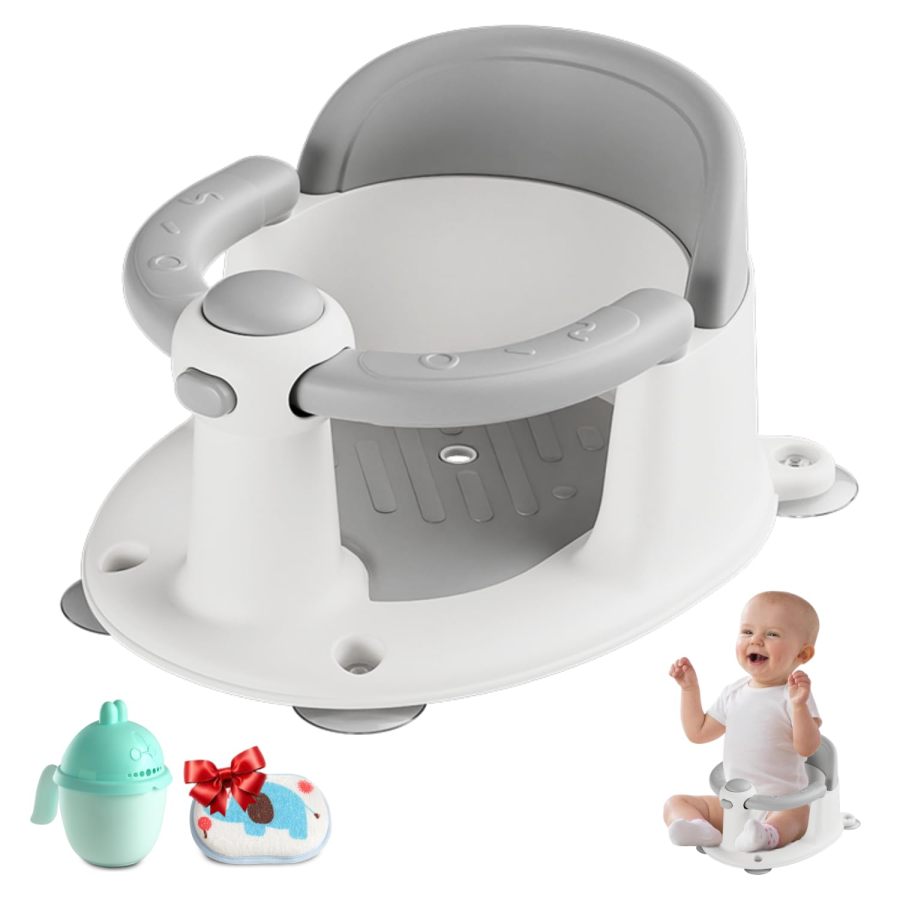
Baby bath seats are bathing aids designed for infants aged 6 months and older who can sit up independently but may still be unsteady, or who require assistance to sit. Their core function is to provide stable support and anti-slip protection, allowing babies to bathe safely and comfortably in a bathtub or shower while freeing parents' hands. Products in this category typically use PP+TPR materials, feature suction cups on the bottom, and some integrate water thermometers, interactive toys, or adjustable designs. The following table illustrates the key characteristics of consumer behavior in this category.
| Dimension | Segment | Description |
|---|---|---|
| Need Driver Type | Planned Purchase / Emergency-driven Purchase | Purchases are typically driven by the baby reaching a specific developmental milestone (e.g., sitting up at 6 months) or by seeking a safer and more convenient alternative due to inconvenience with existing bathing tools. |
| Purchase Frequency | Low Frequency | Usually a one-time purchase, rarely repurchased after one child outgrows it, unless the product breaks or a significant functional iteration proves attractive. |
| Decision Complexity | Medium | Consumers compare and weigh core factors such as safety certifications, anti-slip performance, stability, comfort, and ease of use before making a decision. |
| Price Sensitivity | Medium | Price is an important consideration, provided baby safety and core functions are assured. However, parents are willing to pay a reasonable premium for higher quality or innovative features for their baby's health and safety. |
| Emotional Dependency | Medium | The product embodies parents' deep care for their baby's safety and comfort, providing the peace of mind of 'hands-free' bathing and the emotional value of 'bath-time fun,' though practical functionality remains the primary driver. |
II. User Personas & Usage Scenarios
2.1 First-Time Parents
🎯 First-time parents, full of enthusiasm for baby care but lacking experience, especially concerned about their baby's safety and comfort during bath time.
| Typical Usage Scenarios | Core Pain Points | Primary Purchase Drivers |
|---|---|---|
|
|
|
2.2 Practical & Efficiency-Oriented Parents
🎯 Parents with prior childcare experience or those pursuing a high-quality lifestyle, seeking parenting products that streamline routines, improve efficiency, and offer multi-functionality.
| Typical Usage Scenarios | Core Pain Points | Primary Purchase Drivers |
|---|---|---|
|
|
|
III. User Needs Hierarchy (KANO Model)
3.1 Basic Needs (Must-Haves)
- Safety & Stability: The bath seat must firmly adhere to the bottom or sidewall of the bathtub, preventing sliding, tipping, or overturning to ensure absolute safety during bathing.
- Material Safety: Product materials must be non-toxic, skin-friendly, free from harmful substances like BPA, and pass relevant child product safety certifications (e.g., CPSC, CPSIA).
- Comfortable Support: Ergonomically designed to provide good support for the baby's head, back, and body, ensuring a natural and comfortable sitting posture and avoiding discomfort or pinching.
3.2 Performance Needs (Linear Satisfiers)
- Easy In & Out: The gate/arms should have a convenient, smooth opening/closing/locking mechanism, allowing parents to safely place and remove the baby with minimal hassle.
- Easy Cleaning & Drying: Product design should minimize hard-to-clean areas, use materials that are easy to wipe down, and facilitate quick drainage and drying to effectively prevent mold growth.
- Anti-Slip Cushion: The seat cushion should be soft and anti-slip, providing extra padding to further enhance the baby's comfort and sitting stability.
- Portability & Storage: The product should be lightweight, foldable, or easy to disassemble for convenient travel carrying and compact storage when not in use at home.
3.3 Excitement Needs (Delighters)
- Smart Water Temperature Indicator: Built-in or included water thermometer/temperature strip that visually indicates water temperature (e.g., via color change or digits), providing parents with instant reference and alleviating temperature concerns.
- Interactive Play Accessories: Included or integrated bath toys (e.g., spinning beads, squeezable silicone toys, rubber ducks) to increase the baby's bath-time fun, distract them, and make bathing more enjoyable.
- Multi-Mode/Angle Adjustment: Features like sit/recline mode switching or adjustable tilt/height to accommodate babies of different ages, extending the product's useful life.
3.4 Unmet Needs & Opportunities
-
Suction Cup Reliability on Textured Surfaces: Numerous users report that traditional suction cups fail to adhere firmly to textured, matte, or non-smooth bathtub bottoms, causing the seat to slide or even tip over, posing a serious safety hazard. This is the most critical pain point.
User Reviews (VOC) The suction cups don't work on my textured tub bottom. // The suction came undone. He fell face forward into the water. // The suction cups are iffy. My son was leaning to grab a toy and I noticed the seat start tipping.
-
Gate/Arm Opening Smoothness & Reliability: Some products have gates or arms with mechanisms that are stiff, not smooth, or even require forceful pulling or become loose, affecting parental convenience and posing risks of pinching or the baby falling.
User Reviews (VOC) The arms are not easy to open though. // Mechanical failures! The button sticks, the arms stick. A lot of pushing and pulling is required! // The piece that goes around does not stay locked in pops out way to easy.
-
Deep Cleaning & Mold-Resistant Structure: Although many products claim easy cleaning, in actual use, seams and hard-to-reach corners in the product structure tend to trap water. Long-term dampness leads to mold, impacting the hygiene and health of the baby item.
User Reviews (VOC) It does have some areas that can get moldy because they're hard to reach. // REPLACE OFTEN AS MOLD GROWS IN PARTS YOU CAN'T REVEAL!!!
-
Comfortable Fit for Older/Larger Babies: Some bath seats have limited legroom or overall dimensions that are too small. For babies who grow quickly or have longer legs, the seat can quickly become cramped and uncomfortable, even leaving red marks on the skin, limiting the product's actual usable lifespan.
User Reviews (VOC) Not for the bigger babies =D, but still really useful. // My baby is 21lb and 28inches and fit in this quite well. The front handle typically leave red marks on the baby as it isn't soft.
IV. User Decision Drivers
4.1 Key Decision Factors
- Safety: Anti-slip performance (suction cup strength, especially on wet, textured surfaces), anti-tip design, gate/arm lock reliability, and non-toxic materials (CPSC/CPSIA certified) are parents' primary and non-negotiable considerations.
- Stability: Whether the bath seat remains absolutely stable without wobbling or sliding when the baby moves, providing reliable support and ensuring safety throughout the bath.
- Ease of Use: How conveniently and quickly parents can place and remove the baby from the seat, whether adjustment functions are intuitive and smooth, and how easily they can clean the baby's body during the bath.
- Comfort: Whether the baby's sitting posture is natural, if it provides soft support, and avoids pressure or discomfort on the spine or skin, affecting the bathing experience.
4.2 Secondary Decision Factors
- Cleaning Convenience & Mold Prevention: Whether the product is easy to rinse, dries quickly, can be disassembled for deep cleaning, and effectively prevents water retention and mold growth, ensuring long-term hygiene.
- Functional Extensibility: Whether it includes additional features like a water thermometer, interactive toys, or has multi-mode (sit/recline) adjustments to extend the applicable age range and usage scenarios.
- Storage & Portability: Whether the product is lightweight, foldable, and convenient for storage in limited home spaces or for carrying during travel, saving space.
- Aesthetic Design & Brand Trust: Whether the design is cute, colors are attractive to babies or match home decor, and if the brand has a good reputation and reliable after-sales service.
V. Selling Points & Competitive Landscape
5.1 Selling Point Analysis
5.1.1 Standard Features (Points of Parity)
- Safety Certifications: Commonly emphasize safety standards like CPSC/CPSIA certification, BPA-free, ensuring materials are non-toxic and harmless to babies.
- Anti-Slip Suction Cups: Equipped with 3-4 strong suction cups on the bottom as the primary fixing method, ensuring the seat stays firmly in place within the bathtub.
- Ergonomic Design: Structures like high backrests and fully surrounding arms aim to provide comfortable support, help the baby sit up, and free parents' hands.
- Easy-Clean Materials: Often made from PP+TPR plastic, with smooth surfaces marketed as easy to wipe and rinse clean.
- Applicable Age Range: Most products label the applicable age as 6 months and above, with some extending to 12 or 24 months.
5.1.2 Key Differentiators
- Water Temperature Indicator: Built-in water thermometer or floating temperature device/strip providing a visual display of water temperature, enhancing safety.
- Interactive Toys: Included or integrated bath toys (e.g., beads, ducks, abacus) to increase the baby's bath-time fun and distract them.
- Openable/Foldable Design: Arms that open with one click or the entire product folds for easy baby access and storage/transport.
- Soft Pad/Mesh Seat: Provides an extra soft seat cushion to enhance baby comfort, some of which are removable for washing.
- Open-Back Design: Backrest features openings or cut-outs, allowing parents to easily wash the baby's back and bottom, reducing cleaning dead spots.
5.1.3 Unique Selling Propositions (USPs)
- Sit & Recline Dual-Mode Adjustment: Unique multi-position (e.g., three-position) backrest adjustment design enabling switching between newborn and toddler sit/recline modes, adapting to babies of different ages.
- Specific Themed Designs: Cartoon shapes like frogs, bears, or snails to attract consumers by increasing product fun and cuteness.
- Extended Warranty/Return Service: Offering after-sales guarantees like a 1-year no-questions-asked return policy to boost consumer confidence.
- Multi-Functional Accessory Bundles: Including items like rinse cups or shampoo visors alongside toys, constituting a more complete bathing solution.
5.2 Competitive Landscape
5.2.1 Market Maturity
The baby bath seat market has entered a mature stage with high product homogenization. Core functions like secure attachment, basic support, and material safety are now standard. Competition primarily revolves around price, aesthetic details, marketing claims, and minor functional optimizations. Most brands show little differentiation in design, materials, and basic safety performance, leading consumers to rely more on review feedback and price sensitivity when choosing.
5.2.2 Innovation Trends
Current innovation trends in the category mainly focus on 'solving existing pain points' and 'enhancing user experience.' Specifically, smart features are evident in water temperature reminders (evolving from simple stickers to digital displays), providing more intuitive safety assurance. Regarding multi-functionality, some products attempt to expand usage scenarios (e.g., doubling as a living room seat) or offer multi-stage adaptability (e.g., sit/recline modes). Additionally, addressing the widespread cleaning challenge, some designs are beginning to consider modular disassembly for thorough cleaning and fast drying. Adhesion technology remains a bottleneck, but the market's strong demand for stable fixation on non-smooth surfaces indicates potential breakthrough innovations in suction cup technology or structural design in the future.
VI. Marketing Claims vs. Reality Check
The table below analyzes the gap between common marketing claims and actual user experiences in this category:
| Dimension | Marketing Claim | User Reality | Verdict |
|---|---|---|---|
| Suction Cup Stability & Tub Compatibility | Strong suction cups, firmly attached, suitable for all smooth surfaces. | Numerous user feedback indicates suction cups fail to adhere firmly on textured or non-smooth bathtub bottoms, with reports of serious safety incidents where suction failed and babies fell. | Sellers oversimplify the physical conditions for adhesion, ignoring the diversity of actual tub surface materials, causing the core safety promise to completely fail in specific scenarios, severely misleading consumers. |
| Gate/Arm Opening Smoothness | One-click opening/closing, easy and convenient for placing/removing the baby. | Users commonly report stiff, sticky opening/closing mechanisms requiring forceful pulling to operate, impacting user experience and posing a risk of pinching baby's fingers. | Product design fails to adequately consider mechanical precision and daily operational convenience. The marketed 'one-click ease' starkly contrasts with the actual 'sticky struggle,' undermining a core user expectation. |
| Deep Cleaning & Mold Prevention | Easy-clean materials, preventing bacterial growth. | Although the material surface is easy to wipe, the product structure contains numerous seams and hard-to-reach corners prone to water retention and difficult to dry thoroughly, leading to grime and mold over time, contradicting the 'easy-clean' promise. | Sellers focus only on surface-level cleanability of materials, failing to address long-term hygiene risks from structural design in humid environments, leaving users' deep health needs unmet. |
Key Takeaway: The market exhibits widespread parameter inflation and scenario-based experience exaggeration, particularly regarding suction cup stability and gate/arm opening smoothness, where significant gaps exist between marketing claims and actual user experience.
VII. Supply-Demand Misalignment Analysis
The table below highlights mismatches between seller focus and buyer priorities:
| Dimension | Seller Behavior | User Focus | Verdict |
|---|---|---|---|
| Suction Cup Performance on Textured Tubs | Sellers commonly emphasize 'strong suction cups' and 'firm adhesion' but rarely specify in listings the product's actual performance guarantee or solution for textured, matte, or non-smooth tub surfaces. | Users strongly complain about suction cup ineffectiveness on non-smooth surfaces, directly threatening baby safety, making it a focal point for returns and negative reviews. | Sellers generalize ideal-state selling points, overlooking users' core safety demands in complex tub environments, resulting in insufficient reliability of the product's core function. |
| Gate/Arm Opening Operation Experience | Sellers commonly advertise 'one-click opening' or 'easy access,' but most products have stiff, difficult-to-open mechanisms in practice, lacking detailed support for these claims. | Users report opening difficulties, sometimes requiring both hands, contradicting the 'hands-free for parents' concept and creating a significant experience gap. | Sellers over-promise on a key operational experience without delivering on design details, causing users to feel friction and inconvenience during daily high-frequency interactions, weakening the product's core value. |
| Safety of Built-in Interactive Toys | Some products include or integrate small-sized bath toys intended to increase baby fun, without fully considering the swallowing risk for oral-stage babies, lacking clear safety warnings. | Users explicitly point out that included small duck toys are too small, posing a choking hazard, directly questioning product safety. | In pursuit of 'feature-rich' and 'fun' elements, sellers neglect the most basic principles of child product safety, marketing potential dangers as selling points, representing a serious commercial ethics and safety oversight. |
Key Takeaway: Sellers collectively remain silent or downplay core pain points like suction cup reliability, opening smoothness, and deep cleaning, while oversupplying feature-stacking and low-value details, leading to supply-demand misalignment.
VIII. Strategic Opportunities & Recommendations
8.1 Multi-Surface Compatible High-Stability Bath Seat
8.1.1 Target Audience & Pain Points
⚡️ Pain Points Addressed: Low suction cup reliability on textured surfaces; inability to guarantee bath seat stability in actual use.
8.1.2 Action Plan
Develop new adhesion technologies, such as combining traditional suction cups with vacuum/mechanical locking mechanisms or extendable side clamps, ensuring firm fixation on various tub surfaces (smooth, textured, slightly rough). Include CPSC certification markings and clearly label test reports in product design.
| Tech Complexity | Medium |
| Cost Impact | Medium Impact |
| Trade-off Warning | May increase product structural complexity or slightly increase size, but significantly improves safety. |
| Price Band | Only viable above $34.99 |
8.1.3 Marketing Strategy
Emphasize 'Fearless of textured tubs, stable peace of mind on all surfaces'; showcase superior adhesion via demonstration videos on different surfaces; highlight the promise of 'Multiple locks, baby safety assured' to build differentiated trust.
8.2 Fully Modular Easy-Clean & Mold-Resistant Bath Seat
8.2.1 Target Audience & Pain Points
⚡️ Pain Points Addressed: Deep cleaning & mold prevention; product structure prone to trapping water and dirt.
8.2.2 Action Plan
Adopt a fully modular, easily detachable design where all components (seat pad, gate, backrest) can be effortlessly separated, rinsed, and air-dried. Reduce seams and grooves in the structure, optimize drainage paths to ensure no water retention. Consider using materials with antimicrobial properties or provide a matching cleaning brush.
| Tech Complexity | Low |
| Cost Impact | Low Impact |
| Trade-off Warning | No significant physical side effects, primarily optimizing structure and materials. |
| Price Band | Only viable above $29.99 |
8.2.3 Marketing Strategy
Highlight 'Disassembles without dead spots, goodbye mold worries'; reinforce 'Healthy & clean, peace of mind every bath' with clear disassembly/cleaning demo videos; emphasize 'Innovative antimicrobial materials, protecting baby's delicate skin.'
8.3 Optimized Operation & Growth-Adaptable Bath Seat
8.3.1 Target Audience & Pain Points
⚡️ Pain Points Addressed: Poor gate/arm opening smoothness; insufficient comfort adaptation for older/larger babies.
8.3.2 Action Plan
Redesign the gate/arm opening mechanism for smooth, one-click operation without sticking, backed by durability testing. Add width adjustment to the gate or provide replaceable larger legroom accessories. Increase or make adjustable the backrest height to accommodate baby growth, ensuring continued good head and back support and avoiding pinching.
| Tech Complexity | Low |
| Cost Impact | Low Impact |
| Trade-off Warning | Optimizing mechanical structure may slightly increase part tolerances but does not affect core functionality or size. |
| Price Band | Only viable above $28.99 |
8.3.3 Marketing Strategy
Emphasize 'One-click smooth opening, goodbye sticky struggles'; showcase the advantage of 'Grow-with-me design, from small to big'; highlight the selling point 'Spacious legroom, comfortable for bigger babies too.'
8.4 Safely Integrated Interactive & Smart-Temp Bath Seat
8.4.1 Target Audience & Pain Points
⚡️ Pain Points Addressed: Potential hazards from accessories; water temperature concerns; baby boredom during bath.
8.4.2 Action Plan
Integrate a high-precision, waterproof digital water temperature display instead of fragile stickers. Incorporate large, securely fixed, non-detachable interactive toys, eliminating choking hazards. All designs must comply with the strictest child product safety standards (e.g., CPC) and provide clear certification information.
| Tech Complexity | Medium |
| Cost Impact | Medium Impact |
| Trade-off Warning | Integrating electronic components requires strict waterproofing, increasing structural complexity; built-in toys must ensure large size and non-detachable nature to avoid choking risk, potentially increasing mold costs. |
| Price Band | Only viable above $39.99 |
8.4.3 Marketing Strategy
Highlight 'Smart water temperature manager, peace of mind at a glance'; emphasize 'Safe interactive play, fun & educational bath time'; showcase the product's safety performance and interactive experience certified by authoritative bodies.