Amazon US Market Analysis: Trekking Poles Category
📊 Executive Summary
📈 Market Trends
Portability and durability remain mainstream, but user skepticism about 'true performance' intensifies. The trekking pole market suffers from severe product homogenization, with lightweight and foldability as common selling points. However, there is a significant gap between the marketed 'sturdy and durable' and 'long-lasting reliability' claims and actual user experience, especially regarding locking mechanism failure and consumable accessory wear. Simultaneously, demand for easy operation and travel convenience continues to rise.
⚡ Major Pain Points
Unstable locking, quick tip wear, and cumbersome assembly are high-frequency complaints. Users' core pain points lie in poor stability of trekking poles at critical moments (e.g., under load), easy loosening or damage of locking mechanisms, and excessively fast wear of rubber tips with difficult replacement. Additionally, non-intuitive assembly processes for some products raise the barrier for new users, weakening the product experience.
💡 Selection Opportunities
Deep dive into the real pain points of 'reliability' and 'ease of use' to build differentiated advantages. Opportunities lie in launching reliable products with 'lifetime guarantee for core components,' addressing user trust crisis regarding locking and accessory durability. Simultaneously, simplify product operation through a 'zero learning curve' smart guidance system. For high-end users, develop a 'performance balance' carbon/aluminum hybrid pole, and offer a 'multi-functional portable kit' for travelers to meet the deep-seated needs of different market segments.
I. Analysis Overview
1.1 Introduction & Report Scope
This report analyzes the 'Trekking Poles' category within the Amazon US market, focusing on target user personas, core needs, decision drivers, market communication, and potential opportunities.
1.2 Category Snapshot
Trekking poles are essential equipment for outdoor sports and daily walking, providing support and balance. These products typically feature lightweight construction, foldable or telescopic designs, and adjustable height. Materials are primarily aerospace-grade aluminum alloy and carbon fiber, with handles emphasizing ergonomics, sweat absorption, and slip resistance. They not only reduce knee pressure and enhance walking stability but also adapt to various complex terrains, making them ideal companions for hiking, mountaineering, and travel. The following table illustrates the key characteristics of consumer behavior in this category.
| Dimension | Segment | Description |
|---|---|---|
| Need Driver Type | Planned Purchase / Emergency-driven Purchase | Purchasing behavior typically stems from equipment planning before outdoor activities or from an immediate need for assistance due to physical conditions (e.g., knee discomfort, balance issues). |
| Purchase Frequency | Low Frequency | Trekking poles are durable goods, typically purchased once every few years. Some consumers repurchase due to product wear, damage, or a desire for performance upgrades. |
| Decision Complexity | Medium | Consumers need to weigh factors such as material, locking mechanism, folding method, handle comfort, and price. The decision-making process involves moderate information gathering and comparative evaluation. |
| Price Sensitivity | Medium | Consumers have basic expectations for performance and durability and are willing to pay a premium for reliable quality. However, there remains a strong demand for high-value products. |
| Emotional Dependency | Low to Medium | The primary driver is functionality and practical value, but the sense of security, hiking enjoyment, and physical comfort provided by the product also constitute significant emotional value. |
II. User Personas & Usage Scenarios
2.1 Outdoor Hiking Explorer
🎯 Enthusiastic about moderate to high-intensity hiking, mountaineering, and backpacking. Frequently explores complex and varied terrains with high demands for equipment performance, portability, and reliability.
| Typical Usage Scenarios | Core Pain Points | Primary Purchase Drivers |
|---|---|---|
|
|
|
2.2 Leisure Traveler / Daily Walker
🎯 Enjoys casual city strolls, short outings, or sightseeing abroad. May need extra balance support and places greater emphasis on product ease of use, portability, and price.
| Typical Usage Scenarios | Core Pain Points | Primary Purchase Drivers |
|---|---|---|
|
|
|
2.3 Rehabilitation Aid / Senior User
🎯 Requires reliable walking aids due to aging, post-surgery recovery, or declining balance to enhance safety and independence in daily activities.
| Typical Usage Scenarios | Core Pain Points | Primary Purchase Drivers |
|---|---|---|
|
|
|
III. User Needs Hierarchy (KANO Model)
3.1 Basic Needs (Must-Haves)
- Basic Support & Balance: Trekking poles must support the user's weight, provide fundamental body support, and prevent accidental falls.
- Adjustable Length: Ability to meet the basic needs of users of different heights, adaptable for flat ground and slopes.
- Non-Slip Tips: Providing sufficient traction on common ground surfaces to prevent slipping.
3.2 Performance Needs (Linear Satisfiers)
- Lightweight Design: Reducing arm burden, convenient for prolonged use and carrying, especially suitable for long-distance hiking or travel.
- Quick Folding & Storage: Compact folded size for easy placement into backpacks, suitcases, or travel bags, facilitating transport and storage.
- Stable & Reliable Locking Mechanism: Ensuring pole length does not shorten or loosen unexpectedly under pressure, guaranteeing safety.
- Comfortable & Non-Slip Handle: Handle materials (e.g., cork, EVA foam) are sweat-absorbent, non-slip, and ergonomic, reducing hand fatigue and blisters.
- Multi-Terrain Accessories: Inclusion of various tips and baskets/mud/snow guards to flexibly handle complex environments like mud, rock, ice, and snow.
3.3 Excitement Needs (Delighters)
- Efficient Shock Absorption System: Effectively absorbing walking impact, further reducing pressure on knees, back, and joints, significantly enhancing comfort during long-distance hiking.
- Smart & Quick Assembly/Adjustment: One-click deployment or color-coded assembly guides enabling quick operation without reading instructions, saving time and effort.
- Carbon Fiber or Carbon/Aluminum Hybrid Material: Achieving ultimate lightweight while ensuring strength, providing a premium experience, or offering unique aesthetics and feel with materials like wooden handles.
- Integrated Accessory Storage: All tips and baskets/mud/snow guards cleverly integrate with the poles or storage bag, preventing loss and facilitating management.
3.4 Unmet Needs & Opportunities
-
Long-Term Locking Mechanism Reliability: Many users report that trekking pole locking mechanisms tend to loosen or fail completely after a period of use, impacting safety and user experience.
User Reviews (VOC) Brisé dès le premier ajustement... pourtant l'autre verrou à très bien fonctionné...je suis très déçu car dispendieux... // the small rubber pole tips didn't last a day and the flimsy pile locks (2 per pole) break too easily.
-
Tip & Rubber Cap Durability: Especially on hard surfaces or with frequent use, rubber tips wear out too quickly, requiring frequent replacement, which adds extra cost and inconvenience.
User Reviews (VOC) The only thing I did not like was that the rubber end wore out on both of them (lots of concrete) making them prone to sliding. // One month of daily 1 mile walks and the tips were shot.
-
Intuitive Assembly & Adjustment: Assembly steps for some foldable trekking poles are unclear, requiring users to spend time figuring them out, potentially leading to instability due to incorrect operation.
User Reviews (VOC) I was unable to open and close them easily. The diagram was not helpful. // When I first followed the instructions included, the walking stick continued to collapse. However, when instructions refer to "pull to click", it did not click.
-
Accessibility of After-Sales Repair & Replacement Parts: When product components (e.g., locks, tips) are damaged, users find it difficult to purchase original replacement parts separately, leading to disposal of the entire product.
User Reviews (VOC) I contacted them twice now over two years to buy a replacement pole section and I've been rebuffed pushing me to a warranty claim through the original seller because I bought off amazon.ca. Even though I have a brochure that came with the product that states "Parts are available from us so you can keep your poles working like new without spending a fortune. // I lost (but found) a tip in the mud...Lesson learned...keep extra tips on hand....we just ordered more just in case.
IV. User Decision Drivers
4.1 Key Decision Factors
- Stability & Safety: Whether the trekking pole is sturdy and wobble-free during use, if the locking mechanism is absolutely reliable, and if it can effectively support the body to prevent falls are consumers' primary concerns.
- Durability & Quality: Whether the product material is high-strength, if key components (e.g., locks, tips) are durable, and if it can withstand long-term, high-intensity outdoor use without damage.
- Handle Comfort: The sweat absorption, slip resistance, ergonomic design of the handle material, and the comfort of the wrist strap directly impact hand feel during prolonged use.
4.2 Secondary Decision Factors
- Lightweight: The product's own weight affects carrying convenience and fatigue during long-term use, especially for long-distance hikers and those with limited physical strength.
- Portability / Folded Size: Whether it's compact enough when folded to easily fit into backpacks or suitcases, meeting travel or daily commute storage needs.
- Price & Value: Whether the product's pricing and overall value proposition are competitive, given that basic functionality and expected quality are met.
- Ease of Use: Whether the assembly, disassembly, and length adjustment processes are simple and quick, and user-friendly for beginners or those with limited hand dexterity.
- Multi-Functional Accessories: Whether it includes various terrain-adaptable tips, baskets/mud/snow guards, etc., to enhance the product's versatility in different environments.
V. Selling Points & Competitive Landscape
5.1 Selling Point Analysis
5.1.1 Standard Features (Points of Parity)
- Lightweight Design: Sellers commonly emphasize the use of aerospace-grade aluminum alloy (e.g., 7075) or carbon fiber to highlight the lightweight characteristic and reduce user burden.
- Foldable / Telescopic: As a core selling point, highlighting the product's compactness when folded for easy storage and carrying, meeting travel needs.
- Height Adjustable: Emphasizing the product's flexibility in adjusting to user height and terrain, suitable for a wide range of people.
- Sturdy & Durable Material: Promoting the high strength of aerospace-grade aluminum alloy or carbon fiber, claiming it can withstand pressure and impact, handling harsh environments.
- Comfortable Ergonomic Handle: Highlighting the sweat absorption, slip resistance, and hand-conforming design of cork or EVA foam handles to improve grip comfort.
- Multi-Terrain Accessories: Commonly mentioning the inclusion of various rubber tips, baskets/mud/snow guards to enhance the product's adaptability to different surfaces and seasons.
5.1.2 Key Differentiators
- Flip-Lock / Quick-Lock System: Compared to traditional twist locks, emphasizing their fast, convenient length adjustment and locking method, improving operational efficiency and safety.
- Shock Absorption Function: Some products promote built-in shock absorption technology, aiming to further reduce joint impact and enhance comfort.
- Extra-Long EVA Handle: Providing a larger grip range, allowing users to quickly adjust hand position on steep slopes or uneven ground without frequently adjusting pole length.
- Travel-Friendly Design: Specifically emphasizing that the folded size can easily fit into carry-on luggage, facilitating air travel.
- Optimization for Specific Groups: Some products specifically highlight suitability for seniors or those in injury recovery, emphasizing balance assistance and safety.
5.1.3 Unique Selling Propositions (USPs)
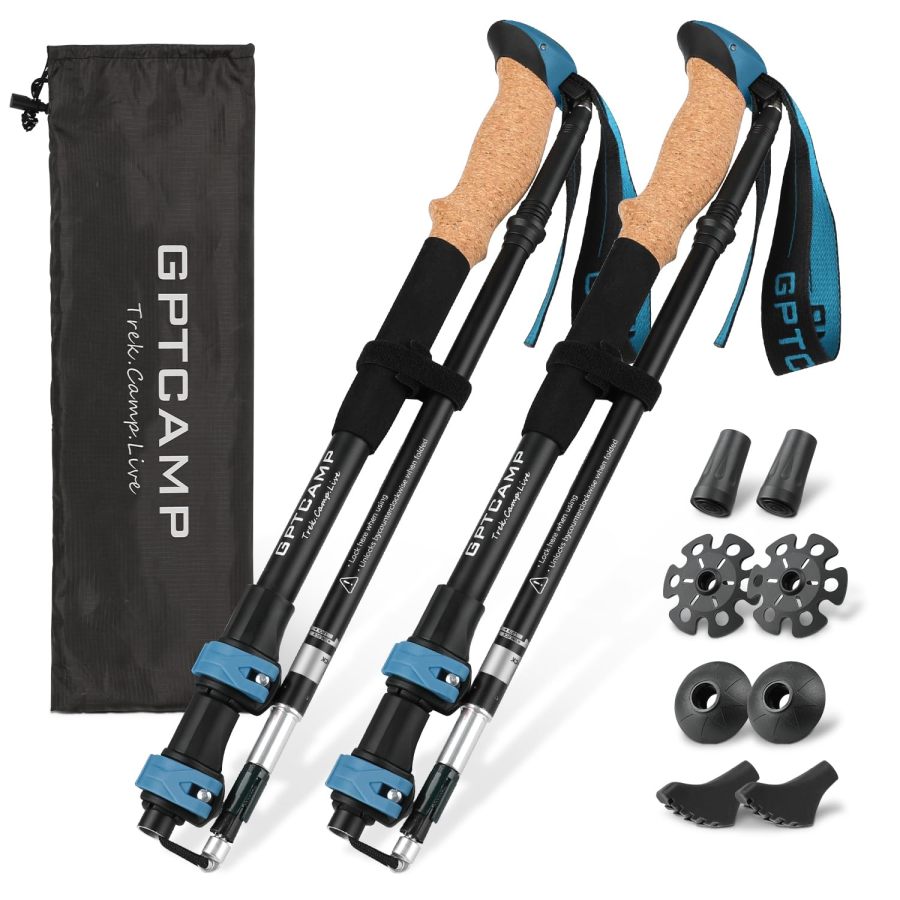
- Ball Bearing Locking System: GPTCAMP has products promoting a unique ball bearing lock, emphasizing instant adjustment and stability.
- Natural Beech Wood Material: FOREST PILOT offers wooden trekking poles, attracting specific buyers with unique materials and retro aesthetics in a homogenized market.
- Local Brand Heritage: Hiker Hunger Outfitters and others emphasize being a US-based brand with testing background in the Rocky Mountains, building trust and a professional image.
- Extended Warranty Period: Some brands offer 2-3 year or longer warranty services as an endorsement of product quality and brand confidence.
5.2 Competitive Landscape
5.2.1 Market Maturity
The trekking pole category market has matured. Basic functions and core performance (e.g., lightweight, foldable, adjustable) have become industry standards. Competition among brands is intense, with differentiation sought through material combinations, micro-innovations in locking mechanisms, handle comfort optimization, more comprehensive accessory packages, and differentiated marketing. Price competition is fierce, while high-end carbon fiber products also target the professional market.
5.2.2 Innovation Trends
Current innovation primarily revolves around 'lighter, smaller, more durable.' Hybrid materials (e.g., carbon/aluminum alloy) aim to balance performance and cost. Locking mechanisms continue to evolve towards greater stability and ease of use, such as optimized flip-locks or button locks to reduce the loosening issues of traditional twist locks. Handle design pursues better ergonomics and sweat management. Additionally, customized needs for specific scenarios (e.g., ultralight backpackers, senior assistance) are gradually emerging. Future attempts may include more smart integrations (e.g., GPS, sensors).
VI. Marketing Claims vs. Reality Check
The table below analyzes the gap between common marketing claims and actual user experiences in this category:
| Dimension | Marketing Claim | User Reality | Verdict |
|---|---|---|---|
| Locking Mechanism Reliability | Upgraded quick-lock system, stable and secure, will never slip or detach. | User feedback on multiple products (e.g., GPTCAMP B0CQSB1RXN, GPTCAMP B0DYDR2RRV) indicates locks easily loosen, jam, or even break on first use, causing poles to shorten unexpectedly or disassemble during use. | Sellers over-promise on a critical safety feature, while actual quality control fails to keep up. Attributing core reliability issues to 'user error' is a serious evasion of responsibility, directly threatening user safety. |
| Material Strength Comparison | Aerospace-grade 7075 aluminum is tougher than carbon fiber and withstands greater pressure. | While it's true that aluminum is less prone to brittle fracture under lateral force, carbon fiber typically has a higher strength-to-weight ratio and better shock absorption. Some user feedback indicates aluminum poles can still bend or break, and aluminum is less advantageous than carbon fiber for pursuing ultimate lightweight. Some listings also show material contradictions (e.g., B07X6MXH51 description says Carbon Fiber, but Specification says Aluminum). | This is typical marketing spin, using aluminum's resistance to brittle fracture to mask its disadvantages in lightweight and specific strength. Material choice should be based on scenario needs, not blanket claims of 'tougher,' ignoring physical properties and cost balance. |
| Tip Rubber Cap Durability | Includes multi-functional tips, adaptable to all terrains, long-lasting and durable. | Extensive user feedback, especially on hard surfaces (e.g., asphalt, cobblestone) or with high-intensity use, indicates rubber tips wear out extremely quickly, even 'worn out in a day,' and are difficult to replace. | Sellers employ a low-cost strategy for consumable accessories, leading to a significant drop in user experience that severely contradicts the 'long-lasting and durable' promise, increasing user extra costs and inconvenience. |
| Product Quantity & Size Information | 2pc Per Set (two poles), suitable for XX height range. | Some products (e.g., B0DJZ788GL) have titles claiming '2pc Per Set' but the Specification 'Number of Items' shows '1,' and are sold at a single-pole price on the listing, causing consumer confusion. Additionally, claims about suitable height ranges are vague or inconsistent with actual minimum/maximum adjustment lengths. | This is clear listing information confusion and misleading, using ambiguous language to induce consumers, severely damaging the shopping experience and brand integrity. Accuracy of sizing information also directly impacts user experience and needs to be clear and consistent. |
Key Takeaway: The market exhibits widespread parameter inflation and scenario-based experience exaggeration, especially regarding lightweight claims, locking system reliability, and accessory durability.
VII. Supply-Demand Misalignment Analysis
The table below highlights mismatches between seller focus and buyer priorities:
| Dimension | Seller Behavior | User Focus | Verdict |
|---|---|---|---|
| Long-Term Reliability & Replaceability of Core Components (Locks/Tips) | Sellers commonly emphasize the strength of the pole material (e.g., 7075 aluminum alloy) but pay insufficient attention to the long-term stability of locking mechanisms and the wear resistance of tip rubber caps. They also rarely provide convenient channels for purchasing replacement parts. | Users are most worried about trekking poles failing at critical moments. They want locks to be truly secure, rubber tips to wear less quickly, and to be able to easily buy replacements when parts break, rather than throwing the whole thing away. | Sellers fail to understand users' holistic demand for reliability in trekking poles as safety aids. They over-focus on pole strength while neglecting the actual pain points of key vulnerable components. |
| Intuitive Ease of Assembly & Adjustment | Sellers often claim 'easy to assemble and adjust' in listings, but some products still require users to watch videos or carefully study manuals for correct operation, failing to provide a truly 'foolproof' experience. | Especially for first-time or senior users, they want trekking poles to be ready to use out of the box, without a complex learning process. Complicated instructions and operational steps cause frustration. | Sellers underestimate user expectations for operational convenience. For leisure and assistive users, a complex initial setup process significantly reduces product appeal. |
| Balance Point Between Ultimate Lightweight & Structural Strength | Commonly emphasize 'ultra-light' characteristics in aluminum products while claiming 'stronger than carbon fiber,' attempting to cover all advantages, but actual performance and price ranges fail to reflect this balance. | Professional users are willing to pay a premium for carbon fiber's ultimate lightweight and shock absorption, while general users value aluminum's cost-effectiveness and resistance to brittle fracture. Over-promising 'having it all' can lead to dissatisfaction from both user groups. | Sellers attempt to blur the true value of material differences in marketing, excessively pursuing an 'all-in-one' label while ignoring the inherent physical trade-offs between materials in cost, weight, and strength, creating value misalignment. |
Key Takeaway: Sellers over-competition on product materials, yet collectively under-communicate or under-invest in core user pain points like long-term locking mechanism reliability, accessory durability, and ease of operation, leading to a supply-demand mismatch.
VIII. Strategic Opportunities & Recommendations
8.1 Modular Design & Lifetime Guarantee for Core Components
8.1.1 Target Audience & Pain Points
⚡️ Pain Points Addressed: Long-term locking mechanism reliability, tip & rubber cap durability, accessibility of after-sales repair & replacement parts.
8.1.2 Action Plan
Adopt high-strength engineering plastics or aluminum alloy for quick-lock buckles, optimizing internal engagement structures to ensure no loosening under extreme pressure. Develop quickly replaceable, standardized-size ultra-wear-resistant tungsten carbide tips and high-elasticity, aging-resistant rubber caps, providing convenient online purchase channels. Introduce a 'lifetime free replacement for key components' service.
| Tech Complexity | Medium |
| Cost Impact | Medium Impact |
| Trade-off Warning | Upgrading to high-strength lock components and wear-resistant tips increases unit cost, but users are willing to pay a premium for reliability and peace of mind. |
| Price Band | Only viable above $34.99 |
8.1.3 Marketing Strategy
Emphasize 'Safety Assured, Core Components Lifetime Guaranteed.' Showcase product reliability in harsh environments through high-intensity testing videos and user extreme-use case studies. Promote 'Say goodbye to repeated purchases, one investment, lifetime peace of mind.'
8.2 'Zero Learning Curve' Smart Guidance System
8.2.1 Target Audience & Pain Points
⚡️ Pain Points Addressed: Intuitive assembly & adjustment, complexity of assembly operation.
8.2.2 Action Plan
Use color coding or clear graphic indicators (e.g., numbers 1-2-3) at pole connection points for intuitive assembly sequence. Design a spring-assisted 'auto-deploy' or 'semi-auto lock' mechanism that clicks into place upon extension. Provide simplified illustrated instructions and a 15-second silent tutorial video (scannable QR code on packaging).
| Tech Complexity | Low |
| Cost Impact | Low Impact |
| Trade-off Warning | Adding color coding or optimizing instructions has no negative impact on physical performance; the main investment is in design and content creation. |
| Price Band | Only viable above $24.99 |
8.2.3 Marketing Strategy
Position as 'Ready to Use Out of the Box, Depart in Seconds.' Highlight product's extreme ease of use through user quick-assembly challenges and senior user easy-operation demos. Emphasize 'Say goodbye to complex manuals, save time for the scenery.'
8.3 Ultimate Portable Multi-Functional Travel Kit
8.3.1 Target Audience & Pain Points
⚡️ Pain Points Addressed: Inconvenient to carry / hard to store, accessory wear, later maintenance, integrated accessory storage.
8.3.2 Action Plan
Optimize folded length to under 14 inches, ensuring it fits all mainstream carry-on luggage. Design a high-quality compartmentalized storage bag where each accessory (including replacement tips, mud baskets, snow baskets) has a dedicated spot and can be securely attached to the outside of a backpack or suitcase handle. Use waterproof, wear-resistant material for the bag to enhance the overall travel experience.
| Tech Complexity | Medium |
| Cost Impact | Medium Impact |
| Trade-off Warning | Designing a more compact folding structure may increase mold costs; high-quality storage bags and accessories raise overall BOM but improve user experience and repurchase rate. |
| Price Band | Only viable above $39.99 |
8.3.3 Marketing Strategy
Emphasize 'Travel Companion, All-in-One Bag.' Promote 'TSA-friendly design, worry-free global travel.' Collaborate with fashionable travel bloggers to showcase product integration with travel lifestyle, highlighting portability and efficiency.
8.4 Premium Carbon/Aluminum Hybrid 'Performance Balance' Series
8.4.1 Target Audience & Pain Points
⚡️ Pain Points Addressed: Aluminum weight is not ultra-light, single material choice, lack of shock absorption function.
8.4.2 Action Plan
Develop trekking pole shafts using a hybrid of carbon fiber and aerospace-grade aluminum alloy, optimizing segment ratios for the best balance between weight and strength. Integrate a more efficient elastic shock absorption system (e.g., internal spring or silicone buffer) to further reduce joint impact. Offer multiple sizes and height adjustment ranges to meet broader professional needs.
| Tech Complexity | High |
| Cost Impact | High Impact |
| Trade-off Warning | Carbon fiber hybrid materials significantly increase costs, and production processes are more complex, requiring a balance between strength and price. May not achieve the ultimate lightweight of pure carbon fiber but can offer better value. |
| Price Band | Only viable above $69.99 |
8.4.3 Marketing Strategy
Position as 'The Professional's Choice, No Performance Compromises.' Promote its excellent balance in lightweight, shock absorption, and strength, emphasizing it is 'built for long distances and complex terrain.' Establish a high-performance image through professional athlete endorsements and lab test data.