Amazon US Market Analysis: Suction Grab Bars Category
📊 Executive Summary
📈 Market Trends
Portability demand grows, safety trust crisis intensifies. The suction grab bar market is favored for its no-drill, easy-installation features. However, current products suffer from severe homogenization, and consumers are widely skeptical of the core selling point-suction reliability-leading to a trust deficit. Future market trends will lean towards smarter, more reliable, and more universally applicable solutions to rebuild user confidence.
⚡ Major Pain Points
Unstable suction and poor surface compatibility are critical flaws. Users' core pain points are frequent unexpected detachment of suction bars, posing serious safety threats, and strict product limitations on wall types (e.g., textured tiles, tile grout lines), preventing many from effective installation. Additionally, sellers' contradictory messaging of 'heavy-duty support' versus 'balance assistance only' severely misleads consumers.
💡 Selection Opportunities
Deepen safety reliability, expand product applicability. The greatest product selection opportunities lie in dramatically improving suction stability and providing real-time safety warnings (e.g., smart suction bars), genuinely addressing core user concerns. Secondly, developing a 'universal fit' mark-free wall adapter plate can break the strict surface limitations of traditional suction bars, expanding market reach. Simultaneously, focusing on long-term hygiene (e.g., antibacterial, easy-clean designs) and extreme portability (e.g., travel-specific models) can establish differentiation in niche markets and capture premium pricing.
I. Analysis Overview
1.1 Introduction & Report Scope
This report analyzes the 'Bath & Shower Grab Bars' category (Suction Grab Bars) in the US Amazon market, focusing on target user personas, core needs, decision factors, market communication, and potential opportunities.
1.2 Category Snapshot
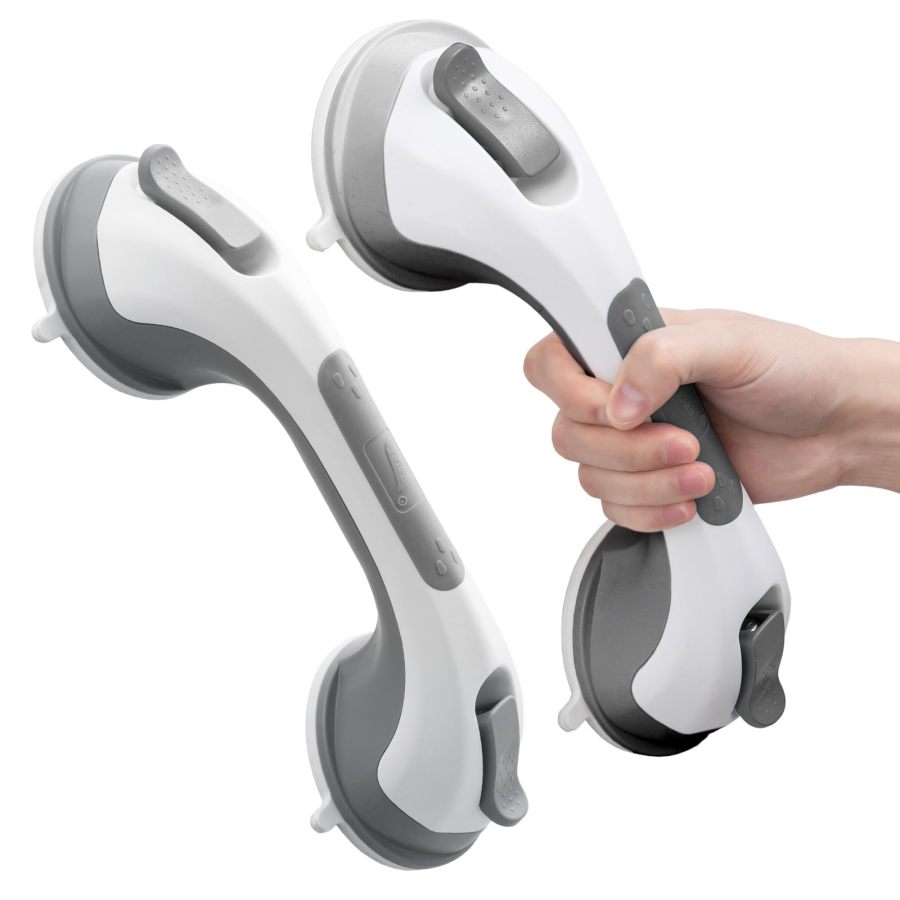
Suction grab bars are non-drilling assistive tools specifically designed for bathroom environments. They adhere to smooth wall surfaces via vacuum suction, providing balance support for users in slippery shower areas, bathtubs, or beside toilets. These products cater to temporary or non-permanent safety assistance needs with their easy installation and portability, primarily serving the elderly with mobility issues, pregnant women, post-operative recovery patients, and children. The following table illustrates the key characteristics of consumer behavior in this category.
| Dimension | Segment | Description |
|---|---|---|
| Need Driver Type | Emergency-driven / Planned Purchase | Purchases are often triggered by sudden mobility issues for the user or their family (e.g., post-operative recovery, pregnancy) or by proactive planning for future safety risks. |
| Purchase Frequency | Low | Typically a one-time purchase, replaced only when the product is damaged, fails, or needs change; not a high-frequency repurchase item. |
| Decision Complexity | Medium | Consumers carefully compare suction power, safety, surface compatibility, and price but usually do not conduct overly in-depth technical research, relying more on reviews and brand promises. |
| Price Sensitivity | Medium | Price is an important consideration, provided basic safety is assured. However, users are willing to pay a premium for significant reliability and peace of mind. |
| Emotional Dependency | High | The product directly relates to the user's personal safety and independence in daily life, making trust and peace of mind extremely critical in the purchase decision. |
II. User Personas & Usage Scenarios
2.1 Aging-in-Place Seniors / Individuals with Mobility Issues
🎯 Experience declining balance due to age or health conditions, seeking stable support in the home bathroom to reduce fall risks and maintain independent living.
| Typical Usage Scenarios | Core Pain Points | Primary Purchase Drivers |
|---|---|---|
|
|
|
2.2 Temporary Need Users / Renters
🎯 Require temporary bathroom assistance due to short-term injury recovery, pregnancy, or rental housing restrictions, with the possibility of removal after recovery or moving.
| Typical Usage Scenarios | Core Pain Points | Primary Purchase Drivers |
|---|---|---|
|
|
|
III. User Needs Hierarchy (KANO Model)
3.1 Basic Needs (Must-Haves)
- Secure Adhesion: The bar must reliably adhere to smooth, flat, non-porous surfaces. This is the most fundamental and critical function; its absence renders the product unusable.
- Easy Installation: Requires no additional tools or professional skills; users can install and detach it by hand within seconds, meeting expectations for convenience.
- Water & Moisture Resistance: Must function properly in humid bathroom environments; suction cups should not lose grip due to moisture ingress, and the product itself should not rust or deform.
- Appropriate Size: Bar length and grip width must be suitable for user grasp without occupying excessive space.
3.2 Performance Needs (Linear Satisfiers)
- Weight Capacity: Should withstand the advertised minimum weight (e.g., 240-350 lbs) to provide sufficient balance assistance and enhance user confidence.
- Non-Slip Grip: The grip surface should feature anti-slip textures, rubber material, or ergonomic design to ensure a secure hold even with wet hands, preventing slippage.
- Stable Suction: Should remain firmly attached for extended periods after installation, not prone to self-detachment, with any minor loosening being noticeable to the user.
- Surface Compatibility: The product should be compatible with various common bathroom surfaces (e.g., different tile sizes, glass, fiberboard) to avoid installation failure due to surface limitations.
3.3 Excitement Needs (Delighters)
- Suction Indicator: Provides visual (e.g., red/green window or gauge) indication of suction status, offering real-time feedback on secure attachment and enhancing peace of mind.
- Portable Storage: Includes a storage bag or clever design for easy travel carrying or compact storage when not in use, adding product value.
- Aesthetic Design: Product color, shape, and materials should blend with modern bathroom decor, not appear obtrusive, and potentially enhance overall home aesthetics.
- Easy Reset Mechanism: When suction weakens, allows for quick reactivation (e.g., via a button press) without requiring complete removal and reinstallation.
3.4 Unmet Needs & Opportunities
-
Long-term Reliability & Anti-Detachment: Suction grab bars commonly suffer from weakening suction or sudden detachment over time. A fundamental solution is needed to build lasting trust and eliminate user concerns about safety hazards.
User Reviews (VOC) They release themselves at least once a day. Dangerous. // It initially held great but today just came crashing down all by itself! Don't buy // Only holds for a short period
-
Broader Surface Compatibility: Existing products have strict requirements for wall flatness and material (e.g., textured tiles, small tile grout lines), limiting application scenarios and preventing many users from installing them.
User Reviews (VOC) They wouldn't stick to the shower walls but they worked on the glass of the door. // It would fit perfectly if I had a flat wall but not on tiles. The suction cups over lapped over tiles so they wouldn't be secure which could be dangerous. // Does not stick to rough surfaces.
-
Clear & Reliable Weight Capacity Promise: Users often find the disclaimer 'for balance assistance only, do not bear full body weight' contradictory, hoping for a product they can truly rely on to prevent falls and support weight.
User Reviews (VOC) Not safe. Will not retain the suction and falls off the wall. // I am now withholding even that advice. I've had a lot more experience with them now and even the brands that I was "recommending" at the time are off my list. They can not be fully trusted and it is better to be safe than sorry, to be cliche.
-
Simple & Efficient Suction Reset: When suction weakens, users need a simpler, more reliable method to re-secure the bar, not just 'dry and try again.' Current methods are inefficient and fail to provide peace of mind.
User Reviews (VOC) Need to check & reset suction before each use. They don't hold on indefinitely. Need to be repositioned/reset before pretty much each expected use.
-
Hygienic Structure & Mold Prevention: Some users report water accumulation inside suction cups or latch gaps leading to mold growth, affecting product hygiene and long-term user experience. Designs lack easy-clean, anti-mold features.
User Reviews (VOC) However, water sits inside the latches and somehow between the handle and the suction cup. Mold built up over a few months even when spraying cleaner and cleaning the shower. I didn't know about the nasty water being trapped between the handle and the suction cup until I unlatched one side and the water spilled out. A better design could resolve these issues.
IV. User Decision Drivers
4.1 Key Decision Factors
- Absolute Safety & Reliability: Whether the bar can provide rock-solid support at critical moments without detaching or slipping is paramount, directly impacting user safety and is the overwhelming primary consideration in purchase decisions.
- Long-lasting Suction Stability: Whether the bar remains firmly attached over time, not prone to self-failure due to time, humidity, or temperature changes, avoiding frequent user checks or worry.
- Easy & Damage-Free Installation: Requires no professional tools or skills, allowing users to install and detach quickly without causing any wall damage, avoiding extra cost and hassle.
- Weight Capacity & Function Alignment: The advertised weight capacity must align with actual usage instructions (e.g., whether it can support full body weight), avoiding misleading users into safety risks.
4.2 Secondary Decision Factors
- Surface Compatibility: Whether the product is suitable for the specific surface type in the user's bathroom (e.g., different tile sizes, glass, fiberboard) is a key filter in product selection.
- Grip Comfort & Slip Resistance: Whether the grip design is ergonomic, features anti-slip textures or coatings, and provides comfort and stability when hands are wet.
- Portability & Reusability: Ease of disassembly, movement, and travel carrying, and whether suction remains reliable after multiple uses, meeting temporary or multi-scenario needs.
- Brand Trust & Reviews: In a safety-critical category, brand reputation, customer review ratings, and negative review rates are key references for building consumer trust and making choices.
- Visual Safety Indicators: Auxiliary features like suction status indicators that visually display safety status can enhance user peace of mind and product appeal.
V. Selling Points & Competitive Landscape
5.1 Selling Point Analysis
5.1.1 Standard Features (Points of Parity)
- No-Drill Installation: Almost all products emphasize their tool-free, wall-friendly installation, catering to user needs for convenience and wall protection.
- Powerful Suction Cup Design: Sellers commonly claim products have 'powerful suction cups' and 'heavy-duty weight capacity' (e.g., 240-350 lbs), positioning this as the core safety guarantee.
- Multi-Functional Application Scenarios: Widely promoted as suitable for the elderly, pregnant women, injured individuals, and various locations like bathrooms, bathtubs, showers, and toilets, expanding the potential user base.
- Bathroom Safety Assistance: All products position 'providing balance assistance, preventing slips' as their core value proposition, emphasizing enhanced user safety in slippery environments.
- Detachable & Reusable: Most products highlight easy detachment, cleaning, and reinstallation, allowing users to adjust positions flexibly or carry them while traveling.
5.1.2 Key Differentiators
- Suction Status Indicator: A few products offer visual cues like red/green windows, providing real-time feedback on suction safety to enhance user trust and operational peace of mind.
- Enhanced Suction Cup Material/Technology: Some products claim to use 'upgraded silicone,' 'TPE rubber,' or 'octopus-inspired suction technology' to improve cup durability and adhesion.
- Non-Slip Grip Design: Enhances grip comfort and slip resistance through details like added anti-slip strips, raised textures, or ergonomic wave designs, especially for wet-hand conditions.
- Higher Weight Capacity Claims: Some products highlight higher theoretical weight capacities (e.g., up to 500 lbs), attempting to establish a safety advantage, though this often conflicts with the 'balance assistance only' disclaimer.
- Three-Suction-Cup Structure: A few products use a three-cup design, aiming to provide stronger suction stability and weight capacity as an upgrade to two-cup models.
5.1.3 Unique Selling Propositions (USPs)
- Brand Co-branding or High Price Point: Products under brands like Omron leverage brand endorsement to enhance perceived value, despite different actual manufacturers. Alternatively, extremely high pricing may accompany specific technology or design claims.
- Special Surface Treatment Suggestions: Some user reviews mention using products with water-repellent sprays to enhance adhesion on slightly textured tiles, but this is user-driven exploration, not an official selling point.
5.2 Competitive Landscape
5.2.1 Market Maturity
The suction grab bar market has entered a mature stage, with severe homogenization in basic form and core functions. Current competition primarily revolves around foundational selling points like 'suction strength,' 'ease of installation,' and 'safety.' However, widespread user feedback indicates poor actual experience with these core promises, centering on unreliable suction and safety hazards. This suggests the market still faces significant challenges in addressing users' most fundamental needs.
5.2.2 Innovation Trends
Current innovation focuses on improving suction reliability and user trust. Examples include introducing visual suction indicators, adopting more durable suction cup materials (e.g., TPE/silicone), and optimizing cup structure (e.g., three-cup design). Some products are beginning to offer more detailed surface compatibility guidance or auxiliary tools. Future trends may move towards smarter suction monitoring, broader surface adaptability, and clearer safety grading, aiming to genuinely solve user pain points.
VI. Marketing Claims vs. Reality Check
The table below analyzes the gap between common marketing claims and actual user experiences in this category:
| Dimension | Marketing Claim | User Reality | Verdict |
|---|---|---|---|
| Suction Stability & Reliability | Claims like 'powerful suction,' 'vacuum lock,' 'heavy-duty support' imply the product can remain firmly fixed for long periods, providing absolute safety. | Users commonly report frequent, spontaneous detachment of suction cups, even without external force, sometimes failing within minutes or hours of installation, posing serious safety threats. | Sellers overstate the physical performance limits of suction cups, failing to adequately disclose their inherent limitations and instability in real-world use, misleading consumer expectations of the core safety function. |
| Weight Capacity & Functional Positioning | All products include clear disclaimers in details stating 'for balance assistance only, do not bear full body weight,' directly contradicting the high weight capacity claims. | Sellers use high weight numbers for attention but use disclaimers to avoid liability, causing serious user misunderstanding of the product's actual function. This may lead users to over-rely on the bar in emergencies, resulting in danger. | |
| Surface Compatibility & Installation Limitations | Claims like 'easy installation,' 'works on various surfaces like tile, glass, metal' imply broad applicability. | Products have extremely strict requirements for wall flatness, non-porosity, and tile size. Most common bathroom walls (e.g., with textured tiles, small tile grout lines) cannot support secure installation or adhesion. | Sellers fail to adequately disclose the stringent requirements of suction cup technology for installation surface material and geometry, leading to installation failure for many users due to incompatibility, severely limiting the product's practical usability. |
Key Takeaway: The suction grab bar market is plagued by inflated specifications, exaggerated marketing, and selective omission of critical information, especially regarding core safety performance, leading to a severe lack of consumer trust.
VII. Supply-Demand Misalignment Analysis
The table below highlights mismatches between seller focus and buyer priorities:
| Dimension | Seller Behavior | User Focus | Verdict |
|---|---|---|---|
| Long-term Suction Reliability & Safety Promise | Sellers commonly emphasize initial adhesion capabilities like 'powerful suction,' 'install in seconds,' but collectively remain silent or downplay solutions or effective warning mechanisms for suction decay, long-term reliability, and emergency detachment. | Users care most about 'whether it stays firmly attached long-term' and 'whether it can truly support me in an emergency.' Current experience is 'falls off several times a day,' 'unsafe,' contradicting sellers' 'safety guarantee.' | Sellers fail to directly address the core reliability pain point of suction grab bars, leading to persistent breach of trust regarding the most critical safety value, which is the root cause of the category's trust crisis. |
| Full Body Weight Support vs. Assistance Positioning | Sellers prominently advertise 'heavy-duty,' 'high weight capacity' in listing titles and descriptions, yet include disclaimers stating 'for balance assistance only, do not bear full body weight.' This contradictory communication strategy confuses users. | Users expect a safety bar that truly provides 'fall prevention' and 'full body support,' not a 'balance aid' that may fail at any moment. They are confused and disappointed by this 'have-it-both-ways' messaging. | Sellers create a false sense of security with ambiguous product positioning, which could lead to user accidents and severely damages the overall integrity of the category. |
| Solutions for Different Wall Types | Sellers generally have extremely high requirements for 'smooth, non-porous' installation surfaces but rarely provide practical solutions or auxiliary accessories for textured tiles, small tile grout lines, or non-smooth walls. | Many users cannot install or experience adhesion failure due to incompatible bathroom walls, urgently needing universal solutions that adapt to more wall types, not simple 'not applicable' notices. | Sellers fail to invest in solving the compatibility bottleneck of suction technology in real home environments, transferring technical limitations to users and missing opportunities to expand the market and improve user satisfaction. |
| Hygiene & Maintenance During Long-term Use | Sellers almost never mention potential hygiene issues like water accumulation or mold growth in humid environments, nor do they offer easy-clean, anti-mold, or modular replacement solutions. | Some users report water accumulation and mold inside suction cups, affecting long-term experience. Additionally, frequent suction checks and resets add to daily maintenance burden. | Sellers overlook hygiene and maintenance pain points during long-term use in high-humidity bathrooms, leading to declining user experience over time and impacting repurchase intent. |
Key Takeaway: The suction grab bar market suffers from a severe misalignment between supply and demand focus: sellers downplay core safety issues while over-promoting secondary features, leaving users' most critical pain points unresolved.
VIII. Strategic Opportunities & Recommendations
8.1 "True Grip" Smart Suction Bar with Active Warning
8.1.1 Target Audience & Pain Points
⚡️ Pain Points Addressed: Long-term Reliability & Anti-Detachment; Clear & Reliable Weight Capacity Promise; Easy Suction Reactivation.
8.1.2 Action Plan
Develop an electric adhesion system based on micro vacuum pumps or composite materials, supplemented by high-precision pressure sensors for automatic suction maintenance. Integrate tri-color indicators (Green: Safe, Yellow: Caution, Red: Danger) and audible/visual alarms. Add Bluetooth module for app-based real-time monitoring, remote alerts, and battery life warnings. The product must pass rigorous safety certifications (e.g., ADA, UL) and confidently promise full body weight support under specific conditions.
| Tech Complexity | High |
| Cost Impact | High Impact |
| Trade-off Warning | To achieve stronger adhesion and smart monitoring, the product may be slightly bulkier or require periodic charging, requiring a balance with portability. |
| Price Band | Only viable above $49.99 |
8.1.3 Marketing Strategy
Emphasize 'Active Smart Safety, Rock-Solid Every Time,' highlighting 'Real-Time Visible Safety Assurance' and 'No-Detachment Peace of Mind Guarantee.' Build absolute trust through third-party authoritative certifications and challenging weight capacity test videos. Position as 'Part of a Smart Home Safety System,' not an ordinary grab bar.
8.2 "Universal Fit" Mark-Free Wall Adapter Plate Kit
8.2.1 Target Audience & Pain Points
⚡️ Pain Points Addressed: Broader Surface Compatibility; Poor Surface Compatibility.
8.2.2 Action Plan
Develop a reusable, high-adhesion, mark-free (e.g., using nano-adhesion technology) transparent adapter plate. This plate can be firmly attached to textured tiles, small tiles, or slightly porous walls, allowing the suction bar to adhere to the plate. Offer multiple plate sizes and include precise measurement and positioning tools for easy installation.
| Tech Complexity | Medium |
| Cost Impact | Medium Impact |
| Trade-off Warning | The adapter plate will protrude slightly from the wall and may affect bathroom aesthetics for some, but this is a necessary trade-off for functionality. |
| Price Band | Only viable above $29.99 (including bar) |
8.2.3 Marketing Strategy
8.3 "No-Pooling" Anti-Bacterial, Easy-Clean Suction Bar
8.3.1 Target Audience & Pain Points
⚡️ Pain Points Addressed: Hygienic Structure & Mold Prevention; Hygiene & Maintenance During Long-term Use.
8.3.2 Action Plan
Adopt an open-structure design with self-draining features to reduce water-trapping crevices. Upgrade suction cup and handle materials to food-grade antibacterial silicone or ABS plastic with anti-microbial additives to inhibit mold growth. Enable one-click suction cup detachment for thorough cleaning. Showcase structural diagrams and cleaning processes in the listing.
| Tech Complexity | Low |
| Cost Impact | Low Impact |
| Trade-off Warning | To facilitate drainage and antibacterial properties, the product structure may appear slightly more 'industrial' than minimalist, prioritizing functional value. |
| Price Band | Only viable above $16.99 |
8.3.3 Marketing Strategy
Emphasize 'Healthy Bathroom Starts with the Bar,' highlighting the hygiene selling point of 'Anti-Bacterial & Anti-Mold, Goodbye to Hidden Hazards.' Use clear visuals to demonstrate the easy-clean, no-pooling design and provide simple maintenance guides to enhance user confidence in long-term use.
8.4 "Travel Buddy" Portable Suction Bar
8.4.1 Target Audience & Pain Points
⚡️ Pain Points Addressed: Insufficient Portability; Travel Accommodation Safety Needs.
8.4.2 Action Plan
Design a more compact (e.g., 8-10 inches), lightweight suction bar with a custom portable storage pouch. Optimize the quick-adhesion/release mechanism to reduce friction during assembly/disassembly. Ensure stable performance on common smooth hotel bathroom tiles and glass. Consider lighter yet sturdy engineering plastics for materials.
| Tech Complexity | Low |
| Cost Impact | Low Impact |
| Trade-off Warning | For maximum portability, the product may be relatively shorter, sacrificing some grip length. This must be clearly stated in the description, and the center of gravity should be optimized. |
| Price Band | Only viable above $14.99 |
8.4.3 Marketing Strategy
Highlight 'Worry-Free Travel, Safety On-the-Go,' emphasizing 'Safety Bar in Your Pocket.' Use travel-themed visuals (airport security, hotel bathroom installation) to showcase extreme portability and quick installation. Market as 'The Reassuring Gift for Traveling Loved Ones.'