Amazon US Market Analysis: Golf Practice Nets Category
📊 Executive Summary
📈 Market Trends
Portability and integration are mainstream, but quality trust needs rebuilding. The golf practice net market is maturing, with products commonly selling on points like lightweight, easy installation, and multi-functional accessories. However, beneath surface prosperity, user concerns about product durability are growing, and skepticism about the actual value of 'complete set' concepts is rising. Consumers increasingly expect products to truly deliver on promises, not just appear feature-rich.
⚡ Major Pain Points
Durability is the Achilles' heel; hitting mats become useless. The most concentrated user pain point is that practice nets and support poles are extremely prone to damage, creating a huge gap with seller claims of 'Heavy Duty', leading to a trust crisis. Secondly, included hitting mats are generally too small, slide easily, and are of low quality, failing to provide effective practice experience, becoming 'discarded' accessories for users, reducing overall bundle value.
💡 Selection Opportunities
Return to quality fundamentals, deeply address scenario-specific pain points. Market opportunities lie in creating truly 'Super Durable, Unbreakable' professional-grade practice nets, paired with 'Oversized, Stable Multi-Turf Hitting Mats' to solve core user pain points. Simultaneously, addressing specific scenarios (like urban indoor) with 'Quiet Design' and outdoor 'Rugged Wind Resistance' capabilities can open new premium space, helping brands stand out in homogeneous competition and build long-term user trust.
I. Analysis Overview
1.1 Introduction & Report Scope
This report analyzes the 'Hitting Nets' category (golf practice nets) within the Amazon US market, focusing on target user personas, core needs, decision drivers, market communication, and potential opportunities.
1.2 Category Snapshot
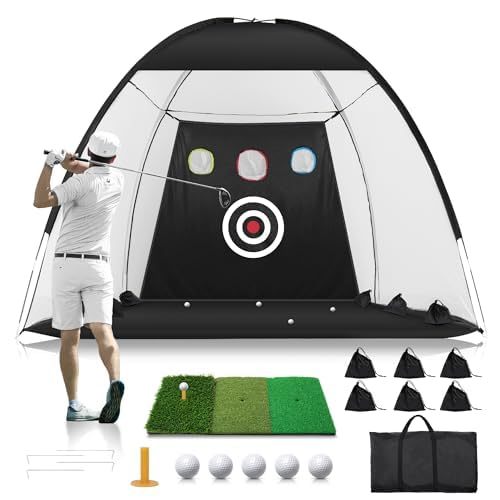
Golf practice nets are training equipment designed to provide golf enthusiasts with convenient indoor and outdoor practice, with the core function of safely and effectively catching struck golf balls. These products typically include a net, support frame, and often come with a hitting mat, target, practice balls, and carry bag. They cater to various practice needs from full swings to chipping, aiming to break limitations of space and weather to improve user skills. The following table illustrates the key characteristics of consumer behavior in this category.
| Dimension | Segment | Description |
|---|---|---|
| Need Driver Type | Planned Purchase / Emergency-driven Purchase | Purchases are typically driven by a long-term plan to improve skills, or by sudden circumstances like inability to access a driving range or poor weather, seeking a convenient home-based alternative. |
| Purchase Frequency | Low Frequency / Replacement-driven | Typically a one-time purchase. Repeat purchases are usually due to damage of the existing product, need for functional upgrades, or as a gift. The purchase cycle is relatively long. |
| Decision Complexity | Medium / Moderately Complex | Consumers actively compare information on product dimensions, material durability, accessory completeness, installation ease, and user reviews. |
| Price Sensitivity | Medium | Price is an important consideration in the decision-making process. However, users are willing to pay a corresponding premium if the product offers reliable quality, excellent durability, and a superior user experience. |
| Emotional Dependency | Low to Medium | The product primarily fulfills functional training needs but also delivers emotional value such as the joy of improving skills, enjoying the sport, and gaining a sense of professionalism. |
II. User Personas & Usage Scenarios
2.1 Avid Golf Enthusiast
🎯 Passionate about improving golf skills, desires to maintain high-frequency, high-quality practice off the course to achieve technical breakthroughs.
| Typical Usage Scenarios | Core Pain Points | Primary Purchase Drivers |
|---|---|---|
|
|
|
2.2 Golf Beginner / Casual Player
🎯 A beginner interested in golf or a casual player who simply wants to experience the fun of golf in a relaxed atmosphere.
| Typical Usage Scenarios | Core Pain Points | Primary Purchase Drivers |
|---|---|---|
|
|
|
III. User Needs Hierarchy (KANO Model)
3.1 Basic Needs (Must-Haves)
- Sturdy, Reliable Net: The ability to effectively catch golf balls, preventing them from flying out and causing loss or danger, is the most core function of a practice net.
- Easy to Assemble & Disassemble: Users expect the product to be quick and easy to set up and pack away, saving time and effort, thereby increasing usage frequency.
- Adequate Size: Provides a large enough hitting area to ensure safe and effective practice, which is crucial especially for full swings.
- Portable & Easy to Store: Includes a carry bag for easy transport and storage when not in use, adapting to limited home space.
3.2 Performance Needs (Linear Satisfiers)
- High Durability: Can withstand repeated high-intensity hits without easily wearing or tearing, ensuring long product lifespan and avoiding frequent replacements.
- Hitting Mat (Turf) Quality: Provides simulated hitting experiences for different turf types (tee box, fairway, rough) with good size and stability.
- Multi-Target Design: Includes target areas or pockets of different sizes and heights for improving shot accuracy and skill training.
- Indoor & Outdoor Versatility: Suitable for various locations (backyard, garage, basement, indoors) and adaptable to different weather conditions and usage needs.
- Ball Return Function: Balls automatically roll back near the hitting area after being struck, reducing ball retrieval time and increasing practice efficiency.
3.3 Excitement Needs (Delighters)
- Quiet Hitting Design: Special materials or structures that significantly reduce noise generated upon impact, enabling a 'community-friendly' indoor/outdoor practice experience.
- All-in-One Golf Training Kit: Beyond the net and mat, includes a full set of accessories like high-quality golf balls, tees, scoreboard, sandbags, ready to use out of the box.
- Smart Data Feedback (Low-Cost): Integrates simple sensors to provide basic data feedback like ball speed and direction, assisting users in improving technique.
3.4 Unmet Needs & Opportunities
-
Actual Durability of Net & Frame: Many users report that nets and support poles are prone to damage, especially under high-intensity hitting. There is a strong need for more robust and durable materials and structures to match marketing claims.
User Reviews (VOC) The net ripped the first day of setting it up. It wasn't super hard to set up. I would not recommend going with this one. Save your time and money and get a better one. // Already a hole after three days of light indoor use with a 6 and 7 iron. The seam between the heavier nets in the middle is all frayed already and at least in one spot it has separated so a ball can get through.
-
Hitting Mat Quality & Size: Existing hitting mats are generally too small, thin, prone to sliding, or fail to provide a realistic hitting experience. Users commonly need larger, more stable, and more realistic mats.
User Reviews (VOC) The hitting mat is a little small, but that is a minor deterrent. // The mat is really hard to hit off of because it is really small. The balls that it comes with are like hitting rocks.
-
Stability & Wind Resistance for Outdoor Use: When used outdoors, products are easily affected by wind, causing wobbling or even collapse. More reliable anchoring systems or a more stable overall structural design are needed.
User Reviews (VOC) It falls with a light breeze. // Suggestions would be to get some tent stakes that are a little stronger and don't try to use in any type of wind conditions, the air must be still or this thing becomes a kite.
-
Hitting Noise Control: For indoor or residential area use, the noise generated upon impact is a potential pain point. The market lacks widely available and demonstrably effective noise-reduction features.
User Reviews (VOC) If you choose to keep up the chip target in the net, it's really loud when the ball makes contact. I took it down and used the white drop net instead. // It is also very quiet, just a thump into the cloth.
-
Clear, Simple Assembly Instructions: Some users report that assembly instructions are unclear, leading to confusion or time-consuming setup, negatively impacting the initial user experience.
User Reviews (VOC) The instructions were basic but straightforward. While the placement of the side skirts was a bit confusing, a little common sense made it easy to figure out. // The first time I did I put them in incorrectly and when trying to take one of them out the stretchy rope broke.
IV. User Decision Drivers
4.1 Key Decision Factors
- Net & Frame Durability: Consumers are most concerned about whether the product can withstand high-intensity hitting without easily wearing or tearing, directly impacting lifespan and training safety.
- Installation Ease: Whether the product can be set up and taken down quickly and simply directly influences user willingness and frequency of use.
- Hitting Area Safety: Whether the net surface is large and stable enough to effectively prevent golf balls from flying out, causing loss or danger, is a core safety consideration.
- Hitting Mat Practicality: The size, slip resistance, durability, and ability of the hitting mat to simulate real turf directly affect the hitting experience and training effectiveness.
4.2 Secondary Decision Factors
- Product Price: Price is a significant factor influencing the final purchase choice, provided core functionality and durability are met.
- Complete Accessory Package: Whether it includes golf balls, tees, carry bag, stakes, etc., offering a convenient, all-in-one, ready-to-use experience.
- Outdoor Wind Resistance Stability: When used outdoors, whether the product can remain stable against wind, avoiding wobbling or collapse, affects usability in various scenarios.
- Multi-Target Training Function: Whether the net provides varied target areas or pockets to help users train for accuracy and add fun.
- Hitting Noise Level: The volume of noise generated upon impact, especially for indoor or residential use, affects the user and surrounding environment.
V. Selling Points & Competitive Landscape
5.1 Selling Point Analysis
5.1.1 Standard Features (Points of Parity)
- Easy to Assemble & Disassemble: Most products emphasize quick setup, often claiming completion in just a few minutes, saving user time.
- Indoor & Outdoor Versatility: Commonly highlight usability in various indoor/outdoor scenarios like backyard, garage, basement, unrestricted by weather.
- Full Training Accessories: Most products include a hitting mat, golf balls, tees, carry bag, etc., positioning as an all-in-one solution.
- Sufficiently Large Hitting Area: Widely advertise large dimensions (e.g., 10x7 ft) to provide ample and safe practice space.
5.1.2 Key Differentiators
- Multi-Target Design: Some products add pockets or bullseye targets of different sizes for precision training, enhancing fun.
- Enhanced Durable Materials: Some brands mention using upgraded materials like 600D Oxford cloth, high-density nylon net, thick fiberglass poles to emphasize impact resistance.
- Tri-Turf Hitting Mat: Offers simulation of different grass lengths (fairway, rough, tee box) to improve hitting realism.
- Portable Storage & Lightweight: Emphasize compact storage, inclusion of a carry bag for easy transport and storage in limited spaces.
5.1.3 Unique Selling Propositions (USPs)
- Quiet Hitting Technology: A very few premium brands adopt technologies like EchoShield™ to significantly reduce hitting noise, providing a quieter practice experience.
- Professional US Design/Brand: Some brands emphasize product design originates from US golf enthusiasts, claiming better understanding of professional needs to build trust and command a premium.
- Long-term Warranty Promise: A few brands offer a 2-year or longer worry-free warranty to boost consumer confidence in product quality.
- Scoreboard / Interactive Scoring: A few products integrate a scoreboard or similar design to add fun and interaction with family and friends during practice.
5.2 Competitive Landscape
5.2.1 Market Maturity
The golf practice net market has entered a mature stage, primarily characterized by high functional homogenization. Most sellers promote around basic selling points like easy installation, large size, and indoor/outdoor versatility, leading to intense price competition. Although some brands attempt differentiation through material upgrades or extra accessories, overall innovation is insufficient. The core pain points (like actual durability) of most products remain unresolved.
5.2.2 Innovation Trends
Current innovation trends are mainly in two directions: First, high-end specialization. A few brands are investing in R&D for more impact-resistant nets and frames, more realistic hitting mats, and even quiet technology and data feedback functions to meet the advanced training needs of seasoned players, offering longer warranties to build trust. Second, foundational practicality. Within entry-level products, optimizing core durability and convenience to attract casual players with higher value and more authentic quality. Additionally, improving accessory completeness (e.g., including golf balls, tees, sandbags) and multi-functionality (e.g., for other ball sports) have become directions for some sellers to enhance appeal.
VI. Marketing Claims vs. Reality Check
The table below analyzes the gap between common marketing claims and actual user experiences in this category:
| Dimension | Marketing Claim | User Reality | Verdict |
|---|---|---|---|
| Net & Frame Durability | Claims like 'Heavy Duty', 'Withstands 200 MPH Ball Speed', '7-Layer/5-Layer High-Strength Net', 'Upgraded Reinforced Frame', implying the product can withstand powerful hits long-term. | Users widely report net surfaces tearing, developing holes, and even poles breaking after short-term use, sometimes with the first hit penetrating the net, severely contradicting claims. | This is typical parameter inflation and over-promotion, equating ideal lab data or theoretical maximums directly with real-world experience, severely misleading consumers, leading to collapsed user trust and high return rates. |
| Hitting Mat Quality & Size | Claims like 'Tri-Turf Realistic Hitting Experience', 'Heavy-Duty Non-Slip Hitting Mat', 'Complete Training System Includes Hitting Mat', implying a professional and comprehensive striking experience. | Users report included hitting mats are generally too small (e.g., 18x12 in), lacking comfortable standing area, prone to sliding, made of inferior materials, easily damaged. Some users call them 'like hitting rocks' or 'useless', requiring separate purchase. | Sellers cut corners on key accessories, fulfilling the 'complete set' concept in form but with quality and size contradicting the 'real experience' promise, forcing users to spend more, severely diminishing the product bundle's value. |
| Installation Ease | Claims like '90-Second Quick Setup', '2-5 Minute Easy Assembly', 'As Simple as Setting Up a Tent', highlighting extreme convenience. | Users report actual assembly typically takes 10-25 minutes, poles can get stuck, instructions are unclear, and solo setup can be difficult, a significant gap from the promised 'instant' experience. | Sellers overlook potential friction and cognitive barriers users might encounter during operation, overly optimistically assessing installation difficulty, leading to user frustration during initial use. |
Key Takeaway: The golf practice net market is characterized by a widespread tendency to exaggerate product performance in marketing, especially regarding core durability and convenience. There is a significant gap between seller promises and actual user experience.
VII. Supply-Demand Misalignment Analysis
The table below highlights mismatches between seller focus and buyer priorities:
| Dimension | Seller Behavior | User Focus | Verdict |
|---|---|---|---|
| Product Actual Durability | Sellers commonly highlight 'Heavy Duty', 'High-Strength Impact-Resistant Materials', but actual product quality fails to match these claims, lacking reliable assurance for the actual lifespan of nets and frames. | Users' core pain point is that nets and poles break too easily, complaining 'ripped after a few uses', 'pole snapped', perceiving claims as false, even posing safety risks. | On the core quality issue users care most about, sellers provide false promises rather than real solutions. This is the root cause of the product trust crisis. |
| Hitting Mat Real Value | Most sellers promote a 'Complete Training System' including a hitting mat, emphasizing multi-turf functionality, but generally ignore the core user experience of its size and stability. | Users report included hitting mats are too small, slide easily, and are of poor quality, severely affecting swing posture and experience, ultimately requiring purchase of a larger mat, rendering the feature useless. | Sellers engage in low-value feature stacking (like tri-turf) on hitting mats but fail to solve the most fundamental size and stability issues as a training aid, resulting in resource waste and user dissatisfaction. |
| Outdoor Wind Stability & Noise Control | Sellers emphasize product 'Indoor & Outdoor Versatility' and include stakes, but generally lack in-depth solutions or clear performance promises for structural stability in strong outdoor winds and noise issues for indoor use. | Users complain products easily topple in light breezes, or hitting noise disturbs neighbors. These are hidden pain points limiting usage scenarios and frequency, which sellers fail to address effectively. | While claiming to expand product applicability, sellers fail to fully consider key challenges in actual usage environments (like wind, noise), resulting in experience far below expectations in specific scenarios. |
Key Takeaway: A severe supply-demand misalignment exists in the current golf practice net market: sellers collectively remain silent or downplay core pain points while over-supplying secondary or ineffective features.
VIII. Strategic Opportunities & Recommendations
8.1 "Super Durable, Unbreakable" Professional-Grade Practice Net
8.1.1 Target Audience & Pain Points
⚡️ Pain Points Addressed: Nets and frames easily damaged, cannot withstand high-intensity hitting; severe mismatch between current product claims and actual durability.
8.1.2 Action Plan
Adopt multi-layer composite high-toughness fiber net (e.g., UHMWPE or aramid fiber), combined with thickened, high-strength alloy steel or aerospace-grade aluminum alloy frame. Provide third-party authoritative lab impact test reports with clear data like 'withstands XX full-swing hits', and offer at least a 3-year unconditional warranty.
| Tech Complexity | Medium |
| Cost Impact | High Impact |
| Trade-off Warning | Using sturdier materials (e.g., high-strength composite fiber net, thickened alloy steel frame) may slightly increase product weight and packaging dimensions, raising logistics costs, but durability improvement is significant, and users are willing to pay for it. |
| Price Band | Only viable above $129.99 |
8.1.3 Marketing Strategy
Position as 'Set it and forget it, fear no powerful swing'; showcase superior performance under extreme hitting via comparison videos; emphasize 'Professional-grade training, warranty peace of mind', building ultimate reliability and trust.
8.2 Oversized, Stable Multi-Turf Hitting Mat
8.2.1 Target Audience & Pain Points
⚡️ Pain Points Addressed: Hitting mats are too small and slide easily; fail to provide sufficiently realistic hitting experience; poor quality of included mats in bundles.
8.2.2 Action Plan
Develop a multi-turf hitting mat at least 1 meter wide for standing, with a high-density, heavy-weight non-slip rubber base to ensure no movement during swings. Upgrade turf material to high-simulation, high-durability nylon or PP grass, potentially integrating a shot trajectory display layer.
| Tech Complexity | Low |
| Cost Impact | Medium Impact |
| Trade-off Warning | Increasing size (e.g., 1.5m x 1m) and rubber base thickness significantly increases weight, raising logistics costs and storage space requirements. However, this is a user necessity. |
| Price Band | Only viable above $39.99 (as a bundle upgrade or standalone product) |
8.2.3 Marketing Strategy
Highlight 'Immersive, realistic hitting feel'; showcase stability and size advantage via videos of users taking full swings on the mat; emphasize 'Say goodbye to small mat awkwardness, immersive training starts underfoot'.
8.3 Community-Friendly Quiet Golf Practice Net
8.3.1 Target Audience & Pain Points
⚡️ Pain Points Addressed: Loud hitting noise indoors or in backyards, disturbing neighbors, affecting usage frequency and experience; market lacks effective noise solutions.
8.3.2 Action Plan
Develop multi-layer composite sound-absorbing target fabric, or add a removable noise-reducing back panel behind the net. Optimize frame structure to reduce resonance transmission. Clearly provide noise decibel comparison test data in listings (e.g., 50% noise reduction), emphasizing the scenario value of 'practice late at night without disturbing neighbors'.
| Tech Complexity | Medium |
| Cost Impact | Medium Impact |
| Trade-off Warning | Adding sound-absorbing materials may slightly increase net thickness and weight, but the value of noise reduction far outweighs this, with no significant negative physical impact. |
| Price Band | Only viable above $79.99 |
8.3.3 Marketing Strategy
Core message: 'Enjoy the swing in peace, without disturbing others'; showcase significant noise reduction via comparison videos; emphasize emotional values like 'Top choice for harmonious family training', 'Your personal indoor quiet driving range'.
8.4 Rugged, Wind-Resistant Outdoor Golf Practice Net
8.4.1 Target Audience & Pain Points
⚡️ Pain Points Addressed: Outdoor use easily affected by wind, causing wobbling or collapse, impacting training safety and continuity; current product stake anchoring is ineffective.
8.4.2 Action Plan
Use heavier, thicker steel base and frame connectors, add extra sandbag weight attachment points or longer spiral stakes. Optimize net and frame aerodynamics to reduce wind resistance. Provide test data for stable use in winds up to XX mph.
| Tech Complexity | Low |
| Cost Impact | Medium Impact |
| Trade-off Warning | Adding heavier frame materials and base weights significantly increases overall product weight, sacrificing some portability and raising logistics costs. |
| Price Band | Only viable above $99.99 |
8.4.3 Marketing Strategy
Emphasize 'Unafraid of strong winds, steady as a rock'; showcase exceptional stability via outdoor wind resistance test videos; position as 'All-weather outdoor practice expert', eliminating user concerns about outdoor use.