Amazon US Market Analysis: Plug-in LED Sensor Night Lights Category
📊 Executive Summary
📈 Market Trends
Smart & Personalization Drive Category Upgrade. The plug-in LED sensor night light market is evolving from basic illumination towards smart integration, multi-functionality, and customization. Consumer expectations now extend beyond basic lighting to more comfortable light experiences, convenient smart interaction, and design aesthetics that complement home 风格.
⚡ Major Pain Points
Bedroom Brightness Issues & Smart Connection Woes. Users commonly report night lights being 'too bright' even at minimum settings in bedrooms, disturbing sleep. Concurrently, poor connection stability, complex setup, and insufficient customization of smart night light features are frequent complaints. These issues severely impact user experience, sometimes turning 'value-add' features into negatives.
💡 Selection Opportunities
Deep Dive into 细分场景,Solidify Smart Experience. Market opportunities lie in developing 'Ultra-Low Brightness, Blue-Light Free Sleep Aid Night Lights' to address bedroom pain points, and enhancing 'Smart Night Light Connection Stability & Simplicity' by optimizing technologies like the Matter protocol. Additionally, launching 'Multi-Dimension Adjustable, Context-Aware Smart Sensor Night Lights' and 'High-Quality Micro-Glow Decorative Night Lights' will satisfy deeper user needs in functionality and aesthetics, enabling differentiation and brand premium.
I. Analysis Overview
1.1 Introduction & Report Scope
This report analyzes the 'Night Lights' category (Plug-in LED Sensor Night Lights) in the Amazon US market, focusing on target user personas, core needs, decision factors, market communication, and potential opportunities.
1.2 Category Snapshot
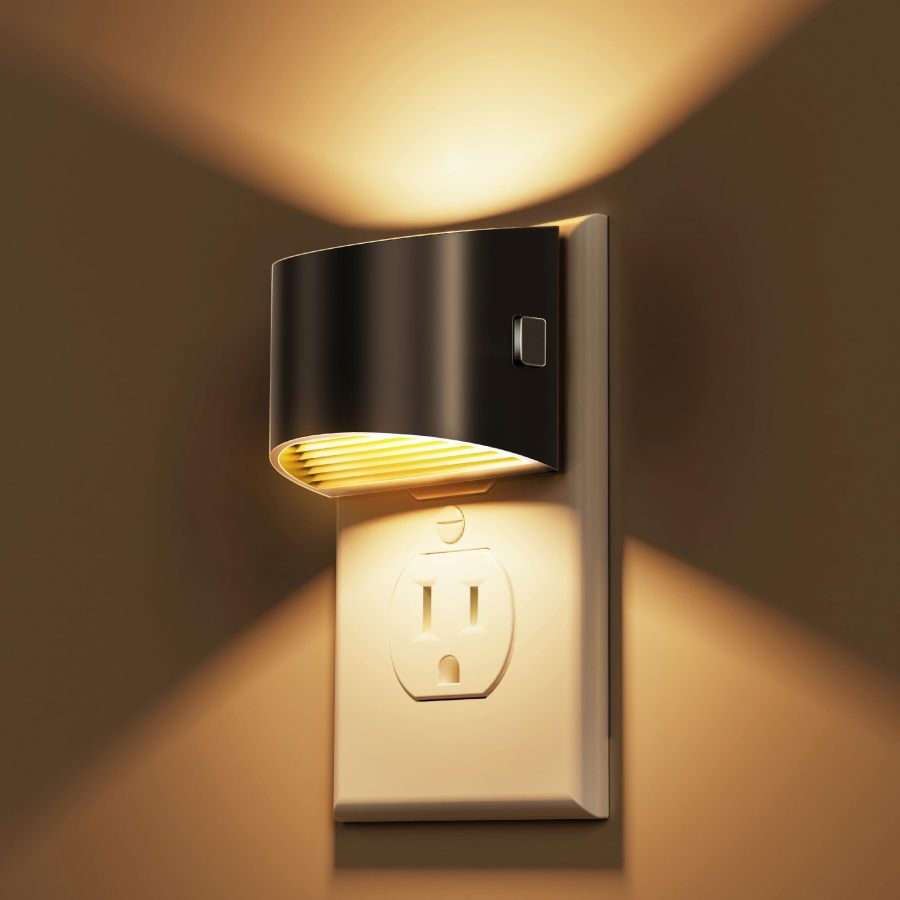
A plug-in LED sensor night light is a small lighting device that plugs directly into a wall outlet, primarily using ambient light or human motion sensors to achieve automatic on/off functionality. The product aims to provide auxiliary nighttime lighting for homes, enhancing hallway safety, creating a comfortable ambiance, and offering energy efficiency and convenience. They are typically compact, often sold in multi-packs, and widely used in areas like bedrooms, bathrooms, hallways, and kitchens. The following table illustrates the key characteristics of consumer behavior in this category.
| Dimension | Segment | Description |
|---|---|---|
| Need Driver Type | Planned Purchase / Emergency-driven Purchase | Purchases typically stem from planned needs to prevent nighttime falls, address existing lighting inconveniences, or provide auxiliary lighting for specific scenarios (e.g., children's rooms). It also includes emergency lighting needs for temporary low-light situations. |
| Purchase Frequency | Low Frequency | As durable home appliances with a long lifespan, a single purchase of a multi-pack can meet whole-house needs, resulting in a long repurchase cycle. |
| Decision Complexity | Medium | Consumers will compare factors like brightness, sensor functionality, energy consumption, size, design, and price, but typically do not conduct deep technical research. |
| Price Sensitivity | Medium to High | There is a high expectation for value-for-money regarding basic functional features and multi-pack products. However, consumers are willing to pay a reasonable premium for products offering significant smart upgrades, personalization, or superior user experience. |
| Emotional Dependency | Low to Medium | The product primarily meets functional lighting needs but provides nighttime safety, home convenience, and a comfortable ambiance, offering certain emotional value and peace of mind. |
II. User Personas & Usage Scenarios
2.1 Safety & Convenience-Focused Residents
🎯 Concerned about nighttime safety for elderly family members and children, as well as their own convenience and comfort when getting up in the dark.
| Typical Usage Scenarios | Core Pain Points | Primary Purchase Drivers |
|---|---|---|
|
|
|
2.2 Modern Consumers Seeking Home Aesthetics & Smart Integration
🎯 Value design sensibility and smart home experiences. They want night lights to be not only functional but also complement their décor and offer advanced interaction methods.
| Typical Usage Scenarios | Core Pain Points | Primary Purchase Drivers |
|---|---|---|
|
|
|
III. User Needs Hierarchy (KANO Model)
3.1 Basic Needs (Must-Haves)
- Plug-and-Play: Works immediately upon plugging into a wall outlet, requiring no batteries, complex wiring, or installation steps, maximizing convenience.
- Light-Sensing Auto On/Off: Built-in ambient light sensor automatically turns the light on when it's dark and off at dawn, eliminating manual operation.
- Energy Efficient: Uses LED technology with very low power consumption (typically 0.5W-1.5W), ensuring long-term use does not significantly increase electricity bills.
- Doesn't Block Outlets: Compact design ensures it doesn't occupy or block adjacent outlets, allowing other appliances to be used normally and improving space utilization.
- Soft, Non-Glare Light: Provides a gentle, diffused glow that avoids direct glare into the eyes, preventing disruption to night vision adaptation and sleep.
3.2 Performance Needs (Linear Satisfiers)
- Adjustable Brightness: Offers multiple levels or stepless dimming, allowing users to tailor light intensity to different scenarios (e.g., bedroom vs. hallway) and personal preference.
- Human Motion Sensor: Adds motion detection alongside light sensing for on-demand lighting, automatically turning off when no one is present, further enhancing energy savings and convenience.
- Warm White Color: Provides a warm white light (2700K-3000K) that creates a cozy, relaxing atmosphere conducive to sleep.
- Reliable Sensor Range: Motion sensor should have sufficient detection distance and angle (e.g., 3-5 meters, 120 degrees), responding promptly and accurately without lag or false triggers.
- Memory Function After Power Loss: The product remembers the last brightness or mode setting after a power interruption, eliminating the need for reconfiguration.
3.3 Excitement Needs (Delighters)
- Multi-Color / Adjustable Color Temperature: Offers RGB multi-color modes, gradient effects, or multiple color temperatures (e.g., 1600K/3000K/5000K) to satisfy personalized ambiance and sleep-aid needs, adding趣味性.
- Smart Home Integration: Compatibility with Alexa, Google Home, Matter, etc., enabling advanced features like remote control, scene automation, and scheduling via app or voice.
- Unique Light Effect Design: Features like backlighting, up/down lighting, or 300-degree rotating heads provide more refined, glare-free, or directional lighting, enhancing aesthetic value.
- Adjustable Motion-On Duration: In motion-sensing mode, allows users to customize how long the light stays on (e.g., 60s/120s, or stepless adjustment), improving flexibility.
- Elegant / Modern Design: Features fashionable, minimalist外观设计 with premium materials (e.g., brushed metal, high-quality PC) to better serve as part of home décor.
3.4 Unmet Needs & Opportunities
-
Bedroom Light Too Bright: Some products are perceived as too bright even at their lowest setting in a bedroom, disturbing sleep for light-sensitive individuals, lacking a true 'micro-glow' mode.
User Reviews (VOC) Bright but Not Adjustable... in a bedroom it can feel a little too strong if you prefer a softer glow. // The lowest brightness (30 lumens) is still too bright for a bedroom environment, affecting sleep.
-
Smart Connection Stability: Smart night lights (especially Matter/Wi-Fi types) suffer from connection drops, complex pairing, or occasional feature malfunctions, severely impacting user experience.
User Reviews (VOC) They constantly disconnect and need to be unplugged and powered back to reconnect. // The motion sensor doesn't work in Wi-Fi mode.
-
Motion Sensor Accuracy & Customization: Sensors are either too sensitive (false triggers) or not sensitive enough (misses). On-duration is often fixed, lacking custom options, e.g., insufficient time for bathroom trips.
User Reviews (VOC) I wished these had a slider on the bottom of the device to control time off shut off... the light constant shuts off on you. A.bit.annoying. // Solo falta mejorar el alcance del sensor, tienes que estar como a un metro o metro y medio para que te detecte.
-
Settings Reset After Power Loss: Some dimmable or multi-mode night lights revert to default settings after a power outage, requiring manual readjustment, causing inconvenience.
User Reviews (VOC) The brightness resets to full on when there's a power failure or if you move outlets. // when we lose power, even a quick blip, these reset to the opposite setting of where I want them.
IV. User Decision Drivers
4.1 Key Decision Factors
- Automation & Sensor Reliability: Whether light and motion sensors are sensitive, accurate, and stable is the core driver for purchasing a night light. A light that fails to switch reliably loses its fundamental value.
- Light Comfort & Appropriateness: Whether the brightness is just right-providing sufficient guidance without being glaring-especially in bedrooms and children's rooms, directly impacts user experience and sleep quality.
- Energy Efficiency & Safety: Low power consumption (0.5W-1.5W) and safety certifications (e.g., UL) ensure long-term economic use and safety, fundamental assurances for home appliances, particularly for children and the elderly.
- Size & Outlet Compatibility: Compact design that doesn't block adjacent outlets is a critical practical consideration for many users, directly affecting overall household outlet utilization efficiency.
4.2 Secondary Decision Factors
- Brightness / Mode Adjustment: Adjustable brightness and mode switching (motion/always-on/light-sensing) significantly enhance product applicability and user satisfaction, adapting to different needs and scenarios.
- Aesthetic Design & Quality Feel: Minimalist, modern design and good material触感 allow the product to better integrate into the home environment, enhancing quality of life and decorative appeal.
- Multi-Functionality & Personalization: Features like color-changing, adjustable color temperature, and smart connectivity cater to higher-order personalized needs, transforming night lights beyond mere illumination tools.
- Value-for-Money & Brand Reputation: The economic benefit of multi-packs, along with the trust and after-sales assurance from reputable brands or positive口碑, are important considerations in user decision-making.
V. Selling Points & Competitive Landscape
5.1 Selling Point Analysis
5.1.1 Standard Features (Points of Parity)
- Light-Sensing Auto On/Off: Emphasizes the 'Dusk to Dawn' sensor for convenient automatic nighttime illumination and daytime shut-off, eliminating manual operation.
- Energy-Efficient, Long-Lasting LED: Highlights the low power consumption and long lifespan (50,000+ hours) of LED technology, saving users on electricity and bulb replacement costs.
- Compact, Doesn't Block Outlets: Stresses the small size that doesn't interfere with adjacent outlet use, improving space utilization and convenience.
- Multi-Scenario Applicability: Marketed as suitable for various home areas like bedrooms, bathrooms, hallways, kitchens, and stairs, implying strong versatility.
- Warm White Light: Emphasizes providing soft, cozy warm white light (2700K-3000K), ideal for nighttime illumination without eye strain.
5.1.2 Key Differentiators
- Adjustable Brightness: Offers multi-level or stepless dimming (e.g., 30/60/100 LM, 1-120 LM) to meet different brightness needs, avoiding glare or insufficient light.
- Human Motion Sensor: Adds motion detection alongside light sensing for smarter on-demand lighting, further saving energy and boosting convenience.
- Multi-Pack Value Bundles: Sold in multi-packs (e.g., 4, 6, 8 pieces) to enhance value-for-money and encourage one-time purchase for whole-house coverage.
- Modern Minimalist Design: Adopts contemporary shapes like squares, circles, or cylinders to improve aesthetics and home décor compatibility, moving away from the 'cheap look' of traditional night lights.
5.1.3 Unique Selling Propositions (USPs)
- Multi-Color / Adjustable Color Temperature: Provides RGB multi-color modes, gradient effects, or multiple color temperatures (e.g., 1600K/3000K/5000K) to enhance ambiance and personalization, even featuring blue-light blocking for sleep aid.
- Smart Home Connectivity: Supports Matter, Alexa, Google Home, etc., enabling app and voice control for integration into smart ecosystems.
- Unique Light Direction: Features like backlighting, up/down lighting, or 300-degree rotating heads ensure light doesn't shine directly into eyes or provides targeted illumination, focusing on user experience细节.
- Adjustable Motion-On Duration: Allows users to adjust how long the light stays on after motion is detected (e.g., 60s/120s), offering greater flexibility.
5.2 Competitive Landscape
5.2.1 Market Maturity
Medium to High Maturity. Basic features (light-sensing, energy efficiency, compact size) are now category standards. The market is highly competitive with significant homogenization. Differentiating features (dimmability, motion sensing, multi-packs) have become mainstream selling points, with consumer expectations rising. Smart features, multi-color/temperature options, and special light effect designs represent emerging innovation directions, though their stability and user experience still need improvement.
5.2.2 Innovation Trends
The category is evolving towards'smart integration, customization, and multi-functionality' to meet consumer demands for convenience, personalization, and higher quality of life. Specifically, this is seen in the shift from single light-sensing to combined light + motion sensing; from fixed brightness to multi-level/stepless dimming and variable color/temperature; from standalone devices to integration with smart home ecosystems (Matter, Alexa, Google Home), attempting to offer deeper automation; and in pursuing more refined, decorative, and user-friendly details in 外观设计 and light effects (e.g., backlighting, rotation).
VI. Marketing Claims vs. Reality Check
The table below analyzes the gap between common marketing claims and actual user experiences in this category:
| Dimension | Marketing Claim | User Reality | Verdict |
|---|---|---|---|
| Brightness Claims vs. Actual Comfort | Claims of 'perfect brightness, not too bright or dark, non-glaring,' emphasizing soft light suitable for bedrooms. | Users commonly report that even at the lowest setting, products are still perceived as too bright in bedrooms, disturbing sleep, lacking a true 'micro-glow' mode. E.g., reviews state 'feels a bit too strong in a bedroom' or 'lowest brightness is still too bright for bedrooms.' | Typical seller overconfidence, failing to truly understand consumers' need for an extremely faint 'comfortable night light' in bedroom scenarios, leading to poor experience in a core application场景. |
| Smart Feature Stability & Ease of Use | Promotes 'Matter certified, seamless connection, simplified setup,' 'App control, compatible with Google Home and Alexa.' | Users of some smart night light products (e.g., BlissLights BlissEmber, THIRDREALITY Smart Color Night Light) frequently report connection drops, complex pairing processes, poor app experience, and even limited functionality in motion-sensing mode. Users complain, 'constantly disconnect, need to unplug and reconnect.' | Sellers promote 'smart' as a selling point before fully refining the user experience and resolving stability issues, backfiring by transferring product complexity to the user. |
| Sensor Function Claims vs. Actual Performance | Some products claim 'smart motion & light sensor,' wide detection range, providing on-demand lighting. | Some products (e.g., Jedqlnye) actually only have light sensing, lacking motion detection, misleading consumers. Even with motion sensing, sensitivity or fixed on-duration (e.g., 90s) fails to meet all scenarios-too short for bathroom trips, turning off prematurely if stationary, causing inconvenience. Reviews state, 'lacks a slider to control shut-off time... light constantly shuts off, a bit annoying.' | Sellers provide vague descriptions or固化的功能 regarding smart sensing, failing to meet real user needs for on-demand lighting and personalized on-duration, leading to a gap between expectations and actual experience. |
Key Takeaway: The plug-in LED sensor night light market exhibits widespread parameter inflation and scenario-based experience exaggeration, particularly regarding the definition of 'appropriate brightness' and the connection stability of smart products.
VII. Supply-Demand Misalignment Analysis
The table below highlights mismatches between seller focus and buyer priorities:
| Dimension | Seller Behavior | User Focus | Verdict |
|---|---|---|---|
| Bedroom Micro-Glow Mode | Sellers commonly emphasize night lights as having 'moderate brightness,' 'non-glaring,' but fail to offer a dedicated bedroom mode or option that dims to an extremely low level (e.g., <1 lumen). | Users repeatedly complain night lights are 'too bright,' 'disturb sleep' in bedrooms, even at the lowest setting, indicating a market-wide lack of products truly designed for light-sensitive individuals. | A significant认知偏差 exists between sellers' definition of 'soft night light' and users' need for an extremely faint glow in bedroom scenarios. Sellers fail to provide sufficiently granular brightness solutions, resulting in poor experience in a core usage场景. |
| Smart Connection Reliability & Simplicity | Most smart night light sellers actively promote app control, Matter/Alexa/Google Home compatibility in listings but lack deep commitment or technical guarantees addressing core pain points like connection stability, easy pairing, and automatic reconnection. | Numerous users report smart night lights 'frequently disconnect,' 'pairing is complex,' 'app features malfunction,' turning 'smart' into a synonym for '麻烦.' | When promoting smart features, sellers overemphasize feature lists rather than the user's actual need for a 'seamless, stable, convenient' smart experience, causing premium selling points to become sources of negative feedback. |
| Motion-On Duration Customization | Motion-sensing night lights in the market typically offer a fixed on-duration (e.g., 60s or 90s), with a few providing 2-3 options, but rarely support user-customizable or stepless adjustment. | Users complain that fixed durations cause inconvenience, e.g., 'light keeps turning off while using the bathroom, very annoying' or 'light turns off after a short pause in the hallway, requiring waving to trigger.' | Sellers lack洞察 into细分场景 for motion sensing functionality, failing to provide flexible on-duration customization, leading to体验摩擦 in actual use. |
Key Takeaway: Sellers generally have a 偏差的理解 or lack 供给 regarding core pain points like true light comfort and smart connection stability, while over-investing in stacking basic features and minor details, leading to a supply-demand mismatch.
VIII. Strategic Opportunities & Recommendations
8.1 Ultra-Low Brightness, Blue-Light Free Sleep Aid Night Light
8.1.1 Target Audience & Pain Points
⚡️ Pain Points Addressed: Bedroom light is too bright, affecting sleep quality.
8.1.2 Action Plan
Design a mode that dims to an extremely low level (e.g., <1 lumen), add blue-light free amber (~1600K) or soft red light options, and provide finer stepless dimming. Integrate fade-in/fade-out functionality to avoid abrupt light changes.
| Tech Complexity | Low |
| Cost Impact | Low Impact |
| Trade-off Warning | No significant physical side effects, primarily involves optimizing LED chip selection and drive algorithms. |
| Price Band | Only viable above $12.99 |
8.1.3 Marketing Strategy
Emphasize 'Bedroom-Exclusive Micro-Glow, Guardian of Peaceful Sleep.' Use comparison visuals to showcase its non-glaring effect and ability to create a serene atmosphere in bedrooms. Highlight 'Blue-Light Free for Healthier, Deeper Sleep.'
8.2 Matter Protocol Enhanced, Stable Smart Night Light
8.2.1 Target Audience & Pain Points
⚡️ Pain Points Addressed: Poor smart connection stability, cumbersome setup.
8.2.2 Action Plan
Optimize the Matter protocol stack and firmware to ensure seamless, stable connections with mainstream smart ecosystems (e.g., HomeKit, Google Home, Alexa). Develop features like NFC tap-to-connect to simplify pairing. Provide clear in-app troubleshooting guides and support local control during network outages.
| Tech Complexity | Medium |
| Cost Impact | Medium Impact |
| Trade-off Warning | Increases product R&D and testing cycles. Initially may require more售后支持 to address compatibility challenges from emerging protocols. |
| Price Band | Only viable above $24.99 |
8.2.3 Marketing Strategy
Highlight 'Matter Certified, Stable & Worry-Free,' 'Instant Pairing, Easy Setup.' Demonstrate its stability and convenience within complex smart home environments. Emphasize 'The Truly Reliable Smart Night Light.'
8.3 Multi-Dimension Adjustable, Context-Aware Smart Sensor Night Light
8.3.1 Target Audience & Pain Points
⚡️ Pain Points Addressed: Insufficient motion sensor accuracy & customization; settings reset after power loss.
8.3.2 Action Plan
Develop night lights with advanced motion sensors, allowing users to precisely adjust detection range, sensitivity, and customize on-duration (e.g., 10s-300s) via app or physical controls. Ensure all settings are memorized after power loss.
| Tech Complexity | Low |
| Cost Impact | Low Impact |
| Trade-off Warning | No significant physical side effects, primarily involves software logic and interaction design optimization. |
| Price Band | Only viable above $15.99 |
8.3.3 Marketing Strategy
Emphasize 'Intelligent Sensing, Light Follows Your Will,' 'Your Night, Defined by You.' Showcase scenario-based customization of sensor parameters, e.g., 'Bathroom Mode with Adjustable Duration.'
8.4 High-Quality Micro-Glow Decorative Night Light
8.4.1 Target Audience & Pain Points
⚡️ Pain Points Addressed: Plastic-like materials,平庸外观, lack of premium feel.
8.4.2 Action Plan
Use materials like brushed metal, high-quality PC/ABS with喷涂工艺, or incorporate elements like wood grain or fabric to enhance触感 and visual premiumness. Designs can align with current home décor trends like Scandinavian minimalism or Japanese wabi-sabi.
| Tech Complexity | Low |
| Cost Impact | Medium Impact |
| Trade-off Warning | High-quality materials typically come with higher costs, pushing the product into a higher price tier, potentially sacrificing some low-price market share. |
| Price Band | Only viable above $19.99 |
8.4.3 Marketing Strategy
Emphasize 'Art Integrated into Life, Details Reflect Taste.' Highlight materials, craftsmanship, and design. Use high-quality renders and场景图 to show how the product elevates home style.