Amazon US Market Analysis: Kitchen Knife Sharpeners Category
📊 Executive Summary
📈 Market Trends
Portability, Efficiency, and Versatility are Mainstream; Electrification Trend is Significant. The kitchen knife sharpener market is evolving towards simpler operation, more comprehensive functionality, and more reliable performance. Electric sharpeners are becoming a consumer preference due to their effort-saving and efficiency, while manual sharpeners focus more on portability and basic ease of use. Market demand is growing for products that can handle various tool types (e.g., ceramic knives, serrated knives). However, significant mismatches between marketing and user expectations remain, urgently needing resolution.
⚡ Major Pain Points
Knife Damage Concerns and Motor Performance are Core Pain Points. Users commonly worry that sharpeners may excessively wear or damage expensive knives, with V-slot designs particularly questioned. While efficient, electric sharpeners often disappoint due to insufficient motor power or excessive noise. Furthermore, many products are overly optimistic in compatibility claims, with poor actual results; and they lack clear, detailed usage instructions, increasing user learning costs and misoperation risks.
💡 Selection Opportunities
Deep Dive into Blade-Protection Smart Electric, Expand Versatile Manual Systems. Market opportunities lie in developing an 'Intelligent Adaptive Blade-Protection Electric Sharpener' that balances efficiency and knife protection through smart sensing technology, meeting high-end user needs. Simultaneously, launch a 'Multi-angle / Full Tool Compatibility Manual Sharpening System' to serve the mass market with high value-for-money and excellent compatibility. Additionally, optimizing products for 'Shavings Collection & Quiet Operation' and providing a 'Tutorial-style' User Experience can effectively enhance product competitiveness and build brand moats through attention to detail.
I. Analysis Overview
1.1 Introduction & Report Scope
This report analyzes the 'Knife Sharpeners' category in the US Amazon market (specifically kitchen knife sharpeners), focusing on target user personas, core needs, decision factors, market communication, and potential opportunities.
1.2 Category Snapshot
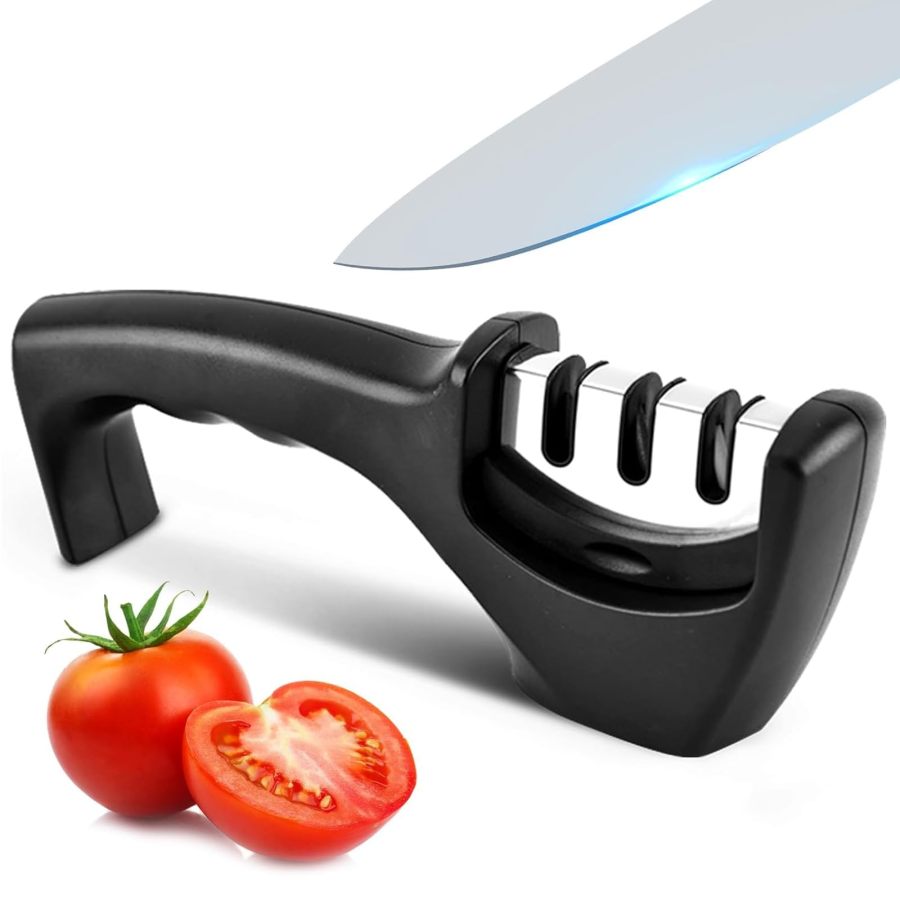
Kitchen knife sharpeners are practical tools used to restore and maintain the sharpness of various kitchen knives (including chef's knives, Japanese knives, scissors, etc.). The category primarily includes manual pull-through, manual adjustable-angle, and electric sharpeners. They utilize multi-stage grinding systems (e.g., coarse, fine, polishing) to treat the blade edge, aiming to enhance food-cutting efficiency, safety, and the overall cooking experience. Product functionality varies from basic sharpness restoration to professional edge maintenance. The following table illustrates the key characteristics of consumer behavior in this category.
| Dimension | Segment | Description |
|---|---|---|
| Need Driver Type | Planned Purchase / Emergency-driven Purchase | Users typically develop an emergency need when knives become dull, affecting efficiency and safety, or make a planned purchase for routine maintenance and extending knife lifespan. |
| Purchase Frequency | Low Frequency | Knife sharpeners are durable goods with low purchase frequency, generally every few years, unless the product fails or a significantly upgraded new model is discovered. |
| Decision Complexity | Medium | Consumers evaluate multiple dimensions such as manual vs. electric, number of sharpening stages, compatible knife types, sharpening angle, safety features, and price. |
| Price Sensitivity | Medium | Price is an important consideration, but users place greater emphasis on sharpening effectiveness, convenience, and safety. They are willing to pay a reasonable premium for products that offer a significant experiential improvement. |
| Emotional Dependency | Low to Medium | The need is primarily functional, but the efficient pleasure derived from sharp knives and the self-satisfaction of feeling like a 'professional chef' also carry a degree of emotional value. |
II. User Personas & Usage Scenarios
2.1 Everyday Home Cook
🎯 Busy homemakers or office workers who cook at home regularly. They have basic requirements for knife sharpness but lack professional sharpening knowledge and time. They seek convenient and safe sharpening solutions.
| Typical Usage Scenarios | Core Pain Points | Primary Purchase Drivers |
|---|---|---|
|
|
|
2.2 Kitchen Tool Enthusiast / Semi-Professional User
🎯 Users with high demands for knife performance, owning various types (e.g., Japanese, Western, ceramic) and materials of high-end knives. They focus on long-term knife care and achieving ultimate sharpness.
| Typical Usage Scenarios | Core Pain Points | Primary Purchase Drivers |
|---|---|---|
|
|
|
III. User Needs Hierarchy (KANO Model)
3.1 Basic Needs (Must-Haves)
- Quick & Effective: The sharpener should quickly make knives sharp, immediately improving the cutting experience.
- Easy to Use: No complex learning process required; beginners can easily start using it.
- Safe & Stable: Features a non-slip base and ergonomic design to ensure safety and stability during use.
3.2 Performance Needs (Linear Satisfiers)
- Multi-stage Sharpening System: Provides multiple stages like coarse, fine, and polishing for comprehensive edge repair and fine finishing, catering to knives with different levels of dullness.
- Universal Compatibility: Suitable for various kitchen knives like straight-edge knives, chef's knives, pocket knives, and even some ceramic and serrated knives, enhancing practicality.
- Durable Abrasives: Uses high-hardness, wear-resistant abrasives like diamond, tungsten steel, or ceramic to ensure long-term effectiveness and minimal wear on knives.
- Ergonomic Design: Comfortable handle grip suitable for both left and right hands, reducing fatigue during prolonged use.
3.3 Excitement Needs (Delighters)
- Electric Automation: Electric mode significantly saves effort, providing faster, more consistent sharpening results, especially suitable for users less skilled with manual operation.
- Precise Angle Guidance: Fixed or adjustable sharpening angles ensure consistent optimal edge geometry, extending knife life and enhancing cutting performance.
- Shavings Collection: Magnetic or detachable shavings collection box for easy cleanup of metal debris, keeping countertops tidy.
- Low-noise Operation: Electric sharpeners operate quietly, providing a more comfortable and peaceful user experience without noise disturbance.
3.4 Unmet Needs & Opportunities
-
Concern About Knife Damage: Some users worry that V-slot sharpeners may excessively wear down the blade, shortening knife lifespan, especially for high-end knives, by altering the original edge angle.
User Reviews (VOC) I cant honestly reccomend because I love my kitchen knives. The reality is this does work better than not using a sharpener but it does chew through knife material for the result and will absolutely not create a personal edge. This is fine for cheaper knives. I wouldn't use it on an expensive one. // Over repeated use, the V-slot sharpener can essentially ruin the edge and the knife needs to be taken to a professional to restore the edge. I did a visual inspection on the knife I just sharpened, and while the knife edge looked clean and sharp, I can see it is at the V-angle that matches the V-slots. Based on this, I would use this sharpener for my inexpensive knives, but keep them away from my premium knives.
-
Insufficient Motor Power: Some electric sharpeners experience noticeable motor slowdown or even stoppage when pressure is applied to the knife, affecting sharpening effectiveness and efficiency, thereby reducing user experience.
User Reviews (VOC) The motor is a little weak when you push down hard it slows down and sometimes stops, but then you don't need to push that hard really it does put a nice edge on all my tools // Needs better motor. Although it is well presented and pretty the motor that runs the wheels is pretty weak. The blades stop with almost any kind of pressure. Have to be light and very precise on how you place the knife.
-
Insufficient Instructions & Guidance: Some products lack clear, detailed user manuals, especially for multi-stage or adjustable-angle sharpeners, forcing users to figure it out themselves or watch external videos, increasing the barrier to use.
User Reviews (VOC) Insufficient Information about this Knife Sharpener. Knives are sharpened by their manufacturers to different angles, for example, 15 degrees or 20 degrees. It looks like this knife sharpener has no adjustment for the angle of sharpening, and the angle at which this sharpener sharpens knives is not given. // It didn't come with any instructions and I am clueless how to properly use this. I googled how to sharpen my knivex, but they are still very dull. I'll continue to watch videos and practice!
-
Insufficient Compatibility for Specific Knives: Although many products claim universal compatibility, the actual sharpening results for Japanese thin-blade knives or knives with special angles may be unsatisfactory or even cause damage.
User Reviews (VOC) This machine will not work for some Japanese blades that require even less angle. // It does metal knives OK, but doesn't sharpen ceramic knives at all, and ruined a scissors.
IV. User Decision Drivers
4.1 Key Decision Factors
- Sharpening Effectiveness: Whether the knife achieves sufficient sharpness for smooth, clean cuts is the core goal of purchasing a sharpener.
- Ease of Use: Simple, intuitive operation with a low learning curve, requiring no professional skills for good results, determines user willingness for daily use.
- Safety: Whether the sharpener is stable and slip-resistant during use, and effectively protects fingers from the blade, is a fundamental concern for users.
- Knife Protection: Whether the sharpening process excessively wears or damages the blade, affecting its lifespan or altering its original geometry, is crucial, especially for high-end knife users.
4.2 Secondary Decision Factors
- Versatility: Ability to sharpen various tool types (e.g., scissors, knives of different materials) or provide additional functions, enhancing value-for-money.
- Brand Reputation / Quality: Consumers trust well-known brands or products with numerous positive reviews more, perceiving them as having guaranteed quality and after-sales support.
- Price: Whether the product price meets expectations and budget, and offers good value for money, is a key consideration once core functions are met.
- Cleaning Convenience: Ease of cleaning metal shavings post-sharpening and overall product maintenance affects the daily user experience.
- Noise Level: The operating noise level of electric sharpeners impacts user experience, especially in home kitchen environments.
V. Selling Points & Competitive Landscape
5.1 Selling Point Analysis
5.1.1 Standard Features (Points of Parity)
- Multi-stage Sharpening: Commonly offers 2-4 stages like coarse, fine, and polishing, emphasizing comprehensive repair and fine finishing capabilities.
- Easy to Use: Sharpening is completed via simple pulling or button pressing, requiring no expertise, marketed as 'foolproof operation.'
- Non-slip Base: Equipped with rubber feet or suction cups to ensure stability and safety during sharpening, reducing slip risk.
- Fast Sharpening: Emphasizes the ability to make dull knives sharp again in a short time (e.g., 30 seconds, a few minutes), improving efficiency.
- Compact & Portable: Products are typically designed to be small for easy storage in drawers or on countertops, without taking up much space.
5.1.2 Key Differentiators
- Electric Operation: Provides automatic, efficient sharpening, significantly differentiating from traditional manual sharpeners and saving effort.
- Diamond Abrasives: Emphasizes the use of high-hardness diamond abrasives to improve sharpening efficiency and durability while reducing potential knife damage.
- Multi-tool Compatibility: Supports sharpening various tools like scissors, ceramic knives, and serrated knives, offering a one-stop solution.
- Precise Angle Guidance: Designs with fixed or adjustable sharpening angles (e.g., 15°/20° or multi-stage adjustment) ensure consistent edges, meeting professional needs.
- Shavings Collection: Includes detachable or magnetic shavings collection boxes for easy cleanup, keeping workspaces tidy.
5.1.3 Unique Selling Propositions (USPs)
- Includes Cut-resistant Gloves: Some manual sharpeners include gloves, further enhancing operational safety and reducing user concerns.
- LCD Screen Display: Electric sharpeners display information like sharpening speed or mode, providing a visual operational experience and a sense of technology.
- Wireless Portable Design: Built-in battery with Type-C charging, convenient for outdoor or workshop use without power outlets, enhancing flexibility.
- Edge-grip Design: Patented design allows the sharpener to be clamped onto a countertop edge, facilitating sharpening of long knives and preventing tip damage to the surface.
- Celebrity Collaboration Design: Examples like the Paris Hilton edition use unique colors and fashionable appeal to attract specific consumer groups, adding perceived value.
5.2 Competitive Landscape
5.2.1 Market Maturity
The kitchen knife sharpener market has reached maturity. Manual sharpeners are highly commoditized with intense price competition. The electric sharpener market, while offering more innovation points, still suffers from feature bloat and exaggerated performance claims. Consumer expectations for product performance, safety, and lifespan continue to rise, driving the market towards more refined, professional, and user-friendly development.
5.2.2 Innovation Trends
Current innovation trends primarily focus on enhancing user experience, including: Electrification (pursuing higher efficiency and effort-saving), Multi-functionality (compatibility with more tool types like ceramic knives, serrated knives, scissors), Precision (adjustable or fixed professional angles), Smart features (e.g., pressure sensing, LCD displays), and continuous optimization of safety and cleaning convenience (e.g., included gloves, shavings collection). Additionally, providing clear instructional guidance to lower the user barrier is an important development direction.
VI. Marketing Claims vs. Reality Check
The table below analyzes the gap between common marketing claims and actual user experiences in this category:
| Dimension | Marketing Claim | User Reality | Verdict |
|---|---|---|---|
| Motor Power & Efficiency (Electric Sharpeners) | Powerful motor, razor-sharp in 30 seconds, fast sharpening. | Multiple user reviews report motor slowdown or even stoppage with minimal knife pressure (e.g., B0F1YZZNJY, B0CRZ5Y149), affecting grinding efficiency and smoothness. | Sellers overstate the work efficiency and power of electric sharpeners, failing to deliver on the promised motor performance in real-world scenarios, severely impacting the core user experience. |
| Multi-tool Compatibility (Straight-edge, Serrated, Ceramic Knives, Scissors) | 5-in-1 all-in-one sharpener, compatible with all kitchen knives, including straight-edge, serrated, ceramic knives, and scissors. | Some product listings explicitly state they are not for serrated or ceramic knives (e.g., B0FN5W6J2S, B079WWFZY6), or user feedback indicates poor results or damage to ceramic knives/scissors (e.g., B0CRZ5Y149 user feedback: ceramic knife ineffective, scissors ruined). Product B0FBRGX6T6's listing claims it's electric and for straight-edge knives, but reviews describe it as manual, 4-in-1, supporting scissors/ceramic knives, showing severe listing information confusion or product misrepresentation. | In pursuit of the 'versatile' selling point, sellers overstate product compatibility, overlooking the physical and technical differences in grinding methods required for different tools, leading to mispurchases and poor user experiences. |
| Knife Protection & Lifespan | Professional sharpening, doesn't damage knives, extends knife life, 100% diamond abrasives. | V-slot sharpeners carry a common risk of excessive blade wear. Long-term use may alter blade geometry and shorten lifespan, making them unsuitable for high-end knives (e.g., B0BLXSCGL8 user feedback: 'chew through knife material'). | Sellers emphasize abrasive hardness and sharpness but fail to effectively address the inherent damage risk V-slot designs pose to knives, leading to deep-seated user concerns about long-term maintenance of expensive knives. |
Key Takeaway: The market is rife with spec inflation and overclaimed compatibility, particularly regarding battery life, motor power, and multi-tool applicability. A significant disconnect exists between marketing claims and actual user experience.
VII. Supply-Demand Misalignment Analysis
The table below highlights mismatches between seller focus and buyer priorities:
| Dimension | Seller Behavior | User Focus | Verdict |
|---|---|---|---|
| Long-term Knife Protection & Wear | Sellers commonly emphasize the 'professionalism' and 'sharpness' of results, but lack effective communication or technical explanations on how the sharpener protects the knife's original edge geometry, minimizes material removal, or avoids irreversible damage from long-term use. | Users strongly worry that sharpeners might 'ruin' expensive knives or cause excessive blade wear, shortening knife lifespan, rather than simply 'sharpening.' | Sellers focus on immediate sharpening results but fail to address users' deep-seated need to protect their knives as long-term investments. This undermines user trust, especially in the high-end knife market. |
| Electric Sharpener Motor Performance Stability & Noise | Electric sharpeners commonly advertise 'efficient,' 'fast,' or even 'quiet' operation, but rarely provide performance guarantees under load or actual noise decibel data. They are collectively silent on the common issue of motors stalling under pressure. | Users are disappointed by insufficient motor power (stalling under pressure) and excessive noise in electric sharpeners during actual use, compromising the convenience and comfort experience. | To highlight electric advantages, sellers obscure the true levels of motor performance and noise, failing to address core user concerns about the stability and comfort of electric products, impacting word-of-mouth and repurchase. |
| Clear & Detailed Usage Instructions | Most products simply claim 'easy to use,' but included manuals are often brief, lack diagrams or multi-language support, and can be contradictory. Few brands provide video tutorials or online support. | Users complain about unclear instructions, difficulty identifying sharpening slot numbers, and needing to search online for video tutorials, increasing the learning curve and risk of incorrect operation. | Sellers underestimate the user need for proper operational guidance, especially for multi-function or electric sharpeners. This results in a high learning cost and increased risk of negative reviews or knife damage due to improper use. |
Key Takeaway: Sellers generally over-promote 'fast sharpening' and 'feature bloat,' but collectively neglect core user pain points regarding 'long-term knife protection,' 'motor performance stability,' and 'clear usage instructions.' This creates information asymmetry and a trust gap between supply and demand.
VIII. Strategic Opportunities & Recommendations
8.1 Intelligent Adaptive Blade-Protection Electric Sharpener
8.1.1 Target Audience & Pain Points
⚡️ Pain Points Addressed: Concern about knife damage, insufficient motor power, complex operation.
8.1.2 Action Plan
Develop built-in torque or pressure sensors to monitor blade pressure in real-time, intelligently adjusting grinding speed and force to prevent excessive wear. Use a low-noise, high-torque motor to ensure stable output. Offer replaceable grinding modules to adapt to different edge angles and materials (e.g., a dedicated ceramic knife module).
| Tech Complexity | High |
| Cost Impact | High Impact |
| Trade-off Warning | Requires more precise internal structures and sensors, potentially leading to a slightly larger product size or significantly higher initial R&D costs. Needs to balance with portability. |
| Price Band | Only viable above $129.99 |
8.1.3 Marketing Strategy
Emphasize 'AI Intelligent Blade Protection: Sharpens Without Damaging'; showcase data visualization during the sharpening process (e.g., pressure curve); provide comparative wear test reports from authoritative institutions proving extended knife lifespan; highlight the 'Low-Noise, Essential for High-End Kitchens' positioning.
8.2 Multi-angle / Full Tool Compatibility Manual Sharpening System
8.2.1 Target Audience & Pain Points
⚡️ Pain Points Addressed: Insufficient compatibility for specific knives, lack of sharpening angle information, insufficient instructions.
8.2.2 Action Plan
Design sharpening slots with precise adjustability (e.g., 1-degree increments) or multiple fixed professional angles (e.g., 15°/20°/22°). Add dedicated slots for scissors and serrated knife finishing. Include detailed illustrated manuals with recommended angles for various knives, sharpening steps, examples of incorrect use, and a QR code linking to official tutorial videos.
| Tech Complexity | Medium |
| Cost Impact | Medium Impact |
| Trade-off Warning | An adjustable angle mechanism may increase product structural complexity and mold costs. Must ensure smooth, durable adjustment to avoid loosening. |
| Price Band | Only viable above $29.99 |
8.2.3 Marketing Strategy
8.3 Integrated Shavings Collection & Noise-optimized Electric Sharpener
8.3.1 Target Audience & Pain Points
⚡️ Pain Points Addressed: Inconvenient cleaning, loud noise.
8.3.2 Action Plan
Optimize the internal shavings channeling system, paired with a large-capacity, easily detachable magnetic or snap-fit shavings collection box to ensure efficient, leak-free collection. Use high-quality quiet motors and internal sound-dampening materials to keep operating noise below 50dB, and provide authoritative noise test reports.
| Tech Complexity | Low |
| Cost Impact | Low Impact |
| Trade-off Warning | Designing a more comprehensive sealed structure and shavings channeling system may slightly increase mold complexity, but with no significant performance sacrifice and a clear user experience improvement. |
| Price Band | Only viable above $49.99 |
8.3.3 Marketing Strategy
Emphasize 'No-Mess Cleaning, Sharpening in Peace'; showcase countertop cleanliness before and after sharpening with comparison images; highlight 'Quiet Sharpening, No Disturbance to Family'; marketing videos can feature low-noise operation scenes, creating an atmosphere of quality living.
8.4 "Beginner-Friendly" Cut-resistant Manual Sharpener Kit
8.4.1 Target Audience & Pain Points
⚡️ Pain Points Addressed: Safety hazards, complex operation.
8.4.2 Action Plan
Based on existing manual sharpeners, bundle high-quality cut-resistant gloves as a standard inclusion. Provide more detailed, illustrated, multi-language paper manuals and include a QR code linking to beginner-focused tutorial videos (e.g., how to hold the knife correctly, controlling sharpening pressure).
| Tech Complexity | Low |
| Cost Impact | Low Impact |
| Trade-off Warning | Including gloves and more comprehensive instructions will increase packaging costs and shipping weight, but the overall impact is minor. |
| Price Band | Only viable above $14.99 |
8.4.3 Marketing Strategy
Highlight 'Beginner-Friendly, Safe Sharpening First Step'; emphasize 'Zero Experience? Get Started Easily, Say Goodbye to Cut Worries'; use real-person demonstration videos to eliminate user fear of sharpening operations and build brand trust.