Amazon US Market Analysis: 3-in-1 Wireless Charging Station for Apple Devices Category
📊 Executive Summary
📈 Market Trends
This category is evolving from traditional Qi 7.5W toward Qi2 15W/25W and higher-power adapters. Sample prices range from $13.99 to $119.99, with the mainstream concentrated at $15–$35. In terms of form factor, folding travel designs and vertical magnetic designs dominate the market, while aluminum-alloy heat conduction and active air cooling are becoming premium price directions.
⚡ Major Pain Points
Core pain points center on current splitting, heat, and slow charging caused by low-power charging heads during concurrent charging; premature failure of the watch charging position within 1–3 months; lightweight bodies that tip the base when the phone is removed with one hand; and mechanical interference between compact folding structures and closed-loop bands. Large-screen, heavy models also show noticeably limited one-handed blind-operation experience.
💡 Selection Opportunities
Prioritize entering the $25–$35 mid-range segment. Recommendations: 1. Include a 35W–45W GaN adapter by standard to ensure three-channel concurrent charging without current splitting; 2. Improve the elevated cantilever structure to fully accommodate closed-loop bands; 3. Combine micro-suction foot pads to improve the one-handed phone-removal experience. Exercise caution and conduct prototype validation for active cooling.
I. Analysis Overview
1.1 Introduction & Report Scope
This report analyzes the 'Charging Stations' category in the Amazon US market (3-in-1 wireless charging stations for Apple devices), focusing on target user personas, core needs, decision drivers, market communication, and potential opportunities.
1.2 Category Snapshot
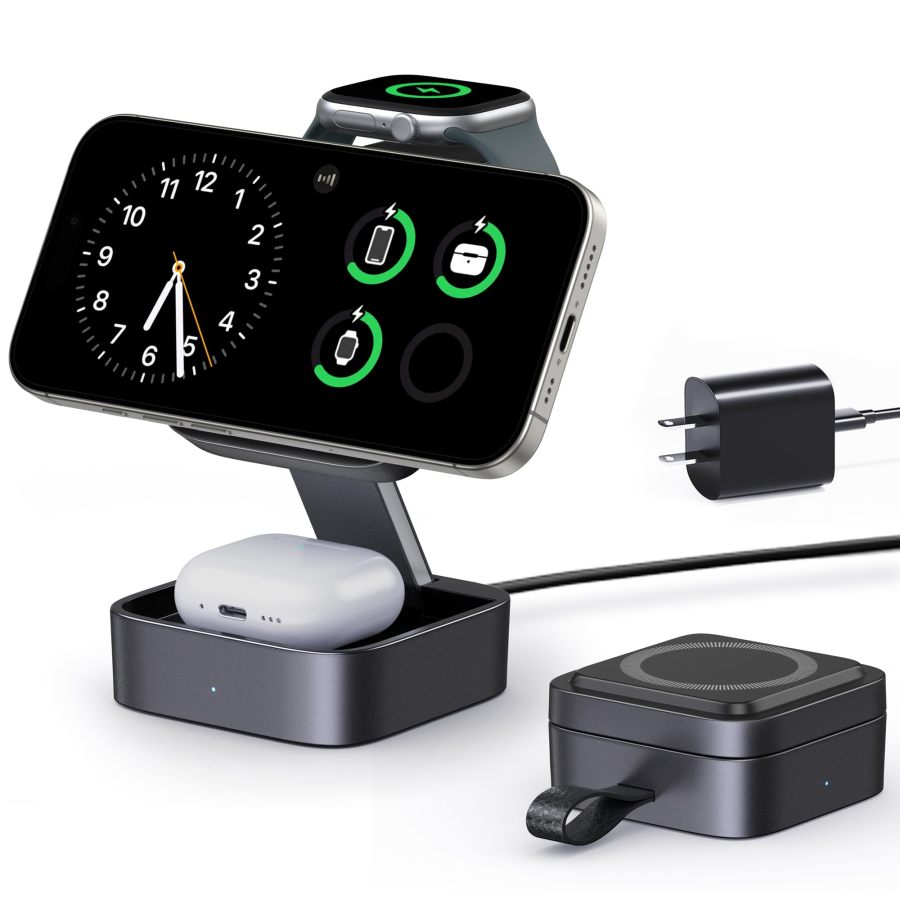
3-in-1 wireless charging stations for Apple devices integrate concurrent wireless charging for iPhone via magnetic attachment, Apple Watch, and AirPods. Common form factors include multi-fold flat designs, floating stand designs, and active air-cooling models. Supply and demand show a pattern of 'strong demand for single-cable organization and portable travel use, but sharp contradictions in entry-level models: insufficient total power headroom, heat and current splitting under concurrent multi-device charging, and premature failure of the watch charging position.' The following table illustrates the key characteristics of consumer behavior in this category.
| Dimension | Segment | Description |
|---|---|---|
| Need Driver Type | Planned Purchase / Habitual Purchase | Primarily Apple ecosystem multi-device users proactively improving desktop clutter, optimizing bedside charging arrangements at night, or simplifying gear for travel. |
| Purchase Frequency | Low Frequency | Durable consumer electronics accessory, typically purchased once for a fixed bedside or office desk setup and repurchased only after malfunction, ecosystem upgrade, or adding a second travel set. |
| Decision Complexity | Medium | Buyers primarily compare magnetic holding strength, heat during concurrent charging, whether a high-power charging head is included, and foldable portability, and are relatively sensitive to Qi2 certification and price. |
| Price Sensitivity | Medium-High | Entry-level to mid-range products cluster at $15–$35, where buyers seek an included adapter and strong value for money; above $50, they become extremely demanding about build quality and feel, charging temperature rise, and official protocol certification. |
| Emotional Dependency | Medium-Low | Focuses on physical-level peace of mind, neatness, and a clean sense of order, relying on the certainty of picking up fully charged devices in the morning, with little strong emotional projection. |
II. User Personas & Usage Scenarios
2.1 Multi-device Business Travelers and Commuters
🎯 Carry an iPhone, Apple Watch, and AirPods, frequently travel between hotels, business trips, and the office, and dislike luggage stuffed with charging cables and plugs.
| Typical Usage Scenarios | Core Pain Points | Primary Purchase Drivers |
|---|---|---|
|
|
|
2.2 Minimalist Desktop and Bedside Organizers
🎯 Seek a visually minimalist workstation or bedroom nightstand, have zero tolerance for messy cables and nighttime light pollution, and habitually charge overnight while using the iOS StandBy clock.
| Typical Usage Scenarios | Core Pain Points | Primary Purchase Drivers |
|---|---|---|
|
|
|
III. User Needs Hierarchy (KANO Model)
3.1 Basic Needs (Must-Haves)
- Three-position concurrent physical compatibility: The base must be able to physically accommodate and stably power the iPhone, all Apple Watch series, and the AirPods wireless charging case simultaneously, without structural interference.
- Automatic precision magnetic alignment: The phone magnetic module has sufficient holding force to penetrate standard magnetic cases and automatically correct alignment with the coil, preventing charging interruptions from minor vibrations.
- Overcharge and short-circuit safety thermal control: Includes basic hardware-level FOD foreign-object detection, overvoltage, overcurrent, and overheating power-reduction protection to prevent thermal damage to device batteries.
3.2 Performance Needs (Linear Satisfiers)
- Concurrent charging without significant current splitting: Paired with sufficient input power (at least 27W–45W), ensuring the phone side maintains stable output power when the watch and earbuds are connected simultaneously, without excessively extending total charging time.
- Counterweight stability and one-handed removal: The base has sufficient mechanical counterweight or silicone suction so that it does not lift or tip forward when a strongly magnetic phone is pulled off.
- Folding hinge durability and damping stiffness: The travel folding hinge does not become loose after repeated bending and can firmly support large Pro Max models without collapsing.
3.3 Excitement Needs (Delighters)
- Qi2 15W/25W high-wattage certified fast charging: Official protocol-certified handshake enables the iPhone to quickly regain 50% in 30–40 minutes, with heat significantly lower than traditional Qi solutions.
- Seamless smart thermal control and self-extinguishing lights: Breeze-level silent air cooling or semiconductor cooling; indicator lights automatically turn off in 10–15 seconds or shut off with one touch, achieving maximum bedroom friendliness.
- Unibody metal feel and integrated carrying case: A high proportion of CNC aluminum alloy in the body paired with an OEM-custom hard-shell travel case greatly enhances unboxing value and gift appeal.
3.4 Unmet Needs & Opportunities
-
Heat from concurrent charging causes slowdowns and charging interruptions: Most entry-level models accumulate heat when all three channels are fully loaded, triggering thermal current limiting in the phone or watch or even stopping at 80% charge; some buyers speculate that insufficient heat-dissipation area damages the battery.
User Reviews (VOC) Overheats and doesn’t charge. I’ve woken up twice while traveling and my phone was dead. Or wasn’t charged at all. Doesn’t work.
-
Premature failure of the watch charging module: Many buyers report that after 1–3 months of use, the watch magnetic charging channel fails completely while the phone position still works, indicating a widespread weakness in the electrical reliability of multi-channel independently controlled power supply.
User Reviews (VOC) Used for 3 months... watch charger stopped working.. phone still charges....
-
Base too light, causing tipping when removing the phone with one hand: Lightweight plastic bodies combined with strong N52 magnets cause the base to be lifted or even tipped over when the phone is removed with one hand, requiring two-handed operation.
User Reviews (VOC) ...The platform is too small and not too heavy, the magnet is so strong that when you try to removing the phone, the whole thing moves and almost falls....
-
Watch band structure interferes with the charging pad: In compact folding designs, closed-loop bands (such as Solo Loop) cannot lie flat against the raised watch charging disc due to limited space, causing the watch to tilt up and interrupt charging.
User Reviews (VOC) Great charger, but feel like the watch part should be on top of phone charger. It won’t connect right with Apple Watch band attached.
IV. User Decision Drivers
4.1 Key Decision Factors
- 3-in-1 functional integration and cable cleanliness: Whether a single cable can serve as a one-stop charging solution for the iPhone, Apple Watch, and AirPods is the absolute prerequisite for buyers to switch from separate chargers to this category.
- Included adapter and total input power: Whether the product includes an adequately rated charging head out of the box (20W–45W) directly determines whether buyers must spend again on an accessory and their experience of concurrent charging speed.
- Folding form factor and travel portability: Whether it can be flattened into a flat, pocket-sized volume for easy packing is the core dividing line that determines whether a product is suitable for both home and travel use.
- Magnetic positioning security and stand angle: Whether the iPhone attaches securely without falling and whether it can rotate freely between portrait and landscape to support StandBy bedside clock mode.
4.2 Secondary Decision Factors
- Base counterweight and smooth one-handed removal: Whether the base weight is sufficient to counteract magnetic force determines the convenience and premium feel of daily blind-operation removal.
- Nighttime indicator-light control logic: Whether indicator lights are harsh enough to disrupt sleep and whether delayed auto-off or physical touch controls are available.
- Appearance material and heat-dissipation quality: Whether the shell is cheap plastic or has aluminum-alloy metal quality, and whether it features heat-dissipation-friendly structures or thermal-control chips.
- After-sales warranty commitment: Given the industry reputation that multi-channel charging stations are prone to failure, a 24–36-month extended warranty can significantly reduce buyers' purchase hesitation.
V. Selling Points & Competitive Landscape
5.1 Selling Point Analysis
5.1.1 Standard Features (Points of Parity)
- Apple ecosystem 3-in-1 simultaneous charging: All 25 samples include three independent charging positions for phone, watch, and earbuds, prominently positioning a single cable as a replacement for three tangled charging cables.
- MagSafe compatibility and strong magnetic attachment: Claimed to feature N52/N55 strong magnet arrays, supporting magnetic alignment for the full iPhone 12–16 lineup and portrait/landscape StandBy mode.
- Foldable portability and travel concept: The vast majority of models use hinge folding or flexible silicone multi-fold structures, promoting pocket-sized dimensions and lighter travel packing.
- Included charging head for out-of-the-box use: Most samples include, directly in the package, an 18W–45W USB-C charging head and a dual-USB-C data cable.
5.1.2 Key Differentiators
- Protocol certification and input-power tiering: Entry-level models mostly use the standard Qi protocol with 18W–20W input (e.g., B0BFCC18FS, B0DK4VM1SX); mid-to-high-end models use official Qi2/Qi2.2 certification and include 40W–45W adapters by standard (e.g., Anker B0CF56WHV4, B0FHWK3W1S).
- Materials and body counterweight: Low-priced models use lightweight ABS/PC plastic (approximately 150g–270g), while high-end models incorporate more than 35% aluminum alloy or all-metal CNC bases (weighing up to 350g–500g, e.g., Acer B0GSQYZH69, Petino B0BRHZ9YX9), significantly improving one-handed phone-removal stability.
- Active thermal-control cooling system: A very small number of high-end models (e.g., B0H35J5P36, Anker B0FHWK3W1S) feature low-noise fans or CryoBoost/AirCool active-cooling panels, keeping the body from overheating during high-power fast charging.
- Nighttime ambient lighting and sleep control: Some products (e.g., B0CZ6TQLMZ, B0CNTH3F7P) feature touch-dimmable or switchable base night lights, while other models have indicator-light logic that automatically turns off after 10–15 seconds.
5.1.3 Unique Selling Propositions (USPs)
- 360° rotating compact cylindrical architecture: Acer B0GSQYZH69 uses a cylindrical rotating structure, enabling 360-degree phone rotation and side-wing storage within a small vertical footprint.
- 3-year extended replacement warranty without return: Some white-label products (e.g., B0CNTH3F7P, B0GXRFRHZZ) make aggressive service promises such as a 3-Year Warranty or even free replacement without returning the original item.
5.2 Competitive Landscape
5.2.1 Market Maturity
The category is in a transition period from high maturity toward protocol-specification iteration. In terms of form factor, 3-in-1 folding and vertical magnetic designs have become highly commoditized, and the underlying supply chain is highly concentrated in Shenzhen/Dongguan contract manufacturers. The market is currently upgrading from traditional Qi 7.5W to Qi2 15W/25W protocols and higher-power adapters.
5.2.2 Innovation Trends
Three main technology innovation themes: first, a comprehensive upgrade to Qi2 and Qi2.2 protocols to break through the iPhone wireless fast-charging barrier; second, the introduction of silent active air cooling and metal housings to address heat-driven frequency reduction during concurrent charging; third, the spread of 5W independent fast charging on the watch side and optimization of mechanical clearance for loop-style bands.
VI. Marketing Claims vs. Reality Check
The table below analyzes the gap between common marketing claims and actual user experiences in this category:
| Dimension | Marketing Claim | User Reality | Verdict |
|---|---|---|---|
| Concurrent charging speed | Claims 15W–25W wireless fast charging and full charging of iPhone, watch, and earbuds in 1.5–2 hours. | For some models (e.g., B0BFCC18FS with a nominal 18W input and B0G1LGJMRR with a nominal 20W input), when three devices work simultaneously, energy-conversion losses and current splitting mean only 5W–7.5W is actually allocated to the phone, and full charging takes as long as 3–5 hours or even longer. | The total input-power budget is insufficient to support multiple channels at full speed; inflated fast-charging claims will cause severe disappointment among daytime urgent-charging buyers and generate slow-charging negative reviews. |
| One-handed removal experience | Claims a weighted base and strong anti-slip pad, so the phone can be removed with one hand while the unit remains stable and does not tip over. | Specification sheets list some models (e.g., B0BFCC18FS at only 230g net weight and B0FR5YYSJB at only 270g) as using all-plastic housings; under strong magnetic attachment, pulling the phone straight up inevitably lifts the base, and most require a second hand to press down and help release it. | The demand for lightweight portability inherently conflicts physically with a heavy anti-tip base; overclaiming one-handed blind removal easily triggers complaints that the product feels cheap and insubstantial. |
| Premature model compatibility | Several product titles and bullet points extensively claim compatibility with iPhone 18 Pro Max, iPhone Duo, Apple Watch Series 12, and Ultra 4. | These models had not yet been publicly released when this report was written; the claims are purely premature exaggeration by sellers pre-embedding future keywords to capture search traffic, with no physical verification. | This is typical SEO keyword inflation; although it may capture long-tail search traffic in the short term, it damages brand professionalism and rigor and exposes the listing to compliance review and ranking-reduction risk. |
| Internal inconsistency in claims | The page's bullet points claim an included high-power charger, while the feature section claims MagSafe compatibility and multi-year warranty. | Some products have contradictions (e.g., B0BFCC18FS bullet points say Non-MagSafe but the parameter table says MagSafe Compatible; B0B6RCKDM4 bullet points promise a 24-month warranty but the specification table lists only 18 months; B0H35J5P36 bullet points say a 45W head is included but the package list only mentions a cable). | Roughly produced listing copy and conflicting parameter fields reflect lax quality control and operational information management, leaving the seller at a legal disadvantage in after-sales disputes. |
Key Takeaway: The category has significant marketing illusions: inflated nominal power ratings, premature search-traffic exploitation of unreleased model names, and swapping ideal single-device fast charging for multi-device concurrent fast charging.
VII. Supply-Demand Misalignment Analysis
The table below highlights mismatches between seller focus and buyer priorities:
| Dimension | Seller Behavior | User Focus | Verdict |
|---|---|---|---|
| Electrical durability of secondary charging positions | Throughout the listing, they emphasize smart-chip protection, ETL/FCC safety certification, and flame-retardant housing materials, limiting safety to preventing overcharging and burn damage. | Buyers frequently complain that the watch and earbud chargers stop working completely without warning after 1–3 months of use, indicating weak surge resistance and thermal-aging durability in the multi-channel independently controlled power modules. | Sellers overlook the long-term service life of secondary charging circuits; premature aging of multi-channel step-down components is the main root cause of persistently high negative-review and return rates in this category. |
| Physical compatibility with watch bands | Marketing pages use rendered images with detached standard bands, emphasizing the palm-sized thinness and symmetrical aesthetics of the folding form factor. | Buyers using closed-loop bands (such as Alpine Loop or Solo Loop) find that the watch body is propped up by the band and cannot lie flat against the magnetic contact, making it very easy for the watch to fall off and interrupt charging. | The industrial design is detached from the real-world high-frequency use scenario of closed-loop bands, and the lack of a floating or raised module design leads to structural interference. |
| Passive heat dissipation and thermal-control expectation management | Low-priced models under roughly one hundred dollars commonly use exaggerated terms such as 'AI smart cooling' and 'Active Cooling'. | Buyers report severe heat during whole-unit charging, triggering phone protection slowdowns or even a drop in charged battery level, and the so-called cooling does not live up to its name. | Packaging routine overheating power-reduction protection as active cooling exacerbates buyers' overly high expectations for thermal-control capability; this should be corrected through aluminum-alloy heat conduction and rational power strategy. |
Key Takeaway: Sellers focus excessively on premature model-name search traffic, extreme cooling concept packaging, and exaggerated wattage numbers, while seriously failing on core experience pain points such as long-term electrical durability of the watch position, mechanical interference with loop-style bands, and one-handed damped removal.
VIII. Strategic Opportunities & Recommendations
8.1 High-headroom desktop stand with included 35W–45W adapter Go
8.1.1 Target Audience & Pain Points
⚡️ Pain Points Addressed: Severe slowdowns, current splitting, and full-load heat caused by insufficient total input power when three devices charge concurrently.
8.1.2 Action Plan
In the $25–$35 price band, phase out old 18W/20W single-port heads and include a 35W GaN adapter by standard; optimize the internal three-channel DC-DC step-down splitting circuit to lock in independent output channels of at least a steady 10W–15W for the phone, 5W for the watch, and 5W for the earbuds.
| Tech Complexity | Low |
| Cost Impact | Medium Impact |
| Trade-off Warning | Upgrading to an included GaN charging head (from 20W to 35W/45W) increases BOM cost by approximately $2.5–$4.0, with a slight increase in packaging volume. |
| Price Band | Break-even price cannot be estimated from public information alone |
8.1.3 Marketing Strategy
Lead with 'true three-channel concurrent charging without current splitting'; include a measured power-allocation table in the listing for three devices connected simultaneously to eliminate concerns about full-load slowdowns.
8.2 Closed-loop band-compatible elevated cantilever folding architecture Go
8.2.1 Target Audience & Pain Points
⚡️ Pain Points Addressed: The pain point where closed-loop bands (Solo Loop/metal link bands) interfere with the base's flat body, causing the watch to tilt up from magnetic attachment and interrupt charging.
8.2.2 Action Plan
Redesign the mechanical clearance of the watch charging module, using a vertical pop-out hinge or high-position cantilever architecture to leave at least 20mm of free band-threading space beneath the watch face; use an officially certified module or high-spec overcurrent/surge-resistant capacitors to improve durability.
| Tech Complexity | Medium |
| Cost Impact | Low Impact |
| Trade-off Warning | Raising the cantilever height of the watch charging pad or adding a mechanical pop-out structure may slightly increase mold complexity and maximum folded thickness by approximately 2–3mm. |
| Price Band | Break-even price cannot be estimated from public information alone |
8.2.3 Marketing Strategy
Emphasize 'designed specifically for closed-loop/loop bands,' use dynamic renderings to visually demonstrate unobstructed magnetic attachment with thick bands and metal bands, and differentiate by capturing traffic from established competitors.
8.3 Dual-counterweight base plus nano-suction micro-grip foot pad solution Go
8.3.1 Target Audience & Pain Points
⚡️ Pain Points Addressed: The physical trade-off contradiction in which a portable, lightweight base is inevitably lifted or easily tipped over when the phone is removed with one hand under strong magnetic attachment.
8.3.2 Action Plan
Add a detachable zinc-alloy counterweight to the lower base shell, and upgrade the conventional rubber foot pads to washable, reusable nano-micro-suction PU pads; optimize the magnetic flux distribution at the edges of the phone-side magnetic poles and provide self-aligning guide grooves to reduce the tangential resistance required for lateral push-off release.
| Tech Complexity | Low |
| Cost Impact | Low Impact |
| Trade-off Warning | A stamped metal counterweight built into the base adds approximately 80–120g to the overall unit (estimated for candidate specifications), slightly increasing the load for users seeking ultimate lightweight travel. |
| Price Band | Break-even price cannot be estimated from public information alone |
8.3.3 Marketing Strategy
Promote 'true one-handed blind removal without tipping,' highlighting firm desktop grip and an elegant removal interaction experience.
8.4 Ultra-quiet micro-air-channel active-cooling vertical fast-charging station Caution
8.4.1 Target Audience & Pain Points
⚡️ Pain Points Addressed: Severe temperature rise, battery health degradation, and nighttime bedroom noise interference associated with high-power wireless charging (Qi2 15W/25W).
8.4.2 Action Plan
Before project approval, prioritize prototype validation of the cooling efficiency of a micro turbine fan under low-noise conditions of 15–20dB; design a physical sleep silent switch (one-touch fan shutdown that switches to 5W slow-charging mode), and ensure the air channel directly contacts the phone backplate for heat conduction.
| Tech Complexity | High |
| Cost Impact | High Impact |
| Trade-off Warning | An internal micro centrifugal fan and thermally conductive fins significantly increase body thickness and cost, and long-term fan operation carries risks of dust accumulation and bearing wear. |
| Price Band | Break-even price cannot be estimated from public information alone |
8.4.3 Marketing Strategy
Lead with 'ice-cool fast charging that does not harm the battery,' and publish third-party temperature-rise comparison curves and a 19dB silent sleep-grade test report.