Amazon US Market Analysis: Plush Toy Hanging Storage Category
📊 Executive Summary
📈 Market Trends
From Basic Storage to Aesthetic Integration, Drill-Free and Smart Features Gain Favor. The plush toy hanging storage category is evolving from purely solving clutter problems towards balancing children's room aesthetics, convenient installation, and more reliable user experience. Drill-free solutions and storage products with design sense, even integrated smart functions, will become more popular. The market is calling for products with differentiated upgrades in details and quality.
⚡ Major Pain Points
Insufficient Durability & Misleading Function Claims are Core Pain Points. Current market products commonly suffer from hard flaws like fragile materials, poor load-bearing stability, and low-quality installation accessories, leading to user complaints about easy tearing and sagging. Additionally, additional features like LED lights often fail to provide a complete experience due to missing batteries or quality control issues, creating a severe gap between marketing claims and actual results, greatly damaging user trust.
💡 Selection Opportunities
Deep Dive into Quality Details, Create Worry-Free User Experience & High-Value Premium. The core opportunity lies in enhancing product durability and load-bearing stability by upgrading materials and strengthening structures, and providing versatile drill-free installation solutions. Simultaneously, manage user expectations through precise capacity and size communication. For additional features like LED lights, ensure their completeness and reliability, and consider smart upgrades, fundamentally solving user pain points. Only then can a product stand out in a homogeneous market and achieve category value leap.
I. Analysis Overview
1.1 Introduction & Report Scope
This report analyzes the 'Hanging Organizers' category (specifically for plush toy storage) within the Amazon US market, focusing on target user personas, core needs, decision factors, market communication, and potential opportunities.
1.2 Category Snapshot
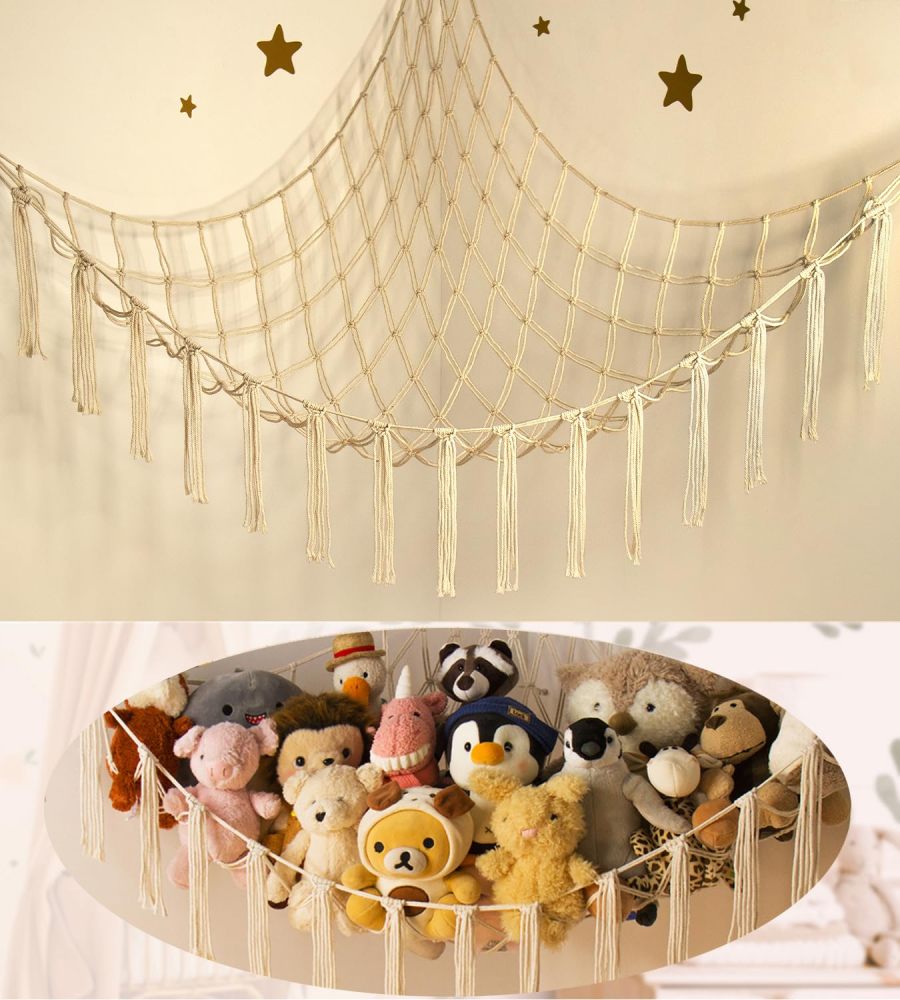
The plush toy hanging storage category aims to efficiently organize a large number of plush toys and other soft items in children's rooms or home environments by utilizing vertical spaces such as corners and behind doors. Main product forms include triangular net hammocks and multi-pocket over-the-door hanging bags, designed to address pain points like insufficient floor space and room clutter while also considering decorative aesthetics. The following table illustrates the key characteristics of consumer behavior in this category.
| Dimension | Segment | Description |
|---|---|---|
| Need Driver Type | Planned Purchase / Emergency-driven Purchase | User purchases typically stem from anticipated children's room arrangements or issues like floor clutter due to a surge in toy quantity, indicating a clear need for vertical storage. Some purchases are also made for gift-giving purposes. |
| Purchase Frequency | Low | This type of product is usually a one-time purchase to solve long-term storage problems. The product lifespan is long, and the repurchase cycle is slow, unless moving or room renovation occurs. |
| Decision Complexity | Medium | Consumers compare different products based on capacity, installation method (drill-free vs. drilling required), material, additional features (e.g., lighting), and price, and consider whether they match the room's style. |
| Price Sensitivity | Medium | Price is an important consideration, but users are willing to pay a reasonable premium for more convenient installation, sturdier materials, or unique decorative effects. |
| Emotional Dependency | Medium | The product not only provides functional storage but also enhances the warmth and sense of order in a child's room through aesthetic design and ease of access for children, delivering emotional value. |
II. User Personas & Usage Scenarios
2.1 Parents Seeking Tidy & Efficient Solutions
🎯 Have many children or a large number of plush toys at home, urgently needing efficient, space-saving storage solutions to maintain household tidiness and alleviate parenting stress.
| Typical Usage Scenarios | Core Pain Points | Primary Purchase Drivers |
|---|---|---|
|
|
|
2.2 Parents Focused on Children's Room Aesthetics & Ambiance
🎯 In addition to storage function, they also hope the storage product can integrate into the room design, enhance overall aesthetics and ambiance, combining storage with decoration.
| Typical Usage Scenarios | Core Pain Points | Primary Purchase Drivers |
|---|---|---|
|
|
|
III. User Needs Hierarchy (KANO Model)
3.1 Basic Needs (Must-Haves)
- High Capacity: The product must be able to hold a large number of plush toys or soft items, effectively solving accumulation problems, not just storing a small amount.
- Space Saving: Utilizing corner or door-back space through hanging methods to effectively free up floor area is the core reason for purchasing this type of product.
- Easy Installation: Users expect the product to be easy to install, requiring no complex tools or professional skills, ideally with complete accessories and clear instructions.
3.2 Performance Needs (Linear Satisfiers)
- Durable & Sturdy: Sturdy materials, not easily torn or deformed, stable load-bearing capacity, ensuring long-term use, especially for children's daily use and pulling.
- Easy Access: Convenient for children and parents to easily put in or take out toys, encouraging children to tidy up independently, rather than being hung too high or hard to reach.
- Visibility: Transparent mesh or open design, allowing children and parents to see inside items, finding desired toys without rummaging.
- Versatility: In addition to plush toys, it can be flexibly used to store other household soft items, such as diapers, clothes, pillows, etc., enhancing product value.
3.3 Excitement Needs (Delighters)
- Integrated Lighting: Built-in LED string lights add a warm or dreamy atmosphere to the room, especially usable as a night light, enhancing decorative effect and fun.
- Unique Design & Materials: Such as hand-woven (Macrame) or cute cartoon-themed shapes, eco-friendly cotton, enhancing the room's artistry and decorativeness, making storage itself a scenic element.
- Adjustability/Expandability: Product size or compartments can be adjusted or expanded according to needs, adapting to different quantities, sizes of toys, and different spatial layouts, providing flexibility.
3.4 Unmet Needs & Opportunities
- Actual Load Capacity & Sagging Improvement: User feedback indicates some hammocks sag easily when loaded with many or heavy toys, affecting aesthetics and actual load-bearing effect, requiring stronger structural support and material tensile resistance.
- Installation Accessory Quality & Compatibility: Users complain about poor quality included hooks, prone to deformation or incompatibility with doors/walls, causing unstable installation or requiring user replacement, affecting stability.
- Transparent Size & Capacity Information: Consumers misjudge the product's actual size and capacity, thinking it's 'smaller than expected' or 'cannot fit large toys,' hoping for more intuitive and accurate presentation.
- LED String Light Function Reliability: Products with LED lights have issues like batteries not included, lights not working, or being easily damaged, affecting user experience, expecting more stable and reliable lighting functions and matching batteries.
- Over-the-Door Bag Impact on Door Closure: Over-the-door hanging bag products sometimes prevent doors from closing completely, causing inconvenience for rooms with small gaps between door frame and door body, requiring thinner or more fitting designs.
IV. User Decision Drivers
4.1 Key Decision Factors
- Storage Capacity & Efficiency: Whether the product can effectively and substantially store plush toys and significantly save floor space is the user's primary consideration for solving clutter problems.
- Installation Convenience & Stability: Whether the installation process is simple and quick, and whether the product remains firmly and reliably installed without falling or sagging, directly impacts user experience and sense of security.
- Product Material & Durability: Whether the product material is sturdy and tear-resistant, can withstand children's daily use and cleaning, ensuring long-term service life, avoiding frequent replacement.
4.2 Secondary Decision Factors
- Appearance Design & Style: Whether the product is aesthetically pleasing, coordinates with the overall style of the children's room or home, and can balance decorative function, enhancing room ambiance.
- Child Accessibility: Whether children can easily put in and take out toys, fostering independent tidying habits, is an important factor affecting daily use experience.
- Practicality of Additional Features: Whether additional features like LED lights, makeup mirrors, multi-purpose holders are truly practical and reliable in quality, enhancing product value.
- Cost-Effectiveness: While meeting core functions and certain quality requirements, whether the product price is reasonable, offering good economic value.
V. Selling Points & Competitive Landscape
5.1 Selling Point Analysis
5.1.1 Standard Features (Points of Parity)
- High-Capacity Storage: Commonly emphasizes the product's ability to hold a large number of plush toys, effectively solving toy accumulation problems.
- Space-Saving Design: Highlights the use of vertical space in corners (triangular hammocks) or behind doors (over-the-door bags), freeing up floor and desk space, keeping rooms tidy.
- Easy Installation: Promotes the product as easy to hang, includes hooks or anchors, allowing quick installation without complex tools.
- Versatile Use: Emphasizes that besides toys, it can also store other children's items (e.g., diapers) or household soft items, expanding usage scenarios.
5.1.2 Key Differentiators
- Aesthetic Decorativeness: Some products emphasize their role as room decor elements, such as Bohemian-style Macrame weaving, cartoon themes (Unicorn) designs, or different color choices.
- Built-in LED String Lights: Some hammock products offer additional LED string lights, aiming to increase nighttime ambiance and fun, enhancing product appeal.
- Material Emphasis: Such as emphasizing the eco-friendliness and texture of pure cotton (Macrame), or the lightness and durability of polyester mesh.
- Specific Installation Advantage: Clearly states whether it's a corner triangular hammock (utilizing corners) or an over-the-door multi-pocket bag (doesn't occupy wall surface), meeting different user preferences for installation location and space utilization.
5.1.3 Unique Selling Propositions (USPs)
- Patented Design: A few products claim to have patents (e.g., 'The Original Stuffed Animal Storage (Patent Pending)'), implying uniqueness and innovation in design.
- Worry-Free Refund Guarantee: Provides unconditional return/refund promises (e.g., '100% Returnless Refund Guarantee') or extended warranty periods, enhancing consumer trust and purchase confidence.
- Single-Point Installation: Some hammocks innovatively adopt a single hanging point design, simplifying the installation process and reducing wall damage.
5.2 Competitive Landscape
5.2.1 Market Maturity
Moderately Mature. The plush toy hanging storage category has become relatively homogeneous in basic functions, with market competition mainly revolving around price, capacity, and installation convenience. Although some products attempt differentiation through design and additional features, overall innovation speed is medium, with most innovation points focusing on user experience detail improvements.
5.2.2 Innovation Trends
The category is evolving from purely functional towards 'Storage Aesthetics' and 'Convenience & Reliability.' Products with decorative elements (e.g., Macrame, themed shapes) or additional functions (e.g., LED lights) are popular. Simultaneously, user demands for installation stability, load capacity, and material durability are increasing, driving product iteration and improvement in basic quality. Drill-free or simplified installation designs, along with clearer capacity communication, are important trends.
VI. Marketing Claims vs. Reality Check
The table below analyzes the gap between common marketing claims and actual user experiences in this category:
| Dimension | Marketing Claim | User Reality | Verdict |
|---|---|---|---|
| Product Durability & Load Capacity | Sturdy and durable, not easily torn, can hold dozens of plush toys, suitable for long-term use. | Users commonly report cheap, easily torn mesh material, or significant sagging when loaded with many toys; stitching on over-the-door bags also easily splits. | Sellers overstate product durability, but actual materials and craftsmanship fail to support their promises, leading to fatal flaws in core service life and load-bearing stability, severely impacting user trust. |
| LED Light Function Completeness & Quality Control | Includes LED lights, adding a warm and fun atmosphere. | Users report LED string lights do not include batteries, and some light strings are of poor quality, with cases of lights not being included at all, compromising the 'out-of-the-box' experience. | Promoting an additional feature that lacks its core component (batteries) as a selling point creates a severe mismatch between user expectations and actual experience, rendering the lighting feature useless and representing a typical low-cost marketing trap. |
| Actual Capacity & Size Perception | Extra large capacity, expandable to 51x51x71 inches (or similar dimensions), massive storage. | Some users report the product's actual capacity is 'smaller than expected,' or large plush toys are difficult to accommodate effectively, and when full, it sags easily, affecting spatial aesthetics. | Sellers advertise using maximum dimensions or theoretical capacity but fail to intuitively demonstrate actual loading effects, leading users to misjudge the product's real capacity and usage outcome, affecting satisfaction. |
Key Takeaway: The market exhibits a widespread tendency to exaggerate parameters and functions, particularly regarding actual experience of product durability and additional features (e.g., LED lights), with significant gaps between claims and reality.
VII. Supply-Demand Misalignment Analysis
The table below highlights mismatches between seller focus and buyer priorities:
| Dimension | Seller Behavior | User Focus | Verdict |
|---|---|---|---|
| Core Product Durability & Load-Bearing Assurance | Sellers commonly emphasize 'sturdy and durable' and 'high capacity,' but rarely provide specific load test data, material density, or reinforced stitching details as evidence in listings. | Users consistently complain about nets tearing easily, sagging, and poor hook quality, indicating concerns about product long-term performance and safety are not effectively addressed. | Sellers' promotion of core functional attributes remains superficial, failing to fundamentally solve user pain points regarding product lifespan and sense of security, which is the root cause of returns and negative reviews. |
| Completeness & Quality of Installation Accessories | Commonly promote 'easy installation' and include hooks, but collectively remain silent on details about hook material, load capacity, and compatibility with different doors/walls (e.g., drywall). | Users frequently report poor hook quality, prone to breaking, or unsuitability for their door frames/walls, leading to installation difficulties or instability. | Sellers oversimplify installation convenience, overlooking that accessory quality and environmental compatibility are key to the user's initial experience, causing users to question the product's overall reliability. |
| Complete Experience of LED Light Additional Feature | Some sellers use 'with LED lights' as an eye-catching selling point but generally do not include batteries in the package or have insufficient quality control over the light strings. | Users complain that light strings don't include batteries, lights don't work, or are easily broken, considering it just a superficial gimmick that adds post-purchase hassle. | Sellers over-market additional features without ensuring their completeness and stability, turning a potential value-add into a source of negative experience, consuming user trust. |
Key Takeaway: Sellers are under-supplying on the critical 'durability and load-bearing stability,' failing to adequately address user pain points, while putting significant effort into superficial additional features, leading to a supply-demand mismatch.
VIII. Strategic Opportunities & Recommendations
8.1 Structural Reinforcement & High-Quality Material Upgrade
8.1.1 Target Audience & Pain Points
⚡️ Pain Points Addressed: Insufficient product durability, poor load-bearing stability, prone to tearing and sagging.
8.1.2 Action Plan
Adopt higher density, stretch-resistant polyester dense mesh or wear-resistant cotton-linen blend materials, strengthen edge stitching and hanging point reinforcement. For hammock products, consider adding less elastic load-bearing straps or multi-layer mesh structures at the bottom to reduce sagging under heavy loads.
| Tech Complexity | Low |
| Cost Impact | Medium Impact |
| Trade-off Warning | Upgrading materials may slightly increase product weight (e.g., denser polyester or cotton-linen blend), but the impact on portability is minimal. |
| Price Band | Only viable above $14.99 |
8.1.3 Marketing Strategy
Highlight 'Military-Grade Quality, Holds XX lbs Without Deformation'; provide third-party durability test reports; showcase real photos of the product loaded with heavy objects (e.g., dumbbells or books) to reinforce its sturdiness and durability.
8.2 Versatile Drill-Free Installation Solution
8.2.1 Target Audience & Pain Points
⚡️ Pain Points Addressed: Poor quality installation accessories, inconvenience of needing to drill holes, incompatibility with all doors/walls.
8.2.2 Action Plan
Provide two installation accessory options: upgraded high-strength drill-free adhesive hooks (for smooth walls/light loads behind doors) and reinforced expansion screw hooks (for heavy loads/drywall). Over-the-door bags should provide thinner, padded metal hooks to ensure they don't affect door closure and reduce noise.
| Tech Complexity | Medium |
| Cost Impact | Medium Impact |
| Trade-off Warning | Drill-free solutions (e.g., strong adhesive hooks) have lower weight limits than drilled options, requiring clear usage scenarios and weight restrictions; thinner over-the-door hooks may increase BOM cost. |
| Price Band | Only viable above $12.99 |
8.2.3 Marketing Strategy
Emphasize 'No Drilling, No Wall Damage!', 'Multiple Installation Choices, Fits All Homes'; provide detailed installation videos showcasing load-bearing effects of different methods, and clearly suggest light/heavy load zone recommendations.
8.3 Precise Capacity Visualization & Size Guide
8.3.1 Target Audience & Pain Points
⚡️ Pain Points Addressed: Deviation between actual capacity and size perception, leading to user misjudgment during purchase.
8.3.2 Action Plan
No product changes needed. The core lies in marketing information optimization.
| Tech Complexity | Low |
| Cost Impact | Low Impact |
| Trade-off Warning | No significant physical side effects, primarily optimizing marketing content. |
| Price Band | Only viable above $9.99 (Applicable to all price segments, not a price increase) |
8.3.3 Marketing Strategy
Provide detailed three-view dimension diagrams in the listing, accompanied by loading example images with different sizes and quantities of plush toys (e.g., holds X small, Y medium, Z large toys) to help users intuitively understand actual capacity. Offer product options in different sizes (S/M/L) with clear selection guides.
8.4 Integrated LED Light String & Ambiance Customization
8.4.1 Target Audience & Pain Points
⚡️ Pain Points Addressed: LED string lights lack batteries, unstable quality control, incomplete experience.
8.4.2 Action Plan
Design the LED light string as an integrated module, providing built-in rechargeable batteries (USB-C port) and a simple switch. Optimize lighting modes, offering multi-color temperature and brightness adjustment, even remote control or timer functions, enhancing its smart ambiance creation. Ensure the light string connection to the main net is more secure and less prone to damage.
| Tech Complexity | Medium |
| Cost Impact | Medium Impact |
| Trade-off Warning | Integrating batteries will slightly thicken or increase product weight but provides a more integrated and reliable user experience. |
| Price Band | Only viable above $24.99 |
8.4.3 Marketing Strategy
Emphasize 'Wireless Integrated Design, Say Goodbye to Battery Hassles'; highlight 'One-Click Dream Space Lighting, Create Exclusive Fairy Tale Nights'; showcase room ambiance images under different lighting modes, emphasizing its dual value as decor and night light.